As members are aware the IAF is in the process of selecting a suitable aircraft for MRCA requirements and there are few in competion for the same namely Grippen,Mig-29 SMT, F-16Block60, Mirage-20005/9 are under consideration , but as all are aware for reasons Political and to maintain commonality with the present Fleet in terms of Spare, Training and Maintenance , The only serious competators are the Mirage-2000/9 and the Mig-29SMT , Below is an article by force about the same and specification for Mirages , which one among the two should India go for.
Joint collaboration with Indian PSUs may win the day for the Russian giant
BY Prasun K. Sengupta Force jan 2005
The expected orders for upgrading the Indian Air Force’s existing MiG-29B-12 fleet to the MiG-29SMT air superiority combat aircraft standard, and the Indian Navy’s already-placed and yet-to-be-placed orders for the MiG-29K ship-borne multi-role combat aircraft (MRCA), augur well for the super-manoeuvrable MiG-29SMT to be selected yet again by the air force for the continental air defence role. For it is now well-established that the air force’s Air Staff Qualitative Requirements will place priority on:
Maximum systems and weapons commonality between the 126 new air superiority combat aircraft that will be procured, and the IAF’s principal MRCA, the 190 Sukhoi Su-30MKIs, this being done to greatly reduce the through-life-cycle costs of the combat aircraft fleet.
Maximising Indian industrial content through direct offsets, which again will benefit the Russians, and RAC-MiG in particular, since both state-owned Hindustan Aeronautics Ltd (HAL) and the IAF have decades of experience in licence-producing, servicing, operating and upgrading combat aircraft of Russian origin (like the MiG-21, MiG-27M and MiG-29B-12), and already possess a sprawling infrastructure, and a highly skilled workforce well-versed in the design philosophies and maintenance procedures of airframes, engines, accessories and cockpit instrumentation of Russian origin.
The original equipment manufacturer’s (OEM) willingness to share the technologies, costs and risks of co-developing a customer-specific air superiority combat aircraft with its Indian counterpart/s, especially in the areas of network-centric warfare and electronic warfare. Here again, OEMs like airframe manufacturer IRKUT Corp, engine manufacturer NPO Saturn, the Tikhomirov Scientific Research Institute of Instrument Building, and Russiya Avionika have a well-proven business track record in India, thanks to the Su-30MKI programme.
Says Alexey Fedorov, President of IRKUT Scientific Production Corp, who last November also became the General Director of RAC-MiG: “Undoubtedly we plan to take part in the Indian air force’s competitive bidding process. A tough competition will be developing for this contract, as the world’s main combat aircraft manufacturers will participate in it, and it is hard for me to evaluate our chances of success. But in 1995, when we competed for an operational IAF requirement for an MRCA with the Su-30MKI, it wasn’t any easier, and we won. So, there is the experience, and we hope to achieve positive results once again”. Fedorov, who owns 26.7 per cent of IRKUT Corp’s shares, was handpicked by President Vladimir Putin to revitalise a cash-strapped RAC-MiG and enable it to successfully implement the Indian Navy’s MiG-29K contract.
Another factor, which Fedorov emphasises, could favour the RAC-MiG bid is Russia ’s willingness to co-develop a fifth-generation MRCA and a new multi-role transport aircraft (MRTA) with India . “We are transitioning to a completely new stage of military and technical cooperation with India — from simple off-the-shelf sales and licensed production to the joint development of new military hardware,” explained Fedorov. “Subsequent joint projects with India will include joint marketing, development, manufacturing, product deliveries and after-sales servicing. Only such a system of interdependent relations will allow us to prevail in the long run in one of our largest markets,” Fedorov said.
The Mig-29 MRCA offered to India has the following Features


The Product 9-17 alias MiG-29SMT being proposed by RAC-MiG for the IAF will incorporate:
More fuel in an enormous dorsal ‘hump’ tank attached aft of the cockpit to increase the aircraft’s fuel capacity to 4,775kg. Also added are 1,150-litre tanks underneath the wings and a 1,520-litre tank under the fuselage, which ensure a ferry range of 2,900km. Even more fuel could be stored in the wing roots, which extend to the front of the aircraft, if the vents for the additional air intake were removed.
An in-flight refuelling probe, which is installed on the left-hand side next to the cockpit.
A quadruplex digital fly-by-wire control system, a MIL-STD-1553B digital databus and an open architecture avionics suite centred around a mission computer developed by India’s state-owned, Bangalore-based Defence Avionics Research Establishment (DARE). The avionics suite will incorporate systems from French, Israeli and Indian companies, as is the case with the IAF’s Sukhoi Su-30MKI MRCA.
An improved navigation system which combines ring-laser gyros with a GPS-receiver.
An integral health and usage monitoring system used for undertaking predictive maintenance procedures, thereby greatly increasing flight safety and aircraft serviceability/availability.
A glass cockpit with two colour active-matrix liquid crystal displays (15x20cm each), HOTAS controls, and a wide-angle Head-up-Display.
N011M ‘Bars’ (panther) passive phased-array radar built by the Tikhomirov Scientific Research Institute of Instrument Building and incorporating two HAL-built and DARE-developed radar display processors. The radar has a 130km range in the forward hemisphere, tracks 24 airborne targets simultaneously and can engage the eight most threatening targets with air combat missiles.
Beyond-visual-range air combat missiles like the Vympel-built R-77, R-27ER1 and R-27ET1, and R-73E within-visual range air combat missiles. The maximum payload is 4,000kg.
Thrust vector control for the twin Klimov RD-43 turbofans, comprising a nozzle that can be swivelled by 15 degree in all directions. The RD-43 will deliver 98.1kN thrust, have an airflow rate of 85kg/second, and its turbine inlet temperatures will be 120 degrees Kelvin higher.
Radar absorbent coating using new types of varnish to lower the radar reflection area by a factor of 10.
New on-condition maintenance procedures to lengthen the life expectancy of the aircraft from 2,500 to 4,000 hours.
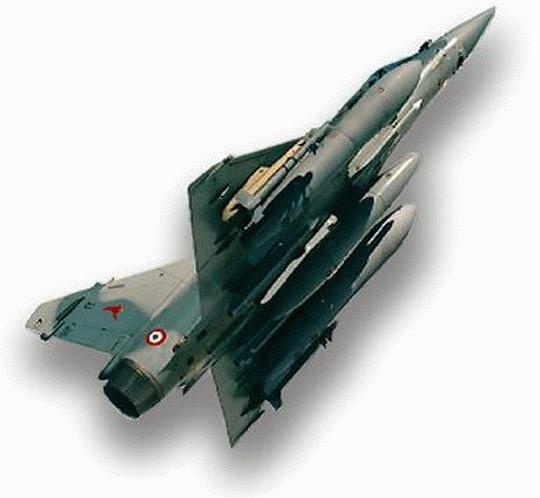

Cockpit of Mirage-2005
Specifications
Radars in use :- RDY-2 (Mirage 2000-5 Mk.2/2000-9)
AAMs :- MICA EM/IR,Super 530F/D,R-27R,R-550 Mk.1/2,R-73E,AIM-9L
PGMs :- ASMP,SCALP EG,Black Shaheen,APACHE,Exocet,ARMAT,AS-30L,Laser Guided Bombs (US, Israeli, French)
Dumb weapons :- Beluga cluster dispenser,Matra F-1-36 rocket launcher,
Type 100-6 rocket launcher,Mk 80 family bombs,SAMP GP bombs,Durandel anti runway weapon
Combat Radius :- * 800 nm (1,475 km) w/ 4 250-kg bombs
* 1,000 nm (1,850 km) w/2 1,700-liter drop tanks
* 1,800 nm (3,335 km) max fuel w/2 1,700-liter + 1 1,300-liter drop tanks
COCKPIT
Mirage 2000-5 is available as a single-seater or two-seater multi-role fighter. The aircraft has hands-on throttle and stick (HOTAS) control. Mirage 2000-5 incorporates the Thales VEH 3020 head-up display and five cathode ray tube multifunction advanced pilot systems interface (APSI) displays. The combined head-up/head-level display is collimated at infinity, and presents data relating to flight control, navigation, target engagement and weapon firing. Sensor and system management data is presented on two coloured lateral displays.
COUNTERMEASURES
The aircraft is equipped with a self-protection suite installed internally. Mirage 2000-5 carries the ICMS Mark 2 automated integrated countermeasures system from Thales. ICMS Mark 2 incorporates a receiver and associated signal processing system in the nose section for the detection of missile command data links. The system can be interfaced to a new programmable mission planning and a post-mission analysis ground system.


 Sign In








 January 4, 2005 at 11:03 am