The North American P-51 Mustang has been heralded as the best Allied WWII fighter ever and made a significant contribution to the defeat of Nazi Germany and the Luftwaffe.

With over 15,500 of them built, in all variants, this aircraft found its way into the European, CBI and Pacific theaters.


Powered by a Packard-built Rolls Royce Merlin V-1650 V-12 piston engine, drawing ~1700 hp, the P-51 reached speeds of 700 km/h, and with a pair of drop tanks, it had the range to escort bombers from the UK to Berlin and back, from Iwo Jima to the Japanese home islands and back.
Packing six .50 cal Browning M2 machine guns with over 1600 rounds of ammo, the Mustang had enough firepower to rip any enemy fighter into shreds.
http://www.youtube.com/watch?v=ddtqJImF5Qc
I’m sure that you aviation fans know a lot more about the P-51, but I have started this thread because I wanted to ask this question:
What if the P-51 Mustang had not been in WWII?
My response to that is maybe the U.S. 8th AF would have to compensate using P-38s (fork-tailed devils) and probably late mark RAF Spitfires.
This would have meant more bomber casualties and losses from German AAA and Luftwaffe Bf 109s, Fw 190s and Me 262s. More of them could have been airborne due to the aircraft plants not being bombed.

What is your response?

By: Bager1968 - 19th December 2009 at 03:08
To reverse the question, take armour. The American’s ‘best’ tank was the Sherman, which was outclassed, but performed for the allies. Had, say, the Pershing or Centurion been available in 1943, maybe we’d be asking how they’d have coped without them.
Regards
Or the British Comet tank in mid-1942?
Thus in time for initial combat deployment in North Africa with Operation Torch?
By: minimans - 17th December 2009 at 18:24
The Griffon was well developed by then it would have taken the merlins place with ease, The griffon was put on the backburner so to speak because of the urgency to improve the Merlin already in service. So if the Merlin wasn’t there the Griffon would have got the early development it deserved.
By: D1566 - 17th December 2009 at 16:35
After reading this thread it would also be good question to ask, what if the RR
Merlin hadn’t been available in WW2.:D
Given the reliance placed on it in 1940 and the lack of viable alternatives, (or the time to develop them) that one does not bear too much thinking about.
By: Bruggen 130 - 17th December 2009 at 14:34
After reading this thread it would also be good question to ask, what if the RR
Merlin hadn’t been available in WW2.:D
By: Mondariz - 17th December 2009 at 10:22
Perhaps the next volumes of your story might mention another 1936 type. Name begins with ‘S’… Escapes me at the moment. Shrew? 😀
The difference between a great design and a good design (another ‘good’ 1936 baby was the Hurricane) in 1936 could be a crucial one by 1940 and again more so by 1941-2.
In answer to the question, if there’d been no P-51D, then they’d have managed with the alternatives. There might’ve been different numbers of casualties in different places, but the war’s main course wouldn’t have been changed.
To reverse the question, take armour. The American’s ‘best’ tank was the Sherman, which was outclassed, but performed for the allies. Had, say, the Pershing or Centurion been available in 1943, maybe we’d be asking how they’d have coped without them.
Regards
Thats a very good point.
By: DazDaMan - 17th December 2009 at 09:02
Or how about mating a late mark Spitfire with the Merlin or Griffon engine? And perhaps increasing its fuel capacity like a bloated whale?
Which they did.
By: Moggy C - 17th December 2009 at 08:07
This thread is getting a bit loony….. the escorting Mustangs and Thunder bolts then took off flying at nearly 400 mph and caught them up, however, having to weave, and burn precious gas
A significant contribution to the ‘looniness’ in itself
Moggy
By: JDK - 17th December 2009 at 07:40
There was nothing wrong with the p40, it served with distinction on nany fronts, but lets face it, it was a 1936 design, it is like comparing an Austin 12/ 6 to a Rolls Royce. end of story.
Perhaps the next volumes of your story might mention another 1936 type. Name begins with ‘S’… Escapes me at the moment. Shrew? 😀
The difference between a great design and a good design (another ‘good’ 1936 baby was the Hurricane) in 1936 could be a crucial one by 1940 and again more so by 1941-2.
In answer to the question, if there’d been no P-51D, then they’d have managed with the alternatives. There might’ve been different numbers of casualties in different places, but the war’s main course wouldn’t have been changed.
To reverse the question, take armour. The American’s ‘best’ tank was the Sherman, which was outclassed, but performed for the allies. Had, say, the Pershing or Centurion been available in 1943, maybe we’d be asking how they’d have coped without them.
Regards
By: grounded - 17th December 2009 at 06:45
If the Mustang had not been in ww11
There was nothing wrong with the p40, it served with distinction on nany fronts, but lets face it, it was a 1936 design, it is like comparing an Austin 12/ 6 to a Rolls Royce. end of story.
By: JDK - 17th December 2009 at 03:25
Good post, but:
The Merlin P-40s only saw combat in the Mediterranean Theater where they gave good account of themselves regardless of their assignment.
Certainly the 44th FG in the Pacific took the Merlin P-40 into action. The sole airworthy Merlin P-40 is Judy Pay’s VH-HWK based out of Tyabb, Vic.

(Rob Fox photo)
In the article we ran in Flightpath in Australia on these aircraft, Jack Cook 44th FS historian wrote of VH-HWK’s sister aircraft:
After recovery and repair Little’s 41-14107 went on to shoot down at least five enemy planes before Charlie Sacket was killed in it off Bouganville on September 14, 1943. Radzuikinas’s 41-14202 (the other P-40F salvaged) flew in combat until November 1943 when the Squadron stood down for conversion to P-38Hs. Frank scored half a Zero kill in it off Munda Point, New Guinea, being shot up in the process, while Bruce Macklin got the other half flying 41-14107!
The RAAF also used the Merlin P-40 in N Africa and (I think) Italy. (RAAF Museum Photo)

The Merlin Hawk’s history is certainly underestimated in history.
Regards,
By: Malcolm McKay - 17th December 2009 at 03:03
Maybe there would have been more developement of the P40. – supercharged engine etc Or the Bell P39 and 63
There was a souped up P40 – the P40Q (bubble hood, better engine etc.) however it, like the P63 which was basically developed for the same reason, was not put into production simply because it was no improvement over the existing P47s and P51s. Take the P51 out of the equation and you still have the P47D, M and N models. All of which were well up to the job of handling the harried undertrained remnants of the Luftwaffe.
The P63 was only put into production for supply to France and Russia – the few that served with the USAAF were trainers or the flying pinball target adaption.
By: Bager1968 - 17th December 2009 at 02:05
To go one further what about the P40 with Merlin or Griffon?? it would seem the logical thing with out the Stang………….
They did that… and it wasn’t much better.
P-40F (1,200+ built), and later P-40L (about 600).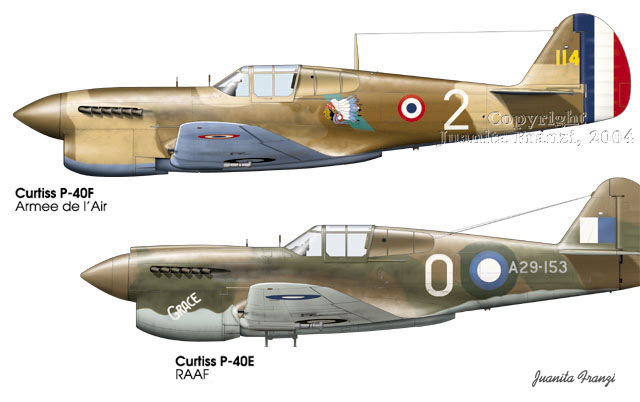
The P-40 was always at a disadvantage due to the altitude performance restrictions of the non-supercharged Allison engine. In 1941, as Packard began producing the Merlin 28 with a single-stage supercharger, Curtiss decided to change power plants from the Allison to the Merlin. The result was the P-40F and P-40L (lightened P-40F).
The main visual difference between these two sub-types and others was the lack of the carburetor intake on the upper cowling, and an overall more “squarish” look to the cowl. The P-40F-1 was produced with the short fuselage, which was changed from the P-40F-5 onwards to the extended fuselage which was designed to deal with a lack of directional stability associated with the shorter fuselage.
The P-40F entered production just prior to the attack on Pearl Harbor. The 57th Fighter Group – equipped with “short-tail” P-40F-1s – was sent to Egypt in the Summer of 1942 to reinforce the RAF and allow the American pilots to gain valuable combat experience. Operationally, it was found that the single-stage supercharger did not provide the P-40F with a major increase in high-altitude performance, though best altitude was increased from 10,000 ft to 15,000 ft. Given the altitudes at which combat took place in North Africa, the airplane was not at a disadvantage so long as there were Spitfire escorts around. Otherwise, the P-40F pilots – like their Commonwealth counterparts in Allison-powered P-40s – invariably found the enemy above them.
The 57th Fighter Group was primarily tasked with ground support of the 8th Army during the westward advance from Egypt following the Battle of El-Alamein in November 1942. On April 17, 1943, the unit took part in “Bloody Sunday”, the massacre of a large formation of Ju-52s carrying supplies from Sicily to Rommel’s forces in Tunisia. The unit carried on in the ground support assignment through the invasion of Sicily and Italy, until their Merlin P-40s were replaced with far more capable P-47 Thunderbolts in the spring of 1944.
The Merlin P-40s only saw combat in the Mediterranean Theater where they gave good account of themselves regardless of their assignment.
The main reasons for the marginal performance improvement were the better supercharger* and the fact that the Packard Merlin V-1650-1 was rated at 1,300 hp, while the Allison V-1710-39 in the P-40E was rated at 1,150 hp.
The P-40K got the Allison V-1710-73, rated at 1,325 hp. This virtually duplicated the performance of the P-40F, except for higher-altitude power.
*The Allison V-1710 in the P-40 had an integral single stage, single-speed supercharger, while the Merlin V-1650-1 had a single-stage, two-speed supercharger.
By: grounded - 16th December 2009 at 06:51
If the p 51 mustang had not been in ww11
This thread is getting a bit loony, a lot of people seem to think that an escorting fighter took off with the bombers and stayed with them all the time, this was not the case, The B 17s and B 24s flying at less than 200 mph were anything up to two hours forming up before setting course, the escorting Mustangs and Thunder bolts then took off flying at nearly 400 mph and caught them up, however, having to weave, and burn precious gas, they soon had to return to base, meantime more escorts had taken off later, they too caught up and escorted for a few miles, before they too had to return, and so it went on, including escorting for the return flight, now I ask you how many fighters would you need to escort a thousand bombers??? I would guess two thousand. So it would be a waste of time putting more powerful engines in obsolete aircraft, time would not allow it anyway, in those days you used what you had and was thankful for it, I am sure the powers to be did their level best with the aircraft and facilities they had.
By: talltower - 16th December 2009 at 05:56
Or how about mating a late mark Spitfire with the Merlin or Griffon engine? And perhaps increasing its fuel capacity like a bloated whale?
It wouldn’t have hurt if the Allies had waited just a little longer to get the late mark Spitfire with RAF squadrons to escort 8th AF bombers into the Third Reich, would it?

By: minimans - 15th December 2009 at 01:42
To go one further what about the P40 with Merlin or Griffon?? it would seem the logical thing with out the Stang……………….
My local airports newest flyer……………..
By: talltower - 14th December 2009 at 06:45
Maybe there would have been more development of the P40. – supercharged engine etc Or the Bell P39 and 63
The P-40 would have been inferior to the Messerschmitt Bf 109 in the ETO. Even a supercharged Allison engine wouldn’t have helped.
By: sparky - 13th December 2009 at 09:18
Maybe there would have been more developement of the P40. – supercharged engine etc Or the Bell P39 and 63
By: Arabella-Cox - 12th December 2009 at 19:07
I’m sure the Iwo Jima invasion plan envisioned escorting bombers towards Japan from Iwo Jima, but by March 1945 (when the first B-29 landed on Iwo Jima), the Americans really didn’t need much escorting over Japan and even P-51D could hardly escort a B-29 the 1500 mile roundtrip from Iwo Jima to Japan.
The Iwo Jima strip was mostly used for emergency landings (B-29wise). Naturally it could and did (to some extend) provide a base for escort fighters, but from late 1944, the Japanese air defense was not a serious threat. They even removed armor and defensive weaponry from the B-29 to accommodate more bomb-load.
You are absolutely right; the USN/USMC suffered a lot of casualties for nothing.
A good article here: http://www.hnn.us/articles/10693.html
That’s an interesting article, but I still think that my friends who flew those P-51s off of Iwo would dispute the idea that they were just wallflowers. They flew a LOT of missions over Japan and did do a lot to make the Japanese interceptors life more difficult. It would’ve been even more necessary if the Japanese hadn’t been running out of fuel for their fighters.
As to my earlier post, my thinking is that it isn’t just that the money savings was useful, but if you have a tanker bring in X gallons of fuel, and you can fly 200 P-51 sorties on that gas, while only flying 160 P-47 sorties or 150 P-38 sorties (not actual, just an example) that it essentially gives you the advantage of being able to put more aircraft up more times on the same logistical chain.
Ryan
By: talltower - 12th December 2009 at 03:58
Without the existence of the P-51 Mustang, the Luftwaffe would have more breathing space to field more Me 262s, because the production facilities would not have been bombed that intensely out of existence.
In that case, Republic Aviation would have rolled out the P-47N variant of the Thunderbolt and supplied them to USAAF ETO and MTO-based squadrons, followed by one, maybe two squadrons of P-80 Shooting Stars. Oh, boy, that would have presented a good opportunity for the first jet-vs-jet duels over Europe instead of the Korean War.
By: bazv - 10th December 2009 at 22:09
I’m fairly sure that a contributing factor to Mustangs having such success in the ETO is because there were few quality Axis pilots left by 1944. A great deal of success must surely be down to the excellent training given to Allied pilots so far away from the theatre of operations.
True enough…but I’ll bet ‘Fat Hermann’ never dreamed of single engined fighters over Berlin,must have been quite a shock for the Luftwaffe when they started meeting P51’s deep into ‘Ze Fatherland’.
They had a bad enough nightmare with Mosquito’s operating over berlin 😀
now they could cruise very fast without a ‘Laminar Flow’ wing 😉


 Sign In








 December 8, 2009 at 4:03 pm