Given that the moderators on this forum have shown no interest in reopening the locked IAF thread, I’m creating a new one to post IAF related news.
Starting with news related to the IAF resurrecting No.17 “Golden Arrows” squadron, which will be the first squadron to fly the Rafale in the IAF.
IAF resurrects No.17 Golden Arrows for Rafale
The Indian Air Force (IAF) on Tuesday resurrected the Air Force Station (AFS) Ambala-based 17 Squadron ‘Golden Arrows’, which will operate the first squadron of Rafale fighter jetsin the near future.
The first batch of Rafale jets are scheduled to be formally handed over to Defence Minister Rajnath Singh on October 8 in France, officials said, speaking on condition of anonymity. The jets are set to arrive in India in May 2020.
The resurrection ceremony was presided over by IAF Chief Air Chief Marshal (ACM) B.S. Dhanoa. Incidentally, he had commanded the 17 Squadron during the Kargil conflict in 1999. On December 31, 2011 the squadron was ‘number plated’ after the Russian Mig-21 jets that it flew were decommissioned as part of the IAF’s long-term plan to phase the decades-old aircraft out of service and was since awaiting newer inductions.
The 17 Squadron was raised at Ambala on October 01, 1951, under the command of Flight Lieutenant D.L. Springett and initially equipped with the Harvard-II B aircraft. “By November 1955, Squadron converted fully to De Havilland Vampire and by 1957, Hawker Hunter aircraft were flown by the ‘Golden Arrows’. The Squadron converted to the Mig-21 M in 1975,” the IAF said in a statement.
Between October 2019 and May 2020, three batches — each comprising eight IAF pilots along with engineers and technicians — would undergo advanced training on the Indian jets in France, a defence official said. So far, three IAF pilots and two technical officers have trained on the French Air Force’s Rafales as per the terms of the contract. The Indian standard Rafale incorporating all the India Specific Enhancements (ISEs) would be operationally ready, latest by September 2021.
…

By: BlackArcherRedux - 18th February 2020 at 20:04
The newly appointed Chief of Defence Staff, former Indian Army Chief of Army Staff Gen. Bipin Rawat’s comments on prioritisation and staggering orders to allow for affordable purchases has ruffled a lot of feathers. He suggested additional 36 orders for Rafale in 3-4 years, rather than a massive 114 unit order. While it made a lot of sense, given the massive outlay required for the 114 MRCA ($20 billion plus), it is still to be seen whether the Govt. of India is serious about going ahead with that approach.
With Anil Ambani (the brother of the richest Asian, Mukesh Ambani) nearing bankruptcy, Dassault-Reliance Aerospace Limit (DRAL) is probably also in doldrums. Which might explain why Dassault is back discussing with HAL on possible work share on any additional orders for Rafales.
Indian posters following defence are all suggesting the same approach. Buy 36-48 more Rafale jets in another Govt. to Govt. contract and dump the MRCA since it isn’t going anywhere. With the MWF getting the IAF’s full backing and supposed to be inducted in huge numbers (170+ units), the MRCA contest doesn’t serve much purpose if it is going to perennially delayed thanks to umpteen processes to be followed in such a contest.
HAL back on Rafale radar- talks on making jets in India
NEW DELHI: French aircraft manufacturer Dassault and state-owned HAL are in talks for possible cooperation in producing Rafale fighter jets in India for additional anticipated orders under a ‘staggered procurement’ plan.
Sources have told ET that a few rounds of discussions have taken place between the companies on possible work share for additional orders of the cutting edge combat jet, though there is no going back to earlier discussions that broke down in 2012 over differences in localisation and pricing.
The two aviation companies are old partners, having worked most recently on the $2.1 billion deal to upgrade the Indian Air Force’s Mirage 2000 fleet. If additional orders are placed for Rafale — Chief of Defence Staff Gen Bipin Rawat hinted recently that 36 more fighter jets could be ordered within four years — a work share model could be worked out to manufacture parts for the fighter jet at HAL facilities.
At present, French manufacturers are executing the order for 36 jets and investing 50% of the €7.8 billion contract price in the Indian aerospace and defence sectors as part of the offsets clause, with a factory in partnership with Reliance Defence at Nagpur also geared to produce the Falcon executive jets.
While the contours of a possible partnership have not been finalised, sources confirmed that detailed discussions have taken place on how HAL facilities and expertise could be used for the next round of localisation when more jets are ordered.
In several comments over the past weeks, General Rawat has spoken of staggered purchases of fighter jets in the future, his idea being that small batches would be ordered to ensure that allocated funds can cover the price. The top officer also suggested that 36 more Rafales could be ordered in three to four years to make up for gaps in fighter squadron strength.The current batch of Rafales on order are following the ‘staggered payments’ model, with India paying for 11 fighter jets every year till deliveries end. If the contract is extended, the staggered procurement could stretch over the next few years to make up for fighter shortages.
As reported by ET, an offer is on the table for the sale of two more squadrons, which means 36 additional Rafale jets, for the IAF. While the deal for 36 Rafale jets signed in 2016 cost €7.87 billion, the additional 36 aircraft could cost significantly lower at around €6 billion as fixed costs covering India specific enhancements, training equipment and infrastructure have already been made.
The two airbases that are being created for the Rafales on order are capable of absorbing additional jets without any change, which would also bring down the cost of the deal. If the Rafale jet deal is extended with the ‘staggered order approach’ it could lead to a rethink on earlier plans of acquiring 110 fighter jets under the Strategic Partnership (SP) model that requires an Indian company to tie up with a foreign collaborates to produce the aircraft domestically.
By: TomcatViP - 10th February 2020 at 11:20
From Scramble.nl on FB:
Hornets and ski-jump testing
According to Boeing’s Vice President Thom Breckenridge, the company is planning ski-jump testing for the F/A-18 Super Hornet. This claim was made by the vice president at the DefExpo 2020, which is being held at Lucknow (state of Uttar Pradesh) and is directly related to a possible future Bharatiya Nau Sena (Indian Navy) contract for the Super Hornet.
The Indian Navy uses STOBAR (short take-off but arrested recovery) at her aircraft carriers, whereas the US Navy uses CATOBAR (catapult take-off but arrested recovery). The Indian Navy aircraft carriers, INS Vikramaditya and the under-construction carrier, use STOBAR technology by using a ski-jump ramp.
The Indian Navy had issued a Request for Information (RFI) in 2018 for 57 fighter aircraft, intended as day-and-night capable, all-weather, multi-role, deck-based combat aircraft which can be used for air defence, air-to-surface operations, buddy refueling, reconnaissance etc. from IN aircraft carriers. Competitors for this contract are the Dassault Rafale (France), Boeing F/A-18 Super Hornet (USA), MiG-29K (Russia) and the Saab 39 Gripen (Sweden). Scramble Magazine assesses that a twin-engined aircraft will be favored for this role.
Boeing will be conducting their first test-launches of the F/A-18 Super Hornet from a shore-based ski jump in the United States as the culmination of a long-standing message to the Indian Navy that the American aircraft would be compatible with Indian aircraft carriers. Most probably these tests will be performed at Naval Air Station (NAS) Patuxent River (MD), where Lockheed Martin used the ski jump for refining this manoeuvre for the F-35B Lightning IIs operating from the Royal Navy’s new Queen Elizabeth class (QEC) aircraft carriers.
Photo credit: US Navy
By: BlackArcherRedux - 5th February 2020 at 22:29
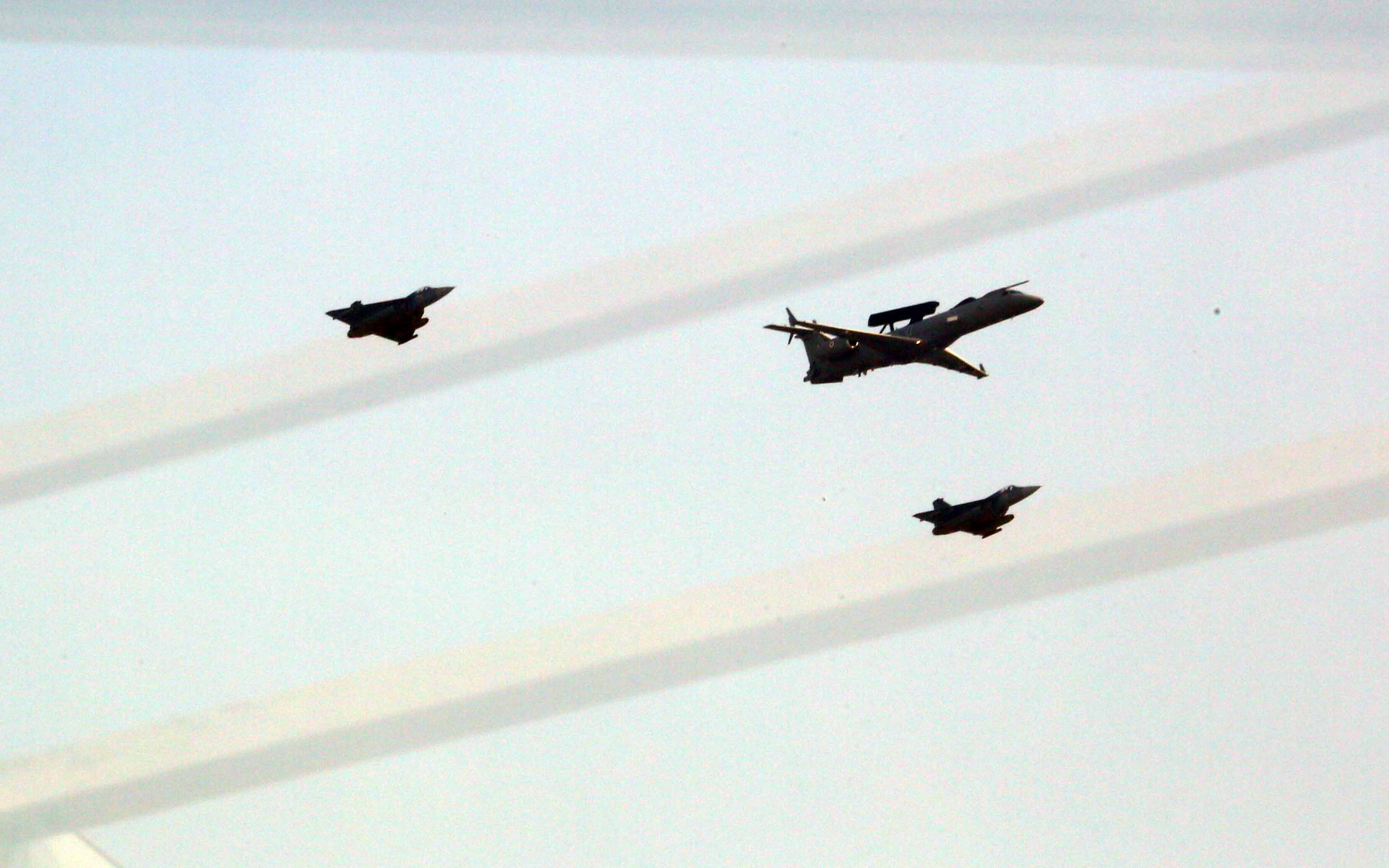
2 Tejas fighters escort a Netra AEW&C at the DefExpo 2020 flypast
By: BlackArcherRedux - 5th February 2020 at 22:13
AMCA to go into detailed design phase for the first prototypes (Next Gen-Tech Demonstrators -NGTD)) within a few months. Latest iteration of the AMCA design, with DSI intakes a new forward swept intakes like those on the F-35. Neither of these were seen in the iteration displayed in February 2019 at Aero India 2019.


Lucknow: India’s inspiring attempt to develop a 5.5. generation, twin-engine, single-seater, multi-role fighter Advanced Medium Combat Aircraft (AMCA) will enter a crucial phase with the detailed data generation process for making prototypes set to begin in the second half of this year.
..
The sanction for the design phase was accorded in December 2018 with an allocation of Rs 400-crore plus after successful completion of conceptual design and feasibility.
Ahead of this, Rs 90-crore plus was allocated for the feasibility study.
The AMCA is being designed and developed Aeronautical Development Agency (ADA).
Sources privy to information about this highly-sensitive programme confirmed to Onmanorama that the design phase is nearing completion.
The scientists have made few changes to AMCA design and are now focussing on fine-tuning plans ahead of wrapping up the design phase.
In the next two to three months the design for AMCA will be completed.
ADA plans to develop five AMCA prototypes and will be seeking the government approval towards the end of this year.
The sanction will be critical for making the prototypes, flight-testing and configuration.
While the final cost is still being worked out, the expected funding could be in excess of Rs 10,000 crore.
The first few prototypes will be to check the stealth systems on board AMCA. Advanced technologies will be progressively introduced into the prototypes.
AMCA will be embedded with the Diverterless Supersonic Intake (DSI) system that would give it more stealth and better performance in supersonic flight.
..
As reported by Onmanorama earlier, AMCA will be initially powered by a 90kN GE F414 engine and later by one with higher thrust of 110kN, which is yet to be developed. If all blocks fall into place, then the first AMCA prototype will fly by 2025.
..
The Indian Air Force (IAF) is backing the AMCA mission to the hilt with Air Chief Marshal R K S Bhadauria tracking the developments closely.
“The IAF’s keenness on AMCA is definitely pushing the project with renewed direction,” adds an official.
..
By: BlackArcherRedux - 3rd February 2020 at 19:50
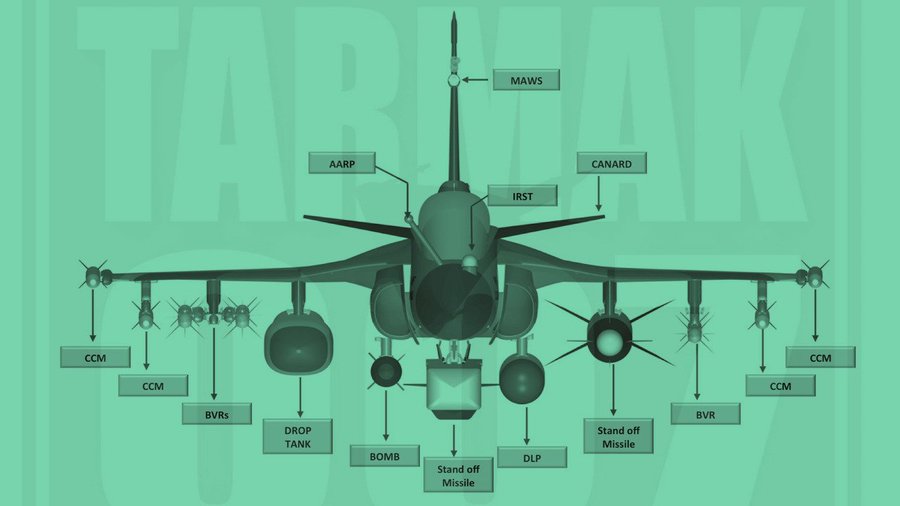
MWF loadout drawing
Designed to carry upto 8 BVRAAMs + 4 CCMs
Centerline hardpoint will be designed to carry upto 1800 kg payload. A new heavy stand-off precision weapon named Rudram-3 is in development and MWF will need to be able to carry it.
Rudram-1 is an anti-radiation weapon
Rudram-2 is another stand-off weapon
By: BlackArcherRedux - 3rd February 2020 at 19:39
HAL signs contract with IAI for 54 Elta 2052 AESA radars for Jaguar DARIN III upgrade. Includes ToT
JUST IN! HAL signs contract with IAI ELTA for AESA Radar: The Avionics Division, Hyd has entered into a contract with IAI ELTA, Israel for manufacture/supply of AESA Radar (total of 54) for Jaguar DARIN III upgrade aircraft under the Transfer of Technology.
As part of TOT, HAL will manufacture Gallium Arsenide-based Trans Receiver (T/R) Elements of Radar Antenna. Also, Transfer of Design Tech like Antenna with different configurations, development of Radar Processor application software/Low Voltage Current Source are also ensured
By: BlackArcherRedux - 25th January 2020 at 00:36
IAF Rafale jets in France. Intense work up period for the training of the first sets of IAF crews
pic credit in the image itself
RB003


RB004


RB005


RB006 at Bordeaux Mérignac

By: Spitfire9 - 21st January 2020 at 09:50
IAF should receive the following fighters in 2020:
12 x Tejas, 8 x Rafale. 10 x Su-30MKI
Tejas Mk1A order may be signed at DefExpo 2020 next month.
http://idrw.org/deal-for-83-lca-tejas-and-additional-sukhoi-30-soon-wit…
By: BlackArcherRedux - 20th January 2020 at 21:47
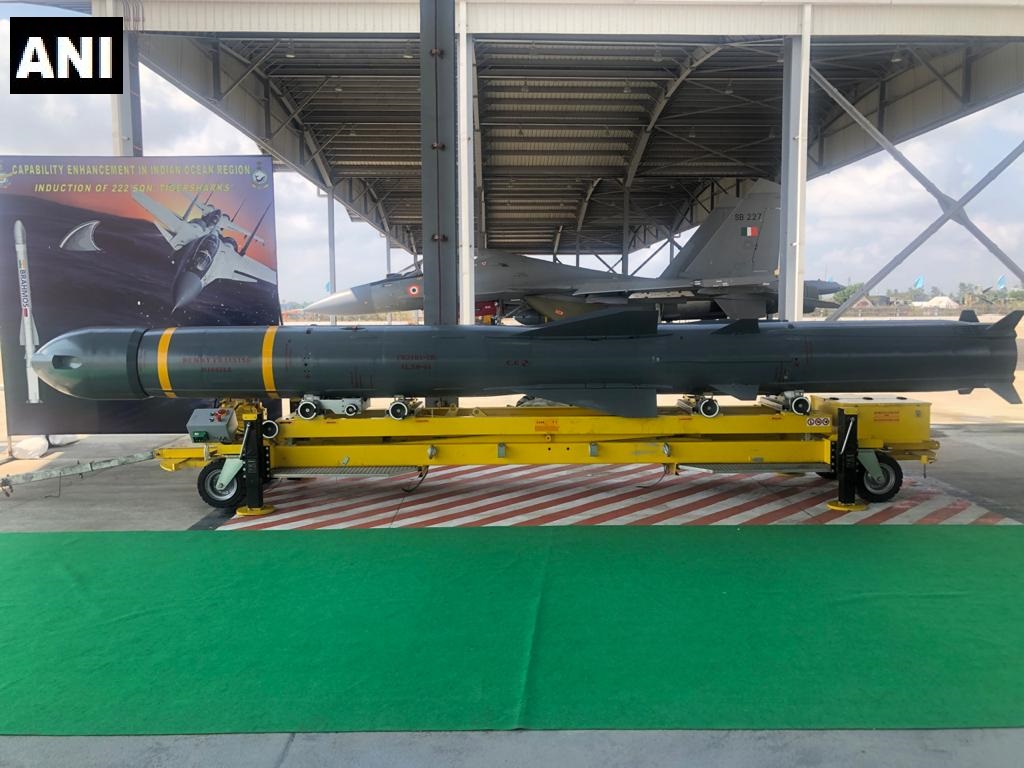
Brahmos-A. The newly resurrected No.222 ‘Tigersharks’ squadron will be dual tasked as an Air Dominance and Maritime Strike squadron, based in South India at Thanjavur AFS in Tamil Nadu state. Will work closely with the Indian Navy to take protect India’s interests in the Indian Ocean and Bay of Bengal region. Should also see detachments sent to the Andaman & Nicobar islands, with Su-30MKIs armed with the Brahmos-A ALCM.
Finally South India gets first Su-30MKI squadron
A force induction tomorrow on India’s peninsular tip will be one of the most significant in years. A squadron of the Indian Air Force’s most capable in-service jet, the Su-30 MKI will be commissioned into a unit in Thanjavur, Tamil Nadu — a unit dusted off the shelf after it was closed down in 2011.
The 222 Squadron ‘Tigersharks’, which began life in the late sixties in Ambala with a complement of Su-7 fighters was ‘numberplated’ in 2011 after a stint with MiG-27 jets. It has been revived now to house Su-30 MKI planes marked out for the maritime role, which centres around a deterrent ethic, but includes anti-ship operations if the need arises.
India’s new Chief of Defence Staff General Bipin Rawat and IAF chief Air Chief Marshal RKS Bhadauria will oversee the induction on Monday in Thanjavur. The IAF’s Southern Commander and Indian Navy’s Eastern Commander will also be in attendance, all part of an emphasis on tri-service unity.
While the IAF is rightly reluctant to point deployments at any one country or threat, the positioning of Su-30s for the first time in India’s south on a permanent basis (there have been temporary detachments before) is clearly at least in part a response to Chinese activity in the Indian Ocean, and specifically the Indian military’s area of responsibility.
..
Sources tell Livefist that at least some of the Tigersharks squadron Su-30s will be modified versions capable of deploying a BrahMos-A supersonic anti-ship cruise missile. The BrahMos-A is expected to be cleared for operational service this year. The Indian Navy handles airborne anti-submarine operations with its fleet of P-8I jets stationed also in Tamil Nadu, about 300 km north of Thanjavur in Arakkonam.
The 222 Tigersharks will be the second fighter squadron in the state of Tamil Nadu. The other is the 45 Flying Daggers squadron housing the IAF’s first LCA Tejas Mk.1 jets situated 250 km east of Thanjavur in Sulur.
…
By: BlackArcherRedux - 18th January 2020 at 00:52
There has been absolutely no issues with the F-404-INS6 that powered the Technology Demonstrators or the F-404-IN20 that powered the LSP and SPs. The decision was taken to power the LCA with a single engine, back when the project was in PD phase itself. And it has proven to be reliable and generally easy to maintain. So I don’t see any point whatsoever in discussing this. it’s like saying the Gripen should’ve been a twin engine jet with 2 X F-125s. It brings in no value as such to a type that is in service and doing well without any engine related issues.
The MWF is being built with a single F-414, akin to the Gripen E. So in both cases, the evolution is clear, from a light fighter to medium weight fighter, swapping a single F-404 with a higher thrust F-414 and an enlarged fuel load and payload.
The Navy is the one that felt that 2 engines was necessary due to range and payload requirements and ADA is reluctantly going with the TEDBF instead of N-LCA Mk2 with 1 X F-414. It’s basically a MiG-29K class jet as a replacement for the MiG-29K.
I truly doubt the Navy’s 57 MRCBF requirement will go ahead, for Rafale M or Super Hornets.
By: MadRat - 15th January 2020 at 23:50
I had a brain fart on F125 weight. That was the weight difference between Adour and F125 per engine. The twin F125 arrangement actually was closer to the single F404 when you add the starter/generators and engine mounts. The twin F125 had future room for growth in the 16,000 pound range by exploiting technology available by license to Honeywell. They also compared very favorably for Honeywell in the upfront price and lifetime costs. F125IN sticker shock was still better than what they paid for slow procurement with the F404IN during Texas development.
By: eagle - 15th January 2020 at 20:38
Hi Eagle, I think most turbofans for fighters of the 1970s had a low bypass-ratio. I have in mind F404, RD-33, RB199 and M53. I’m not sure if the F404 has worse specific fuel consumption compared to the others? If I had to guess, I’d say that the M53, with its single shaft, is the engine with the disadvantage, we’d want to find the figures, though.
Low bypass is relative of course, when talking about fighter engines, I’d say we are in the range of 0.2 to 1 BPR.
In that context, the F404 with its about 0.3 BPR is low, whereas something like the F110-100 with its 0.87 BPR is a high bypass fighter engine.
Here’s some figures for specific fuel consumption, dry, lb/lbf hr (from http://www.jet-engine.net/miltfspec.html)
F404-GE-400: 0.853
RD-33: 0.74
RB.199-34R-04 Mk.105: 0.637
M53-P2: 0.853
F100-PW-229: 0.726
F110-GE-100: 0.745
So you can see your low BPR engines like F404 or M53 use quite a bit more fuel compared to the higher BPR alternatives.
By: eagle - 15th January 2020 at 20:12
A single F125IN (max afterburner) can produce up to 9080 lbf – https://aerospace.honeywell.com/en/learn/products/engines/f125
But a single F404 is rated between 17,700 and 19,000 lbf https://www.geaviation.com/sites/default/files/datasheet-F404-Family.pdf
That is double the F125IN.
Yes, double so 2x F125 equals one F404.
The F125IN version for the Jag seems to be slightly derated. No reason to use that version outside the Jaguar. 9250 to 9500 lbf are mentioned for other applications.
More importantly though, the weight of the engines is not in F125’s favour. It’s not a 600 pounds engine, but 1360 lbs. That’s 2720 vs about 2300 lbs for a single F404. So you would need about a 10500 lbs version to match the F404’s thrust-to-weight ratio.
So even with its worse fuel consumption, a single F404 is the better alternative – unless Honeywell can offer a lot of extra thrust. In practice I mean, in theory there’s the proposed advanced versions with 12500 up to 16400 lbf of thrust.
By: MadRat - 15th January 2020 at 19:00
Twin F125 has been 9,100 pounds of thrust on an operational level since the beginning and has been demonstrated at 9,850lbf (43.8kN) in the F125IN version. They built it modular so 12,500 pounds is attainable with COTS technology. Not bad for a sub-600 pound engine. There are alternatives to F125 they could have also opted for that were in the 9,000 to 12,000 pound ranges of thrust, but it is hard to beat F125 from a reliability angle.
By: Levsha - 15th January 2020 at 10:11
Check your numbers. The F125 is rated at more than 9000 lbf of wet thrust, depending on sources (and variants I guess) up to 9500 lbf. Per engine of course.
The F404 is very reliable, true. But not that economical. This should come as no surprise considering its low bypass ratio.
Compared to an R-25 turbojet, any modern turbofan is a fuel sipper.
Hi Eagle, I think most turbofans for fighters of the 1970s had a low bypass-ratio. I have in mind F404, RD-33, RB199 and M53. I’m not sure if the F404 has worse specific fuel consumption compared to the others? If I had to guess, I’d say that the M53, with its single shaft, is the engine with the disadvantage, we’d want to find the figures, though.
By: QuantumFX - 15th January 2020 at 05:37
A single F125IN (max afterburner) can produce up to 9080 lbf – https://aerospace.honeywell.com/en/learn/products/engines/f125
But a single F404 is rated between 17,700 and 19,000 lbf https://www.geaviation.com/sites/default/files/datasheet-F404-Family.pdf
That is double the F125IN.
By: eagle - 15th January 2020 at 00:36
LOL. How much thrust do you think 2 X F-125IN produce? 40 kN in afterburner! So with 2 X F-125IN it’ll produce even less thrust than the existing F-404-IN20. Adour is no better, and heavier than the F-125IN. If anything, the IAF is VERY happy with the F-404 engine. In multiple interviews this has been mentioned. the previous Air Chief Marshal in an interview mentioned that the F-404 consumed less fuel at 7,000 ft-10,000 ft than a MiG-21 consumed at 33,000 ft. Even earlier, it has been said that the F-404 is a “fuel sipper” of an engine. Plus it’s reliable.
Check your numbers. The F125 is rated at more than 9000 lbf of wet thrust, depending on sources (and variants I guess) up to 9500 lbf. Per engine of course.
The F404 is very reliable, true. But not that economical. This should come as no surprise considering its low bypass ratio.
Compared to an R-25 turbojet, any modern turbofan is a fuel sipper.
By: Spitfire9 - 14th January 2020 at 22:10
I’m very sorry, but there were too many promises and now they are again reconsidering to a fighter that is de facto nothing more than a Rafale made in India…
Would be a step in the right direction.
…about then 30 years too late.
I live in the UK. There is an expression about ‘the elephant in the room’. It refers to everyone pretending something enormously awkward to acknowledge is not there when it is in plain sight. That is the situation in the Indian procurement system. There are many elephants in the room, many enormous defects and shortcomings. Hence things that can be done in reasonable time take eons to come about (if they are not cancelled when they are nearly eons late). Sad.
By: Deino - 14th January 2020 at 19:51
And I don’t understand what you even mean by “cannot afford”. The Indian Navy is serious about going with a twin engine Deck Based Fighter and the LCA Navy Mk1 acts a technology demonstrator for that.
Your opinion is your opinion but India is now serious about indigenisation and not throwing billions of $ on imports. There most likely won’t be any imported MRCBF. There will be a MiG-29K MLU possibly and there will be a Tejas Mk2 MWF.
Nobody in the forces nor in the Govt. shares your viewpoint, but you’re entitled to it, so I’ll let it be. Anyway this forum has people who think they know better about how to run India’s procurement and development programs with a lot of condescending BS, without knowing even ABCD about it, but that’s not going to change.
Indeed, everyone is entitled to his own opinion, but barely no-one outside this pink bubble believed in what the IAF, IN, HAL or ADA tells and promises. The biggest issue always in such annoncements, promisses and claims is “WILL“, but given that HAL, ADA and many other promise that the Tejas WILL have this and that since years, WILL archive this and that soon and WILL be capable of but they are still considering, I won’t hold my breath that we ever WILL see any N-Tejas Mk. 2, a twin-engined development or even an Orca as just recently announced and surely never ever powered by a Kaveri.
I’m very sorry, but there were too many promises and now they are again reconsidering to a fighter that is de facto nothing more than a Rafale made in India developed about then 30 years too late.
By: MadRat - 14th January 2020 at 02:28
Going from podded F125 to podded F4x4 is a smoother transition than single F404 to twin F414.


 Sign In








 September 10, 2019 at 6:52 pm