A ‘what if’.
I was just thinking that the angled flight deck, invented (I believe) and trialled in the 1950s was basically ‘a good idea’ and wasn’t dependant on any technical changes for its invention. It became necessary due to the development of jets in carrier aviation, but most of the benefits would have been of significant use and applicability in W.W.II. In fact, all other things being equal I think it may have turned a battle or two.
I’ve arbitrarily taken 1940 as a hypothetical date for either the British (who really invented it later on) the Americans or the Japanese having a ‘eureka’ moment and developing an angled flight deck before 1941.
Some questions:
1. Was it possible? AFAIK there’s nothing to stop carriers of the era to have angled flight decks developed.
2. What effect/s would it have on carrier battles in general, and…
3. …can we think of any specific examples where being able to launch and recover and avoid into deck park overshoots would have affected a particular aspect of a particular naval engagement. (e.g. would the Salerno Seafire losses have been less?)
4. If nation ‘a’ invented it, how quickly could nation ‘b’ copy it during W.W.II?
5. Any other bright ideas, but not the flexible deck, please!
A good bit of background, including how relatively straightforward such a change would be on many W.W.II carriers: http://en.wikipedia.org/wiki/Flight_deck#Angled_flight_deck
Just some fun, your input wanted…
Regards,

By: pagen01 - 31st March 2025 at 12:29
I don’t have much time at mo, but just a quick input from me.
I think if the Americans had adopted the Angled deck during the early war period that it would have prevented alot of the forward deck accidents that did occur, and thus lives in what was a difficult time for USN aviators.
By: bazv - 31st March 2025 at 12:29
Yes I think flight deck emergencies must have caused many casualties and the angled deck concept got rid of the very dangerous ‘barriers’ etc in use at that time.
To make full use of the angled deck,you would of course need to have catapults available for launching.
By: JDK - 31st March 2025 at 12:29
Thanks chaps.
To make full use of the angled deck,you would of course need to have catapults available for launching.
Certainly the Ark Royal and Illustrious class had them – called ‘accelerators’ but the Ark at least had the cumbersome four point ‘trolley’ type unit.
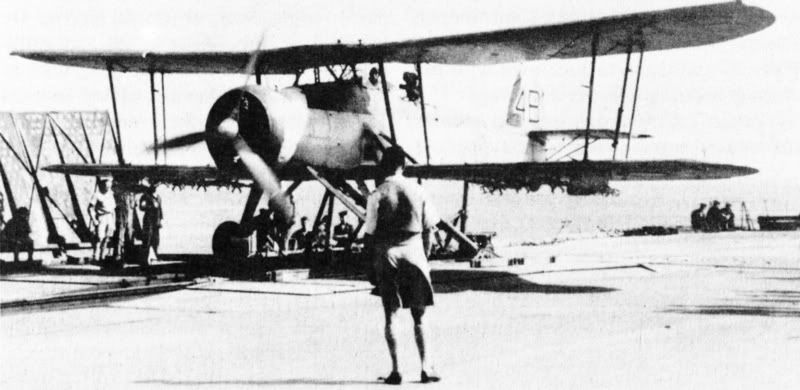
By: D1566 - 31st March 2025 at 12:28
Would the carrier aircraft then in use have had sufficient power to do a ‘bolter’ if they missed all the wires?
By: JDK - 31st March 2025 at 12:28
Would the carrier aircraft then in use have had sufficient power to do a ‘bolter’ if they missed all the wires?
I asked this as a question, as it’s an area I claim no expertise in, but the power on approach would, IMHO be as viable for the piston types as the later jets. An issue would be those at risk of torque roll or with larger flaps like the Firefly, but presumably they ‘bolted’ on land training ADDLS.
By: pagen01 - 31st March 2025 at 12:28
I must stress that I meant purely in a safety sense that the angled deck would have been useful in the earlier days, I don’t think it would have enabled many more launchings, but could have prevented far more aircraft with hook, U/C, fusalage seperations etc from sliding into aircraft ranged on the forward area.
Piston types were capable of bolters then, that became a real problem with the service entry of early jets with their far higher approach speeds and their engines were far slower to pool up in responce to the throttle – which neatly brings us back as to why the angled deck was such a good invention at its time.
By: Creaking Door - 31st March 2025 at 12:28
2. What effect/s would it have on carrier battles in general, and…
3. …can we think of any specific examples where being able to launch and recover and avoid into deck park overshoots would have affected a particular aspect of a particular naval engagement.
Could the outcome of the Battle of Midway have been different if the Japanese had had angled-decks?
IIRC the Japanese were caught (by US dive-bombers) with their aircraft ranged on deck (and in the hanger) whilst changing between bombloads for an attack on Midway and an attack on the (suddenly located) US carrier group.
Would an angled-deck have allowed re-arming to take place without making the carriers so vulnerable? I don’t think the Japanese fighters were trapped on deck by the re-arming of the strike-wing but would the fact that flight operations could continue with some of the strike-wing ranged on deck have increased the options from the all-or-nothing decision that proved so fatal?
By: Pondskater - 31st March 2025 at 12:28
An interesting question James.
The take-off deck is always into wind and I wonder how much difficulty a WWII era prop aircraft would have making a cross wind deck landing, especially when the torque effect would make an overshoot more entertaining.
As for battles – Midway springs to mind as one where cluttered flight decks got in the way for the Japanese. OK, admittedly it was changing the armament of the second attack wave while the first one was arriving back that caused trouble – and then the American dive bombers found them at that crucial moment. But the Japanese fighter cover had been drawn off by the US torpedo bombers and, busy retrieving attack aircraft, there was little chance of getting much else airborne, let alone mounting the counter attack they had planned. Might not have saved the Japanese carriers, but the Japanese might have got that second attack off.
But then, once you change a carrier design, the tacticians would, one assumes, have changed their approach as well and the what ifs become quite wide ranging.
AllanK
EDIT: cross posted with CD. Great minds again!
By: Creaking Door - 31st March 2025 at 12:28
5. Any other bright ideas, but not the flexible deck, please!
WW2 carrier versus carrier battles seem (to me anyway) to be decided upon finding and then reaching the enemy carriers with a strike force (often at extreme range) and not sacrificing your own pilots but not necessarily their aircraft in the process.
It would be very interesting to know what percentage of US or Japanese strike aircraft survived a mission during a battle such as Midway (excluding those lost on the deck). I would imagine the percentage would be small.
So, why bother with landing at all?
Aircraft could be designed for take-off only, without undercarriage or any of the design restrictions required for the rigours of deck-landings, aircraft could be lighter, be more manoeuvrable, have greater range, carry heavier bombloads or some combination of these and at the end of the mission the pilots could simply bale-out within some ‘recovery-area’ to be picked up by rescue ships (or submarines).
Aircraft could be launched from smaller, cruiser-sized, ships by catapult and think of the time, aircraft and lives that would be saved if carrier pilots didn’t have to learn to land on a carrier!
Sounds outrageous? Well the Japanese decision to use the kamikaze was based on the chances of a pilot regaining his base (virtually zero), the CAM ships were judged quite successful and removing the landing gear was considered for the ‘flexible deck’ (sorry :o).
By: JDK - 31st March 2025 at 12:28
It certainly unravels what we know of the reality of W.W.II carrier ops, which is why I offer it here!
I suspect earlier lighter/biplane carrier aircraft would have no great problem using a launch deck area while others landed on.
6 degrees out of wind, or if the captain split the difference, 3 degrees each doesn’t seem much to me, even for, say, Sea Gladiators and Swordfish.
Pagen’s also put his finger on a couple of points – launch frequency wouldn’t necessarily be quicker (and using the RN’s accelerators was sloooow) but the main issue as I understand it launching was impossible while landing on, but with an angled deck, continuous CAP was perfectly possible while – say – retrieving a strike force.
Secondly there was a huge rate of attrition due to aircraft crashing into the deck park while landing on – and not just from structural failure, but as little as missing a wire, or an unfortunately timed hook bounce missing the wires…
As I mentioned earlier, I suspect a lot less Seafires would’ve been lost during the low-wind Salerno landings if they’d been able to ‘bolt’. But in this case, would torque rolling have been an inevitable issue or only one for the less skilled pilots? (I’d presume a power on approach would need only a little more power to climb away safely after bolting.) Additionally, which way would a Merlin Seafire at Salerno torque roll? Towards the island or away? That would be the difference between the loss of one pilot and aircraft, or into the deck park or actual damage to the carrier.
By: mark_pilkington - 31st March 2025 at 12:28
.
Interesting “what if” James,
The Angled Deck was primarily developed in response to the higher landing speeds of jet aircraft, and not for the added advantage of dual operations of recovery and launches as away of improving combat turn-arounds.
I too felt that Midway was the main engagement that may have yielded a different result if the Japanese carriers had been able to turn around aircraft more quickly – particularly with the need to re-arm bombers etc.
Had the Japanese developed angled decks in 1940, it is likely that the benefits and need for them may not have immediately been appreciated and copied by the allies, who were already focussed on low cost high volume light carriers to protect the Atlantic convoys and fight in the European conflict, in anycase, until proven to create a combat advantage I doubt existing ships under construction would have been delayed to add the angled deck?
If the Japanese were the sole users through 1940 to 1941, and used them with success in Pearl Harbour the earliest consideration of utilising the design elsewhere would have been due to the December 1941 attacks?
Yet the element of surprise, and the lack of readiness by the US Defenders probably meant an angled deck would not be considered a major contributor itself to the Japanese success at Pearl Harbour.
Regardless of that, the fact that Midway only occured some 6 months later would have ensured that no US angled deck modified, or new design, could be constructed due to Pearl Harbour experience and be ready by Midway.
Obviously had the Japanese Navy not lost 4 aircraft carriers and a heavy cruiser at Midway, (and the US only 1 carrier) the weakness of the Japanese supply lines may not have been exposed and exploited as quickly, the war in the south west pacific continued on with full occupation of PNG, and clear threats to invasion of Northern Australia, NZ etc, perhaps allowing Japan to secure control over south east asia under a negotiated peace settlement?
The development of the angled deck commenced in 1952, and the first carrier to be laid down with the angled deck was HMS Ark Royal in 1955.
Australia’s HMAS Melbourne was only the third angled deck Carrier to be commissioned when it entered service in 1955.
launched in late WW2 as a british Majestic Class light carrier, its construction was suspended until 1947 when purchased by the RAN, it was then decided to modify it to angled deck resulting in the 8 year delay through to 1955.
Its sister ship HMAS Sydney launched in 1944, retained the original straight deck, and was put into service with the RAN in 1948, some 7 years prior to Melbourne.
While the peace time pace of Melbourne’s conversion would not suggest a similar 8 year period would occur in wartime conditions its clear that unless all Nations concurrently saw the benefit in 1940, then the first mover would have that lead for perhaps 3 or 4 years unless the advantages were instantly recognised, and design/construction immediately implemented?
regards
Mark Pilkington
By: JDK - 31st March 2025 at 12:28
Thanks Mark, some very cogent points.
While the peace time pace of Melbourne’s conversion would not suggest a similar 8 year period would occur in wartime conditions its clear that unless all Nations concurrently saw the benefit in 1940, then the first mover would have that lead for perhaps 3 or 4 years unless the advantages were instantly recognised, and design/construction immediately implemented?
Have a look at the Wiki reference, and a bit of an explore. The first trials were actually using paint, and little more – the arrestor wires weren’t moved, initially. A proper modern style angled deck involves quite a number of changes to a straight deck carrier, it’s true, but a minor angled deck, the 6 degree one has most of the benefits and little structural change requirement.
So any nation could have had some benefit with an extempore angled deck almost immediately, proper modifications taking months to years – critical time in the 1941-2 period I agree.
Lost of good stuff, coming in, including Creaking Door’s out of the box and off the bouncing deck effort!
Regards,
By: pagen01 - 31st March 2025 at 12:28
Yes the earlier carriers only had the angle painted on, the actual physical additions to the port waists came later. There was plenty of deck space to angle the runway across.
I am surprised at the reference that the wires and barriers weren’t initially angled with the ‘runway’ though.
Edit, I can’t find reference at mo, but I’m under the impression that both Audacious Class carriers, Eagle R-05 and Ark Royal R-09, were commenced with straight through decks, and later modded (possibly just after commision?) for angled deck sections, the angle of which was later modified again.
By: pagen01 - 31st March 2025 at 12:27
I thought engines were designed to go that way for left hand circuits, the same reason as Islands are on the right?
By: Pondskater - 31st March 2025 at 12:27
which way would a Merlin Seafire at Salerno torque roll?
I thought the Merlin aircraft torque rolled left. And the island is on the right. Coincidence?
HMS Furious had solved the “land and take off at the same time” problem in the 1920s by having two storey flight decks. The long top deck was for landing on, and at the front, the hangar deck opened out onto a flying-off deck. But she was later rebuilt to remove the lower flying-off deck – and a small island added on the starboard side.
AllanK
By: steve_p - 31st March 2025 at 12:27
Thanks chaps.
Certainly the Ark Royal and Illustrious class had them – called ‘accelerators’ but the Ark at least had the cumbersome four point ‘trolley’ type unit.
Couragous and Glorious had them too.
By: JDK - 31st March 2025 at 12:27
I thought engines were designed to go that way for left hand circuits, the same reason as Islands are on the right?
Up to a point. Fits the ‘British invention’ of the carrier scenario, but let’s not overlook that famously American engines go the other way to Brit ones, excepting the Griffon. I think it’s something to do with driving on the other side of the sky.
By: Pondskater - 31st March 2025 at 12:27
Without prolonging the Island debate – the Japanese Akagi and Hiryu were the odd ones with a port side island.
Akagi was also originally built with three flight decks – a proper multi-storey aircraft carrier, although the middle deck was so short as to be of very limited use for launching.
The early development of the carrier by converting cruisers is neatly shown in this series of images of HMS Furious – Link to Maritime Quest. You can see the take-off ramp added to the bow, then a landing deck to the rear, extending the landing-on deck over the lower flying-off deck, and eventual evolution into a WWII flat top with a starboard island.
AllanK
By: Pondskater - 31st March 2025 at 12:27
Anyway, to comment on the topic of angled decks – I would suggest that strategists and naval architects had methods to enable them to launch and recover aircraft at the same time without needing an angled deck – but decided against using those designs.
Also many of the WWII carriers also came from a treaty era when the total tonnage of carriers was limited – so the Admiralty had to limit the size of ships which would limit flight deck size.
AllanK
By: JDK - 31st March 2025 at 12:27
Anyway, to comment on the topic of angled decks – I would suggest that strategists and naval architects had methods to enable them to launch and recover aircraft at the same time without needing an angled deck – but decided against using those designs.
Interesting point. My reading is the examples you quoted compromise either the seawothyness of the ships (open – non hurricane bows) the number of aircraft in the compliment, or depend on lower-power higher-lift older aircraft (slip-launching Flycatchers). If these were the reasons for their abandonment, then the W.W.II angled deck idea is unaffected. If, as you’re suggesting, strategists decided there wasn’t much need, that makes sense. However naval strategy (like everything else) changed radically on the advent of war, which is why I chose a 1940 date, rather than a pre-1939 one.
The benefit of not losing a batch of aircraft from one overshoot into the deck park seem pretty unarguable to me, on its own. And that seems to have been a particularly hot wartime problem. Had their been an alternative, I suspect it would’ve been grabbed.
Interesting, isn’t it? The feedback has gone in directions I’d not expected, all good too.
Thanks!


 Sign In








 February 4, 2010 at 8:01 am