
By: Tiornu - 17th September 2007 at 09:17
Thanks for looking that up for me. A difference of 100 lbs is a much more conventional figure, as I’ve found only a single reference implying that 20 lbs might be more accurate.
The British and Japanese guns are indeed the most powerful ship-mounted guns during the dreadnought period. To the best of my knowledge, the greatest range achieved with the 18in gun was 40,500 yards using supercharge propellants and increased gun elevation. The 46cm gun could reach to about 45,960 yards.
During the time when pre-dreadnoughts were gestating, there was an enthusiasm for so-called “monster guns.” You’ll find guns of up to 17.7in or so in various navies. These guns used shells that were light by later standards, and the muzzle velocities tended to be very low. Nevertheless, as a group, the monster guns were a flop with numerous barrel failures. The technology of barrel design was too primitive for the pressures involved, and the black powder propellant was little more than an explosive that threw the shell forward in one sudden heave.
By: jackehammond - 17th September 2007 at 06:45
The Gerät 36 was a 533.4mm naval rifle serving in trials and firing a 2200kg shell. The Japanese 36cm/45 5th Year Type (actually a 48cm gun) fired a shell of about 1750kg. The American 18in/47 Mk A/O fired a 3850-lb shell. The British 18in/40 Mk I, which served aboard Furious and a few monitors, fired a 3320-lb shell; thus it rates third among the guns I can think of, but first among those that served afloat. The Japanese 40cm/45 Type 94 (actually 46cm) fired a 1460kg shell, though some sources claim it was actually as heavy as 1520kg, which would edge out the 18in Mk I. I’d be interested to know which source said the British 18in shell had a 20-lb lead over the runner-up.
Dear Member,
The information came from an August 1960s back issue of the USNI Proceeding by a naval officer (note – I mistakenly stated 20lbs when it was 100lbs). The only comparison it gave was between the Japanese WW2 18 inch naval cannon and the British 18 inch naval cannon. It seems the author was unaware of the other cannons you mentioned (as I am). But even with a 100 lbs higher projectile weight (ie the British 18 inch cannons) the Japanese 18 inch cannon had a substantial lead in muzzle velocity and range. Also the author stated the British and Japanese naval cannons were the only ones to ever be mounted on warships. Which I have no knowledge to know if true or not true. Thanks for the additional information.
Jack E. Hammond
Click thumbnail for page of article
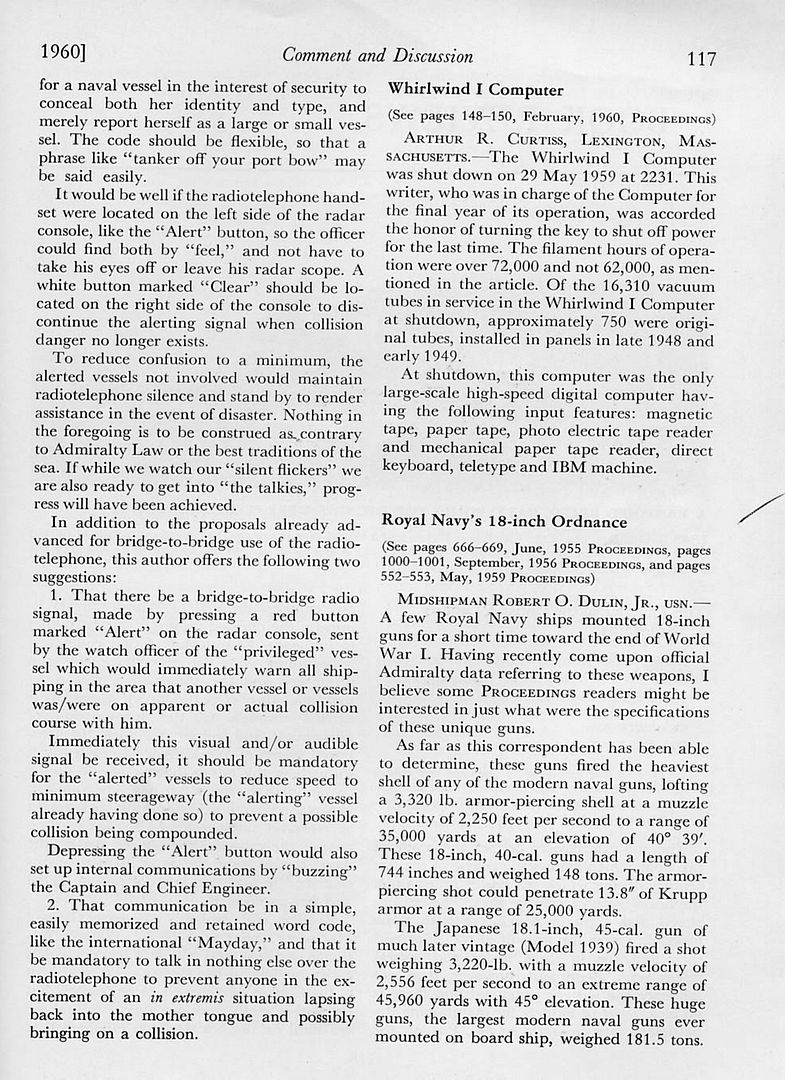
By: Tiornu - 16th September 2007 at 06:56
The Gerät 36 was a 533.4mm naval rifle serving in trials and firing a 2200kg shell. The Japanese 36cm/45 5th Year Type (actually a 48cm gun) fired a shell of about 1750kg. The American 18in/47 Mk A/O fired a 3850-lb shell. The British 18in/40 Mk I, which served aboard Furious and a few monitors, fired a 3320-lb shell; thus it rates third among the guns I can think of, but first among those that served afloat. The Japanese 40cm/45 Type 94 (actually 46cm) fired a 1460kg shell, though some sources claim it was actually as heavy as 1520kg, which would edge out the 18in Mk I. I’d be interested to know which source said the British 18in shell had a 20-lb lead over the runner-up.
By: jackehammond - 16th September 2007 at 05:48
Well, I’ll take a guess. I’ll assume it was a WWII-era weapon, since that’s all I know. How about the German Gerät 36?
Dear Member,
That is a land weapon. Surprisingly it is the WW1 18 naval cannon that saw limited service which is the winner by 20lbs!
Jack E. Hammond
By: Tiornu - 15th September 2007 at 19:58
What naval engagement has ever lasted for hours? Most are very short in duration.
Uh…how about Samar? Gambier Bay went to General Quarters at 0645 and capsized, still under fire, at 0907.
By: Arabella-Cox - 15th September 2007 at 19:21
The battleship gunnery phase of Surigao Strait lasted maybe twenty minutes. Kurita’s ships would have been in battle for hours prior to reaching Homonhon Island. His ammo loadout was split among three types of shells. I’m not sure he would have had any advantage in AP rounds before engaging Oldendorf. I’m also not sure that using HE against Yamato was a bad idea.
What naval engagement has ever lasted for hours? Most are very short in duration……….:rolleyes:
By: Arabella-Cox - 15th September 2007 at 19:10
I’ve always wondered about the Alaska/Guam vs the Gneisenau/Scharnhorst.
I have always loved the Alaskas, for some reason. Perhaps cause it was as close as we got to having battle cruisers in the US Navy.
Well, the Alaska Class had much betters guns vs the Scharnhorst thicker armor. Yet, I believe the former would win because of the superior US fire control.
To give a example of US fire control the USS West Virgina during the Battle of Surigao Straits. Acquired the IJN Fuso and its sqaudron at 42,000 yards. Had a firing solution at 30,000 yards and fired at 22,000 yards. She hit with the very “first salvo” and a matter of fact “hit with 5 out of the next 6 salvos”!:D
Note: The US West Virgina had 8-16 inch guns and her half sisters (California & Tennessee) 12-14 inch guns. All were virtually identical and had the same fire control………..talk about firepower!:diablo:
By: Arabella-Cox - 15th September 2007 at 18:45
Most of the armor piercing rounds carried by the US battle line had been expended (they were carrying short stores on them) and all that would be left would be the HE rounds used for shore bombardment. This would have put the line at a marked disadvantage as they weren’t expecting to go ship to ship, but rather ship to shore.
True, the mix of ammo was 75% (HC) and 25% (AP). Yet, they still would have had thousands of shells combined. Further, the HC Shells would have been more than a match for Japanese Crusiers and Destroyers. Thereby, leaving the AP Shells for the Yamato. Regardless, my point is that ships very rarely fight one vs one. So, even the mighty Yamato would have its hands full in almost any surface engagement with USN Ships. As its likely she would be out gunned. Let’s not forget the longest hit by a heavy ship in WWII was at ~ 26,000 yards. Which, is well within the range of all large battleships.
By: Tiornu - 15th September 2007 at 08:34
Well, I’ll take a guess. I’ll assume it was a WWII-era weapon, since that’s all I know. How about the German Gerät 36?
By: jackehammond - 15th September 2007 at 07:52
Folks,
Trivia: What was the largest naval cannon to fire the heaviest shell in history?
Jack E. Hammond
By: Tiornu - 14th September 2007 at 20:51
The battleship gunnery phase of Surigao Strait lasted maybe twenty minutes. Kurita’s ships would have been in battle for hours prior to reaching Homonhon Island. His ammo loadout was split among three types of shells. I’m not sure he would have had any advantage in AP rounds before engaging Oldendorf. I’m also not sure that using HE against Yamato was a bad idea.
By: kfeltenberger - 14th September 2007 at 19:56
I think my point was the Yamato and her escorts would have had to face several USN Battle Ships plus large numbers of Cruisers and Destroyers. While, the dreadnoughts were WWI vintage ships. (some of Pearl Harbor fame) Many had new fire control that proved very effective during the Battle of Surigao Straits. Clearly, Yamato could have easily taken on one or two. Yet, a Battle Line of several……………..:eek:
Most of the armor piercing rounds carried by the US battle line had been expended (they were carrying short stores on them) and all that would be left would be the HE rounds used for shore bombardment. This would have put the line at a marked disadvantage as they weren’t expecting to go ship to ship, but rather ship to shore.
By: Arabella-Cox - 14th September 2007 at 05:15
It’s quite probable that Yamato and the rest of the task force would have shot Adm. Odlendorf’s Bombardment Fleet to pieces. What really made Oldendorf’s engagement the night before so decisive is the stellar performance of the torpedo attacks by the screening destroyer flotillas and the incredible location where he sited his battleships because he had time to choose the time and place for the engagement.
If the Yamato task force had kept going, they would have been defeated, either by Oldendorf or Halsey’s forces when they turned around and were within range of airstrikes, but Oldendorf’s Bombardment Fleet would have been severely crippled and the beach head in question.
I think my point was the Yamato and her escorts would have had to face several USN Battle Ships plus large numbers of Cruisers and Destroyers. While, the dreadnoughts were WWI vintage ships. (some of Pearl Harbor fame) Many had new fire control that proved very effective during the Battle of Surigao Straits. Clearly, Yamato could have easily taken on one or two. Yet, a Battle Line of several……………..:eek:
By: kfeltenberger - 13th September 2007 at 01:44
What is often overlooked is how well the small and cheaper South Dakota Class performs. Really, its only shortcoming is a little speed……….That said, ship vs ship comparisons mean nothing in reality. Regardless, American fire control was so superior by mid-war that few opposing fleets would have stood much of a chance.
Here’s one…….If, the Yamato and her fleet of Cruisers and Destroyers could have sank Taffy Three and reached the Leyte Gulf Invasion Fleet of Transports. Could she have prevailed against the Pearl Harbor vintage Battleships and Cruisers of Admiral Oldendorf Bombardment Fleet? Remember, just the night before his fleet sunk several ships (i.e. battleships, cruisers, and destroyers) during a night action………
It’s quite probable that Yamato and the rest of the task force would have shot Adm. Odlendorf’s Bombardment Fleet to pieces. What really made Oldendorf’s engagement the night before so decisive is the stellar performance of the torpedo attacks by the screening destroyer flotillas and the incredible location where he sited his battleships because he had time to choose the time and place for the engagement.
If the Yamato task force had kept going, they would have been defeated, either by Oldendorf or Halsey’s forces when they turned around and were within range of airstrikes, but Oldendorf’s Bombardment Fleet would have been severely crippled and the beach head in question.
By: hawkdriver05 - 13th September 2007 at 01:13
Ahhh…..if only Halsey had given “Ching” Lee his chance and formed TF34……..
By: Tiornu - 12th September 2007 at 09:31
Remember, the old rule about warship design. Out fight what you can’t out run and out run what you can’t out fight.
When the Deutschlands started into service, the only likely opponents that could individually outrun and outgun them were the British battlecruisers. But a cruiser squadron can also do the job, as shown historically, not to mention those vexatious wingy-thingies.
He split his force in two thereby dividing the Graf Spee fire.
Since the 8in ships are the real threat, it might be best to separate them and thus complicate the process of switching targets.
Could she have prevailed against the Pearl Harbor vintage Battleships and Cruisers of Admiral Oldendorf Bombardment Fleet?
Kurita’s prospects were not good. Though Oldendorf had expended some effort the previous night, Kurita would have expended far more in his hours-long running fight. He would have suffered continuing air attacks, and he had the disadvantage of his indifferently trained crews.
By: Arabella-Cox - 12th September 2007 at 08:38
Not really, they were certainly not battleships or ships of the line, but they were built to try and give the German Navy capital ship callibre main artillery on a treaty restriction hull (Versailles in this case, not the more often discussed Washington) and so they ended up with a ship that wasn’t really anything. Slower than a cruiser despite cruiser being the nearest equivalent category (and the class being redesignated as cruisers later in their careers) with no real use beyond commerce raiding despite the fact that Germany could’ve achieved that with far greater efficiency with submarines. Yes, I know Versailles prohibited submarines, but it does indicate that the class wasn’t the best choice either for the one role they’re generally held to have been well suited for. With regards what other 12,000T ship could have fought as well at Platte, a conventional cruiser could have used speed to try and assist her escape, ultimately the Graf Spee was lost so it wasn’t a succesful engagement for her.
Personally, I think the Graf Spee design had a lot of merit. Yet, the diesel engines just didn’t provide enough power! Remember, the old rule about warship design. Out fight what you can’t out run and out run what you can’t out fight. 😀
By: Arabella-Cox - 12th September 2007 at 08:32
Looking back at the battle of the River plate how do people think Commodore Harwood would of adjusted his tactics if he had HMS Cumberland on his gun line as well?
Well, he did what any commander would have done. He split his force in two thereby dividing the Graf Spee fire. So, even adding another warship I don’t see it changing his tactics. Of course the extra firepower would have been welcome………….expediting the demise of the German Pocket Battleship.
By: Arabella-Cox - 12th September 2007 at 08:22
Looks at the best of each major player in WWII.
What is often overlooked is how well the small and cheaper South Dakota Class performs. Really, its only shortcoming is a little speed……….That said, ship vs ship comparisons mean nothing in reality. Regardless, American fire control was so superior by mid-war that few opposing fleets would have stood much of a chance.
Here’s one…….If, the Yamato and her fleet of Cruisers and Destroyers could have sank Taffy Three and reached the Leyte Gulf Invasion Fleet of Transports. Could she have prevailed against the Pearl Harbor vintage Battleships and Cruisers of Admiral Oldendorf Bombardment Fleet? Remember, just the night before his fleet sunk several ships (i.e. battleships, cruisers, and destroyers) during a night action………
By: Fedaykin - 11th September 2007 at 12:32
Looking back at the battle of the River plate how do people think Commodore Harwood would of adjusted his tactics if he had HMS Cumberland on his gun line as well?


 Sign In








 October 21, 2004 at 10:17 pm