Hello all
My name is Richard Hudson, my grandfather was part of MU10 at Hullavington throughout war years and up until the unit closed.
I have a healthy interest in aircraft as a result of many many discussion I have had with him. He has now sadly passed, but going through old photographs I came up with this one. Pretty sure my grandad took it from his home in Chippenham. and knowing my grandad he would not have grabbed the old box brownie unless it was pretty damned important
I initially thought Lanc with outboard engines removed but it doesnt match any of the images that I have seen. plus fuselage looked too slim. Then I thought Lincoln. Asked my dad and he commented
“Looked at pictures. Some have not seen before. Big plane is definitely Lincoln when you look at images. Long spike on tail confusing but I know was experimental and by mid 50s May have been reconnaissance version on test. Could find nothing on google about jet assist version. RAF museum may be interested in picture. I saw it at RAF Hullavington home of 10MU and also Empire Flying School. Must have been post 1955 as I cycled there and didn’t have big bike until I passed 11+. Could get through hedge on south side and avoid runway to cycle to big wartime hangers still there.”
anyone add anything to this?
Spoke with dad on the phone and he recalls a lot of information around the lincoln jet assist not being popular and that there was much concern about the jet engines leaving the fuselage behind.
He has grandads flight reords up until early 50s, much of the post war stuff was training and also relocating new aircraft to ireland for recycling.

By: richardthestag - 10th June 2018 at 21:12
I do love a conundrum, there is no deceit on my part at all. I have a small photo print which I recovered from a collection of photos after my grandad passed away. There is much more to come from MU10 including commendations etc.
My dad has no recollection of the above aircraft incident but is absolutely convinced of the location. bear in mind he would have been 11 in 1955.
I posted above links to google maps which show building which appear to match those above. the tail end of parliament street chippenham viewed from ladyfield road chippenham.
My dad is confident that his family moved to Ladyfield Road from a 3 bed prefab in fishponds in the winter just prior to his 11+ exams – which he passed and went to Chippenham Grammar. that would have been winter 1955/56. he was born March 44. Check the build records for ladyfield road I guess. Largely 1950s council housing
This would place the location as the back garden of 76 Ladyfield road Chippenham. I posted the googlemap view from the main road part which looks past the back of 76 ladyfield road.
on the modern images the white gabled house lacks the tall chimney stack but has the window arrangement on the gable end. also the stack arrangement on neighbouring houses + the extensions matches as do the short squat stacks on the other side of the road.
My dad is 99.9999% sure of the location. having compared google maps locations I am also
The only doubt is the date. Maybe my grandfather visited the location prior to moving in.
I do know that box brownie film cost money. and that while grandad was NOT on the breadline he was sole source of income and living in a council house. this image to have been shot and survived 60 years ?!? must have meant somethingto him. alas he is not around to explain.
By: Supermarine305 - 10th June 2018 at 19:42
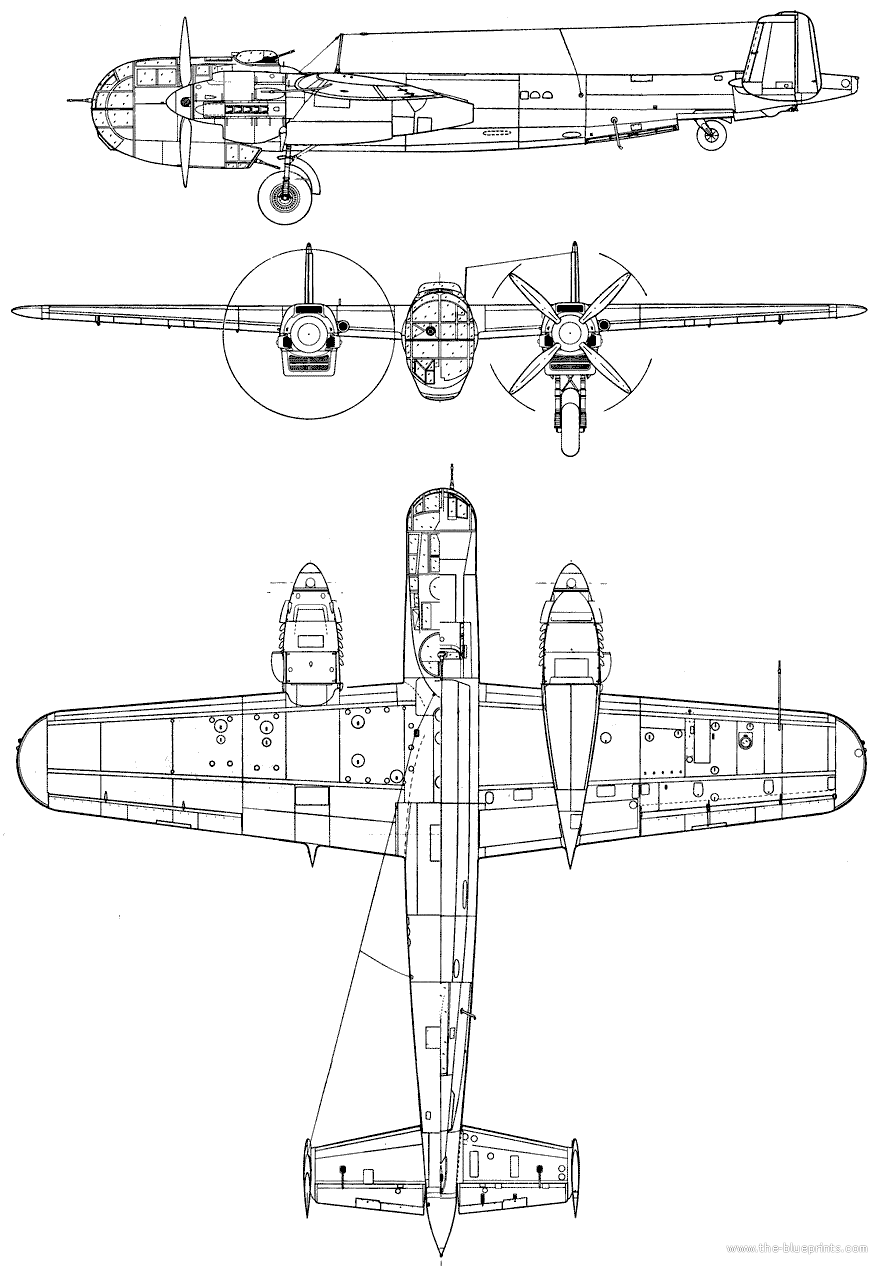
Here is a picture of Dornier Do 217M Wk Nr. 56527 (AM107)
[ATTACH=CONFIG]261018[/ATTACH]
(c) Bill Pippin Collection.
The ‘M’ mark had that distinctive bulbous cockpit (like the K mark). Even if am105 and 106 had pale undersides, the cockpit in Richards father’s photo seems to taper towards the nose.
Compare a 217M with a 217E. The stepped cockpit was also seen with the nightfighter J and N marks. These had inline engines unlike the E’s.
Its a bit of a puzzle to me: Its has dive brakes which suggests a bomber. Has inline engines (cowlings look too narrow to be radials) and that rules out Es. It appears (to me) to have the earlier stepped cockpit and that rules out Ms. Why would a nightfigher J or N have dive brakes?
Whatever it has under its wings have wide (twin-finned??) tail units attached. And it was flying over Wiltshire in 1955 still in German markings?
Two explantions occur to me (And they might raise some ire but need to be considered):
The photo is genuine but date and location are mistaken.
The photo is a fake (wartime Do 217 spliced over picture of houses) but has over time been associated with a genuine memory.
By: Duggy - 10th June 2018 at 18:06
Came across this.
A Do 217M was abandoned by its aircrew over England on the night of 23 February 1944, but made a perfect belly-landing near Cambridge over 62 miles away from London. The aircraft was soon flying again in RAF markings.
RCAF S/L Joe McCarthy test flew Dornier Do 217M-1, (Wk. Nr. 56527), RAF AM106, while serving with the Royal Aircraft Establishment‘s Foreign Aircraft Flight at Farnborough, UK at the end of the war. Three examples had been selected for evaluation in the UK from a group captured at Beldringe, Denmark. Two arrived at Farnborough, AM106 (scrapped in 1945) and (Wk. Nr. 56158), AM107 (scrapped in 1955). A rear fuselage is all that survives from the remains of a Do 217 on display in the Italian Air Force Museum.
Dornier Do 217M, (Wk. Nr. unknown), selected for evaluation after capture at Beldringe, Denmark. This aircraft was designated RAF AM105. It was scrapped at Beldringe, England.
Dornier Do 217M-1, (Wk. Nr. 56527), selected for evaluation in England after capture at Beldringe, Denmark. This aircraft was designated RAF AM106. It was scrapped at Farnborough in 1946.
By: HP111 - 10th June 2018 at 17:56
In the original photo, the leading edge of the wing seems to merge with the sky and is lost, giving the wing (also tailplane) an unnaturally high aspect ratio. The same affect may also apply to whatever is slung under the wings. Take that into account and the drop tanks are looking quite likely, but that shown above does not seem an exact fit. Are there different styles/sizes of drop tank?
By: Duggy - 10th June 2018 at 17:23
Looks like 900 Liter fuel tanks, but they could also carry torpedoes.
But not listed 217 at Farnborough
And the list of Luftwaffe aircraft allocated to the Royal Aircraft Establishment (RAE) at Farnborough, Hants between 1939-45. The RAE facilities at Farnborough were utilized for the flight testing of German and Italian aircraft during the entire 1939-45 period. Many crash-landed airframes were brought to Farnborough for examination and testing. The main flight testing work was carried out by the Aerodynamics Flight of the Experimental Flying Department and the Wireless & Electrical Flight (W&EF) the latter with investigations of radar-equipped aircraft later in the war.
* AE479 – Messerschmitt Bf109E-3 – W.Nr.1304 – “White 1” of JG76 – damaged during forced landing in the US
* AW177 – Heinkel He111H-1 – W.Nr.6853 – 1H+EN of II./KG26 – crashed November 1943
* AX772 – Messerschmitt Bf110C-5 – W.Nr.2177 – 5F+CM of 4.(F)14 – scrapped November 1947
* AX774 – possible Bf110C-5, coded 2N+EP?
* AX919 – Junkers Ju88A-1 – W.Nr.7036 – 9K+HL of I./KG51 – used for spares
* BV207 – Gotha Go145B – W.Nr.1115 – SM+NQ of Stab/JG27 – SoC April 1942
* EE205 – Junkers Ju88A-5 – W.Nr.3457 – 4D+DL of I./KG30 – scrapped early 1948
* ES906 – Messerschmitt Bf109F-2 – W.Nr.12764 – ? of 2./JG26 – SoC October 1941
* MP499 – Focke-Wulf Fw190A-3 – W.Nr.313 – single chevron of III./JG2 – SoC September 1943
* PE822 – Focke-Wulf Fw190A-4/U8 – W.Nr.7155 – H+ of II./SKG10 – crashed October 1944
* PJ876 – Junkers Ju88R-1 – W.Nr.360043 – D5+EV of IV./NJG3 – static display RAF Museum @ Hendon
* PM679 – Focke-Wulf Fw190A-4/U8 – W.Nr.5843 – “Red 9” of I./SKG10 – used for spares July 1944
* PN999 – Focke-Wulf Fw190A-5/U8 – W.Nr.2596 – “White 6” of I./SKG10 – despatched to unknown destination July 1946
* TF209 – Messerschmitt Me410A-3 – W.Nr.10259 – F6+OK of 2(F)/122
* TP190 – Junkers Ju88G-1 – W.Nr.712273 – 4R+UR of III./NJG2 – scapped at Farnborough after October 1945
* TP814 – Messerschmitt Bf109G-6/U2 – W.Nr.412951 – “White 16” of I./JG301 – crashed November 1944
* TS439 – Heinkel He177A-5/R6 – W.Nr.550062 – F8+AP of II./KG40 – shipped to US to become FE-2100, fate unknown
* unknown – Arado Ar234B – W.Nr.140173 – F1+MT of III./KG76 – fate unknown
* SL538 – Gotha Go242 – W.Nr.unknown – unknown – unknown
* unknown – Junkers Ju87B-1 – W.Nr.087/5600 – S2+LM of II./St G77 – noted on Farnborough scrap area December 1944.
By: Supermarine305 - 10th June 2018 at 14:46
If the Do 217 is captured material is should be easy to figure which one:
Light undersides.
Clamshell airbrake.
Daimler Benz inline engines (Pretty sure DO 217s didn’t just Junkers Jumos)
Stepped canopy. Do 217Ks and Ms have redisnged bubble canopies and this doesn’t look like them. Though I can’t be certain.
Fitted out for anti-shipping duties. What are those things under the wings?: Torps with stabilising fins? Glide bombs or missiles? Though I can’t figure which ones. For cert not Fritz-X or Hs 293. Long range fuel tanks? (And why would it be carrying them inland? Surely anything of that nature that can fit in the back of a truck would be?)
By: andrewclark - 10th June 2018 at 13:10
Thanks, Ant.H. That would make sense……
By: Ant.H - 10th June 2018 at 12:59
Regards the markings, IIRC some of the Luftwaffe aircraft flown to the UK at the end of the war were still in German colours. The suggested scenario for the above pic would be a Do217 that’s either stopped off or been demonstrated at Hullavington on the way to Farnborough. I have absolutely no evidence for this, or even an ID for the particular Dornier involved, but it’s an idea.
By: andrewclark - 10th June 2018 at 12:40
This is intriguing. It certainly does not look like any of the big Avro aircraft to me, so suspect the Dornier theory is right. It also looks as if it is wearing German markings but, if it had been captured, wouldn’t those have been replaced with RAF roundels before being flown again? Just a thought…..
By: richardthestag - 10th June 2018 at 12:25
check out my post #13
my dad moved to Ladyfield road in Chippenham with his parents in late 1955. he is certain of this. having lived there 10 years he is also certain that the houses at the bottom of the image are those from parliament street when viewed from the back garden of 76 ladyfield road.
with the above in mind this is just 5 miles south of Hullavington
By: Ant.H - 10th June 2018 at 11:07
It looks as though the Do217 has just taken off, the main wheel bays are open and the tailwheel is still down. Perhaps a captured example routing to Farnborough for evaluation??
By: Ossington - 10th June 2018 at 10:03
Amen to that book. It’s worth every penny.
By: HP111 - 10th June 2018 at 09:29
Just filling in on some of the other points. As far as I can tell, only Lancastrians were used for Avon testing, not Lancasters or Lincolns. VH742, VL9709 and VM732 were used for Avon trials and VH737 and VH742 for Nene trials. I can find no reference to RA716 being used. The Lancaster/Lincoln family was however used for all sorts of engine testing. There is a reference to Bristol Theseus Lincoln RA716 that has been cut and pasted to several sites across the internet, but as I understand it the Theseus Lincoln was RE418.
Main source: Hucknall – the Rolls-Royce Flight Test Establishment by David Birch published by The Rolls-Royce Heritage Trust (an expensive book but crammed with over 400 pages of information), supplemented by a bit of delving into the internet.
However, back on topic, the burning question is where was the photo of the 217 taken?
By: l.garey - 10th June 2018 at 08:39
I take back what I said about the Lancastrian a couple of posts back. I just saw this model on an Airfix forum
https://www.tapatalk.com/groups/airfixtributeforum/airfix-1-72-dornier-do217-j-e-04020-t6998-s60.html
It explains the extended tail. Especially the last picture, of an “overhead” view. But why was it there then?
By: richardthestag - 9th June 2018 at 20:31
sir you are a star
My Grandfather continues to surprise us
gents
thanks you
Speaking to my dad tonight he is very excited but doesnt reacall the event. the houses look very similar to those in parliament street chippenham, which could be seen from the back of 76 ladyfield road in chippenham. my grandfather moved his family into this area in winter 55. there was a dornier recorded as scrapped in 55 in Bovingdon. wonder if this is the same aircraft?
this image is a streetview image from google maps. the last house on the right is 76 ladyfield road where grandad and family moved late 1955. I think the chimneys etc look the same as the photo. especially the short squat stacks in the distance
this is the streey map image of parliament street, the house with the white gable on the right side of the street is the same house I think as the one in the image, on the other side of the street past the 1960s “new builds” are houses with similar short squat stacks as on the image
https://goo.gl/maps/rwpMPWesGms
More interestingly I have taken a high res scan of the 4×3 photo and the German Luftwaffe markings are clear as are the angular mouldings on the engine nacelle ends.
the nose is faint so I guess the poor quality of photographic equipment used …. sorry… didnt capture it.
Interesting also that the undercarriage doors are open.. Hullavington is 10 miles north of the pic. was it prepping for a landing prior to relocation to Bovingdon?
will be nice when I dont have to wait for mod approval and can post images 🙂
By: richardthestag - 9th June 2018 at 20:22
gents
thanks you
Speaking to my dad tonight he is very excited but doesnt reacall the event. the houses look very similar to those in parliament street chippenham, which could be seen from the back of 76 ladyfield road in chippenham. my grandfather moved his family into this area in winter 55. there was a dornier recorded as scrapped in 55 in Bovingdon. wonder if this is the same aircraft?
More interestingly I have taken a high res scan of the 4×3 photo and the German Luftwaffe markings are clear as are the angular mouldings on the engine nacelle ends.
the nose is faint so I guess the poor quality of photographic equipment used …. sorry… didnt capture it.
Interesting also that the undercarriage doors are open.. Hullavington is 10 miles north of the pic. was it prepping for a landing prior to relocation to Bovingdon?
By: Southern Air99 - 9th June 2018 at 17:08
I’d say a 217, you can make out the rear-facing machine gun gondola below and behind the cockpit.
By: HP111 - 9th June 2018 at 17:06
The proportions do not match Lancaster/Lincoln. As others have said it looks very like a Dornier 217 with a couple of glide bombs.
By: Arabella-Cox - 9th June 2018 at 16:51
I can see the Dornier likeness – but if it was a Do-17 then wouldn’t the engine nacelles protrude a little from the trailing edge of the wing ?
The angle could be deceiving, but the wing trailing edges do look straight


 Sign In








 June 9, 2018 at 2:29 pm