I assume this has been done before but a quick search didn’t turn up any hits so…
The British sale of jet engines to the Soviet Union after WW2 is described by many books and sites as a massive bonus for the Soviet Union – was it as significant as the books and websites suggest?

By: Papa Lima - 26th December 2007 at 14:25
Bager 1968, which Jane’s All the World’s Aircraft did you scan that from? It’s not one of those in my collection and I would like to obtain a copy.
By: Bager1968 - 25th December 2007 at 17:56
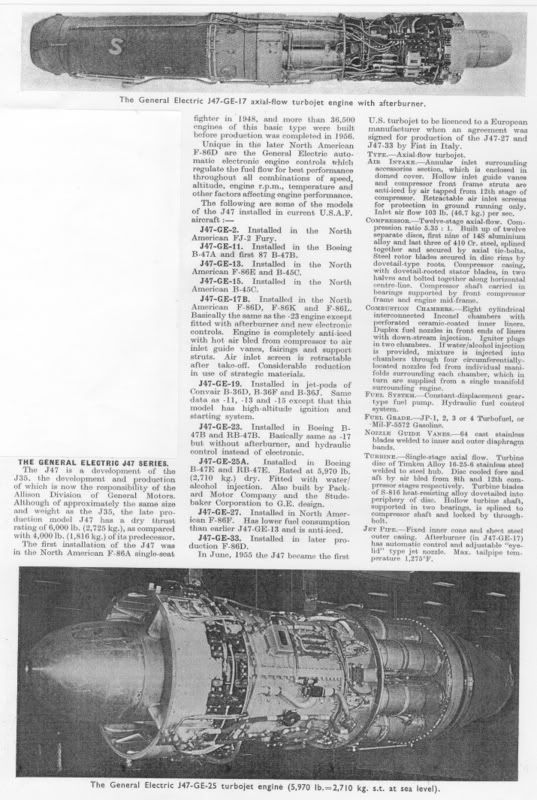
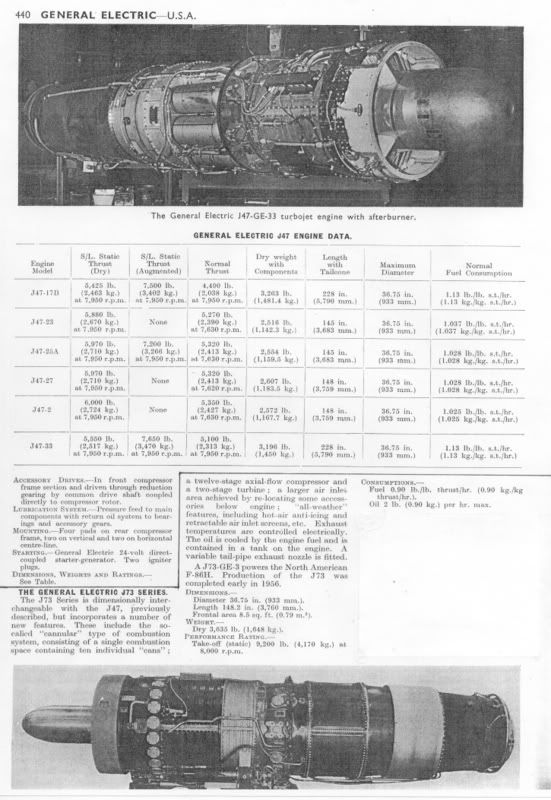
By: Fedaykin - 25th December 2007 at 12:59
Fedaykin,
According to the information in Bill Gunston’s ”The Development of Jet and Turbine Aero Engines”, I paraphrase:
The J47 has its roots in the TG-180 (to become the Allison J35), which first ran on the testbed on 21 April 1944. This engine had an 11-stage compressor handling 75 lb/s at a p.r. of 5, eight tubular chambers and a single-stage turbine, producing 4,000 lb thrust. It first flew in the XP-84, a single-engined fighter, on 28 February 1946.
The TG-180 was redesigned by General Electric to become the TG-190, which first ran on 21 June, 1947. This had a 12th compressor stage and as the J47 became by far the most important engine for the USAF. Studebaker and Packard helped to produce 36,500 of them by 1956. The biggest applications were in the B-47 and the F-86, thae latter in the afterburning version (F-86D and-K) providing 7,650 lb thrust.
Thanks for that Papa Lima, have a nice Christmas.
By: Papa Lima - 25th December 2007 at 12:27
Fedaykin,
According to the information in Bill Gunston’s ”The Development of Jet and Turbine Aero Engines”, I paraphrase:
The J47 has its roots in the TG-180 (to become the Allison J35), which first ran on the testbed on 21 April 1944. This engine had an 11-stage compressor handling 75 lb/s at a p.r. of 5, eight tubular chambers and a single-stage turbine, producing 4,000 lb thrust. It first flew in the XP-84, a single-engined fighter, on 28 February 1946.
The TG-180 was redesigned by General Electric to become the TG-190, which first ran on 21 June, 1947. This had a 12th compressor stage and as the J47 became by far the most important engine for the USAF. Studebaker and Packard helped to produce 36,500 of them by 1956. The biggest applications were in the B-47 and the F-86, thae latter in the afterburning version (F-86D and-K) providing 7,650 lb thrust.
By: Fedaykin - 25th December 2007 at 11:54
You are perfectly correct of course – my brain is in definite need of a refit memory wise. Thanks for the correction 🙂
I must admit the J-47 is one of those engines I have wanted to know about, any web info out there guys to fill the gap in my knowledge.
By: bazv - 24th December 2007 at 21:35
Little vignettes like that are always fun. OTOH the wreck of a MiG-15bis was found and lifted out of *North* Korea by UN special forces op in April 1951. The report detailing each piece points out a number of differences between its VK-1 and a Nene. Again the RD-45 was the Nene, pretty much period, the VK-1 less so.
Joe
Spot on Joe ,Klimov was talking about the RD45 version.
The VK1 was probably more akin to the RB44 Tay/J48 engine 😉
Cheers Baz
By: Malcolm McKay - 22nd December 2007 at 23:08
The F-86’s engine, the J-47, however had virtually no connection to the Nene. It was axial flow. The only connection to British technology at all was indirect through earlier pretty different GE engines of WWII. Joe
You are perfectly correct of course – my brain is in definite need of a refit memory wise. Thanks for the correction 🙂
By: JoeB - 22nd December 2007 at 16:33
In his autobiography Stephan A Mikoyan mentions that he asked Klimov what the difference was between his engine and the Nene,the answer he got was….
The Nameplate !!;)
Little vignettes like that are always fun. OTOH the wreck of a MiG-15bis was found and lifted out of *North* Korea by UN special forces op in April 1951. The report detailing each piece points out a number of differences between its VK-1 and a Nene. Again the RD-45 was the Nene, pretty much period, the VK-1 less so.
Joe
By: bazv - 22nd December 2007 at 06:10
In his autobiography Stephan A Mikoyan mentions that he asked Klimov what the difference was between his engine and the Nene,the answer he got was….
The Nameplate !!;)
By: JoeB - 22nd December 2007 at 01:58
Early in the Korean War the Soviets used the ‘regular’ MiG-15 with the RD-45 engine, slightly Sovietized Nene. For most of the war their air units used the MiG-15bis with the VK-1, a significantly Sovietized engine with their own bona fide improvements. Nonetheless they surely benefited from that engine/technology purchase.
The F-86’s engine, the J-47, however had virtually no connection to the Nene. It was axial flow. The only connection to British technology at all was indirect through earlier pretty different GE engines of WWII. The J-47 was apparently a less reliable engine than the VK-1, though reliable enough in general. But OTOH the slender profile it allowed in the F-86’s tail section, compared to the stubby shape of the MiG-15 to accomodate a centrifugal flow engine, was one reason that F-86’s could exceed Mach 1 in a dive (once control issues were dealt with, ie. F-86E’s and onward could routinely do so) and the MiG-15 firmly stopped out below the Mach. That was actually tactically signficant in Korea.
In contrast the J-42 used in most models of the Navy’s F9F, which also fought the MiG-15 in Korea, was a license built Nene.
Joe
By: Arabella-Cox - 14th December 2007 at 05:35
Regarding the original post I think you could argue both ways… without the nene and the derwent the Soviets still had jet engine technology and just would have had to work harder with their espionage to make up the lost ground… of course with getting the engines it shortened development time and of course led to aquiring manufacturing knowledge earlier allowing it to be applied earlier too.
I remember a story about how when they were offered a chance to view the new engines they were getting being made the Soviet delegation were given special shoes by the KGB… or NKVD I think they might have been called at that time, that had special soft soles and they were told to stand in the shavings of the tools in the workshop. The shoes were designed to catch shards and cuttings of metals and hold them. The results of this was that by the time the engines were delivered the Soviet engineers already knew about the metal alloys being used and were better prepared to start manufacture as quickly as possible.
Regarding the Meteor, it it had been a German plane it might have been more widely remembered because as an interceptor of bombers it would have been a very capable machine. Modifications to allow high altitude use would have made it an excellent anti bomber aircraft which might have made a significant difference. The shorter range of the jet less important in the interception role… just base them near the target and the other guys come to you.
As it was the only bomber threat the Brits faced when the Meteor was operational was the V-1s and the V-2s, and even a modern jet would have problems with V-2s though that could be changing too.
By: Malcolm McKay - 14th December 2007 at 02:50
The Bell X-5 was to all intents and purposes a beefed-up Messerschmitt 1101 with variable sweep thrown in.
The original was damaged somewhere betwixt Germany and America and although ground tested, was never flown.
Thanks – I forgot about the X-5 connection.
By: Scouse - 14th December 2007 at 01:19
the Me-1101 (built but not flown IIRC)
The Bell X-5 was to all intents and purposes a beefed-up Messerschmitt 1101 with variable sweep thrown in.
The original was damaged somewhere betwixt Germany and America and although ground tested, was never flown.
By: Oxcart - 14th December 2007 at 00:02
Just wanted to say that that incredible RAE test pilot, Eric Brown, says that he thinks the ‘262 was the most formidible aircraft of world war two- and, as he flew just about ALL of them, he is a position to know!!
By: Malcolm McKay - 13th December 2007 at 23:29
I certainly don’t believe any of the dubious claims that a Me262 exceeded Mach 1, and the Me163 was uncontrollable at Mach 0.84.
Quite right the Me262 could not have exceeded Mach 1 for the same reason as the XF-92 and the F-102 prototypes couldn’t – area rule.
So even if the Me262’s rather poor engines were replaced with better ones it still couldn’t have done it.
The Ta-183 (not built) and the Me-1101 (built but not flown IIRC) were true swept wing designs but I suspect even those would, at best, only got over Mach 1 in a dive like the early F86. And even then would have neeeded much better engines than were on offer.
By: XN923 - 13th December 2007 at 11:02
As I understand it – the Me262 wing was “swept” to correct CoG problems, not compressibilty. The 262 was in no way designed to approach high Mach numbers. Also the centre of lift (?) on the wing as we move towards the tip is not moved backwards relative to the leading edge as in a true swept wing.
So despite appearances the Me262 is not a swept swing as we see in the case of the F86. German swept wing research seems to have stayed in the wind tunnel the Me163 excepted, however it also had a swept wing for stability matters rather than hig Mach number problems.
I expect to get a pasting from the Luftwaffe ’46 fanatics, but yes, the swept wing on both the Me262 and the Me163 had nothing whatsoever to do with delaying the onset of compressibility. In the case of the former, the Jumo jet engines were heavier than expected, which meant the wings had to be swept to rectify the c/g. The Me 163… well, have you ever seen a tailless aircraft with straight wings? The sweep gives an equivalent effect to dihedral, and obviously allows the elevators to be behind the c/p where they need to be to allow the aircraft to rotate around its axis. The amount of wing twist and the l/e slots on the Me163 are not conducive to transonic flight. I certainly don’t believe any of the dubious claims that a Me262 exceeded Mach 1, and the Me163 was uncontrollable at Mach 0.84.
However, to give due credit to German engineers, they soon spotted the high speed potential of the configuration they had accidentally discovered and started designing types like the Messerschmitt P.1011 and Focke-Wulf Ta183 which were ‘true’ swept wing designs. IIRC the F-86 wing owed rather a lot to the (built) P.1011 while the MiG-15 drew heavily from the (unbuilt) Ta183.
Although the Meteor was outclassed by the F-86 and MiG-15 by the time of Korea, it was still developed to quite a degree – 600mph+. I believe that if the F.4 had ever met the Me262 in combat the two would have been very closely matched.
By: RPSmith - 13th December 2007 at 10:56
As did they did with Short Sunderland, IIRC….. 😀
Ken
and, before that, the Tiger….:D
Roger Smith.
By: Flanker_man - 13th December 2007 at 09:31
That’s correct. The wings were swept as a late in process action to rectify c-of-g problems. It was much easier to do this than redesign the whole thing.
As did they did with Short Sunderland, IIRC….. 😀
Ken
By: Entropy - 13th December 2007 at 03:04
So what about the infamous snooker game that opened the door for the sale?
By: flyernzl - 13th December 2007 at 02:55
I’m not sure the Meteor F.1 should be considered an “also-ran”? It is a true WW2 operational aircraft, and rarely gets credit for this. It did well at the role that was assigned to it in the closing stages of WW2.
It is generally forgotten that all these early jets had a remarkably short endurance due to very high fuel consumption. For the F.1 Meteor, 60 minutes. Enough for a 50 minute sortie plus a go-around if you stuffed up the landing when arriving home.
This meant that for the Meteor to be effective in actual combat, it would have needed to be based in Europe rather than the UK. Political and security reasons were against this. Hence no operational karma.
The Germans did not have this problem, they were at the front line on take-off.
(Thread creep, I know).


 Sign In








 December 11, 2007 at 7:38 pm