Hi all,
my first post on here, with all the news at the moment about the current USAF tanker competition, I read that the KC-135 did not actually win the original competition back in 1955, but in fact a Lockheed design won the day, but due to the fact that the Boeing design could be delivered earlier, it got put into service.
Does anyone know any details about the ‘succesful’ Lockheed design?

By: Bager1968 - 19th March 2008 at 19:00
The CL-321 would indeed be hard to up-engine… but the CL-291 much easier, with those pylon-mounted twin engine pods.
I notice the CL-291 seems to be an early version of what became the C-141?
The C-141 competition was issued in 1960… 5 years after Lockheed “won” the tanker competition.

By: J Boyle - 19th March 2008 at 18:21
Blimey we’re getting perdantic here….
Thanks for noticing!
There was recently a post about KB-50s that seemed to show a lot of forum members were condused about it’s history. Just trying to be clear.:D
By: pagen01 - 19th March 2008 at 18:10
Blimey we’re getting perdantic here, It was developed on the KB-29, versions of it was used on the KB-29 / 50 and KC-97 and now on the KC-135.
What I was bringing up was the suggestion that as Boeing had a refuelling system and a suitable platform ready ahead of Lockheed, that is why they got the contract.
By: J Boyle - 19th March 2008 at 17:59
It was developed and used on the KB-29 / 50.
Early KB-29s used the early UK-developed-hose/grapple.
The boom came later.
The KC-97 predates the KB-50.
When the KC-97 was being developed, B-50s were stil being used in the bomber role. The tanker conversions came later, after the B-50s were no longer needed as bombers.
By: pagen01 - 19th March 2008 at 17:50
It was developed and used on the KB-29 / 50.
By: J Boyle - 19th March 2008 at 17:20
I read somewhere (desperatly trying to remember source) that the fact that Boeing devised and could put into service it’s own refuelling gear quickly also resulted in them altimately receiving the entire 135 (inc the Cargo A/C) contract.
Boeing developed the “flying” boom system for its KC-97 series in the early 50s.
By: pagen01 - 19th March 2008 at 17:10
I read somewhere (desperatly trying to remember source) that the fact that Boeing devised and could put into service it’s own refuelling gear quickly also resulted in them altimately receiving the entire 135 (inc the Cargo A/C) contract.
By: Arabella-Cox - 19th March 2008 at 16:44
Thanks for that, really fascinating stuff, if it had won, maybe we could have seen these round the worlds airports!
By: Bager1968 - 18th March 2008 at 22:54
I’ve seen a drawing of the Lockheed proposal, looks like a smaller 135 or a Convair 880.
Ummm, no it doesn’t!
The Lockheed proposal (which won the competition) was a larger aircraft, with a higher fuel load capability, and with 4 x J75 engines (~50% more powerful than the KC-135’s original engines) in aft-mounted twin-engine pods blended into the underside of the wings.
The first version: CL-291-1: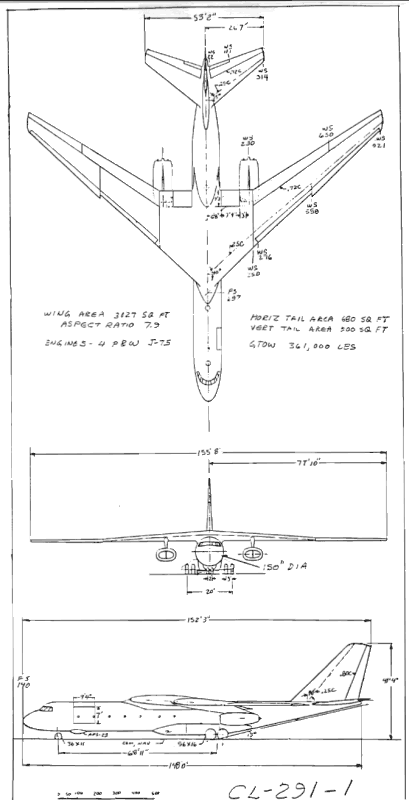
Final version: CL-321-11: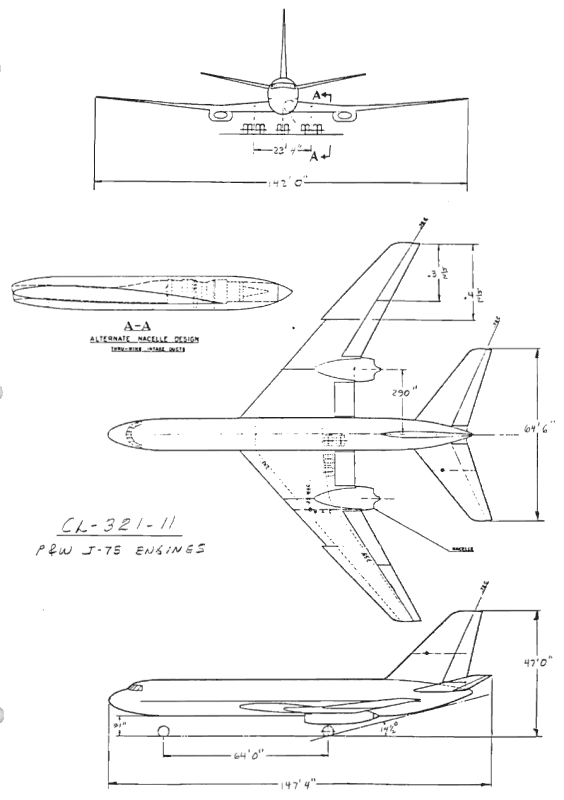
http://www.americanheritage.com/articles/magazine/it/2004/4/2004_4_10.shtml
(article on the history of aerial refueling)
“On March 26, 1952, Boeing’s president, Bill Allen sent a memo to his division heads, asking if they thought they could fly a prototype jet transport in just two years. Jim Barton in Boeing’s cost-accounting group said it would cost $13 to $15 million. On April 22 Boeing’s board of directors unanimously approved $15 million for Project X, or the Model 367-80, better known as the Dash-80. This project posed an enormous risk, for the military had not described the specific performance details that it wanted, and the $15 million investment represented more than twice Boeing’s profits from 1951. Although the plane had civilian uses as well, if the Dash-80 failed as a tanker, Boeing could fail too.
At SAC’s Requirements Conference in November 1953, General LeMay called for 200 jet tankers. The Air Force announced a design competition for a jet tanker on May 5, 1954, and invited Boeing, Convair, Douglas, Fairchild, Lock—heed, and Martin to participate. At that point Boeing’s leaders could only forge ahead with the Dash-80, which had its first successful flight test on July 15, and pray that it would win the competition.
On August 3, 1954, with the jet-tanker design competition still in progress, the Air Force decided to buy interim tankers. The Air Force Secretary, Harold E. Talbott, announced an order to buy 29 tankers from Boeing. Less than two weeks later the Air Force said it would buy 88 more Boeing tankers. It looked as if Boeing was set to win the competition, but it didn’t.
In February 1955 the Air Force announced that Lockheed had won the competition and at least one of its tankers would be funded for construction. In the very same announcement, however, Talbott said the Air Force would buy an additional 169 tankers from Boeing. Eventually it canceled Lockheed’s paper proposal.”
KC-135 engines: JT3s (civilian J57, 10,000 lb.s.t. [later 12,000-14,000 with water injection, then 17,000 lb.s.t. TF33 {turbofan J57} after 1960])
CL-291/321’s engines: J75 (15,000-17,000 lb.s.t.) (perhaps later the 21,000 lb.s.t. TF33 developments?).
KC-135:
Wingspan: 130 feet, 10 inches (39.88 meters)
Length: 136 feet, 3 inches (41.53 meters)
Height: 41 feet, 8 inches (12.7 meters)
CL-321-11:
Wingspan: 142 feet, 0 inches (43.28 meters)
Length: 147 feet, 4 inches (44.91 meters)
Height: 47 feet, 0 inches (14.33 meters)
By: J Boyle - 18th March 2008 at 16:52
Yes, that’s basically correct.
The Boeing funded 367-80 prototype meant Boeing could deliver aircraft years ahead of Lockheed and the story goes that Curtis LeMay didn’t want to wait. SAC was taking delivery of B-52s and still had 1500 (or so) B-47s in the fleet.
I seem to recall a story on this topic years ago in some publication.
I’ve seen a drawing of the Lockheed proposal, looks like a smaller 135 or a Convair 880. Okay, maybe not….it was awhile ago..:)
After looking at the drawing, it looks like the USAF made the right decision, I don’t think they could have been modified with modern engines like the CFM56 on the KC-135R.


 Sign In








 March 18, 2008 at 4:38 pm