First post on this forum.
I’m currently undertaking a major research project about how fighter pilots in World War One gained their heroic reputations. A necessary element of this research is getting to grips with the ‘Knights of the Air’ mythology – the notion that fighter pilots were the new generation of knights, upholding 19th century ideas of heroism and chivalry in war.
Trouble is, there isn’t a massive amount of detail out there (that I can find at least) about this ‘Knights of the Air’ idea. So I’m asking here whether anybody knows of any literature out there which specifically deals with this particular concept.
Any suggestions, help. comments and ideas much appreciated.

By: Malcolm McKay - 24th November 2006 at 11:26
Interesting indeed James and XN923. I think that it is true that chivalry in the idealised though probably, in actuality, non-existent medieval tradition did not exist in the WW1 air combats. That is a clumsy sentence but what I am saying that much of the chivalry of the Medieval period which involved letting a beaten opponent live was due in reality to the fact that as hostages they were worth a lot of money. Ransom payments funded many an extension to the manor.
The WW1 airmen lived a life so utterly apart, in combat terms, from the foot sloggers in the trenches and their individual combats may have seemed for fleeting moments for those in the meat grinder to be somehow preferable. Yet a bullet in the head is a bullet in the head whether it’s from a pilot or a muddy scared infantryman.
To me the Germans seem to have engrained the mythic element of knightly combat into their military philosophy to a much greater extent than most with the possible exception of the French. And it is apparent that this ethic survived into the WW2 Luftwaffe. XN923 cites the status accorded the Experten, and this status is unparalleled in the Allied forces. But the price was heavy because by creating those mythic warriors they also created a system where the very best had no respite other than death or incapacitation from constant combat.
The Allies were much more pedestrian and rotated pilots out of combat so that they could instruct or put their leadership skills to tactical and strategic use. In Germany in WW2 the leadership was striving to recreate the myth of the Teutonic Knight – the knights who had first come to prominence in the expansion into the pagan parts of Eastern Europe and from which the Prussian national identity grew. A knight cannot retire he is always on a quest or he ceases to be that mythic figure – for want of a better example its like the man of La Mancha Don Quixote. The quest is always there but in the end no Knight can be immortal.
This creation of a myth was necessary to legitimise what was essentially a working class right wing party that had taken over from the WW1 and pre-WW1 aristocratic German leadership.
But that is a digression. Like James, I see precious little of the myth of knightly behaviour in WW1 air combat. Lanoe Hawker was killed after he had run out of ammunition and was trying to escape. In the Medieval period he would have possibly been captured and held for ransom, but that is not an option in the air. Also the reality was that an enemy who survives and escapes will come back to try and kill you.
A very interesting discussion.
By: XN923 - 24th November 2006 at 10:28
Interesting discussion. We’ve covered chivalry (or lack thereof) and Malcolm also mentioned the ‘warrior’ tradition. I think there’s also a sense of this, or the individual ‘champion’ in air war (particularly in the first war) which allowed easy comparisons with knights. The fact that, rather than the industrialised slaughter of the surface war (land and sea), there was the possibility for (relatively) ‘clean’ one-on-one combat makes the comparison with knights easy, and that’s followed by all the attendant stuff. It’s easier to identify ‘heroes’ (people who win VCs in the land war are generally dead before they become famous and it’s hard for the newspapers to follow the fortunes of a corpse) and not being able to see the faces of the enemies who butcher your compatriots makes it less personal.
What’s equally interesting is the way this was protrayed. According to some sources, the German government played on creating individual heroes while the British command refrained from it, and it was left to the newspapers to give the people what they wanted. The whole culture of giving medals for achievement was different as well (the British tend to give medals for conspicuous heroism usually in the face of overwhelming odds and often pointless sacrifice) so the Germans seemed to have played up the ‘knights’ comparison while the British emphasised the ‘team’. This is also true in the BofB when the ‘experten’ went jousting round the skies trying to beat the scores of their rivals accompanied by bands of ‘squires’ who were purely to keep the enemy off the back of the lords.
By: JDK - 24th November 2006 at 10:03
Dear Malcolm,
Thanks for answering my question and XN923 and yourself for expanding it. You’ve made a couple of points I’d not thought of, and I’m in agreement, too.
… the “knight” ethic…. defined around a combination of virtues – recognition of the weakest and their protection, sacrifice to a higher ideal (the Morte d’Arthur epic, or the traditions as depicted by the Wagnerian Seigfried idyll seem to be the best parallel. The Grail legends also fit in this) and recognition of the other “civilised” cultural aspects of human society. As an example the troubador tradition in middle and late Medieval society.
Few if any WW1 “Knights of the Air” seem to me to fit within the second group. I feel that we are in fact dealing with a more basic warrior tradition than the complex Medieval tradition of the knight.
I’d agree with that; but I think a lot of it is down to action and it’s reporting – two different things. One basic point is that what mediaeval knights actually did, as against what the Mort d’Arthur formalised and publicised. The cynic in me believes that the there was little real ‘chivalry’ then and rather like today we know that what politicians say and do is utterly disconnected, and the noise made by them and the media has no relation to reality – it’s so well known, and obvious (to us, but not to our descendants, hence) it’s barely worth comment. Likewise the knights and serfs would have nodded at the Morte but known it had nothing to with how knights actually behaved. The problem is we take the written evidence (history) over the facts we discover by analysis and raw material.
To come back to the topic, the stories and reporting of the behaviour of the airmen of W.W.I were always partial – at the time and subsequently, and while we delude ourselves that we have a stripped back unflinching ‘real’ view of what ‘actually happened’ it’s still only a version, and partial.
It’s a rough thesis, and very generalist.
Chivalry in the air never existed – there’s no evidence. Oh, sure, some poor *******s were let off the hook when they could have been killed, and breaching certain conventions was rare (I’m thinking of ammunition types and authorisations, wearing false colours, etc.) but that does not make a code of honour. Anyone working to such a code was killed, and quickly, just like a politician’s political suicide by doing what he (or she) says they’ll do, or a mediaeval knight trusting to another knight’s chivalry.
By: Malcolm McKay - 24th November 2006 at 08:44
I might add to my previous post that there is a clear distinction between the “warrior” ethic and the “knight” ethic. The first seems to be more basic in fighting terms in that it is defined by what one might loosely call the greatest numbers of victories.
To me the second is defined around a combination of virtues – recognition of the weakest and their protection, sacrifice to a higher ideal (the Morte d’Arthur epic, or the traditions as depicted by the Wagnerian Seigfried idyll seem to be the best parallel. The Grail legends also fit in this) and recognition of the other “civilised” cultural aspects of human society. As an example the troubador tradition in middle and late Medieval society.
Few if any WW1 “Knights of the Air” seem to me to fit within the second group. I feel that we are in fact dealing with a more basic warrior tradition than the complex Medieval tradition of the knight.
It was important for the propagandists on both sides in WW1 to select some point which seemed cleaner and more honourable in European traditions than being blown to atoms in the mud and as the aviators flew so far above this reality then they were the perfect example. Couple this with the one to one combat and a legend is developed, however despite that attempt by the propagandists the reality of the published material is that it was actual scores that counted not the other ideals of the knight tradition.
By: Malcolm McKay - 23rd November 2006 at 11:54
Excellent post Malcolm, not much to disagree with. And yet… and yet… there seem to be some characteristics of the scout pilots of the first world war that make the ‘knights’ analogy easier to apply, if not entirely appropriate. For example, many RFC pilots claimed to feel no animosity to the Germans (though some certainly did) and even felt an affinity with them because they were also airmen. Many of the worst horrors of the Western Front were not immediately apparent to the aircrews so this undoubtedly allowed RFC men the luxury of not needing to hate their adversaries. There are also stories that reinforce the ‘affinity’ idea even between adversaries who were fighting to the death. Von Richtofen reported that as he was locked in a turning battle with Lanoe Hawker, the two men gaily waved at each other (neither could bring their guns to bear and all they could do was try to hold the turn. Eventually, running out of altitude and fuel, Hawker had to make a bolt for the lines and Von Richtofen used his Albatros’ superior speed to chase down Hawker’s DH2 and shoot him down). Admittedly, MVR’s ‘honouring’ of his foes often took the form of rather grisly trophy hunting. It’s a fascinating mixture of cold ruthlessness and respect for one’s enemy’s humanity.
Well it was a very condensed history and that tends to leave out one essential thing of the human condition and that is that we do, even in mortal combat, have the capacity to recognise the humanity of others, or their bravery. Of course that is not always the case more’s the pity. We are also capable of horrific cruelty and inhumanity – but that also is a product of a myth creation process.
For example how else are we conditioned to commit acts of genocide e.g. extermination of Jews, or Ruandans etc. except by demonising them so that they lose their humanity. War invokes a complex psychological process in us and demogogues and dictators like Hitler and Stalin are masters at conditioning their subjects to abandon their humanity.
The knightly spirit is a way to sanitise the killing act while the operation of a gas chamber is another. Both achieve the same end but we view them as diametrically opposed. We are complex creatures and yet it is our humanity that causes this strange dichotomy in our rational process. Both extremes are seen as “good” yet both in the end are the same.
By: XN923 - 23rd November 2006 at 11:42
Excellent post Malcolm, not much to disagree with. And yet… and yet… there seem to be some characteristics of the scout pilots of the first world war that make the ‘knights’ analogy easier to apply, if not entirely appropriate. For example, many RFC pilots claimed to feel no animosity to the Germans (though some certainly did) and even felt an affinity with them because they were also airmen. Many of the worst horrors of the Western Front were not immediately apparent to the aircrews so this undoubtedly allowed RFC men the luxury of not needing to hate their adversaries. There are also stories that reinforce the ‘affinity’ idea even between adversaries who were fighting to the death. Von Richtofen reported that as he was locked in a turning battle with Lanoe Hawker, the two men gaily waved at each other (neither could bring their guns to bear and all they could do was try to hold the turn. Eventually, running out of altitude and fuel, Hawker had to make a bolt for the lines and Von Richtofen used his Albatros’ superior speed to chase down Hawker’s DH2 and shoot him down). Admittedly, MVR’s ‘honouring’ of his foes often took the form of rather grisly trophy hunting. It’s a fascinating mixture of cold ruthlessness and respect for one’s enemy’s humanity.
By: Malcolm McKay - 23rd November 2006 at 10:19
Care to expand on that? Do you refer to ‘the age of chivalry’, or W.W.I?
Love to.
The “Age of Chivalry” which is basically the middle to late Middle Ages was a period of colonial expansion into eastern Europe. This was a period when the central part of Europe were becoming over populated and the land owning nobility had to find the means of settling their male children on new land. Remember that the tradition of primogeniture meant that apart from the eldest son and heir there was no place on the family estate for the rest of the males.
It was the younger siblings who had to carve out (pardon the pun) new estates in either unsettled land or in non-Christian areas which in that period, prior to the expansion into the Americas only existed in Eastern Europe or in the Holy Lands.
The “knightly ethic” was basically a church backed philosphy which enabled people to conquer new land and people without incurring the eternal punishment that killing fellow Christians would incur in Medieval Christian theology. I know this is a bit condensed but I think the basic meaning is clear.
The romanticising of the ethic by people like Chretien de Troyes with the Grail epic created a body of literature which turned simple conquest into a sort of religious and spiritual quest. So we see the birth of the ‘parfait knighte’. Before that trend conquest was conquest along the lines of the Roman expansion. The Church and its adherents needed some assurance that their mortal deeds would not result in some form of eternal punishment. Hence the dispensation for Crusaders. The first crusades as such were actually into Eastern Europe.
The reality of war and the pragmatism of the Renaissance magnates killed off the noble quest business but in popular literature it became enshrined until in the 19th Century with the colonial expansion of Europe it once again became a guiding ethic for younger siblings needing new land to farm.
Come WW1 the reality of war was so horrific that a new breed of knight, in this case aerial aces had to be created to somehow convince an increasingly sceptical civilian population that war was fun – not just a meat grinder.
Very condensed I admit but I hope you see my drift.
By: JDK - 23rd November 2006 at 09:48
The “knightly myth” was invented as a means to make it palatable to the squeamish civilians.
Care to expand on that? Do you refer to ‘the age of chivalry’, or W.W.I?
By: Malcolm McKay - 23rd November 2006 at 09:47
This book http://www.amazon.co.uk/Brief-History-Royal-Flying-Histories/dp/1841194700/sr=8-3/qid=1164274063/ref=sr_1_3/026-5310586-4078044?ie=UTF8&s=books has a few things to say about the different attitudes of Germany and Britain on the cult of the ‘Ace’ and the new knights – in a nutshell, the British Army wasn’t so keen on it (eventually bowing to popular newspaper creation of indiividual heroes) while the Germans seemed to encourage it. Stephen Bungay also discusses how the first war values were reflected in the Battle of Britain in ‘The Most Dangerous Enemy’ – more on individual ‘champions’ rather than fighter aces being ‘verray, parfit, gentil knights’. In essence, not so different from the Middle Ages then where the ‘knightly ideal’ had more to do with literature then reality…
Knightly reality was, in any age, being carved up or shredded painfully and fatally with whatever the best weapon to hand was. In a fight you either survive or die, so you use whatever skill or equipment advantage you have to win.
Just because you are flying an aeroplane, riding a horse, sailing a ship, sitting in a tank or just plain walking and carrying a rifle all these are, in reality, only a means to bring the instrument of execution to your opponent and none alter the ethics of the bloody business in any way.
The “knightly myth” was invented as a means to make it palatable to the squeamish civilians.
By: XN923 - 23rd November 2006 at 09:30
This book http://www.amazon.co.uk/Brief-History-Royal-Flying-Histories/dp/1841194700/sr=8-3/qid=1164274063/ref=sr_1_3/026-5310586-4078044?ie=UTF8&s=books has a few things to say about the different attitudes of Germany and Britain on the cult of the ‘Ace’ and the new knights – in a nutshell, the British Army wasn’t so keen on it (eventually bowing to popular newspaper creation of indiividual heroes) while the Germans seemed to encourage it. Stephen Bungay also discusses how the first war values were reflected in the Battle of Britain in ‘The Most Dangerous Enemy’ – more on individual ‘champions’ rather than fighter aces being ‘verray, parfit, gentil knights’. In essence, not so different from the Middle Ages then where the ‘knightly ideal’ had more to do with literature then reality…
By: QldSpitty - 23rd November 2006 at 07:51
Thing I was getting at was the code was an unwritten one.Certainly it wasn,t used as a must have bit of information that every pilot had to use every time he got in the air.The first part of my post stated the idea of romance in the air combat and how in real life that differed.Same as how fighter pilots were viewed as knights glorious and honorary but in real life some were cold blooded killers.Maybe at the begining there was a period of sanity where quarter was given but soon it was no holds barred.Kill or be killed.BVR was the best as he knew how to hunt.Sneak up behind someone and give him what for when he wasn,t looking.Noble,no but effective.He could dogfight as well as he learnt his trade from the best.His airmanship was great and had masterful control of his aircraft.He was who he was and thrived on it,well until his ego outdid his common sence. But in War it came down to the individual.Did a pilot chose to be merciful when a stricken fighter came into his sights,or did he unleash hell.Always it will come down to choice.Was there a fire on board and the pilot trapped?Did the kill save him from a slow agonising death or is it viewed as bloodthirsty.Moral dilemma or human nature.
By: mike currill - 22nd November 2006 at 19:32
Eagerly awaited future reading. What are you messing about at? Get on with it. 😀
By: EGCD - 22nd November 2006 at 13:56
Thanks for all the responses and the emergence of a debate.
However, you need to be very careful reading ANYTHING about von Richthofen as there is a LOT of rubbish out there written about him. ***
I’m well aware of the blurring between illusions and realities. That really is the point of my research – trying to unpick the differences between the realities and myths.
Are you sure the ‘Knights of the Air’ mythology was related to 19th century ideas? I would think it went further back
That’s what I’ll explain in my research which, hopefully, will be published. 😉
By: STORMBIRD262 - 22nd November 2006 at 12:37
Oh here we go again, the whinging pom thought POLICE have arrived yet again!
CARRRRRNNNN THE AUSSIE”S!!!!!!!!!!!!!!!!!!
LET STICK IT UP THESES POMPOUS POM’S!!!!!!!!!!!!
By: STORMBIRD262 - 22nd November 2006 at 12:34
HAAAA HAAAA OOOOOHHH AHHHH WHOOP”S!!!!!!!!!!!!!!!
Good one Andy mate! 😀
I just got he and nearly pisssed me self 😮 ,
and NOT from the Usual M.S. Cr@p!!!! well some of it just maybe TOO!!!
I have just started the book, seem’s not to bad!
BUT like all thing’s written and concieved by Human’s in the last 10,000 year’s :rolleyes: .
I take no notice of all the Human self made and invented, human ego boosting CLAPTRAP!!!
After all MAN did invent the GOD’S in his Image Hey! :rolleyes:
The Holeyer then Hell :diablo: book of bullllllsh*t a perfect example!!! of THAT!
MAN!!! they should have had Dr Joseph
PACK UP YOUR GOEBBELS IN YOU OLD KIT BAG back in dem Dark day’s the dude would have been as happy as a pig in sh#t,
with the job of dazzeling all those, WONTING to be part of the truth, the light and the way! :rolleyes:
Resistance IS futile, all you silly sheep VIL be Assimilated(got the ass part pretty right HEY! 😀 ).
Nic Nic, Do we have a BWIAN HERE!
Door on the left, ONE cross only, DON”T BE CREEDY YOU WILL GO TO HELL!
WELL the made up concept of it anyway 🙂 ,
NOT THE SPANISH INQUISITION!!!!!!!!!!!!!!!!!!!! 😮
Ciao for now, I’m back off to the book’s!
Been as sick as a HUMAN! 😉 ,
Spent 4 day’s last week in the Royal Melb Hospital, Got pumped full of the super Juice Metho Pred for the misbehaving M.S.
Felt like a very Spaced out Superman while the tap was in me arm!! 😎
Biggest Bummer was Spending 3 hour’s straight in the old M.R.I. coffin AGAIN! not being able to move a Inch!!!!!!!! and in massive pain the last 2 hour’s of it! 😡
what a FUN time I had!!!!!!!!!!
High light’s PAY TV 24/7 😀 😎 ,
I was watching History chan and Nat Geo non stop. 😮
(MEGA AIRCRAFT STUFF now fan of Hely CH-101),
and me celly was an old Italian called John 80+ a ex WW2 vet, who even joined the frog’s resistance, the naughty M boy’s.
He’s as sharp as an axe, and read’s 4 new’s paper a day!
Woo Hoo some very nice and young nurse’s looked after my every need! Well almost!!!!! 😉
But I really do think I upset a lot of the dirty rotten shirt lifter’s and mini me Elton John’s that littered the nice place :rolleyes: ,
they are all convinced that playing for both team’s, was way cool and that they are not pooof’s 😮
Well let’s say I STRAIGHTENEMED(No pun) THEM UP A BIT ON THAT SCORE! 😀
Seem’s I come across a little Abrazive.
,
When I call em all POOOF”S for some reason.
WELL JUST WHAT THE HELL ARE THEY THEN!!!!!
Well I did change it to Malvenstar’s for just a few of EM! 🙂
I did make A effort to be civil!
I must now crash, before I really Crash!
” Gut Nacht ” Goodmorning, goodafternoon whatever!!!
I’m off like a smeelly sock!!!
Oooo Roo from Oz!
By: 25deg south - 22nd November 2006 at 12:00
Have we totally discounted the possibility that the “rules” changed as the air war evolved?
By: Andy in Beds - 22nd November 2006 at 11:50
There was a fighting code of sorts.No strafing a downed enemy plane,give quarter if asked ,mercy if needed and fight hard always.Richtoffen is painted as the perfect hunter,skilled and calculating but in real life was he?He was certainly smart enough to fight on his terms,usually finding weaker opponents,avoiding dogfights etc.Anyone know of other tales and missed myths?
I think that’s more or less rubbish.
Voss who for reasons unknown has been painted as the perfect aerial knight who died fighting odds of seven to one in a dual that has become legendary. Sadly, he was also in the habit of strafing the wrecks of aircraft he downed and is on record as killing the occupants of them too–even though they were down on his side of the lines.
Manfred von Richthofen on the other hand has been oft painted as the ruthless slaughterer of innocent British two seaters and has at times been vilified. What a crock, that’s exactly what he was being paid to do!!!
A.
By: VoyTech - 22nd November 2006 at 11:31
A necessary element of this research is getting to grips with the ‘Knights of the Air’ mythology – the notion that fighter pilots were the new generation of knights, upholding 19th century ideas of heroism and chivalry in war.
Are you sure the ‘Knights of the Air’ mythology was related to 19th century ideas? I would think it went further back.
I guess one aspect of the ‘chivalrous knights’ idea (on either side of the front line) was to accept that their opponents were as ‘knightly’. A real ‘knight’ would not fight chivalrously against an enemy who was not a gentleman, would he? That is probably why there wasn’t too much of this kind of mythology in WW2.
By: JDK - 22nd November 2006 at 11:29
What’s all red and go sputter sputter kerplonk? 🙂
Newspaper circulation figures?
By: Malcolm McKay - 22nd November 2006 at 11:23
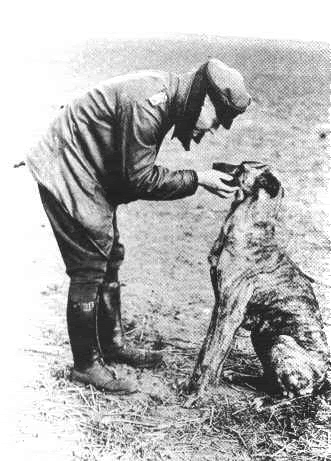
Moritz definitely had no complex about being short!
As you see, Manfred is subjecting Moritz to a very violent tickle, the sort that would send any dog mad enough to go out in the midday sun.
Manfred is not actually that short, he is bending down. Moritz IS that big. He was part Irish Wolfhound and after V R’s death he went to live with another squadron member, survived the war and lived to a very good doggy age. (all go “Ahh”)
So if Moritz got really pissed off Manfred would then have a real dogfight 😀
Alright alright I’ll stop the Manfred von Richthofen jokes apart from one last –
What’s all red and go sputter sputter kerplonk? 🙂


 Sign In








 November 21, 2006 at 1:43 pm