Can anyone who has a good knowledge of Soviet navy comment on the anti-ship capabilities of these ships in the late cold war era ( 80s)
Kresta II
Kara
Udaloy I ( early versions before 1990)
They deployed this missile
https://en.wikipedia.org/wiki/Metel_Anti-Ship_Complex
Not sure if these ships would be able to have any anti-ship capabilities like from their torpedoes ( 533 mm) or other missiles ?
Some soviet naval SAM supposedly had dual anti-air and anti-ship capabilities

By: El_Indigo - 27th October 2015 at 18:54
Really just 25nm ? I thought it was 60nm range of RGM84A
With mid-course correction and dumping of it’s payload. Rastrub’s range was/is 90 km same as the RGM-84A
By: nastle - 6th October 2015 at 22:55
Nah, just in the initial study….
The Harpoon missile is powered by a Teledyne/CAE J402 turbojet in an A/B44G-1 propulsion section, giving it a maximum range of about 185 km (100 nm) for the air-launched version. For surface launches, RGM/UGM-84 variants use a solid-fueled rocket booster in an A/B44G-2 or -3 booster section, which is discarded after burn-out. Maximum range for surface launches is around 140 km (75 nm). After launch, the missile is guided towards the target location as determined by the launching aircraft or ship by a three-axis Attitude Reference Assembly (ATA) in an AN/DSQ-44 guidance section. The ATA is less accurate than a full-fledged inertial system, but good enough for Harpoon’s range
But here it says its 75nm…im so confused
By: Jinan - 1st October 2015 at 23:49
Really just 25nm ? I thought it was 60nm range of RGM84A
Nah, just in the initial study….
In 1965 the U.S. Navy began studies for a missile in the 45 km (25 nm) range class for use against surfaced submarines. The name Harpoon was assigned to the project (i.e. a harpoon to kill “whales”, a naval slang term for submarines). After the sinking of the Isreali destroyer Eilat in 1967 by Soviet-built anti-ship missiles, the U.S. Navy saw the need to develop a dedicated anti-shipping missile, and therefore Harpoon’s primary mission became surface ship attack. The development project was formally begun in 1968, and the missile designator ZAGM-84A was allocated in 1970 after the Navy had issued a formal RFP (Request For Proposals). In June 1971, McDonnell Douglas was awarded the prime contract for Harpoon, and the first test missile flew in October 1972. By that time it had already been decided to develop air-launched, ship-launched and submarine-launched Harpoon variants, designated AGM-84A, RGM-84A and UGM-84A, respectively. Because the range requirement was increased to 90 km (50 nm), turbojet propulsion was selected by McDonnell Douglas. Production of the Harpoon began in 1975, and the first version to enter service was the shipborne RGM-84A in 1977, followed by the AGM-84A on P-3 aircraft in 1979. The UGM-84A became operational on attack submarines in 1981. There are also unarmed training versions of the AGM/RGM/UGM-84A, designated ATM-84A, RTM-84A and UTM-84A.
By: nastle - 12th September 2015 at 15:53
???
Specifically designed to counter the USN, Soviet Navy was devised with its advantage on sole task of eliminating vessels.
Do you know a man by Hyman G. Rickover?
The admiral ? not much about him why ?
By: nastle - 12th September 2015 at 15:52
The first Harpoon RGM-84A had the same range as Rastrub. Granted Rastrub had to have mid-course correction to be practical at it’s max range.
Really just 25nm ? I thought it was 60nm range of RGM84A
By: El_Indigo - 11th September 2015 at 02:11
^ Awesome pic
How will a SSN-14 Rastrub armed ship fare against a Harpoon armed ship though?
As the Harpoon armed ship has the advantage of a longer range, what can the Rastrub armed ship do to survive.
The first Harpoon RGM-84A had the same range as Rastrub. Granted Rastrub had to have mid-course correction to be practical at it’s max range.
By: Glyph - 10th September 2015 at 00:22
Thanks for replying
I forgot to check it myself ! Now forgive for this generalization but I think ( and correct me if I’m wrong ) soviet navy even at its height of the cold war in the mid 80s was a capable force able to counter maybe the combined strength of Japanese/ Turkish/ non-US NATO navies in the Baltic/Barents/Black and Pacific fleet but was never capable enough to beat the USN SAG/CV.(This comparison obviously does not extend to the SLBM from SSBNs)
The anti-ship capabilities of the SSGn/SSN/AV-MF bombers and the “Large rocket ships” of the SOviet navy must have been a huge threat to the Cruisers/Destroyers and frigates of the smaller navies but in time of war could have been easily defeated by 4- 5 carrier battle groups of the USN
???
Specifically designed to counter the USN, Soviet Navy was devised with its advantage on sole task of eliminating vessels.
Do you know a man by Hyman G. Rickover?
By: nastle - 10th September 2015 at 00:12
Apologies Nastle not got a lot of time for this site these days!
Last question first….the P-20 Termit did have an IR seeker variant, but, the harbour attacks in Karachi I believe were executed with the ARH version. This was a fairly simple weapon that was set, manually before launch, with a height and a seeker activation time. It was then fired on bearing to target. As I understand it some of the first targets hit in the harbour were some large POL storage tanks….which would fit as being the biggest RF contrast target in FoV on seeker-activation.
Tom Clancy’s vampires in Red Storm Rising have set an assumed pattern for how ‘SeaAir84’ would’ve played out. That wasnt the fight the RN was expecting to find in the Atlantic basin and on transit though. Principle striking arm was always the subs SSGN’s, SSN’s and SS’s in large numbers…small numbers (surface-launched) of large, fast ‘hi-diving’ missiles were the primary concern. The variables are impossible to calculate as they vary with the starting criteria…from which its possible to stack the deck in either direction. My view is that SOSUS and the GIUK choke gave NATO a ‘home field’ advantage that wouldve been hard to beat without some very creative tactics. There were clearly creative thinkers in the Soviet Navy though. This glosses over the key point also though that its also impossible to look at solely the naval arena as if it were divorced from the AirLand campaign. For example Soviet Long Range Aviation would have had to be tasked with interdicting Kinloss, Lossiemouth and Leuchars in support of Atlantic operations.
So, yes, you are correct that Soviet tactics were to coordinate fires from different platforms to split defensive fire and give their missiles/torpedoes the best chances, but, saturation fires with hundreds of inbounds plotted, out in oceanic waters, was largely literary fiction.
Thanks for replying
I forgot to check it myself ! Now forgive for this generalization but I think ( and correct me if I’m wrong ) soviet navy even at its height of the cold war in the mid 80s was a capable force able to counter maybe the combined strength of Japanese/ Turkish/ non-US NATO navies in the Baltic/Barents/Black and Pacific fleet but was never capable enough to beat the USN SAG/CV.(This comparison obviously does not extend to the SLBM from SSBNs)
The anti-ship capabilities of the SSGn/SSN/AV-MF bombers and the “Large rocket ships” of the SOviet navy must have been a huge threat to the Cruisers/Destroyers and frigates of the smaller navies but in time of war could have been easily defeated by 4- 5 carrier battle groups of the USN
By: Jonesy - 26th August 2015 at 12:26
I completely understand , Im only interested in the late 80s era anyway
Thanks ! Can you comment on the soviet tactics of anti-ship strikes against NATO SAG ? I was reading a book on it by Milan Vego and he said that soviets planned to strike a SAG from multiple directions
SSGN
Crusie missile carrying bombers
Large rocket ships
and lastly by SSN or SS depending on whats availableMy humble opnion is that against a USN CV group this will most likely fail given its AEGIS system and long range interceptors F-15/18 can counter saturation tactics
However against other NATO /Allied navy SAG like Japan , FDR, France, turkey etc it might work given in the 80s none of them had the AEGIS system and would be vulnerable esp to the SSN-7/9 launched from submerged SSGN ( like from Charlie class ) and the supersonic AS-4 from AVMF bombers.The sheer numbers probably compensating for accuracy ( even given a hit probability of 10 %) a single hit from a larger soviet missile would likely disable a destroyer/frigate sized ship. Is this a reasonable assumption ?appreciate your input
DId the soviet short range missiles like Styx , Siren etc have the IR versions ? I wonder if that’s what the indian navy used against pak navy ships at Karachi in 1971
Apologies Nastle not got a lot of time for this site these days!
Last question first….the P-20 Termit did have an IR seeker variant, but, the harbour attacks in Karachi I believe were executed with the ARH version. This was a fairly simple weapon that was set, manually before launch, with a height and a seeker activation time. It was then fired on bearing to target. As I understand it some of the first targets hit in the harbour were some large POL storage tanks….which would fit as being the biggest RF contrast target in FoV on seeker-activation.
Tom Clancy’s vampires in Red Storm Rising have set an assumed pattern for how ‘SeaAir84’ would’ve played out. That wasnt the fight the RN was expecting to find in the Atlantic basin and on transit though. Principle striking arm was always the subs SSGN’s, SSN’s and SS’s in large numbers…small numbers (surface-launched) of large, fast ‘hi-diving’ missiles were the primary concern. The variables are impossible to calculate as they vary with the starting criteria…from which its possible to stack the deck in either direction. My view is that SOSUS and the GIUK choke gave NATO a ‘home field’ advantage that wouldve been hard to beat without some very creative tactics. There were clearly creative thinkers in the Soviet Navy though. This glosses over the key point also though that its also impossible to look at solely the naval arena as if it were divorced from the AirLand campaign. For example Soviet Long Range Aviation would have had to be tasked with interdicting Kinloss, Lossiemouth and Leuchars in support of Atlantic operations.
So, yes, you are correct that Soviet tactics were to coordinate fires from different platforms to split defensive fire and give their missiles/torpedoes the best chances, but, saturation fires with hundreds of inbounds plotted, out in oceanic waters, was largely literary fiction.
By: nastle - 14th August 2015 at 16:22
Sure I couldn’t comment on the actual GWS60 system we deploy still. Official Secrets Act etc.
I completely understand , Im only interested in the late 80s era anyway
Don’t think it’s revealing much to say that most of the early missiles active seekers required a high RF contrast target though….Harpoon itself was intended to hit surfaced submarines so a standout profile against a flat background. AM39 Exocet similarly had modest seeker resolution leading to the fact that I’ve still never heard of an Exocet that hit a target that was actively countering it!.
Thanks ! Can you comment on the soviet tactics of anti-ship strikes against NATO SAG ? I was reading a book on it by Milan Vego and he said that soviets planned to strike a SAG from multiple directions
SSGN
Crusie missile carrying bombers
Large rocket ships
and lastly by SSN or SS depending on whats available
My humble opnion is that against a USN CV group this will most likely fail given its AEGIS system and long range interceptors F-15/18 can counter saturation tactics
However against other NATO /Allied navy SAG like Japan , FDR, France, turkey etc it might work given in the 80s none of them had the AEGIS system and would be vulnerable esp to the SSN-7/9 launched from submerged SSGN ( like from Charlie class ) and the supersonic AS-4 from AVMF bombers.The sheer numbers probably compensating for accuracy ( even given a hit probability of 10 %) a single hit from a larger soviet missile would likely disable a destroyer/frigate sized ship. Is this a reasonable assumption ?
appreciate your input
Some IR missiles may have had some capability attacking harbour shipping and someone once told me about a capability Sea Eagle had that may have enabled that weapon to be effective in that environment. I would not imagine any of the standard early ARH weapons would have been of huge value in that role though.
DId the soviet short range missiles like Styx , Siren etc have the IR versions ? I wonder if that’s what the indian navy used against pak navy ships at Karachi in 1971
By: Jonesy - 13th August 2015 at 16:04
How effective were the early model of the Harpoon in the 80s in identifying ships when they are in port , or from other features of the landscape close to shore/cliff/islands/fiords ?
Also I’m sure attacking a Harpoon armed ship from multiple directions will make this problem worse for them
e.g In a standoff between 2 Rastrub armed ships and 2 harpoon armed frigates , if the Rastrub armed ships have friendly nuclear powered submarines available in the vicinity that would certainly help.The submarines can close in on the ships firing torpedoes providing a distraction while it gives time for the rastrub ships to close the range with the Harpoon ships and can engage at roughly equal terms ?
Sure I couldn’t comment on the actual GWS60 system we deploy still. Official Secrets Act etc. Don’t think it’s revealing much to say that most of the early missiles active seekers required a high RF contrast target though….Harpoon itself was intended to hit surfaced submarines so a standout profile against a flat background. AM39 Exocet similarly had modest seeker resolution leading to the fact that I’ve still never heard of an Exocet that hit a target that was actively countering it!.
Some IR missiles may have had some capability attacking harbour shipping and someone once told me about a capability Sea Eagle had that may have enabled that weapon to be effective in that environment. I would not imagine any of the standard early ARH weapons would have been of huge value in that role though.
As to the tactics I’d imagine that if you had friendly ssn support your asw ships would be opening the range from the Harpoon shooter. You wouldn’t necessarily want your surface and subsurface patrol boxes merged for obvious reasons!
By: nastle - 12th August 2015 at 17:07
Simple answer is break the kill-chain from the Harpoon-shooter. If the other guy cant find you, localise you or identify you at a range that favours his missile….singularly or in any combination of those factors….he cant shoot at you at all!. Be that for reasons of RoE or a simply a desire to avoid wasting the limited number of available shots!.
If you can complete your kill-chain before he does his you will get your missiles off first every time. Failing that you make sure that you get in amongst a lot of other similar sized surface contacts when the inbound missile kicks into terminal phase seeker switch-on. Active Radar missiles like Harpoon arent that picky on which target they hit!.
How effective were the early model of the Harpoon in the 80s in identifying ships when they are in port , or from other features of the landscape close to shore/cliff/islands/fiords ?
Also I’m sure attacking a Harpoon armed ship from multiple directions will make this problem worse for them
e.g In a standoff between 2 Rastrub armed ships and 2 harpoon armed frigates , if the Rastrub armed ships have friendly nuclear powered submarines available in the vicinity that would certainly help.The submarines can close in on the ships firing torpedoes providing a distraction while it gives time for the rastrub ships to close the range with the Harpoon ships and can engage at roughly equal terms ?
By: Jonesy - 8th August 2015 at 00:17
^ Awesome pic
How will a SSN-14 Rastrub armed ship fare against a Harpoon armed ship though?
As the Harpoon armed ship has the advantage of a longer range, what can the Rastrub armed ship do to survive.
Simple answer is break the kill-chain from the Harpoon-shooter. If the other guy cant find you, localise you or identify you at a range that favours his missile….singularly or in any combination of those factors….he cant shoot at you at all!. Be that for reasons of RoE or a simply a desire to avoid wasting the limited number of available shots!.
If you can complete your kill-chain before he does his you will get your missiles off first every time. Failing that you make sure that you get in amongst a lot of other similar sized surface contacts when the inbound missile kicks into terminal phase seeker switch-on. Active Radar missiles like Harpoon arent that picky on which target they hit!.
By: nastle - 4th August 2015 at 01:06
^ Awesome pic
How will a SSN-14 Rastrub armed ship fare against a Harpoon armed ship though?
As the Harpoon armed ship has the advantage of a longer range, what can the Rastrub armed ship do to survive.
By: TR1 - 26th July 2015 at 07:46
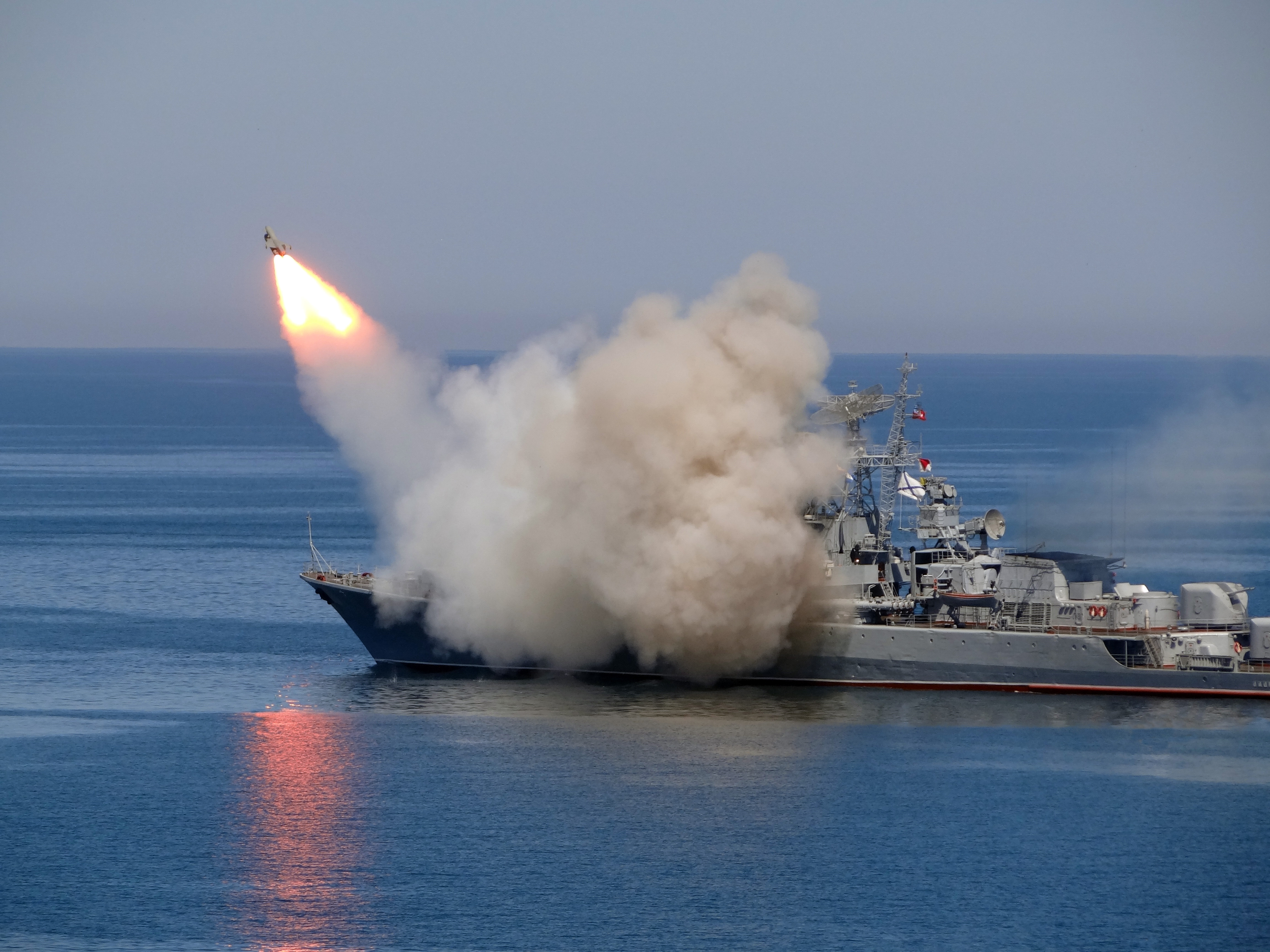
Relevant photo:
By: Jonesy - 20th July 2015 at 08:58
^ I was alluding to that thanks for bring it up
Is there a place where I can read more details on the SOviet air-sea battle tactics in the late cold war era ?
I mean how they intended to guard their SSBN
Deploy their DD/FF to counter western Aircraft carriers and other surface fleet
And their ASW doctrine
etc
I’d start here: http://www.amazon.com/Power-State-Sergei-Georgi-Gorshkov/dp/0080219446
By: nastle - 17th July 2015 at 19:57
^ I was alluding to that thanks for bring it up
Is there a place where I can read more details on the SOviet air-sea battle tactics in the late cold war era ?
I mean how they intended to guard their SSBN
Deploy their DD/FF to counter western Aircraft carriers and other surface fleet
And their ASW doctrine
etc
By: Jonesy - 17th July 2015 at 16:46
Exactly
I mean the Kresta II, Kara , udaloy are very weak in this anti-ship department and defenceless against Harpoon armed ships even of the japanease navy.What was the plan of the soviets to protect these ships from such harpoon armed ships ?
As noted above these class of ships were ASW hunters. In Gorshkovs doctrine they would be forward deployed as part of a taskgroup to prevent NATO/opposing forces from interfering with friendly submarine taskings in blue-water. The group, in the early 70’s era onwards, would have comprised heavy missile ships like the Pr.58/Kynda’s or -1 Kresta’s with P-35’s etc to engage hostile surface units at extended range. Added to that would be the heavy missile fire from a likely taskgroup flag like a Kirov or Kiev class.
By: Gollevainen - 17th July 2015 at 11:56
Remember that you don’t fight anti-ship missiles with anti-ship missiles. Against the anti-ship missiles you have the close-in AA weapon system, albeit in the pr.1134A & B its (AK-630’s and OSA-M in 1134B) dated back to days before the Harpoon was fielded.
All these ships are designated BPK = Large anti-submarine ships. Their task is to hunt and fight submarines, not surface combatants.
By: nastle - 16th July 2015 at 17:01
The Kara’s are commonly quoted as being equipped to fire the 53-65K 21″ wake-homers and so had an anti-surface capability in that regard. Best you’d get, against a 30knt combatant target, though would be a solution at about 8-10,000yrds range max….same sort of range as, allegedly, the AK-726s were effective at for surface fire. Getting close enough to employ either would, you’d assume, mean something had gone quite badly wrong somewhere!.
Exactly
I mean the Kresta II, Kara , udaloy are very weak in this anti-ship department and defenceless against Harpoon armed ships even of the japanease navy.What was the plan of the soviets to protect these ships from such harpoon armed ships ?


 Sign In








 July 13, 2015 at 3:59 pm