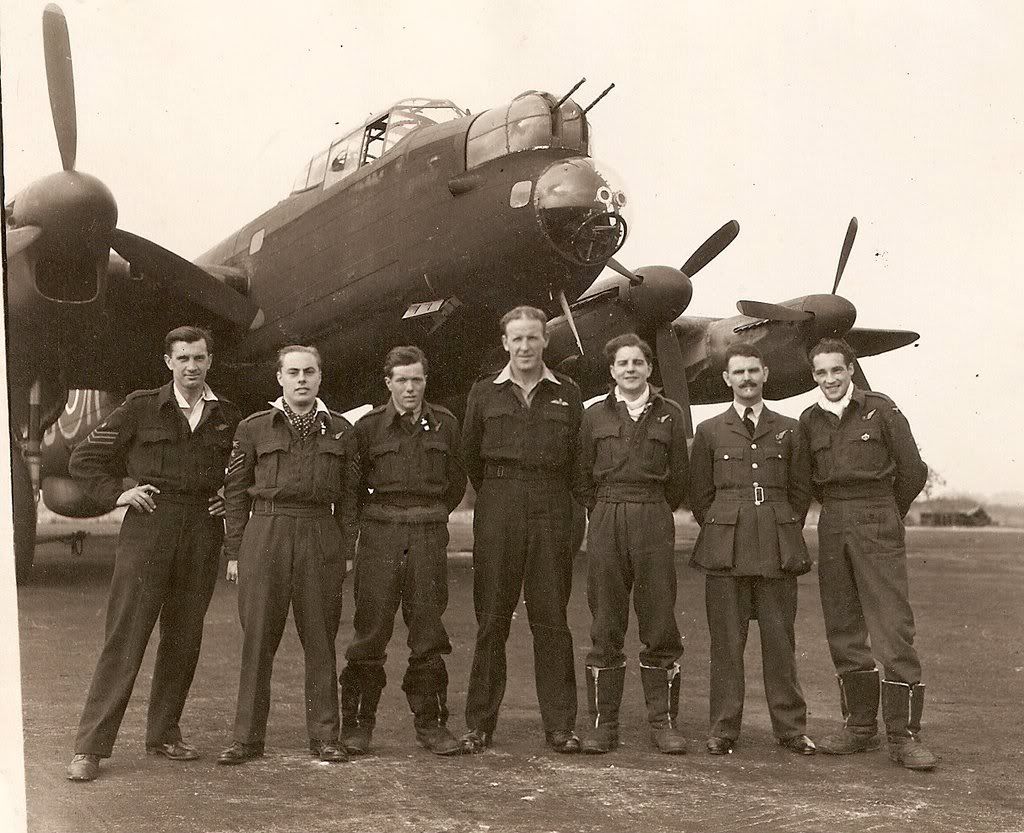
As I understand it there are/were no external/visible differences between Lancaster BI’s and BIII’s. I understand the differences were purely the powerplants although it wouldn’t surprise me if there were other minor detail variations.
I’m getting a mildly detailed model made of my Uncle’s aircraft, can anyone please comment on …
(a) whether there were any visible differences between the BI and BIII that a modeller should pay attention to (I seriously doubt this), and
(b) whether the aircraft in question (EE147) was a BI or BIII?
Many thanks, Don
ps. Of course if you just happen to have a photo of EE147 (PG-P and before that AJ-L) lying about the place … 😎

By: Smith - 31st March 2025 at 13:21
Schräge Musik
Going back to Schräge Musik for a moment (Don, did you “pull” your supplementary thread cos I can’t find it?), a number of questions have occurred to me as a result of reading posts in this thread, and from skimming thru parts of my library in search of definitive answers.
These are mostly to do with Bomber Command’s ignorance of Schräge Musik.
JDK has implied (and I’ve seen other comments supporting the idea) that Bomber Command was unaware of S.M. until the war’s end. Martin Middlebrook, whose books I rate highly, has stated that it took Bomber Command “many months” to realise what was going on – this suggests that S.M. was understood well before the war’s end, given that it started to be used in 1943.
I wonder what the truth is? None of my books is able to provide the answer. I find it hard to accept that no-one in Bomber Command could envisage something along the lines of upward firing guns, given that every heavy bomber in it’s inventory had just that capability with it’s turrets. And had everyone forgotten about one of the RAFs early answers to the shooting down of bombers at night – the Defiant, with guns capable of firing (almost) vertically?
Even if the exact installation details of S.M. eluded them, surely they could have considered the proposition that JU88s were being fitted with turrets capable of firing upwards?
And as the Germans were pushed back from Belgium, France and Holland, we must have discovered wrecked and abandoned night fighters by the score – surely there were some clues to be gleaned from these?
I’ve dragged this old thread out of its dusty closet for a couple of reasons …
1. I found out yesterday that my Uncle was in all probability killed by Schräge Musik.
2. A recent thread on Scarecrows touched on this, readers might find this thread interesting too.
3. I came across an amazing link today. 682Al was bang-on with his comments above.
Look at THIS. A Schräge Musik equipped Bf110 G-4/R-3 found and reported on by American forces in September 1944.
Who says it wasn’t known about? Spot of inter-service rivalry and the keeping of secrets?
cheers Don
By: Smith - 31st March 2025 at 13:20
LEMB link
1000 pardons everyone … I’ve just discovered you’ll need a login/ID at LEMB to view that link.
Short of lifting the content of the thread (and I won’t do that), you’ll have to register and login to view it.
Suffice to say the content is fascinating. It features a copy of a US intelligence report on a captured Schräge Musik equipped Bf110 G-4/R-3 found abandoned in September 1944.
Was this information not passed on to the RAF? Or was it, but not acted upon?
Either way IMO it was a disgrace.
By: lmisbtn - 31st March 2025 at 13:20
Everywhere I look I find the same discussions about schräge musik, some saying they thought/suspected something was up, many noting the lack of any official action and drawing the same conclusion – it just wasn’t recognised.
I have to say if it were it would be a damning indictment on the heirarchy, press on regardless and all that sort of stuff.
Here we have a short piece including an interview with a Bomber Command pilot discussing the effectiveness of the corkscrew vs the earlier “from behind” night fighter stalking technique, but then saying that once schräge musik came on the scene there wasn’t much that could be done. By no means does this imply he did or didn’t know about it beforehand BTW. Interesting though.
I don’t know whether or not the authorities knew about SM or not but ‘Press on Regardless’ was the order of the day for the government and forces.
It’s the same principal that sent numerous T-34 and Sherman crews to their doom… surely, they knew all about the advantages of very thick sloping armour but still sent the poor sods nosing down the lanes of Normandy to hunt Tigers in Tommy Cookers?
Same with the present regime too (just less of an excuse for it), give ’em equipment of a quality & quantity just barely adequate to do the job – but only at a high human cost.
Perhaps they knew about SM but I’d say it was ‘needs must’ during WWII (with many projects competing for physical and scientific resources) and that human cost came a distant second to numbers (bombs on target). Either way, the powers that be had some pretty thankless decisions to make…
Vis-a-vis the perspex tube under the nose – could it’s primary purpose have been for a visual inspection of the lower airframe/undercarriage??
By: JDK - 31st March 2025 at 13:14
Hi Don,
Unfortunately, not only do you have to register, you have to wait for the account to be authorised – it’s not an automatic immediate result, and in the meantime you get shown a perplexing ‘broken link’ page. However once authorised (about 20 min, thanks LEMB!) you can follow the link OK, and it was most interesting.
Regarding the Schräge Musik getting ‘blown’, while the report by the US would be of interest, it wasn’t what they were looking at for their forces, and when passed onto the UK, may not have been recognised for what it was. Bear in mind that if you’d never heard of it, it might seem like a one-off experiment that was doomed to failure, like the inter war Vickers and Westland COW gun fighters of the RAF, or some of Germany’s wartime fighter ideas – He 280, He 100, or in a different sense the not-RLM supported He 219. A further stretch it might be another red-herring like the ‘He 113’. Easy to misfile / ignore.
Secondly we know that Harris and the senior command of Bomber Command were not receptive to data that didn’t fit their views (see the Operational Research debate by Freeman Dyson). Two bits that IMHO virtually guaranteed the report would be ignored.
On a different tack, how many aircraft had been shot down by Schräge Musik by September 1944? Where is September 1944 in the decline of Bomber Command losses?
Regards,
By: EN830 - 31st March 2025 at 13:14
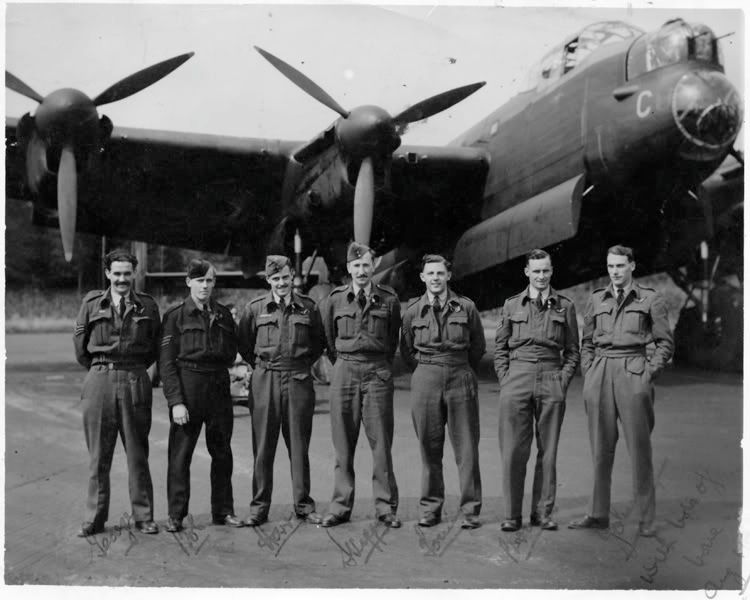
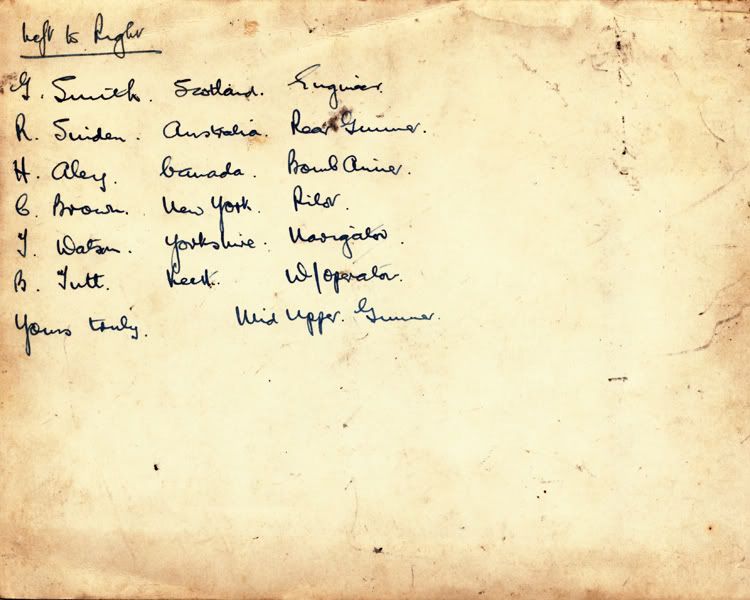
Can’t add anything to the debate except for this picture of an unknown Lancaster and Crew.
By: Arabella-Cox - 31st March 2025 at 13:13
Secondly we know that Harris and the senior command of Bomber Command were not receptive to data that didn’t fit their views (see the Operational Research debate by Freeman Dyson). Two bits that IMHO virtually guaranteed the report would be ignored.
On a different tack, how many aircraft had been shot down by Schräge Musik by September 1944? Where is September 1944 in the decline of Bomber Command losses?
I don’t think you can suggest Harris or his subordinates were slow to sieze on intelligence that could reduce casualties. More a case of the intel being slow to reach Bomber Command, plus, possibly/probably a delay while they convinced themselves it was accurate and valid.
Here’s one of Harris’ own graphs from his Despatch On War Operations, showing (shewing!) losses per 3000 sorties against the introduction of significant E.C.M. counter-measures “and other important factors”.
Note that two of the last last three factors shown (shewn) at the time of the dramatic plunge in losses in July – October 1944 are probably entirely due to the (July 1944) captured Ju88 from Woodbridge revealing its secrets, i.e. Flensburg and Naxos – both extremely effective devices for detecting and homing onto the radar emmissions from our own aircraft, and SN2, a radar the precise details of which seem to have eluded our intelligence for some time (presumably because it was not allowed to be used outside of home territory):-
Radar and Signals silence – e.g. Naxos-Z’s ability to home onto H2S emissions.
Monica restricted – Flensburg had been found to be very effective at picking up signals from Monica. Its use was therefore restricted in August 1944, then forbidden altogether a short time later.
Additionally, Harris has indicated that the loss of occupied territory to the Germans had robbed them of vital early warning. This is no doubt true and will have hindered their efforts to organise and co-ordinate a proper defence against our raids. Whether, though, this factor is more important than the previously listed factors might be an interesting debate in itself.
What a pity the Woodbridge aircraft didn’t have the upward firing guns…
http://upload.wikimedia.org/wikipedia/commons/f/f6/Ju_88_woodbridge.pdf
Actually, I’ve noticed some confusion about whether the Woodbridge JU88 had Naxos equipment. Some web-based texts say it did, but the .pdf report I linked to above does not mention it. Harris’ Despatch states that no Naxos equipment was captured and that intelligence on it came mainly from prisoners.
By: JDK - 31st March 2025 at 13:13
Can’t add anything to the debate except for this picture of an unknown Lancaster and Crew.
You have an RAAF Sergent, and name and with that (are we agreed it’s Sinden, R or Bob?) that gives:
http://www.ww2roll.gov.au/script/veteran.asp?ServiceID=R&VeteranID=972748
Name SINDEN, ROBERT WILLIAM
Service Royal Australian Air Force
Service Number 421133
Date of Birth 20 Apr 1923
Place of Birth COOMA, NSW
Date of Enlistment 7 Dec 1941
Locality on Enlistment Unknown
Place of Enlistment SYDNEY, NSW
Next of Kin SINDEN, NORMAN
Date of Death 26 Nov 1943
Rank Flight Sergeant
Posting on Death 8 PFF
WW2 Honours and Gallantry None for display
Prisoner of War No
Roll of Honour TAREE NSW
He didn’t make it. 🙁
So on the CWGC
SINDEN , ROBERT WILLIAM Flight Sergeant 421133 26/11/1943 20 Royal Australian Air Force Australian 2. H. 8. DURNBACH WAR CEMETERY
By: JDK - 31st March 2025 at 13:13
Thanks AM,
I don’t think you can suggest Harris or his subordinates were slow to sieze on intelligence that could reduce casualties.
I can certainly suggest it – the issue is whether I’m wrong! (Probably).
There’s plenty of evidence to show that Harris’ strategic vision was fixed in certain ways and not to be shifted until given a direct order to change (Coastal Command, D-Day). On a tactical level he did blank feedback from OR, according to Freeman Dyson, although no one could restructure the force quickly.
More a case of the intel being slow to reach Bomber Command, plus, possibly/probably a delay while they convinced themselves it was accurate and valid.
Without bashing on about Harris’ monomania that’s probably a fairer comment. It had to be found (recognised for what it was); evaluated (for efficacy – and here we have a break with supporting evidence as discussed before); and then acted upon. Plenty of places for the chain of reasoning to break.
To take your interesting ‘Woodbridge’ hypothesis, it could have had the guns and they could still have been regarded as (say) a secondary armament (albeit that’s unlikely).
Thanks for the great graph.
So by September 1944, other actions had reduced the losses to below 2%, which they never went above again. (And incidentally, how quickly could that intelligence have reached the RAF – a month? October 1944, min.) So by the time this aircraft’s data had reached the RAF, the knowledge was (in percentage terms) of much smaller import than it would have been earlier – say mid ’43.
And (another thought) I wonder what counter measures would have been proposed has it been recognised earlier? Would the mid upper gunner shedding his turret and watching through a hole near where the H2S was have been a viable option? What else?
Incidentally, ‘shewing’ / ‘shewn’ is good English of the pre-W.W.II period. Harris would have written about ‘alarums’ and ‘gaol’ as well.
All very interesting,
Regards,
By: kev35 - 31st March 2025 at 13:12
“He didn’t make it.”
Neither did any of the others. They were the crew of Lancaster III JB221 OF-W of 97 Squadron who took off from Bourn at 00:30 on the 26th November 1943 for an op to Frankfurt. The aircraft crashed at Brandau, near Reinheim with no survivors.
‘Yours truly’ was 1398493 Sergeant David Henry William Little. He was 32 years of age, was married and came from Shepperton.
Edited to add that this was the first operation for this crew with 97 Squadron. Were they all second tour veterans? Had they just completed a tour and moved on to PFF to complete another 15? I know this is somewhat distracting from the original thread but I find it fascinating.
Regards,
kev35
By: Arabella-Cox - 31st March 2025 at 13:12
Vis-a-vis the perspex tube under the nose – could it’s primary purpose have been for a visual inspection of the lower airframe/undercarriage??
I should have attended to your point about the perspex blister, lmisbtn. This is now positively identified as a formal mod., designed to provide downward vision for defensive purposes, not a window chute.
There have been other threads referring to it since this one.
Air Ministry (682al as was)
By: JDK - 31st March 2025 at 13:12
Thanks Kev,
As they were in PFF, presumably they’d all done a tour already?
Regards,
By: Arabella-Cox - 31st March 2025 at 13:12
Incidentally, ‘shewing’ / ‘shewn’ is good English of the pre-W.W.II period.
I agree, it’s the use of “shewing” then “shown” in the same graph that tickled me. I would have expected shewing/shewn to be more correcter than what the author wrote.
By: JDK - 31st March 2025 at 13:12
Indeed!
By: Linda Ralph - 31st March 2025 at 11:25
Re Lancaster photograph
Was roaming the net last night and couldn’t believe my eyes when I spotted a copy of Carlos Brown’s crew photo. I already have one because my uncle was George Smith, the first guy in the line up. Obviously each crew member had a copy but the reverse of each photo was differently annotated. I am absolutely fascinated as to where EN830 came across the print. I know of one other copy.
I have only just joined the forum today so not sure of etiquette regarding jumping into a thread like this, but hopefully one of you can keep me right. I have done a huge amount of research into the crew and am now trying to find out about the records of reburial of crashed airmen after the war had ended. Only three of the crew were identified and reburied in Durnbach War Cemetery, while the others including my uncle are on the Runnymede Memorial. If anyone is interested, the photo was actually taken while they were with 50sqn where they did about 14 sorties. Sadly they were on their first outing with 97sqn.
Best Wishes Linda
By: ssg keay - 31st March 2025 at 10:42
lancaster JB221
Linda Ralph and Kev35. Can you please contact me as soon as possible? I will explain as soon as I can get you on the phone, or e-mail. I will also send both of you a PM with my contact data. Thanks, Danny
By: David Layne - 31st March 2025 at 10:41
Here is a little about the Carlos Brown crew.
By: ssg keay - 31st March 2025 at 10:20
This is great information. I feel that unknowingly this thread might have helped solve a 60+ year old mystery. Danny
By: Lefty - 7th September 2010 at 13:48
Lanc Squadron designations in your note
Well … The photo is from Mildenhall 15 Sqdn 1944 … from the logbook of the navigator it could be any of the following ….
LL859 Q
LL854 S
ME695 R
ND958 H
LM238 T
LL923 C
LM473 P
ME849 F
LD475 MBut another photo of the same day with a little more of the aircraft may help ????
In case this is of interest;
My father did his second tour of Ops with XV Squadron as XV Squadron Signals Leader from March 1944 until the end of the War. As Signals leader he was not part of a specific crew and flew with all the different crews. I don’t know if this will help at all by narrowing the dates down to when this photo was taken but over the period between March ’44 and February ’45 my father flew in LS-C, LS-F, LS-H, LS-P, LS-Q and LS-Z and in some instances the a/c designated with the squadron letter bore a different serial number due to losses.
I am setting out below the date, serial number and squadron designation of each aircraft at the time
March 16, ’44 LS-Q = W4181
May 14, 17 ’44 LS-H = ND958
Sept 3 , ’44 LS-F = ME849
Sept 6, ’44 LS-Z = PD285
Oct 28, ’44 LS-C ME844
Feb 18,22 ’45 LS-P = NG364
By: Eddie - 5th March 2010 at 23:11
Well… the TR1143 as fitted to Spitfires operated in the 100-124MHz range, so that aerial length would presumably be appropriate for the type C and D Mandrel sets. I’ll be interested to hear what you find at Kew!
Blue 2 – it’s unlikely to be Gee H – first, the aerials appeared significantly before Gee H. Second, Gee used whip aerials on the spine of the aircraft (the frequency band being 20-85MHz for both Gee and Gee-H) – I suspect that Gee H would have used the same aerials.
On the parallel mystery of ME695, these photos show it after landing at Ford – presumably the tail section departed in the landing/undercarriage collapse. http://s633.photobucket.com/albums/uu53/LAF-Forum/101%20Squadron/
As I think can be seen, it’s a long way beyond the capabilities of any unit repair, so must have gone back to the factory for a thorough rebuild. Apparently in November ’44 it ended up at an OTU, so I think it’s probably unlikely it ever made it back to XV Sqn (after all, why would they have had it back, as I’m sure they’d have had a replacement aircraft a day or two after it was damaged!).
By: Arabella-Cox - 5th March 2010 at 12:52
Al,
Look at this photo: http://cas.awm.gov.au/item/UK0469
To me it looks pretty clearly like a Spitfire aerial, with the screw tabs for the insulator sticking off the back. Having checked in “Despatches on War Operations” by Harris, the plan was to fit approximately two aircraft per squadron with Mandrel, and the fact this aerial is the only one that looks “Spitfirey”, and the fact that it seems to appear sporadically through Lanc production, with no apparent rhyme or reason, would tend to fit the facts.
Yes, I think that’s quite a convincing theory, Ed.
The photo in your link, plus keithnewsome’s excellent photos (thanks k!) definitely show what looks to be a redundant bracket on the aerial, supporting the notion that these are Spitfire aerial masts put to another use.
Here’s a paraphrased extract from Martin Streetly’s Confound And Destroy:-
An installation consisted of one TI408 transmitter, one Type 68 modulator, one Type 301 power unit (1.2 kW. 80 volts AC) and a Spitfire-type transmission mast.
T1408A, 88-98 MHz
TI408B, 98-108 MHz
T1408C, 108-118 MHJ
TI408D, 118-128 MHz (the original band covered)
TI408E, 128-138 MHz
TI408F, 138-148 MHz (‘E’ and ‘F’ used a transmission mast of reduced length)The ‘D’, ‘E’ and ‘F’ Mandrels were used by Main Force (100 Group using ‘A’ to ‘F’).
Mandrel was installed as single transmitters in an individual aircraft, all the transmitters in a particular squadron being tuned to one frequency.
So it seems we might be looking at Lancs with Type D Mandrel?
Like I said before, I’ll put this topic near the top of the list for my next Kew trip.
Edited to add:-
So it seems we might be looking at Lancs with Type D Mandrel?
Or are we? In Confound And Destroy, M.S. annotates the picture of Mandrel aerials that I posted a few posts up / and identifies the lower three as being Type D, E and F (lowest). The Type D one doesn’t match what we are seeing in the Lancaster photos.
He also does not mention the second, smaller aerial.
hmmmm!


 Sign In








 February 8, 2007 at 8:57 am