
By: TonyT - 10th December 2011 at 22:49
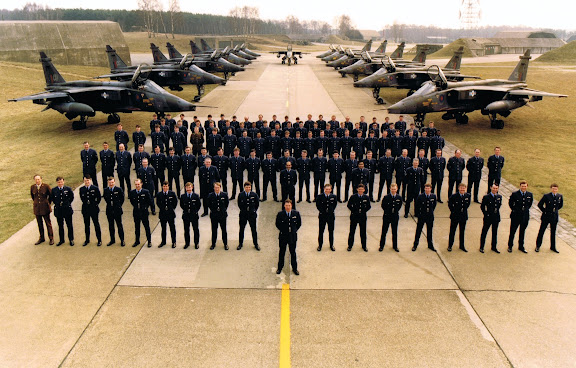
I will show you why you should take pictures of military aircraft at a pinch, this is our Squadrons disbandment picture (20 Sqn) whilst all the aircraft are C(X) coded in white on the fin…. CA on the front right being different is carrying XX for 20 on the nose door….. fine, but look at the third down on the left, it carries a mixture of white and black codes…… Historians in the future will no doubt come up with all sorts of reasons for these special markings…….
The truth………………. A Squadron always has one aircraft away on a Major Service, so to get round the missing aircraft for the photo we borrowed one from another Squadron and altered the code to suit with bodge tape……….. Ohh and i am 3rd main row back 10 in i think 🙂 ohh and the aerial in the background is not there….. shhhhhh 😉
Picture off Fruitbats site (one of the pilots)
By: pagen01 - 10th December 2011 at 22:00
Also worth noting that quite often within a unit, squadron, or even airfield that an aircraft is known by its individual code letter/number rather than its full military serial, even entries in logbooks can sometimes be just the code.
By: Flanker_man - 10th December 2011 at 21:35
Going off at a slight tangent……
US Navy EA-6B Prowlers had a Rad Haz-like marking on the radome – so that the Landing Signals Officer can distinguish between the A-6 Intruder and EA-6 Prowler when they are on approach to the carrier…..
http://worldsairforce.webs.com/USA%20Mlitary%20jet%20fighters/EA-6B.jpg
This was when both types were operataing concurrently.
Similarly, the Grumman E-2 Hawkeye 2000 with 8-bladed props has a nose marking to distinguish it from those with legacy 4-bladed props.
http://www.vectorsite.net/ave2c.html
http://www.planeaday.com/images/2011/Feb/Northrop_Grumman_E-2_Hawkeye_091209-O-0000X-001.jpg
Apparently the approach characteristics are sufficiently different, such that both types have a need to be identified from head-on.
Ken
By: Wokka Bob - 10th December 2011 at 20:53
It is so you can identify it from the front, imagine scrambling out to the line of aircraft then finding you are all at the wrong aircraft. or walking 1/4 a mile out to an aircraft to find it is the wrong one,.
So you’ve been there tooooo!
Fat Alberts were a sod to find especially when we were filming for a certain TV series and two a/c had the same numbers on the front, luckily not at the rear or underwing. Nearly ripped the cargo air conditioning duct out of the wrong one.:mad: Chiefy not amused.:o
Those were the days:D
By: Slipstream - 10th December 2011 at 14:05
So it’s C for Charlie and not copyright, part C or clockwise…:D
Many thanks for the replies chaps
Steve
By: Moggy C - 10th December 2011 at 08:56
You will note that ML407, wearing squadron condes OU-V also carries a V under the spinner

Moggy
By: nuuumannn - 10th December 2011 at 03:31
Copyright 1936 Supermarine Aviation Works (Vickers) Ltd. All rights reserved.
😀
By: Flying-A - 10th December 2011 at 03:17
Can anyone tell me what the letter C inset in a circle on a Spitfire lower cowling , beneath the spinner signifies ?
Copyright 1936 Supermarine Aviation Works (Vickers) Ltd. All rights reserved.
By: TonyT - 9th December 2011 at 20:25
It is so you can identify it from the front, imagine scrambling out to the line of aircraft then finding you are all at the wrong aircraft. or walking 1/4 a mile out to an aircraft to find it is the wrong one,.
By: Themightyelf - 9th December 2011 at 20:15
But seriously folks ……..no mucking about:D
By: Themightyelf - 9th December 2011 at 19:23
Fact or fiction…….am I the only one taking this seriously ? 😮
By: TonyT - 9th December 2011 at 19:11
When New Spits arrived from the factory they were packed in big cardboard boxes on sprues, the letter simply helps the engineers when reading the giant instruction sheet to stick the parts together…… glue part C to part D etc etc etc……… suprised they haven’t washed it off though :p
Look at most aircraft from 737 to typhoons, you will see the codes on the nose doors too, again so you can see from the front which one it is.
By: Bob - 9th December 2011 at 18:41
C for Cowling….
By: Bruce - 9th December 2011 at 17:37
Basically, yes!
Its a repeat of the aircraft code letter.
Bruce
By: ian_ - 9th December 2011 at 17:27
It’s aircraft individual code letter, saves walking around the side to read the fuselage. (I think)
By: tfctops - 9th December 2011 at 17:11
Clockwise?


 Sign In








 December 9, 2011 at 5:03 pm
