I am staggered by the fact that according to Wiki there have only been eleven serious incidents (crashes) at Heathrow in the past sixty years (listed below), and only three in the past forty years.
Given how many movements take place there every single day, let alone on an annual basis, that has to be an outstanding safety record.!
But it did make me wonder how it compared to other majors such as Chicago O’Hare, Paris, Frankfurt, Beijing etc?!
Accidents and incidents;
On 3 March 1948, Sabena Douglas DC3 Dakota OO-AWH crashed in fog. Three crew and 19 of the 22 passengers on board died.[93]
On 31 October 1950, BEA Vickers Viking G-AHPN crashed at Heathrow after hitting the runway during a go-around. Three crew and 25 passengers died.[94]
On 1 August 1956, XA897, an Avro Vulcan strategic bomber of the Royal Air Force, crashed at Heathrow after an approach in bad weather. The Vulcan was the first to be delivered to the RAF, and was returning from a demonstration flight to Australia and New Zealand. The pilot and co-pilot ejected and survived, but the four other occupants were killed.[95]
On 7 January 1960, Vickers Viscount G-AOHU of BEA was damaged beyond economic repair when the nose wheel collapsed on landing. A fire then developed and burnt out the fuselage. There were no casualties among the 59 people on board.[96]
On 27 October 1965, BEA Vickers Vanguard G-APEE, flying from Edinburgh, crashed on Runway 28R while attempting to land in poor visibility. All 30 passengers and six crew on board died.[97]
On 8 April 1968, BOAC Flight 712 Boeing 707 G-ARWE, departing for Australia via Singapore, suffered an engine fire just after take-off. The engine fell from the wing into a nearby gravel pit in Staines, before the plane managed to perform an emergency landing with the wing on fire. However, the plane was consumed by fire once on the ground. Five people &ndahs; four passengers and a stewardess – died, while 122 survived. Barbara Harrison, a flight attendant on board who helped with the evacuation, was posthumously awarded the George Cross.[98]
On 3 July 1968, the port flap operating rod of G-AMAD, an Airspeed Ambassador operated by BKS Air Transport failed due to fatigue thereby allowing the port flaps to retract. This resulted in a rolling moment to port which could not be controlled during the approach, causing the aircraft to contact the grass and swerve towards the terminal building. It hit two parked British European Airways Hawker Siddeley Trident aircraft, burst into flames and came to rest against the ground floor of the terminal building. Six of the eight crew died, as did eight horses on board. Trident G-ARPT was written off,[99] and Trident G-ARPI was badly damaged, but subsequently repaired, only to be lost in the Staines crash in 1972.
On 22 January 1970, Vickers Viscount G-AWXI of British Midland was damaged beyond economic repair when an engine caught fire on take-off. A successful emergency landing was made at Heathrow.[100]
On 18 June 1972, Trident G-ARPI, operating as BEA548, crashed in a field close to the Crooked Billet Public House, Staines, two minutes after taking off. All 118 passengers and crew on board died.[101]
On 5 November 1997, a Virgin Atlantic Airbus A340-300, G-VSKY, made an emergency landing following an undercarriage malfunction. Part of the undercarriage collapsed on landing, and both aircraft and runway were damaged. Recommendations made as a result of the accident included one that aircraft cabin door simulators should more accurately reproduce operating characteristics in an emergency, and another that cockpit voice recorders should have a two-hour duration in aircraft registered before April 1998.[102]
On 17 January 2008, a British Airways Boeing 777-236ER, G-YMMM, operating flight BA038 from Beijing, crash-landed at Heathrow. The aircraft landed on grass short of the south runway, then slid to the edge of the runway and stopped on the threshold, leading to eighteen minor injuries. The aircraft was later found to have suffered loss of thrust caused by fuel icing.[103]
[edit]
RIP all that perished.

By: longshot - 21st June 2012 at 12:39
Apologies for not acknowledging the original thread starter correctly…Wyvernfan…I thought the bus photos had a security interest if not a safety one….do the links work OK if you’re not signed up to the LT Pick&Mix site?
By: garryrussell - 21st June 2012 at 11:39
I don’t myself class G-ARPI as a Heathrow incident, it had flown away from the airport.
One that is missing is Skyways Hermes G-ALDH, written off in an undercarriage collapse on landing LHR 8th March 1960
But all this is not a Heathrow thing. Most airports in the UK see a similar trend as aviation has got a lot safer. I think it mimics aviation safety in general in the UK at least.
Compare for example, the amount of crashes BEA and BOAC had with British Airways who have had only three write off incidents I can think of in their existance and only one of those was fatal.
Trident 3B G-AWZT in a mid air collision over Zagreb was the fatal
The other two were Trident 1E G-AVYD (technically still Northeast then) in a overrun on an aborted take off at Bilbao and the of course G-YMMM the Boeing 777 coming down short on 09L.
There was of course the high profile One-Eleven window blow out and emergency landing at Southampton with the captain hanging out of the window, but full blown crashes are less common now.
This despite the tremendous increase in air traffic over the early days.
I didn’t include the Boeing 737 of British Airtours at Manchester as that was a seperate airline, of G-APFK the KT Boeing 707 that csarshed landed on a training flight, but if you do it’s still impressive.
OK there have been numerous runway excursions, burst tyres and wheels ups etc., but such incidents although major news now…like the recent Blue Islands ATR at Jersey, would not have got more than a brief mention if at all in the past.
So if anything aviation looks a great deal safer than it used to be but is actually even safer than it appears due to the raised profiles of contemporary minor incident.
By: longshot - 21st June 2012 at 00:11
Buses on the Tarmac?
Hallo Veeone….Thought you might enjoy these as a fellow Heathrobsessive!There are some rather atmospheric photos of LT buses mixing it with airliners on the new London Transport Museum Pick&Mix website (search term ‘airport’)
http://www.pickmix.co.uk/explore?s=airport&t=
some samples
http://www.pickmix.co.uk/199845100-bw-print-colin-tait
http://www.pickmix.co.uk/199871954-bw-print-topical-press
http://www.pickmix.co.uk/199885334-bw-print-dr-heinz-zinram
http://www.pickmix.co.uk/199856550-bw-print-w-h-r-godwin
http://www.pickmix.co.uk/199845063-bw-print-w-h-r-godwin
http://www.pickmix.co.uk/199885018-bw-print-w-h-r-godwin
http://www.pickmix.co.uk/199885518-bw-print-w-h-r-godwin
http://www.pickmix.co.uk/199856557-bw-print-colin-tait
The shots with the VC-10s didn’t need to be arranged, thats how it was on the road from Harlington Corner to Hatton Cross from the late 1950s till the early 2000s, I think.
The Topical Press photo is with a USAF/MATS C-54 which were fairly common visitors in the 1950s.
The Pick&Mix site has lots of Aerofilms aerial shots of London and suburbs
By: longshot - 9th August 2011 at 23:33
Misaligned 747 approach LHR North Runway
Hi Longshot. That 747 that almost hit the hotels was flown by the captain alone as the first officer was ill. He established on the false localiser which took him down the ILS slightly to the right of the true localiser. Very low cloud meant he only popped out into VMC tens of feet above the hotels. The CAA and the press hounded him with talk of imprisonment even though it was British Airways’ policy to pressure crews to take flights out whatever problems the crew had. This pilot committed suicide due to the pressure and the ignominous end to his career. Sad. Because despite the ILS error he performed as a top pilot under impossible conditions and saved the day.
I’ve just been reading an article about the case on pprune….terrible shame
http://www.pprune.org/aviation-history-nostalgia/350529-true-story-2.html#post4538047
By: EGTC - 2nd June 2011 at 14:24
Ahh I see! Thanks very much for that info, Vee. Being born in 1984 I only saw the usual runways and runway 23 in action so I wasnt really sure if the other runways prior to that were used or not.
By: VeeOne - 2nd June 2011 at 14:16
Brilliant 🙂
Was runway 23R used for take off’s only when runway 23L was used for landings?
When was runway 23R and also 33L (I think?) removed?
I think all the runways were used initially when the traffic was C-47 and Lancastrian types but I don’t think they used runways other than what they mark as runway 1, 2 and 5 (28R/10L, 23L/05R and 28L/10R) by the 1960s even though these maps show approach lighting on all runways. But i am sure there are others who will know for sure. 😉
By: EGTC - 2nd June 2011 at 00:42
Brilliant 🙂
Was runway 23R used for take off’s only when runway 23L was used for landings?
When was runway 23R and also 33L (I think?) removed?
By: VeeOne - 1st June 2011 at 23:57
I’d love to see the maps 🙂 Thankyou kindly.
LONDON AIRPORT IN 1961, 1964, 1967…
(If anyone would like to see the labels for the maps I can upload that part of the maps too. 😉
1961-62…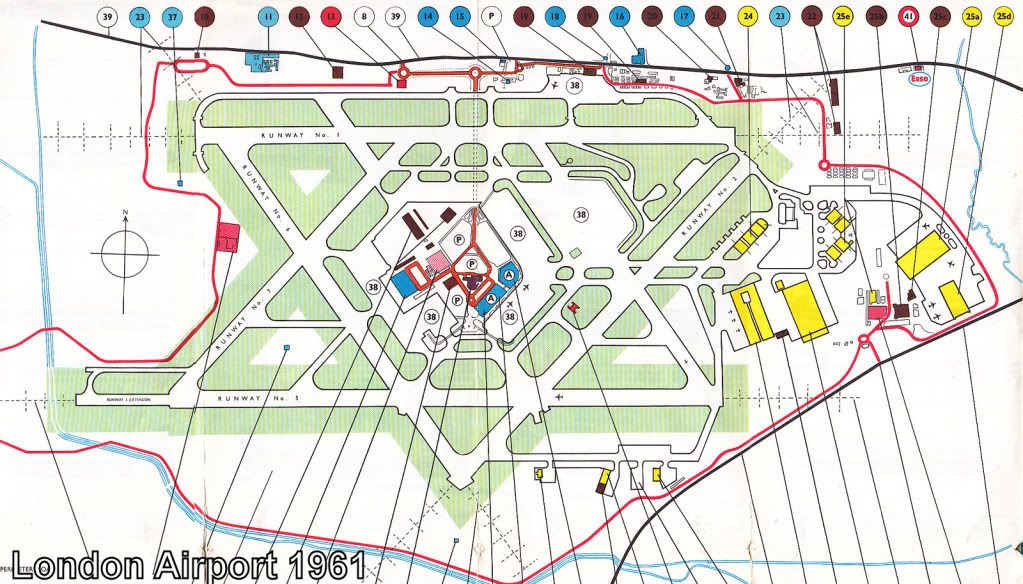
1964-65…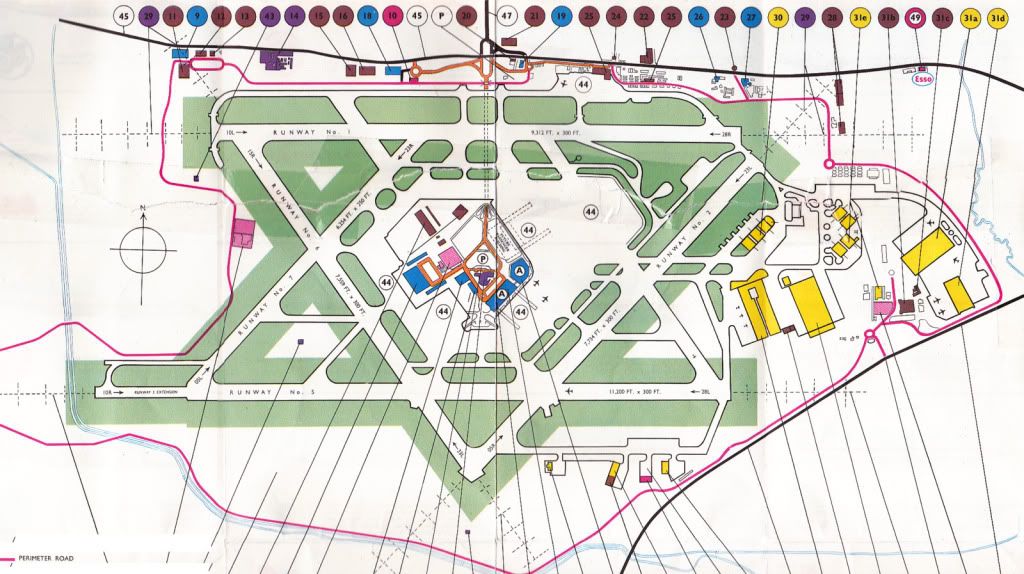
1967-68…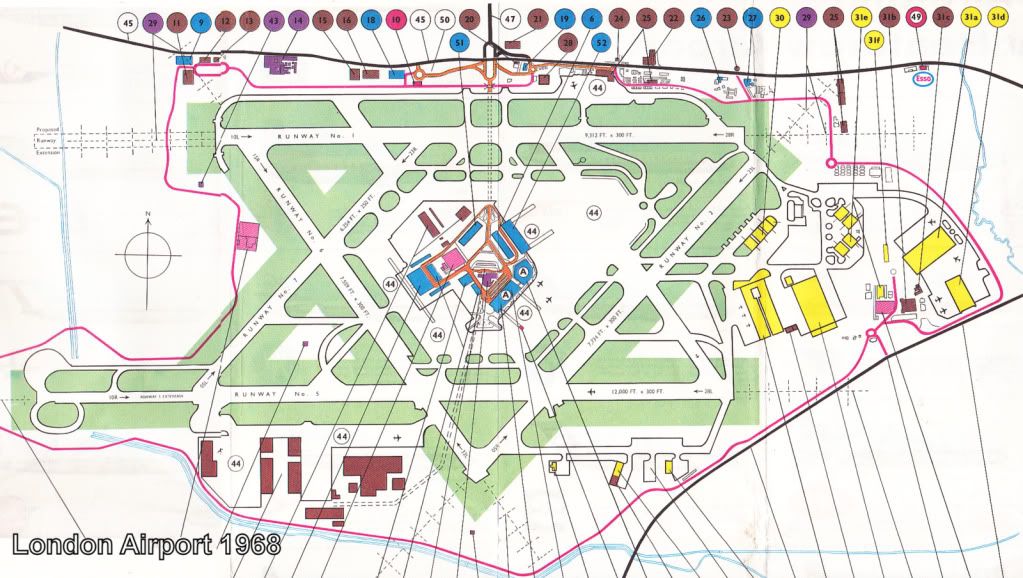
By: Gonzo - 1st June 2011 at 10:14
I loked at the prints in the tower just now and they are all from Hunting Aerofilms. Looking at Wikipedia it seems to suggest that the archive of aerial shots of Britain is available at the National Monuments Record in Swindon.
By: Arabella-Cox - 1st June 2011 at 08:06
Indeed you could. I remember looking at a series of photos showing a Qantas B707 landing at Auckland Airport for the first time and there were a group of small boys parked up with their bicycles on the apron watching.
Imagine that happening now (though I suspect New Zealand isn’t quite as obsessive now as the UK is when it comes to child ‘safety’.).
By: Bmused55 - 1st June 2011 at 07:24
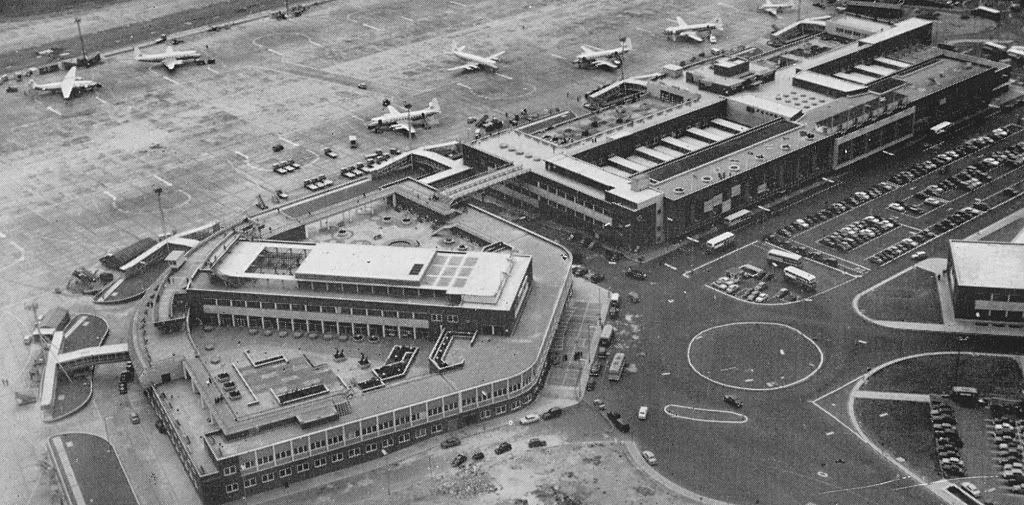
Look at the total lack of any fences, walls, etc. You could walk onto the apron from the street!
I was born in the wrong era methinks.
By: EGTC - 1st June 2011 at 00:31
Thats a lovely photo there! Very nice and clear 🙂
I’d love to see the maps 🙂 Thankyou kindly.
By: VeeOne - 1st June 2011 at 00:20
Here is Terminal 2 and QB in 1959. No T1 as yet. At that time T2 was called No1 Passenger Terminal. By 1962 it was called Europa Terminal with the new Terminal 3 being called Oceanic Terminal.
If you want to see maps of how the airport was in 1961, 1965 and 1968 I can post these maps.
By: EGTC - 31st May 2011 at 20:50
Incredible! Thanks for the photos. Its interesting how heathrow has developed over time 🙂 Thanks alot for that 🙂
By: tornado64 - 31st May 2011 at 11:08
Google Earth or Google maps had a history button where you could see the above view from any they had on record. Obviously photo’s not Satellite images.
.
google earth is all photographed!! satelite images are not clear enough mainly it was photographed from aircraft in the v/late 90’s early 2000’s but is updated occasionaly !!
By: Arabella-Cox - 31st May 2011 at 09:37
I think i can see my bike in that last pic!
By: Al - 31st May 2011 at 09:27
C1956 from PPrune…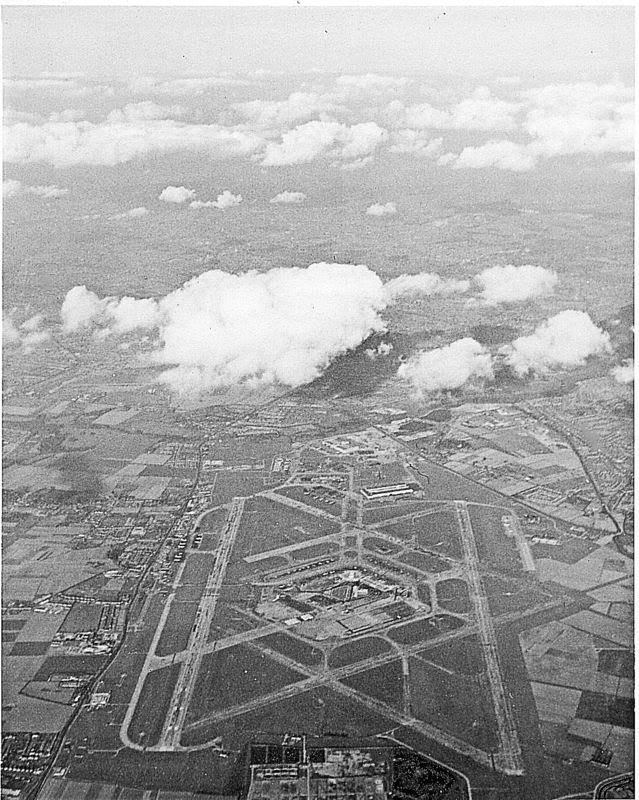
By: Al - 31st May 2011 at 09:26
Here’s some Googled images…
C1945…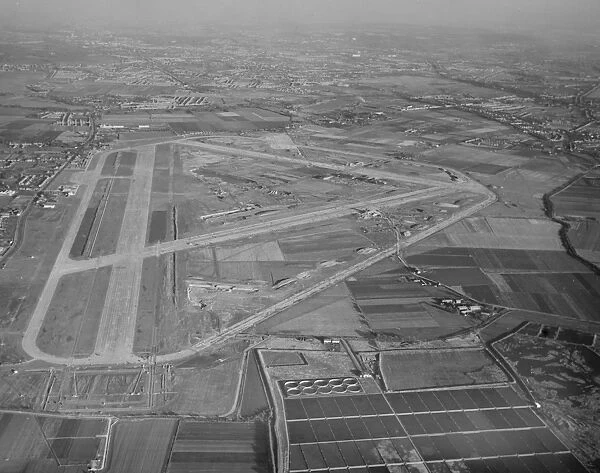
C1954…

C1955…
By: Gonzo - 31st May 2011 at 09:03
There is a series of five aerial photos in the tower atrium from various dates between 1949-1998, so the photos exist somewhere.
By: PeeDee - 31st May 2011 at 01:47
Thanks for clarifying.
I dont suppose there are any overhead photos of LHR from around the 50’s through to the 80’s are there? It would be nice to see how it changed over that period of time.
I’ve just checked and failed…….but I thought Google Earth or Google maps had a history button where you could see the above view from any they had on record. Obviously photo’s not Satellite images.
I’ve seen it somewhere and it would have been something as popular as Google as I don’t wander too far into the net.


 Sign In








 May 26, 2011 at 7:57 pm