Folks,
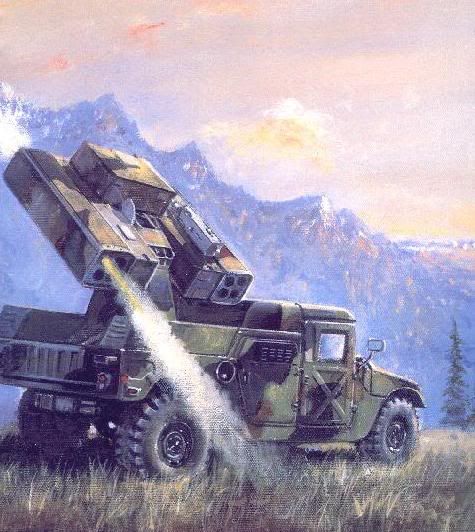
If anyone is interest this link to an online article to the LTV CROSSBOW Pedestal Stinger System that lost out to the Boeing Aerospace AVENGER in 1987. Sort of a hoot today: ie the US Army is using its sole .50 caliber machine gun as a convoy escort — ie total waste of a good antiair system.
Jack E. Hammond

By: Arabella-Cox - 8th June 2006 at 11:27
And 1.8k is all the range a CIWS needs.
Well, I’d argue that any air defence system needs as much range as it can get, but for use on a land vehicle for use against aircraft 1.8km effective range is inadequate today.
Most combat aircraft today can’t take anywhere near the smacking that aircraft of WW2 could.
Would disagree there. Some aircraft, like F-16s are made as light as possible, but specialised aircraft like attack helos and ground attack aircraft generally have some form of armour and redundant systems.
Former Soviet aircraft having armour plates scabbed on, like the Mig-27m etc.
And I think the US Navy was smart enough to weigh the pros and cons of going with the .50 caliber (ie it is offered in both a three and six barrel gatling version by GE) or the 20mm.
50 cal projectiles were already failing on Mig-15 type targets in Korea. They went for 20mm for rate of fire and weight of fire. Those gatlings used against aerial targets in the US and by the Soviets are smaller calibre… 20mm in US and 23mm in the Mig-31 in the East. For use against ground targets or both ground and aerial targets both use 30mm guns in the A-10 and the Mig-27 and Su-24. Of course the Mig-27 and the Su-24 use gatlings because they need to fire rapidly because they will be flying very fast and very low. The slower Su-25 has a twin barrel gun with a lower rate of fire and 30mm calibre. The US 30mm gun has more to do with getting multiple projectiles on target as quickly as possible to increase the chances of a kill, despite being fired from a slow moving aircraft.
Apart from podded guns the only other gatlings are on AC-130 gunships in the US or Helos, with the latter being a 3 barrel lightened 20mm gun chosen for weight and commonality… the 20mm round not being overly wonderful for ground attack.
It is not the rate of fire (ie although that is one of them) but the fact that the cannons rate of fire can easily be changed,
No, it is rate of fire. Although it has an added benefit that rate of fire can be changed, in practise it is generally fired at one of two rates so the true benefit of controlable rate of fire is never realised.
An A-10 will have a short space of time hanging in the air over the target area to fire a burst of 30mm cannon shells into the top of the target. The more shells it can fire in that burst the better the chance for a good kill.
It just keeps firing but not that barrel. And the USN and USAF thought of SABOT rounds for the Phalanx and the A-10s cannon but decided that a better option was a standard AP with a core surrounded by an aluminum body.
The A-10 is a rather simple unsophisticated aircraft. Firing sabot AP rounds and HE rounds with a completely different trajectory would make firing runs less flexible as half the rounds in the belt would go high and half would go low… and sabots in the engines could ruin the pilots day.
By: jackehammond - 8th June 2006 at 05:57
A healthy compromise might be to fit a GAU-12 25mm gun, and attach a Starstreak launcher (I remember reading that it has great capability for destroying tanks, including the latest types due to its velocity) and Hydra rockets, for anti-personnel use. The turret would probably be a bit like the Blazer turret – and would give a good balance, with the gun for anti-materiel and anti-air, Starstreak for anti-aircraft and anti-armour, and rockets for anti-personnel and light anti-armour (costing less than the Starstreaks). It is a compromise, but to be honest, just about anything you try with design work is a compromise!
Dear Member,
The Marines and US Army were both going to fit 2.75 inch Hydra pods to their light antiair vehicles (ie the Avenger and the LAV-AD). The 2.75 inch rockets would each have six bomblets like are used on the MLRS rocket which would be eject at a certain range before the target. The idea was for use against antiarmor helicopters in hover behind a hill or trees. In tests though the 2.75 inch rockets proved to inaccurate (ie only the Canadians seem to have mastered making an accurate fold fin rocket but the US military has “not invented here” syndrome that is horrible). So the idea was dropped.
Jack E. Hammond
By: jackehammond - 8th June 2006 at 05:53
Why would you want Starstreak when you’ve got LOSATs? You ever seen what a LOSAT does to a tank? It’s way faster than Starstreak and about nine times heavier.
Dear Members,
LOSAT is a heavy puppy. In the HUMVEE version four rounds are mounted on top of the roof with limited movement to the side or up and down. As to the Starstreak it would only be a “last resort” weapon against any ground target. And a poor one at that. The Starstreak three guided darts (ie that don’t hit a pin point area but come in at a triangle patter) are only 25mm in diameter and have limited AP ability as they have a small HE content. Now the candidate that lost to replace the Blowpipe/Javelin (ie the updated version of the Blowpipe is called Javelin and causes no end of confusion because of the US Army naming of the Dragon replacement) was the BAC Thunderbolt. it was also laser guided. But it was one single missile of about 60mm diameter. It is a lot like the LOSAT only smaller.
Jack E. Hammond
By: jackehammond - 8th June 2006 at 01:03
GAU-8 is enourmour, yes. It is heavy, yes. But that would be one serious tank killier right there! I wonder how feasible it would be for a new MBT design? Would it have the range necessary to take on something like a T-72 or T-80?
Dear Sean,
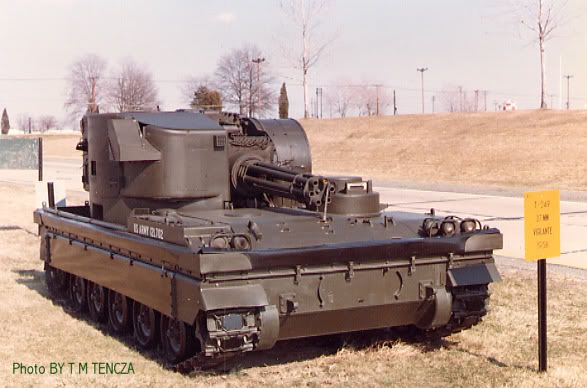
The US Army actually developed such beast in the late 1950s called Vigilante. It first mounted a Gatling cannon firing the WW2 37mm round but that round was found totally unsuitable for antiair and they then fitted a Gatling cannon firing the Oerlikon 35mm round. The US Army though decided it was just to heavy. The armored vehicle used was the same on used for the 8 inch and 175mm SP cannnons.
Finally, No the 30mm or 25mm cannon is not good for engaging T-72s or T-80s. Yes we have all heard the stories from the Gulf War. But over and over US military officers have been begging people not to base future war against a well trained enemy with Russian equipment based on that (ie sort of like the Italians thought biplane fighters were the ticket based on the Spanish Civil War experience). Yes those two cannons have penetration against an MBT (ie especially with a DU AP round), but they have to get close. And most trained tank crews will smoke their drawers before they get close. It is sort of like the US generals saying that the Sherman with the 75mm is good enough against the German Tiger and Panther — ie as long as they have four tanks per German tank and they can get a rear or side shot. Would you want those odds?
Jack E. Hammond
By: jackehammond - 8th June 2006 at 00:57
The 20mm shell used in CIWS is ineffective at more than 1.8km. Against aircraft you could probably extend it a small amount but 20mm is just too small these days. Light projectiles shed velocity too quickly and lack payload.
Modern combat aircraft do not have poor protection… an Apache probably has better protection than a Shturmovick. The A-10 even more so. Modern fighter bombers have the protection of being able to fly higher and faster and still detect and engage targets with better sensors and communications with ground forces.
And 1.8k is all the range a CIWS needs. Other AAA or antiair systems kick in beyond that. And with the CIWS that is the reason DU is used to get the weight of the projectile and rate of fire. And for the last statement, that is the exception and not the norm. There is the famous instance of an F-4 deciding to scare the manure out of a Thai guard on the ground and in turn the scared guard fired an M1 Garand with .30 caliber ammo and forced the crew to eject. Most combat aircraft today can’t take anywhere near the smacking that aircraft of WW2 could. Another prime example was the first Gulf War in 1991. A US Army SpecOps team was emplaced secretly along a main road from Iraq to Kuwait and got discovered by some kids. They called for some help when the regular Iraqi Army arrived in trucks. The F-16 that arrived would not come down for fear of a 37mm AAA in the area. They did not get help till some A-10s arrived.
At about 1.5km a 20mm cannon shell has less energy and penetration than a 50 cal SLAP round. A heavier projectile of larger calibre might leave the barrel at a lower velocity than a 20mm but it will shed velocity slower and if the range is 2km or more would probably actually get to the target sooner than a 20mm round.
There are 20mm round and their are 20mm rounds. If you are talking about the 20mm round used by the HS and Oerlikon cannons that is most likely true. But not the ones used by AA of today and from the late 1950s on. A German Army study into the subject of cannons for armored vehicles looked into the subject. The reason why the 25mm and 30mm was adopted by many NATO nations for armored vehicles was not penetration as many believed but the HE content of the shells. That was why the US Army went with the 25mm cannon over the 20mm (ie the Germans stuck with the 20mm considering it good enough against non-MBT targets). And I think the US Navy was smart enough to weigh the pros and cons of going with the .50 caliber (ie it is offered in both a three and six barrel gatling version by GE) or the 20mm. They decided on a the 20mm for good reason. Weight with muzzle velocity has an effect especially if it has a high rate of fire.
Most systems actually tend to use HE to engage targets. The intention is to set off the incoming missiles warhead rather than punch holes in it. The Soviets, whom arguably have the most experience with highly supersonic Anti Ship missiles use a mix of 30mm in HE-Frag and light guided missiles. Muzzle velocities are not huge… in fact range between 860 and 960m/s, compared to the Phalanx at something like 1,200m/s.
Ahhh…the big debate. The big one between Bofors and others. The USN after WW2 based on their experience with the Japanese sucide aircraft when this route. Developing auto 3 inch and 5 inch cannons firing proximity fuzed rounds. But with ASM and high speed aircraft you have problem: ie the slew rates of cannons slow dramatically with caliber. And with large caliber proximity rounds their is no assurance that you will explode the warhead of the incoming missile or aircraft and it will still after being disabled come crashing into you. The USN (and the Dutch and the Spanish, etc) want a close in weapon that will smack the warhead so hard that it will explode it.
The GAU-8 is enormous and very heavy. A lighter single barrel model firing the same ammo fitted to, say an M60 tank chassis so it can move with the troops with a rate of fire of maybe 800-1200 rounds per barrel and fitted with 2-4 barrels (1200 rpm for 2 barrels or 800 rpm for 4 barrels) would be ideal. The fixed barrels would improve accuracy. The fact that they were not gatling barrels means they wouldn’t need a huge power supply to wind them up… they would fire at normal rate of fire from the first shot instead of having to wind up… and the barrel length you could use would make them even higher velocity than the aircraft model… you could also use Sabot rounds for even better penetration. Of course that would mean you’d need a digital fire control computer as the trajectory of the AP and HE rounds would be completely different. With dual feed guns you could change ammo types at the flick of a switch.
It is not the rate of fire (ie although that is one of them) but the fact that the cannons rate of fire can easily be changed, they have a chance to cool increasing accuracy and more important with the Gatling principle a jam does not make the cannon inoperatable. It just keeps firing but not that barrel. And the USN and USAF thought of SABOT rounds for the Phalanx and the A-10s cannon but decided that a better option was a standard AP with a core surrounded by an aluminum body. And it seems to have worked. Whether right or wrong they believe that 35mm and higher is best for sabot rounds.
Jack E. Hammond
By: sferrin - 31st May 2006 at 12:17
A healthy compromise might be to fit a GAU-12 25mm gun, and attach a Starstreak launcher (I remember reading that it has great capability for destroying tanks, including the latest types due to its velocity) and Hydra rockets, for anti-personnel use. The turret would probably be a bit like the Blazer turret – and would give a good balance, with the gun for anti-materiel and anti-air, Starstreak for anti-aircraft and anti-armour, and rockets for anti-personnel and light anti-armour (costing less than the Starstreaks). It is a compromise, but to be honest, just about anything you try with design work is a compromise!
Why would you want Starstreak when you’ve got LOSATs? You ever seen what a LOSAT does to a tank? It’s way faster than Starstreak and about nine times heavier.
By: Arabella-Cox - 31st May 2006 at 07:14
A healthy compromise might be to fit a GAU-12 25mm gun, and attach a Starstreak launcher (I remember reading that it has great capability for destroying tanks, including the latest types due to its velocity) and Hydra rockets, for anti-personnel use.
It is my understanding that the starstreak is intended for light armour only and therefore would not be much use against heavy armour. If that were the case then either the gun is the primary anti armour weapon or there is no primary anti armour weapon and it is just a air defence slash light support vehicle. With M1A2s around, why would you need your fire support vehicle to be taking on tanks?
If you look at the Russian approach with the BMP-T they fitted two 30mm cannon that fire at high velocity with relatively good sized HE shells. The high rate of fire of gatlings is really only required against very fast moving targets like aircraft. Their weight also counts against them… even if you are putting them in what is an already heavy vehicle… a smaller gun with more ammo makes more sense. With smaller main guns you could add 40mm auto grenade launchers and MGs for more firepower and high angle attack capability.
Phalanx system actually uses a 20mm sabot round, where the projectile is substantially smaller than the calibre of the cannon.
Yes, the projectile is .50 cal, but obviously much denser than a standard 50 cal shell. This means it retains velocity and energy quite well, but needs a direct hit to kill the target. Putting armour on a missile might be possible to deflect a 50 cal round but not a larger projectile… even if that projectile is travelling slower.
The high velocity makes the trajectory flatter and calculations simpler, but 30-35mm guns offer high rate of fire and also a more substantial HE payload which makes them a bit more dual purpose.
By: Spacepope - 31st May 2006 at 04:36
Most systems actually tend to use HE to engage targets. The intention is to set off the incoming missiles warhead rather than punch holes in it. The Soviets, whom arguably have the most experience with highly supersonic Anti Ship missiles use a mix of 30mm in HE-Frag and light guided missiles. Muzzle velocities are not huge… in fact range between 860 and 960m/s, compared to the Phalanx at something like 1,200m/s.
Phalanx system actually uses a 20mm sabot round, where the projectile is substantially smaller than the calibre of the cannon. This is needed as many current anti-ship missiles have an armored bulkhead in the forward part of the missile. Though doubtful that the sabot projectile can punch through it at long ranges, penetration is likely at medium and shorter ranges (high projectile velocity plus missile closing velocity).
By: EdLaw - 29th May 2006 at 20:10
A healthy compromise might be to fit a GAU-12 25mm gun, and attach a Starstreak launcher (I remember reading that it has great capability for destroying tanks, including the latest types due to its velocity) and Hydra rockets, for anti-personnel use. The turret would probably be a bit like the Blazer turret – and would give a good balance, with the gun for anti-materiel and anti-air, Starstreak for anti-aircraft and anti-armour, and rockets for anti-personnel and light anti-armour (costing less than the Starstreaks). It is a compromise, but to be honest, just about anything you try with design work is a compromise!
By: Arabella-Cox - 29th May 2006 at 08:44
The GAU-8 is rather heavy and not especially accurate and its penetration figures are not that great either. 70mm or so armour penetration is great against the thin top armour of most tanks, but against frontal armour you are in serious trouble. And if you think multiple hits will destroy the target think again. No two cannon shells in a burst of 300 rounds will hit exactly the same spot, so if one shell doesn’t penetrate none of them will. That means that all of a sudden that tank is just a missile launcher with a gun on it to shoot at non or lightly armoured targets. Against lightly armoured targets there are a lot of much lighter and more compact gun arrangements that would make much more sense.
By: sferrin - 22nd May 2006 at 09:38
GAU-8 is enourmour, yes. It is heavy, yes. But that would be one serious tank killier right there! I wonder how feasible it would be for a new MBT design? Would it have the range necessary to take on something like a T-72 or T-80?
I don’t think I’d want to take on the frontal armor with the gun but those LOSATs would certainly do the job both outranging and out hitting pretty much any gun on today’s battlefield. Also when you consider that just the turret alone weighs as much as a fully loaded A-10 well, all of a sudden that GAU-8 doesn’t seem so bad. You’d probably want to come up with a more compact ammunition storage/feed system and maybe a low rate of fire mode but between the gun and the LOSATs that would be one mean mother on the battlefield.
By: SOC - 22nd May 2006 at 08:05
GAU-8 is enourmour, yes. It is heavy, yes. But that would be one serious tank killier right there! I wonder how feasible it would be for a new MBT design? Would it have the range necessary to take on something like a T-72 or T-80?
By: Arabella-Cox - 22nd May 2006 at 07:59
The reason for going to a bigger projectile is not that is underpowered if its shells impact the target (ie in fact most combat aircraft are more vunerable to AAA than WW2 aircraft).
The 20mm shell used in CIWS is ineffective at more than 1.8km. Against aircraft you could probably extend it a small amount but 20mm is just too small these days. Light projectiles shed velocity too quickly and lack payload.
Modern combat aircraft do not have poor protection… an Apache probably has better protection than a Shturmovick. The A-10 even more so. Modern fighter bombers have the protection of being able to fly higher and faster and still detect and engage targets with better sensors and communications with ground forces.
The problem is hitting the target.
At about 1.5km a 20mm cannon shell has less energy and penetration than a 50 cal SLAP round. A heavier projectile of larger calibre might leave the barrel at a lower velocity than a 20mm but it will shed velocity slower and if the range is 2km or more would probably actually get to the target sooner than a 20mm round.
The 20mm/25mm/30mm is popular with anti-shipping missile systems because those systems rely on a direct kill method with AP rounds. All three of those caliber have high muzzle velocity and high rate of fires.
Most systems actually tend to use HE to engage targets. The intention is to set off the incoming missiles warhead rather than punch holes in it. The Soviets, whom arguably have the most experience with highly supersonic Anti Ship missiles use a mix of 30mm in HE-Frag and light guided missiles. Muzzle velocities are not huge… in fact range between 860 and 960m/s, compared to the Phalanx at something like 1,200m/s.
A GAU-8 on an M-1 chassis with a four-pack of LOSATs on either side would be nice. And expensive. ISTR there was one based on the M-1 called “Trinity” but it never went anywhere because of cost.
The GAU-8 is enormous and very heavy. A lighter single barrel model firing the same ammo fitted to, say an M60 tank chassis so it can move with the troops with a rate of fire of maybe 800-1200 rounds per barrel and fitted with 2-4 barrels (1200 rpm for 2 barrels or 800 rpm for 4 barrels) would be ideal. The fixed barrels would improve accuracy. The fact that they were not gatling barrels means they wouldn’t need a huge power supply to wind them up… they would fire at normal rate of fire from the first shot instead of having to wind up… and the barrel length you could use would make them even higher velocity than the aircraft model… you could also use Sabot rounds for even better penetration. Of course that would mean you’d need a digital fire control computer as the trajectory of the AP and HE rounds would be completely different. With dual feed guns you could change ammo types at the flick of a switch.
By: sferrin - 20th May 2006 at 03:25
The US relies of its airforce… hense the low priority for such systems.
Personally I think it would make much more sense for them to go with automatic cannon armed vehicles equivelent to Shilka so that when they take it to war and they find they don’t need it it could be used as a very powerful escort vehicle instead.
A four barreled gun system in the 30-35mm calibre for good rate of fire plus heavy shell weight would probably be the best compromise. (The old 40mm dusters were probably too slow firing to get away with being seen as a modern anti aircraft system, and the clip loading is a bit too slow… though the twin 57mm of the ZSU-57-2 were considered quite successful in the ground to ground role, though like the dusters were not credible without radar assistance in the ground to air role).
The Vulcan was a waste of ammo… and a bit underpowered. 20mm is marginal against aircraft these days.
A GAU-8 on an M-1 chassis with a four-pack of LOSATs on either side would be nice. And expensive. ISTR there was one based on the M-1 called “Trinity” but it never went anywhere because of cost.
By: jackehammond - 18th May 2006 at 08:22
The US relies of its airforce… hense the low priority for such systems.
Personally I think it would make much more sense for them to go with automatic cannon armed vehicles equivelent to Shilka so that when they take it to war and they find they don’t need it it could be used as a very powerful escort vehicle instead.
A four barreled gun system in the 30-35mm calibre for good rate of fire plus heavy shell weight would probably be the best compromise. (The old 40mm dusters were probably too slow firing to get away with being seen as a modern anti aircraft system, and the clip loading is a bit too slow… though the twin 57mm of the ZSU-57-2 were considered quite successful in the ground to ground role, though like the dusters were not credible without radar assistance in the ground to air role).
The Vulcan was a waste of ammo… and a bit underpowered. 20mm is marginal against aircraft these days.
Dear GarryB,
The reason for going to a bigger projectile is not that is underpowered if its shells impact the target (ie in fact most combat aircraft are more vunerable to AAA than WW2 aircraft). The problem is hitting the target. With 35mm to 40mm to 57mm you can use proximity fuse and special shells like the Oerliken AHED (ie the shell explodes in front of the target spraying it with tungsten pellets). The 20mm/25mm/30mm is popular with anti-shipping missile systems because those systems rely on a direct kill method with AP rounds. All three of those caliber have high muzzle velocity and high rate of fires. The 25mm/30mm cannon is use on a lot of armor vehicles because those two caliber combine a high HE shell capacity (ie the difference in HE content between a 20mm HE projectile and a 25mm HE shell is astonishing for must 5mm more in diameter) for engaging ATGW teams and other ground targets and air targets with a high muzzle velocity for antiarmor engagements with AP.
Jack E. Hammond
By: Arabella-Cox - 17th May 2006 at 09:05
The US relies of its airforce… hense the low priority for such systems.
Personally I think it would make much more sense for them to go with automatic cannon armed vehicles equivelent to Shilka so that when they take it to war and they find they don’t need it it could be used as a very powerful escort vehicle instead.
A four barreled gun system in the 30-35mm calibre for good rate of fire plus heavy shell weight would probably be the best compromise. (The old 40mm dusters were probably too slow firing to get away with being seen as a modern anti aircraft system, and the clip loading is a bit too slow… though the twin 57mm of the ZSU-57-2 were considered quite successful in the ground to ground role, though like the dusters were not credible without radar assistance in the ground to air role).
The Vulcan was a waste of ammo… and a bit underpowered. 20mm is marginal against aircraft these days.
By: jackehammond - 16th May 2006 at 20:17
Good article, though I disagree that the use of the Avenger is a waste – it has a great precision engagement system, allowing it to use its .50cal at great distances. I have heard few references to it being used for convoy escort though, I had only heard of them being used on an ad hoc basis. One of the major advantages of the Avenger is that it can, if needed, carry a rocket pod in place of one of the Stinger pods, allowing impressive instantaneous firepower with good accuracy.
Dear Member,
The AVENGER is extremely expensive and unarmored in comparison to other types of armored escort vehicles. It should not even have been in Iraq after the Spring of 2003. As to the rocket pod, that was also a Marine idea for taking out helicopters to close to the ground that could not be engaged with the Stinger. In tests it was shown not to work to well and the idea was discarded for the the AVENGER and the LAV-AD.
Jack E. Hammond
By: EdLaw - 16th May 2006 at 13:36
Good article, though I disagree that the use of the Avenger is a waste – it has a great precision engagement system, allowing it to use its .50cal at great distances. I have heard few references to it being used for convoy escort though, I had only heard of them being used on an ad hoc basis. One of the major advantages of the Avenger is that it can, if needed, carry a rocket pod in place of one of the Stinger pods, allowing impressive instantaneous firepower with good accuracy.


 Sign In








 May 16, 2006 at 10:47 am