Today one of the local TV networks was playing an old Fred Astaire and Ginger Rogers film called ‘Shall We Dance’ in which the characters were onboard a cruise ship. This film was made in 1937. Ginger wanted to get off the ship and the captain told her she could go on the mail plane. They had a biplane which looked similar to a Vought Kingfisher type set-up. It was shown firing off the deck by catapult.
Was this common on 1930’s cruise ships, sending mail ahead of the ship by aircraft?

By: old shape - 2nd January 2009 at 12:03
I thought it was more common than posts in the thread suggest.
You can also see one (Mail plane from ship) in one of Harold Lloyds’ films…possibly “Feet First” but I’m not sure.
By: PMN1 - 2nd January 2009 at 11:59
Ah… yes… a purely “civilian” ship… won’t violate WNT, nothing to see, move along… move along.
😉And in wartime it would simply be another merchant ship, sailing with convoys of other merchant ships…actually a decent idea for an early MAC/CVE.
And with all those “lifeboats” and “passengers” it would make a decent prototype “commando carrier”, too!
Too bad that pesky WNT would not accept it as a “non-warship”… at least the other signatories wouldn’t accept it as such.
Yeah, a bit more obvious that the Japanese ‘shadow’ programme – liners and depot ships designed in such a way to be easily converted into A/C when war came.
By: RPSmith - 2nd January 2009 at 01:02
IIRC, the aircraft were there to gain time in international mail runs, the ship ‘shortening’ the sea crossing for ‘air’ mail. So a) they didn’t take passengers or freight and b) they did wait for their ship to arrive in port before re-embarking. I don’t believe the British ever seriously tried it, while the Germans did a lot of it – using the Dornier Wal, 18, Junkers W.33 and Ha 139 among other types. Of course it was an intermediate solution, redundant once payloads and ranges became sufficient.
An alternative in Britain was, of course, the Mayo Composite.
I think the basis of Neville Shute’s (N.S.Norway) final novel “Stephen Morris” revolves around an experiment to catapult a small flying boat with a range of nearly 1000 miles off a trans-Atlantic liner. The difference in speed over 900 miles between aircraft and ship would get the first class mail to it’s destination port a lot quicker.
“Stephen Morris” was not prophetic though – it was written post war (a good yarn though).
Roger Smith.
By: Bager1968 - 1st January 2009 at 22:45
Ah… yes… a purely “civilian” ship… won’t violate WNT, nothing to see, move along… move along.
😉
And in wartime it would simply be another merchant ship, sailing with convoys of other merchant ships…actually a decent idea for an early MAC/CVE.
And with all those “lifeboats” and “passengers” it would make a decent prototype “commando carrier”, too!
Too bad that pesky WNT would not accept it as a “non-warship”… at least the other signatories wouldn’t accept it as such.
By: PMN1 - 1st January 2009 at 13:12
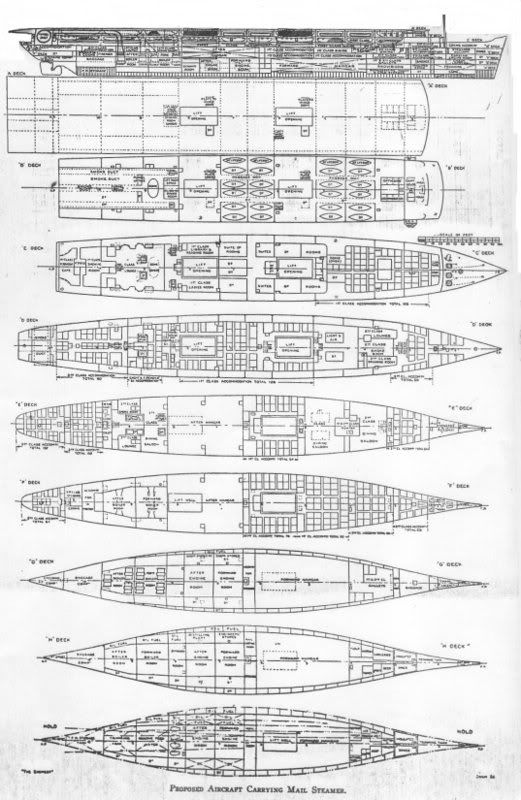
Not an aircraft but an interesting 1923 idea. This originally is suppose to have come from the publication “Transactions of the Institution of Naval Architects” Mar 1923 and was proposed by Eustace d’Eyncourt who was the British “Director of Naval Construction” from 1912 to 1923. According to Friedman’s “US Aircraft Carriers” there was a somewhat similar US proposal in 1928 for a 980-foot high speed North Atlantic liner.
The British proposal was for a 600/80/28 foot, 24 knot mail packet capable of carrying 80% of the first and second class and 40% of the third class passengers of the Mauritania for such routes as the
GB to NY with aircraft delivering mail to Canada on route
GB to Australia with aircraft delivering mail to Egypt and India on route
Vancouver to Hong Kong or Australia.
No armament was mentioned though it did say it could carry either 18 Sopwith Cuckoos or 21 Parnall Panthers or 21 Nieuport Night Hawks.
The mast was said to be not a problem because aircraft took off quickly but if it did become a problem an alternate folding mast and derrick was proposed. Bulges were fitted to protect against “icebergs”.

By: bazv - 31st December 2008 at 23:55
Forgot to mention that the Do18 and Ha139 were diesel powered,I thought maybe at least one other type was also diesel powered but too late to check 😀
I wish everybody a happy new year
regards baz
By: J Boyle - 31st December 2008 at 23:31
They did mention the name but I forget it. Queen something. Probably not a real ship. Wasn’t Queen Elizabeth or Queen Mary.
The Raging Queen*, perhaps?
I’d advise not to use 30’s Hollywood musicals for a great deal of aviation knowledge. 🙂
I’ve seen a clip of one; “Flying Down to Rio” perhaps, where a chorus line is doing their thing on the wing of a DO-X look-alike, in flight. Rather like certain low cost airlines today (seats…inside, extra).
Since were’re on the topic, the famous Shirley Temple song “The good ship lollipop” refers not to a ship but to an American Airways DC-2.
* an old Michael Palin joke.
By: Dave Homewood - 31st December 2008 at 23:30
Yes, the taking of a passenger (Ginger Rogers’ character) was in fact something that the plane normally didn’t do and the Captain was reluctant to allow in the film, but she was a celebrity and a scandal was in the newspapers, etc so he allowed it as a one off. By the way, totally crap film. The aeroplane was the only highlight.
By: bazv - 31st December 2008 at 22:51
Yes, but if they were float planes I presume that the pilot was expected to return to the ship, to be craned back aboard, after flying there and back, to deliver Fred & Ginger’s billet-doux, rather than enjoying a spot of R&R, at the nearest port, whilst awaiting the arrival the US equivalent of the Ile de France, Bremen or Europa!
I think that they normally did sit and wait…Lufthansa lost at least one crew in bad weather.
Blom und Voss Ha 139 was the biggest…
By: JDK - 31st December 2008 at 22:36
Yes, but if they were float planes I presume that the pilot was expected to return to the ship, to be craned back aboard, after flying there and back, to deliver Fred & Ginger’s billet-doux, rather than enjoying a spot of R&R, at the nearest port, whilst awaiting the arrival the US equivalent of the Ile de France, Bremen or Europa!
IIRC, the aircraft were there to gain time in international mail runs, the ship ‘shortening’ the sea crossing for ‘air’ mail. So a) they didn’t take passengers or freight and b) they did wait for their ship to arrive in port before re-embarking. I don’t believe the British ever seriously tried it, while the Germans did a lot of it – using the Dornier Wal, 18, Junkers W.33 and Ha 139 among other types. Of course it was an intermediate solution, redundant once payloads and ranges became sufficient.
An alternative in Britain was, of course, the Mayo Composite.
By: Dave Homewood - 31st December 2008 at 22:31
From the accents of the various staff on the ship who spoke in the film I believe it was meant to be a British liner. They did mention the name but I forget it. Queen something. Probably not a real ship. Wasn’t Queen Elizabeth or Queen Mary.
By: avion ancien - 31st December 2008 at 22:19
Yes, but if they were float planes I presume that the pilot was expected to return to the ship, to be craned back aboard, after flying there and back, to deliver Fred & Ginger’s billet-doux, rather than enjoying a spot of R&R, at the nearest port, whilst awaiting the arrival the US equivalent of the Ile de France, Bremen or Europa!
By: Jemiba - 31st December 2008 at 21:57
Maybe this, from http://www.fliegerweb.com/geschichte/flugzeuge/lexikon.php?show=lexikon-311 ?
Happy new year !
By: bazv - 31st December 2008 at 20:58
The German Liners Bremen and Europa carried mailplanes for a while.
Junkers W33 shown just clearing the catapult… later replaced by Ju46’s
Anybody find a better pic ??
By: Dave Homewood - 31st December 2008 at 10:58
What a fantastic job that would have been for the pilot. Enjoy the cruise then fly to the port, drop of the mail and await the ship to arrive for your next cruise. Brilliant.
By: Malcolm McKay - 31st December 2008 at 09:16
The Ile de France did –


 Sign In








 December 31, 2008 at 8:15 am