Most pilots don’t really understand the relationship between airspeed and angle of attack. If they did, we would not have the loss of control accidents that we do. We fly strictly by numbers because we were taught that way. Very few flight instructors have any experience or knowledge in this area.
Angle of attack graphic
What really matters here: airspeed or angle of attack?
For every flight operation where we use a certain airspeed to achieve maximum performance, there is one correct AOA. That AOA never changes, but the airspeed to achieve it does. All the time. Unfortunately, we are usually only given airspeeds that apply to a very specific set of circumstances. These speeds are only correct at gross weight and 1G.
Guess what? These airspeeds are never correct because we are only at gross weight and 1G sitting on the ramp. If you happen to be loaded to gross weight, as soon as you start your engine, you are burning fuel and your weight is going down. And if you are anything but straight and level in the air, you are not at 1G.
So what’s the big deal? Wouldn’t using the POH numbers provide an extra margin of safety? The answer is NO. We have many fatal accidents every year because pilots were flying too fast on approach. Or too slow because they were not at 1G. They were all flying at the wrong AOA!
We use ten basic airspeeds to fly airplanes. That’s all the manufacturers give us. The five that are marked on the airspeed indicator are aerodynamic or structural limits. They are fixed and do not vary with weight. Here they are starting at the bottom of the indicator:
Vso, bottom of the white, stall speed dirty, at gross weight and 1G
Vs1, bottom of the green, stall speed clean, at gross weight and 1G
Vfe, top of the white, max flap extended speed
Vno, top of the green, max normal operating speed
Vne, top of the yellow, redline, never exceed speed
The other five, the ones that we use as often as the ones on the indicator, are not there because they vary, primarily with weight. Here they are starting at the bottom:
Vref, approach landing speed, 1.3 Vso
Vx, best angle of climb speed
Vy, best rate of climb speed
Vbg, best glide speed
Va, minimum maneuvering speed
Here’s the problem. Using the POH numbers (gross weight and 1G), results in using many different angles of attack as our weight changes, not the one AOA that is correct. For example, if you are flying an airplane that is in the normal category, the limit load factor is 3.8G. Let’s say your clean stall speed, Vs1, is 60. Your weight varies with changes in fuel load, payload and G load. Your load changes whenever you add or remove fuel, pax, or cargo. Your G load changes whenever you move the elevator with the stick or yoke, at a fixed power setting.
Angle of attack
Standard equipment some day?
So how do you know what your stall speed really is? If you had an AOA indicator, it’s easy. Whenever your AOA indicator says you are close to stalling, read the airspeed indicator to see what your stall speed is, if you really care! At a fixed AOA, your stall speed varies directly with weight. Reduce weight (or G), stall speed goes down. Increase weight (or G), stall speed goes up.
How much can it vary? You, the pilot, control your weight, so you control your stall speed. You control your weight on the ground with fuel load and payload. You control your weight in the air with G load. Your airplane doesn’t know the difference, so you can weigh whatever you want! You can vary your G load from zero to 3.8.
Yes, we’ve all done it, you can push to zero G, meaning your weight is zero. Guess what your stall speed is at zero G? Yep, ZERO! Just like the 727 Vomit Comet, ZERO! OK, what is your stall speed at 3.8G? It varies with the square root of the G. The square root of 3.8 is 1.95. Multiply that by your 1G stall speed, 60, and your new stall speed is 117! So, you can vary your stall speed from 0 to 117 by moving the stick/yoke fore and aft, without overstressing your airplane.
So, at the first indication that you are running out of lift (i.e,. sloppy controls, buffet, stall warning, or uncommanded roll), PUSH! This pushes your stall speed down. All the way to zero if you want! Remember, if you don’t stall, you can’t spin.
Don’t go out and try to teach yourself, though. Find an instructor with an aerobatic airplane, who is experienced in all-attitude flying. Ideally, do it in an airplane with a Lift Reserve Indicator (shows lift remaining, using airspeed and AOA). I’m certain that many lives would be saved if all pilots received this training. And new airplanes came with AOA/LRI’s installed. Hopefully, someday it will be the norm, not the exception.
Be safe, and keep learning.
http://airfactsjournal.com/2015/03/airspeed-vs-angle-attack-pilots-dont-understand/
it means, an aircraft like the F-35 despite large AOA angle, but it is less maneuverable and low speed than an F-16. The high-speed aircraft such as the SR-71, MiG-31 are large AOA angle, angle alpha does not affect the g-load factor

By: garryA - 1st December 2016 at 16:20
actually, the AoA means little as what counts is the generation of lift. one strong point of the close coupled canard (and reason it has been chosen for the Rafale) is that the canards allow for better control of airflow over the wings, which in turn, allow for more lift for similar AoA without them. That’s why it cn have such a low approach speed despite being a delta, like, say, the mirage 2000
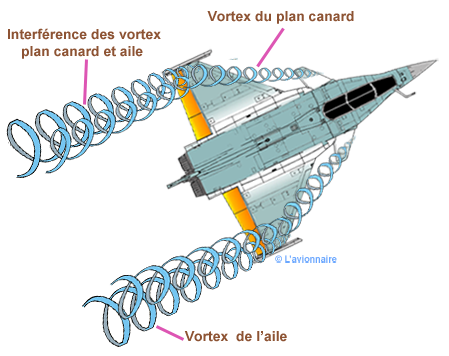
Not really, Cannard will improve CL at the same AoA by creating vortex just like a LERX or chine .But that only help to a certain extent ,aircraft AoA still play very important role.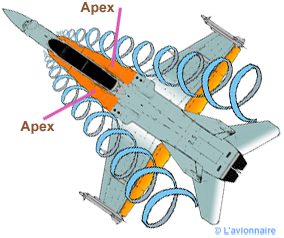

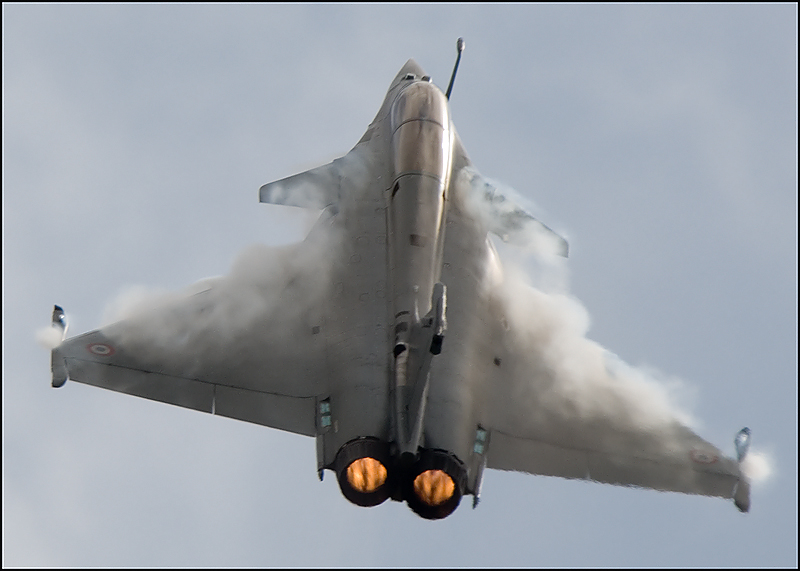
PAK-FA front LEVCONs and F-35 chines also have the same purpose

By: djcross - 1st December 2016 at 12:36
The article posted by blackadam is the way flight control laws are implemented on 99.99% of aircraft flying today where the pilot is embedded in the inner control loop. Only recently have flight control laws been implemented as a series of nested control loops with the pilot only providing input to the outermost loop. The flight control computer controls all the loops dynamically and can compensate to maintain positive safe operation of the airplane under any speed, density altitude, stores configuration or attitude. That is what true “care free handling” is about. It also makes ground/air collision avoidance easier to implement as another sensor driven input on the outer control loop.
By: TooCool_12f - 1st December 2016 at 09:44
actually, the AoA means little as what counts is the generation of lift. one strong point of the close coupled canard (and reason it has been chosen for the Rafale) is that the canards allow for better control of airflow over the wings, which in turn, allow for more lift for similar AoA without them. That’s why it cn have such a low approach speed despite being a delta, like, say, the mirage 2000
By: garryA - 1st December 2016 at 07:58
it means, an aircraft like the F-35 despite large AOA angle, but it is less maneuverable and low speed than an F-16. The high-speed aircraft such as the SR-71, MiG-31 are large AOA angle, angle alpha does not affect the g-load factor
No.
Higher AoA increase CL, aircraft with higher AoA tend to have higher CLmax. That lead to better ITR. But higher AoA increase Cd so your air speed will be depleted when you use higher AoA to turn. As a result, that not good for STR. F-35 has better ITR, nose pointing and subsonic acceleration than F-16. But F-16 is better in STR, top speed and transonic acceleration.
High speed aircraft like SR-71 and Mig-31 have low AoA so their ITR is very bad. But their T/W at dogfight speed is bad too so their STR is also bad.


 Sign In








 December 1, 2016 at 7:41 am