In that other Publication:rolleyes: theres a story about Martlets in royal navy service,and then in one of the captions it goes on to say the type was later Supplanted by the Companys Hellcat?
I didnt even know we used them and would love to see any colour pics of the Aircraft in Naval disguise.

By: Steve Bond - 18th November 2008 at 11:34
Lee,
The pilot was Jack Routley. Log books yes, photos no.
Regards
Steve
By: cotteswold - 17th November 2008 at 15:21
Live & Learn?
Never realised that the ‘Martlets’ in HMS Victorious – escorting us to Russia – were ‘Wildcats. So – I have flown a ‘Martlet’ then – when it was a ‘Wildcat’!!
And a Hellcat for that matter.
By: fantasma_337 - 17th November 2008 at 15:05
Regarding the Martlet IIIs that were diverted to the FAA since they did not arrive in Greece on time:

One of the Greek F4F-3A Wildcats during flight tests in the US, wearing a November registration.
Photo Grumman.
And what it probably looked like -as Steve correctly said- before being applied with the hybrid Desert-Blue cammo
The article on the Official Hellenic Air Force Review is in Greek
http://www.haf.gr/el/articles/wildcat/default.asp
By: BSG-75 - 16th November 2008 at 14:18
the FAA Museum Wildcat
I think its getting the same treatment as Corsair KD-431 now?
I dug out the desert artwork, “azure blue” undersides, “stone” upper – looks nice, interesting scheme for a rebuild one day?
By: LAHARVE - 14th November 2008 at 22:13
TFC’s Hellcat…


TFC’s Wildcat…


Fleet Air Arm Museum, Wildcat….

By: Lee Howard - 14th November 2008 at 21:54
I recently had the pleasure of interviewing a Royal Navy Martlet pilot who flew them in North Africa, yes, out of the desert, not off aircraft carriers.
Steve
Can I ask what his name was? Did he still have his logbooks/any photos?
Lee
By: Chad Veich - 14th November 2008 at 19:50
Just done a bit of Looking myself very Interesting indeed would love to see the TFC Hellcat done up like this one in the Picture what a beast see attached Link..
As I recall, the TFC Hellcat was in RN colors when delivered.
By: schanche - 14th November 2008 at 16:54
Just done a bit of Looking myself very Interesting indeed would love to see the TFC Hellcat done up like this one in the Picture what a beast see attached Link..
By: BSG-75 - 14th November 2008 at 15:23
Not really, these were diverted Greek Air Force machines, flown by 805 Squadron, and painted in an unusual sort of two-tone blue/grey sceheme.
it looks quite attractive if the colour plate in the Osprey book “wildcat aces of WW2” is accurate. Albacores were also shore based there for a while IIRC
By: Steve Bond - 14th November 2008 at 11:10
Not really, these were diverted Greek Air Force machines, flown by 805 Squadron, and painted in an unusual sort of two-tone blue/grey sceheme.
By: JDK - 14th November 2008 at 08:25
I recently had the pleasure of interviewing a Royal Navy Martlet pilot who flew them in North Africa, yes, out of the desert, not off aircraft carriers.
Like this?
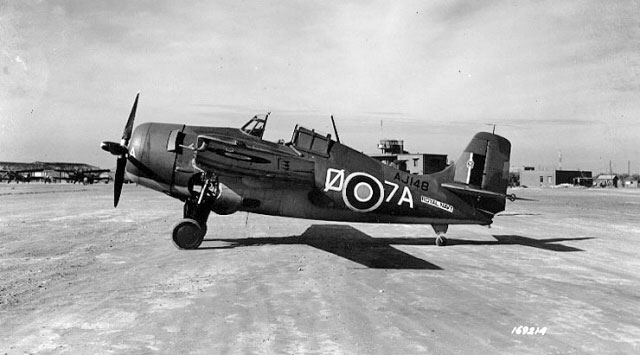
Interesting. Can you share anything here?
By: Steve Bond - 14th November 2008 at 08:22
I recently had the pleasure of interviewing a Royal Navy Martlet pilot who flew them in North Africa, yes, out of the desert, not off aircraft carriers.
By: Flying-A - 14th November 2008 at 02:30
the EMPEROR did participate in the invasion of southern France in August. US Navy Hellcats also fought in that operation, flying from the “jeep” carriers KASAAN BAY and TULAGI. The Hellcats performed strikes and shot down a handful of German aircraft.
That was Operation Dragoon. I once heard a contemporaneous recording of a radio reporter’s interview of a USN Hellcat pilot who expressed disappointment at not encountering German aircraft that day. For that reason, he and the other F6F pilots were redirected to ground targets.
At the beginning of the interview, the reporter asked what type of plane the pilot flew. When he answered “F6F”, the reporter asked for the name because “I can’t keep those letters and numbers straight.”
By: JDK - 14th November 2008 at 02:13
…and there’s examples of FAA Wildcat/Martlet and Hellcat at the FAA Museum, Yeovilton, where you’d expect to find them.
TFC’s Hellcat was painted (with a reversed fin-flash initially) as a RN FAA Hellcat on delivery to the UK from Fighter Rebuilders.
This huge thread has some great shots in the Grumman factory of Martlets and IIRC, RN Hellcats.
http://warbirdinformationexchange.org/phpBB2/viewtopic.php?t=13327
By: Bager1968 - 14th November 2008 at 01:50
A modified version of the U.S. Navy’s F4F, the Grumman Model G-36A provided the Royal Navy with its first high-performance single-seat monoplane carrier fighter. Named “Martlet I” in British service, these 81 aircraft had originally been ordered by France and were taken over by the British after France surrendered. Powered by 1,240 horsepower Wright “Cyclone” radial engines, the first “Martlets” entered service in September 1940, and achieved the first “kill” for any American-built fighter in British service on Christmas day of that year, when a German Ju-88 was forced down near Scapa Flow.
Several other versions of the design followed in 1941. The 100 “Martlet II” and 30 “Martlet III” types had 1,200 horsepower Pratt & Whitney “Twin Wasp” engines, like the American F4Fs. Most “Martlet IIs” also had folding wings. These early “Martlets” had considerable combat service, flying from shore bases and from aircraft carriers, including the pioneer escort carrier, HMS Audacity. Very maneuverable by European standards, and heavily armed, they were a serious threat to enemy aircraft.
The “Cyclone” powered Grumman F4F-4B, a type built solely for transfer to the British, became the “Martlet IV”. Like later versions of the design, these 220 planes were provided through Lend-Lease, rather than by sale, and were delivered starting in 1942. Next in the series were over 300 “Martlet Vs”, identical to the U.S. Navy’s General Motors-built FM-1, with Pratt & Whitney engines. Surviving units of these two types were redesignated “Wildcat IV” and “Wildcat V” in January 1944. There were also 340 “Wildcat VI” fighters, the equivalent to the USN’s FM-2. The first of these arrived in 1944.
The later British “Martlets” and “Wildcats” were extensively used at sea, primarily based on escort carriers though some were also carried aboard fleet carriers. In addition to anti-submarine work, teamed with “Swordfish” strike aircraft, they participated in amphibious operations in the Mediterranean and Normandy, helped make oceanic aerial reconnaissance unhealthy for the German air force and successfully competed with enemy fighters for control of the air over European shores.
More Martlet info can be found here: http://www.faqs.org/docs/air/avf6f.html
http://www.faqs.org/docs/air/avf6f.html
The Hellcat was also heavily used by the British Royal Navy’s Fleet Air Arm (FAA). A total of 252 F6F-3s were supplied beginning in March 1943. The FAA had originally wanted to call it the “Gannet F.I (Fighter Mark I)”, but by this time they were realizing that changing the names of Yank aircraft in their service caused more confusion than it was worth, and so the aircraft was simply called the “Hellcat F.I”.
Two squadrons were built up in 1943, being dispatched on the HMS EMPEROR for convoy duty late in the year, where they saw no real combat. When the EMPEROR returned to Britain in early 1944, the ship was sent north in March as part of OPERATION TUNGSTEN, the attack on the German battleship TIRPITZ in its protected Norwegian fjord. The Hellcats fought in wintry weather, taking on German Bf-109Gs and FW-190As, and claiming three kills for the loss of one of their own.
The Hellcat Is did not participate in the Normandy invasion in June 1944, but the EMPEROR did participate in the invasion of southern France in August. US Navy Hellcats also fought in that operation, flying from the “jeep” carriers KASAAN BAY and TULAGI. The Hellcats performed strikes and shot down a handful of German aircraft.
By this time, the FAA was receiving the F6F-5, with deliveries running to a total of 930. Most were “Hellcat F.II” fighters, with some unknown number fitted with four extended launch rails under each wing, for a total of eight, to carry British 27.2 kilogram (“60 pounder”) unguided rockets.
About 70 of the Hellcat IIs were 70 F6F-5N night fighters, these being given the British designation of “Hellcat NF.II”. Blackburn Aircraft also converted a number of fighters to a photo-reconnaissance standard, with three cameras in the rear fuselage. These machines were given the designation “Hellcat PR.II (Photo-Reconnaissance Mark II)” if they were unarmed and “Hellcat FR.II (Fighter-Reconnaissance Mark II)” if they retained their guns.
The FAA Hellcat IIs saw service against the Japanese beginning in August 1944, in particular operating around Malaya and the East Indies. Most of the FAA Hellcats were out of service by the end of 1945, some squadrons being immediately disbanded with the end of the war. Some Hellcat NF.IIs and PR.IIs remained in service into 1946, and a few Hellcats were retained as hacks or other second-line purposes into the early 1950s.
By: DazDaMan - 13th November 2008 at 23:01
Fank gawd for that! 😀
By: Bradburger - 13th November 2008 at 22:56
What about the Hellcat ? In Royal Naval colours
Am I completely imagining it, or did I see a warbird Hellcat painted in FAA markings at some point? :confused:
You weren’t Daz, it was Tom Freidkin’s NX30FG!
Cheers
Paul
By: DazDaMan - 13th November 2008 at 22:47
Am I completely imagining it, or did I see a warbird Hellcat painted in FAA markings at some point? :confused:
By: schanche - 13th November 2008 at 22:04
What about the Hellcat ? In Royal Naval colours
By: Bradburger - 13th November 2008 at 20:56
CAF Wildcat Colours – Yikes!
Nice shots geedee.
However, the CAF example is not a good example of what a RN Wildcat/Martlet looked like! :rolleyes:
Take a look here schanche to see how one should look:-
http://fighter-collection.com/pages/aircraft/wildcat/index.php
Cheers
Paul


 Sign In








 November 13, 2008 at 8:17 pm