Not long after the Sicily landings my father (serving in the Gordon Highlanders) was wounded (drove over a land mine) and said he was medevaced from the front line in a small aircraft. He can only remember that he was in a canvas stretcher which was attached external to the aircraft with his head just under the wing and the stretcher attached (somehow) along the fuselage. I am guessing this may have been a Stinson but not sure. Anyone else have any suggestions as to what this aircraft would have been? For obvous reasons he can not remember much about that part of the trip. (After landing somewhere in Sicily he was then flown in a larger aircraft – again not sure what – to Malta for hospitalisation).

By: EagleIan - 8th January 2011 at 17:26
Thanks for all the replies. I will pass this link on to him to see if he can remember any of these.
By: wieesso - 8th January 2011 at 02:06
L-5
http://history.amedd.army.mil/booksdocs/HistoryofUSArmyMSC/page140.jpg
By: Bager1968 - 8th January 2011 at 01:55
The Stinson L-5 Sentinel was used in the air ambulance role, but the normal method was to load the stretcher in the fuselage. The L-5 had a hatch in the rear fuselage, and the stretcher was fully inside the fuselage.
One hundred modified Piper J-5Cs (US Army designation L-4) were ordered by the USN as HE-1 ambulance aircraft in 1942. These aircraft could accommodate a pilot and one stretcher. The deck of the fuselage from the trailing-edge of the wing to the vertical fin was arranged to hinge up to permit the loading and unloading of one USN standard litter. The hinge was located forward at the rear of the wing.
PA-18 Piper Air Ambulance
OPERATIONAL HISTORY
In USN service, the HE-1/AE-1 aircraft were usually based at small, remote air stations, e.g., Naval Auxiliary Air Stations (NAASs) Brown Field and Holtsville, California; Chase Field, Texas; Martha’s Vineyard, Massachusetts; Oceana, Virginia; Vero Beach, Florida, etc. that were located some distance from major medical facilities.The U.S. Marine Corps (USMC) accepted their first in 1943. By August of that year, the Marines were operating seven aircraft assigned to the Base Air Detachments (BADs) at Marine Corps Air Stations.
I would not be surprised if some were brought along with the USN landing ships for Sicily, etc.
It might be that either he remembers this before they closed the clamshell, or that the aircraft he was flown in had the hatch removed for quicker access.
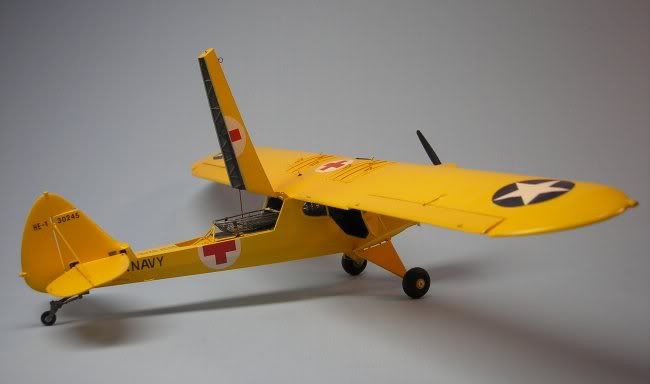
Also, it is possible that various units had begun attaching stretchers beside the fuselage like they would later do with helicopters (TV show M*A*S*H for example), but I haven’t found confirmation of this.


 Sign In








 January 7, 2011 at 7:45 pm