I’m launching a thread to discuss medium carriers. We tend to focus a lot on individual designs or light STOVL carriers, but there have been quite a few medium carriers post-WWII that are worth comparing. All are pretty sexy designs.
My definition of a medium carrier is one that can operate supersonic conventional jet fighters, with an airwing of 25-50 aircraft (i.e. Colussus & Majestic class don’t count). The range of medium carriers goes from HMS Victorious and FS Clemenceau at the small end of the scale to USS Midway and CVF/PA2 at the high end of the scale. Here’s a graphical comparison, with some key statistics:
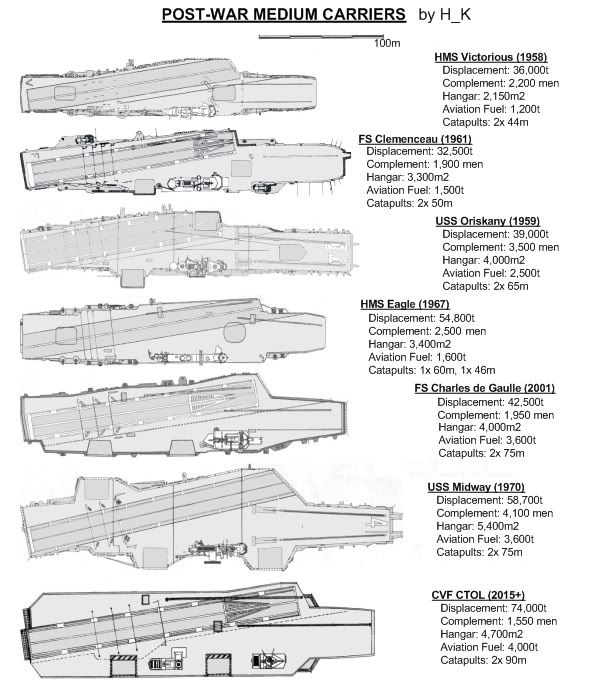

By: H_K - 13th November 2009 at 21:13
But all in all I bet the French wish they would have built CdG 5000 tons larger …
Absolutely. IMHO, a new-build, stretched CdG of 50,000t displacement still makes sense today as an alternative to CVF FR. I’ve actually been toying with this idea:
Hull Plug
– Add a 15m plug below the island, between the propulsion and the munitions storage tranches, allowing you to significantly improve aviation facilities
– Compensate for the increased displacement by using silicone anti-fouling to retain a 27kt top speed
– Use CdG’s post-refit plans, since the refit addressed many equipment obsolescence issues, particularly on the communications side
Improved Aviation Facilities 😎
– 5 extra Rafales in the enlarged hangar and deck parking
– 30% more munitions and aviation fuel storage
– Fit 90m catapults, to enable Rafales to launch at >24t (e.g. with CFTs).
– Enlarge both lifts to carry 2 Rafales each, improving aircraft flow
Cost
– A follow-on CdG was costed at 2b euros in 2003 :eek:, significantly less than CVF FR (2.5 billion), despite have nuclear propulsion. CdG itself cost 2.2b euros in the mid-1990s.
– Additional cost savings of ~200MM euros are possible ;), by simplifying the combat systems and procuring parts from CVF UK. For example, use only one multifunction radar (Herakles) instead of 4 radars on CdG, take one of CdG’s Sylver launchers (16 Aster on each), buy the same lifts as on CVF etc.
See the image below for where CdG’s hull could be stretched: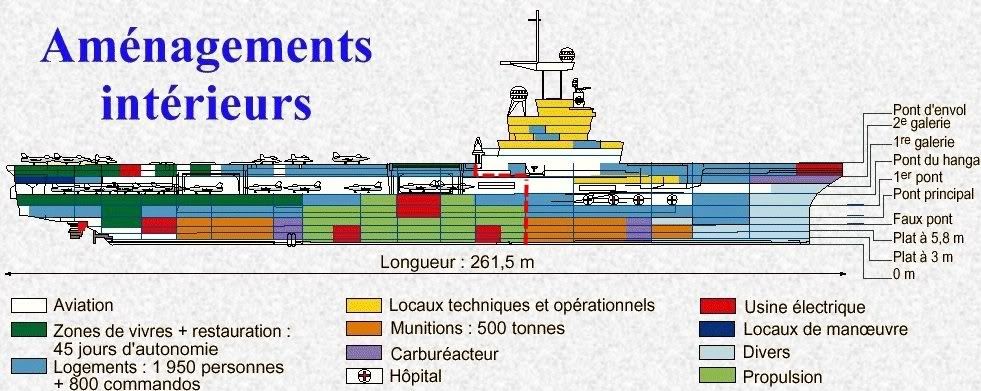
(Original image: http://www.netmarine.net/bat/porteavi/cdg/caracter.htm)
And…the final result: 3rd carrier down from top. :diablo:
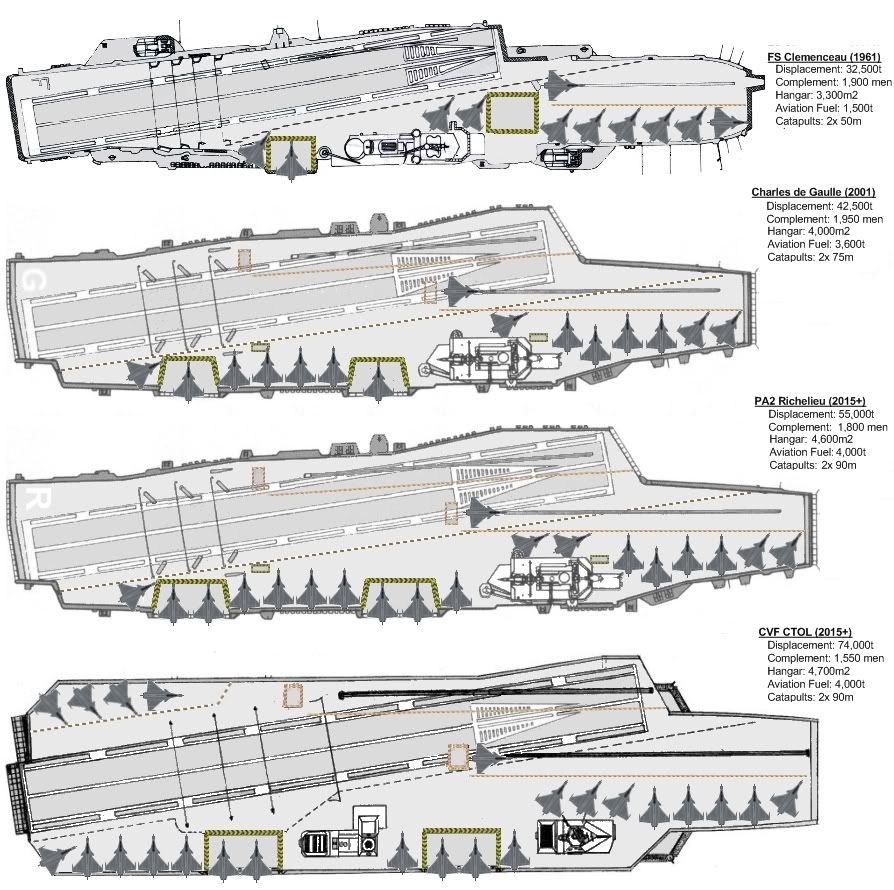
By: H_K - 13th November 2009 at 21:08
There shouldn’t be a need for than ~28 Rafale, since with that number they can realize two strike packages with escorts and optional buddy-buddy-AAR, plus have enough planes left for task force protection CAP. All that under a mission capable rate of at least 80%. Of course it’s not sustainable, but can be done once.
(…) If it’s not for a deep strike mission against some land target CdG would be just fine with, say, 18 Rafale, three Hawkeye, and 8/10 AW101. And later additionally some three or four ISR UAV in the MQ-9 class (like the proposed carrier capable version that lost BAMS).
The problem is that CAP eats up at least 20 sorties a day (2 aircraft every 2.5 hours or so). Then add a minimum of 10 sorties for buddy-refueling, reconnaissance, and air interdiction/escort/SEAD. So unless you’re operating in a permissive environment or with air cover from another carrier or from land, you can only generate strike sorties once you’re past the 30 sortie mark.
At 2 sorties per aircraft per day, that means that you can generate 6 strike sorties with 18 fighters, 30 strike sorties with 30 fighters, and 70 strike sorties with 50 fighters. Those economies of scale explains why it makes so much sense to operate super-carriers, and even more so in pairs.
I’m actually suprised the French didn’t buy the AW101. The ASW capabilities of a French task force seems quite underwhelming!
NH-90 was supposed to bring EH101-like performance 10 years ago, though trading off range/endurance for more airframes (which is not necessarily a bad trade-off). Unfortunately NH-90 is now so late and problematic that in hindsight EH101 wouldn’t have been a bad choice. That said, French ASW capability remains among the best in Europe (almost on par with the RN), thanks to active towed sonar, SSNs, and a great torpedo (Mu-90).
And I’d say a third Hawkeye would be worth its weight in gold!
Fully agree. 😉 In 2007, the US actually offered to sell a second hand Hawkeye (upgraded to Hawkeye 2000 standard) for $260 million, which was a significant discount. This would have allowed the French to deploy 3 Hawkeyes while keeping the 4th at home for training. Unfortunately, they couldn’t afford it.
By: Distiller - 13th November 2009 at 19:20
There shouldn’t be a need for than ~28 Rafale, since with that number they can realize two strike packages with escorts and optional buddy-buddy-AAR, plus have enough planes left for task force protection CAP. All that under a mission capable rate of at least 80%. Of course it’s not sustainable, but can be done once.
I’m actually suprised the French didn’t buy the AW101. The ASW capabilities of a French task force seems quite underwhelming!
And I’d say a third Hawkeye would be worth its weight in gold!
If it’s not for a deep strike mission against some land target CdG would be just fine with, say, 18 Rafale, three Hawkeye, and 8/10 AW101. And later additionally some three or four ISR UAV in the MQ-9 class (like the proposed carrier capable version that lost BAMS).
But all in all I bet the French wish they would have built CdG 5000 tons larger …
By: H_K - 13th November 2009 at 17:37
Does parking behind the island include impinging on the lifts (preventing movements from the hangers)?
I’m including 2 aircraft on the lifts, but these could be moved to the catapults for the 1st launch, or to bow parking (where they would block the bow catapult though). Overall, with 14 Rafales in deck parking, the density is somewhat less than USN practice.
Does CdG have enough fuel or ammunition storage to support that many aircraft?
Yes. CdG’s aviation fuel storage is 4,000m3, which is enough for 7 days of operations at 2 sorties per aircraft per day (about 70 sorties per day including helos). If you scale this up to a USN CVN (2x larger airgroup and at a guess 30% more fuel consumption for the F-35C and F/A-18E/F), that’s the equivalent of approximately 10,500m3.
USN CVNs actually have 13,000m3 Avgas, so their combat endurance should be about 25% better than CdG, which demonstrates the benefits of a larger carrier.
CdG’s munitions storage is 4,900m3, which according to various sources translates to 600t-2,100t of munitions depending on density. USN CVNs carry 2,900t, but it’s unclear at what density. Overall, capacity is similar given that CdG has half the airgroup.
Does CdG carry helicopters? Because they reduce the number of Rafale’s that can be carried. And 2 E-2’s isnt enough for 24/7 coverage.
CdG typically carries 2 medium helos (Puma, NH90 in future) plus 2 light helos (Dauphin/Panther) for plane guard duties. These 4 helos take up about as much parking as 1 Rafale, so they’re almost irrelevant. (I did factor them in though)
2 E-2Cs is unfortunately all the French Navy can deploy at any one time. At 2 sorties per aircraft per day they can provide almost 24/7 coverage, but only for a few days until one needs to go into maintenance.
How much space does CdG’s propulsion plant take up compared to that on CVF or even her predecessors?
Not sure. But the nuclear configuration does allow for more aviation fuel carriage than with conventional propulsion.
How are the hangers arranged? Depending on arrangement, total area does not tell you how much is “usable”.
I’d love to get my hands on a layout. 🙂 However, numbers given originally were 20-25 aircraft, in theory F/A-18Cs since that’s what CdG has been designed around. More recently, 16 Rafales has been mentioned, which is consistent with the Rafale’s larger spotting factor.
Does rafale need more and bigger maintenance equipment then the SE?
The answer is definitely yes for engine spares (since there are 2 engines). However, you also go from 2 types to one type, so I don’t know where it nets out.
Oh, is that 32 rafale number with or without other aircraft? (E-2 & Helicopters)
30-32 Rafale, 2 E-2C, 4 helos
By: StevoJH - 13th November 2009 at 07:12
I’ve given this a lot of thought, and everything points to 24 Rafales being an absurdly low number. So if there’s any truth to this number, IMHO it must reflect peacetime budgetary constraints and not the way CdG could be operated in wartime, or the way another navy such as the USN would operate her.
USN CVN benchmark
USN CVNs had a 72% space utilization rate during OIF, and achieved very high sustained sortie rates despite this (2x per aircraft for 3 weeks, i.e. 125 sorties per day). USN CVNs in the 1980s and 1990s had even higher space utilization rates, but sortie rates may have been lower. CdG’s space utilization rate with 30 Rafales and 2 E-2Cs is 66%. With 24 Rafales this number falls to 54%, which would imply that the French navy doesn’t know how to use parking space efficiently.Clemenceau benchmark
Clemenceau could carry 36 fixed wing of Super Etendard size, despite the fact that her parking space was only 6,800m2 (3,500m2 deck parking + 3,300m2 hangar). CdG has 20-25% more parking space (8,400-8,900m2), which would be enough to carry around 45 Super Etendards.CdG’s design objectives
CdG was designed for an air group of 35-40 aircraft, with F/A-18s providing the fixed wing component. If you take that as meaning 36 F/A-18s and 4 helos, that adds up to 5,300m2. Which in turn translates to about 30 Rafales, 2 E-2Cs and 4 helos.CdG deck parking analysis
CdG can accomodate 14 Rafales in deck parking without interfering with launch or recovery operations (6 on bow, 8 behind the island), and in a fairly efficient layout for aircraft movements. The hangar can accommodate roughly 18 Rafales and E-2Cs. That’s a total of 30 Rafales and 2 E-2CsFrench parliament reports
In 2003, they stated CdG’s capacity as 32 Rafale.
Does parking behind the island include impinging on the lifts (preventing movements from the hangers)?
Does CdG have enough fuel or ammunition storage to support that many aircraft?
Does CdG carry helicopters? Because they reduce the number of Rafale’s that can be carried. And 2 E-2’s isnt enough for 24/7 coverage.
How much space does CdG’s propulsion plant take up compared to that on CVF or even her predecessors?
How are the hangers arranged? Depending on arrangement, total area does not tell you how much is “usable”.
Does rafale need more and bigger maintenance equipment then the SE?
Lots of factors to take into account.
Oh, is that 32 rafale number with or without other aircraft? (E-2 & Helicopters)
By: H_K - 13th November 2009 at 05:23
From memory CdG would carry 30+ aircraft only when the majority were SE’s. The Rafale is a much larger aircraft, so 24 is probably about right.
I’ve given this a lot of thought, and everything points to 24 Rafales being an absurdly low number. So if there’s any truth to this number, IMHO it must reflect peacetime budgetary constraints and not the way CdG could be operated in wartime, or the way another navy such as the USN would operate her.
USN CVN benchmark
USN CVNs had a 72% space utilization rate during OIF, and achieved very high sustained sortie rates despite this (2x per aircraft for 3 weeks, i.e. 125 sorties per day). USN CVNs in the 1980s and 1990s had even higher space utilization rates, but sortie rates may have been lower. CdG’s space utilization rate with 30 Rafales and 2 E-2Cs is 66%. With 24 Rafales this number falls to 54%, which would imply that the French navy doesn’t know how to use parking space efficiently.
Clemenceau benchmark
Clemenceau could carry 36 fixed wing of Super Etendard size, despite the fact that her parking space was only 6,800m2 (3,500m2 deck parking + 3,300m2 hangar). CdG has 20-25% more parking space (8,400-8,900m2), which would be enough to carry around 45 Super Etendards.
CdG’s design objectives
CdG was designed for an air group of 35-40 aircraft, with F/A-18s providing the fixed wing component. If you take that as meaning 36 F/A-18s and 4 helos, that adds up to 5,300m2. Which in turn translates to about 30 Rafales, 2 E-2Cs and 4 helos.
CdG deck parking analysis
CdG can accomodate 14 Rafales in deck parking without interfering with launch or recovery operations (6 on bow, 8 behind the island), and in a fairly efficient layout for aircraft movements. The hangar can accommodate roughly 18 Rafales and E-2Cs. That’s a total of 30 Rafales and 2 E-2Cs
French parliament reports
In 2003, they stated CdG’s capacity as 32 Rafale.
By: StevoJH - 13th November 2009 at 03:35
From memory CdG would carry 30+ aircraft only when the majority were SE’s. The Rafale is a much larger aircraft, so 24 is probably about right.
By: H_K - 13th November 2009 at 00:50
I’m resurrecting this thread to talk about medium carrier air wings, and compare these to USN air wings.
USN CVNs
During Operation Iraqi Freedom (2003), a fairly typical USN airgroup was 12x F-14, 12x F-18E, 24x F-18C, 8x S-3B, 4x E-2C, 4x EA-3B, 2x C-2, 6x helos (on Nimitz). This airgroup was able to sustain ~125 sorties per day for 3 weeks (2 sorties per aircraft per day), so wasn’t overcrowded.
Total parking area:15,400m2 (9,400m2 deck parking, 6,000m2 hangar, so a 60-40 split).
Total spotting area for airgroup (wings folded): 11,000m2
–> That gives us a benchmark space utilization rate of 72%
Charles de Gaulle
The maximum airgroup is said to be 32x Rafale, 2x E-2C, 4x helos, though 24x Rafales has also been quoted.
Total parking area: 8,300m2 (4,300m2 deck parking, 4,000m2 hangar). That’s a 50-50 split, so the hangar is larger than USN practice.
Total spotting area for airgroup (32 Rafales): 5,800m2 –> 70% space utilisation rate. The 24 Rafale airgroup gives a 54% utilization rate.
CVF CTOL
Total parking area: 12,000m2 (7,300m2 deck parking, 4,700m2 hangar). This brings us back to the 60-40 split that is common USN practice.
Assumming a maximum space utilization rate of 70%, this implies a spotting area of 8,300m2.
–> That’s enough for 52x F-35C, 3x E-2C and 6 helos! 😮
Conclusion
CVF could carry about 75% of a USN CVN’s airgroup, and CdG can carry about 50% of a USN CVN’s airgroup. The interesting thing is that CVF is about 75% of the displacement of a USN CVN, and CdG is about 45%. This implies that the economies of scale for carriers don’t apply as much as they did in the past, or that at the very least medium carriers can be designed with enough internal volume to be as efficient pound per pound as a CVN. 😉
(The caveat is that CVF’s fuel & munitions storage isn’t sized to cope with such a large airgroup, so isn’t entirely true).
By: crgritchie - 7th October 2009 at 16:12
I’m launching a thread to discuss medium carriers. We tend to focus a lot on individual designs or light STOVL carriers, but there have been quite a few medium carriers post-WWII that are worth comparing. All are pretty sexy designs.
My definition of a medium carrier is one that can operate supersonic conventional jet fighters, with an airwing of 25-50 aircraft (i.e. Colussus & Majestic class don’t count). The range of medium carriers goes from HMS Victorious and FS Clemenceau at the small end of the scale to USS Midway and CVF/PA2 at the high end of the scale. Here’s a graphical comparison, with some key statistics:
A superb graphic, thanks v.much for posting this. But I’d include CVF & Midway at the bottom of the Supercarrier group.
By: sealordlawrence - 4th March 2009 at 21:55
Totally agree commercial Diesels were the right choice and the chosen ones do get her from point A to B without too much fuss … just not very quickly.
Basically chosen for cost, HMS Ocean is the definition of a budget warship. Which really is not an issue as she gets done what is asked of her and is unlikely to be placed in a situation where she needs anything more.
By: Fedaykin - 4th March 2009 at 20:46
I was referring to the choice of commercial diesels over Gas Turbines, for the reasons outlined above. If they picked the wrong specific engines for the job, that’s another matter. She seems to get from A to B without much fuss though.
Totally agree commercial Diesels were the right choice and the chosen ones do get her from point A to B without too much fuss … just not very quickly.
By: Obi Wan Russell - 4th March 2009 at 20:38
I’m sure that I read somewhere that her Crossley Pielstick 16PC2.6 don’t lend her the best of peformance.
I was referring to the choice of commercial diesels over Gas Turbines, for the reasons outlined above. If they picked the wrong specific engines for the job, that’s another matter. She seems to get from A to B without much fuss though.
By: Fedaykin - 4th March 2009 at 20:06
As far as I can tell, Large commercial diesel engines as fitted to Ocean have similar up front buying costs to Gas Turbines the reals savings come in running and maintenance costs, requiring far fewer engine room personnel to look after them. Hence Super Tankers and other large merchant ships needing only a handful of engineers. Compare Ocean’s complement with an Invincible (upon whose hull Ocean’s design was based) and the difference is significant. Efforts to keep Oceans costs down at the design and build stage are generally agreed to have gone a little too far, and many of these problems have been remedied now, but the choice of engines was a sound one IMHO.
I’m sure that I read somewhere that her Crossley Pielstick 16PC2.6 don’t lend her the best of peformance.
By: Obi Wan Russell - 4th March 2009 at 17:58
As far as I can tell, Large commercial diesel engines as fitted to Ocean have similar up front buying costs to Gas Turbines the reals savings come in running and maintenance costs, requiring far fewer engine room personnel to look after them. Hence Super Tankers and other large merchant ships needing only a handful of engineers. Compare Ocean’s complement with an Invincible (upon whose hull Ocean’s design was based) and the difference is significant. Efforts to keep Oceans costs down at the design and build stage are generally agreed to have gone a little too far, and many of these problems have been remedied now, but the choice of engines was a sound one IMHO.
By: sealordlawrence - 3rd March 2009 at 07:29
No, but they need not be frighteningly expensive (see Juan Carlos I propulsion – she is not a very expensive ship) & they can pay for themselves in reduced running costs.
Very true, but the RN format has so far required development money as well.;)
By: swerve - 2nd March 2009 at 23:36
Gas turbines and electric propulsion do not come cheap.;)
No, but they need not be frighteningly expensive (see Juan Carlos I propulsion – she is not a very expensive ship) & they can pay for themselves in reduced running costs.
By: sealordlawrence - 2nd March 2009 at 22:05
Don’t read anything more sinister into this than amusement. What other conversation could we have where the words ‘only‘ and ‘16,000 tons‘ in the same sentence and no one bats an eyelid?!
Al
Nothing more than a demonstration of the scale of the vessels being discussed, I quite agree however.;)
By: Al. - 2nd March 2009 at 22:04
and is only about 16,000t short of a Nimitz.
Don’t read anything more sinister into this than amusement. What other conversation could we have where the words ‘only‘ and ‘16,000 tons‘ in the same sentence and no one bats an eyelid?!
Al
By: sealordlawrence - 2nd March 2009 at 18:26
Agreed. But the point I was trying to make was that a 20,000 tonne warship was produced for not a great deal more than a 3,000 to 4,000 tonne warship, because the ship’s steel is one of the least expensive aspects of the design. This is also a factor in all the current generation of RN warships (eg Type 45, Albion class LPDs, Bay clalss LSDs and CVF) are so much larger than the ships they are/will replace. The extra volume solves many problems such as habitability and installation of equipment at very litle extra cost, and in the case of improved accomodation will go some way to helping recruitment and retention of service personnel.
So when designing a new warship, and ecomomies are required, making the ship smaller is one of the least effective ways of saving money, and in the long run can make the ship near impossible to upgrade and retain in service (eg type 21) thus forcing replacement at an earlier date.
Indeed, but it is imperative to remember that RN surface combattants are very high end, the T45 is most complex/sophisticated ship in service today and the one effort to better her on that front has essentially failed (DDG1000) and the same applied to the T23 series in its day. Gas turbines and electric propulsion do not come cheap.;)
By: Obi Wan Russell - 2nd March 2009 at 18:22
And she only has direct diesel propulsion (no expensive gas turbines or electric motors) and she was largely built to mercantile standards. Furthermore that figure is very misleading as there were huge variations in the costs for the individual Type 23s. HMS Norfolk (first of class) came out at £135.5 million whereas later units drifted between £60 million and £96 million. At least part of the savings came from halving the man hours required by each unit during the production run. By comparison Ocean came out at about £154 million.
Agreed. But the point I was trying to make was that a 20,000 tonne warship was produced for not a great deal more than a 3,000 to 4,000 tonne warship, because the ship’s steel is one of the least expensive aspects of the design. This is also a factor in all the current generation of RN warships (eg Type 45, Albion class LPDs, Bay clalss LSDs and CVF) are so much larger than the ships they are/will replace. The extra volume solves many problems such as habitability and installation of equipment at very litle extra cost, and in the case of improved accomodation will go some way to helping recruitment and retention of service personnel.
So when designing a new warship, and ecomomies are required, making the ship smaller is one of the least effective ways of saving money, and in the long run can make the ship near impossible to upgrade and retain in service (eg type 21) thus forcing replacement at an earlier date.


 Sign In








 December 14, 2008 at 10:46 pm