How does the Mark-62 quick strike work ? does it explode on contact or it will explode if any ship come near it
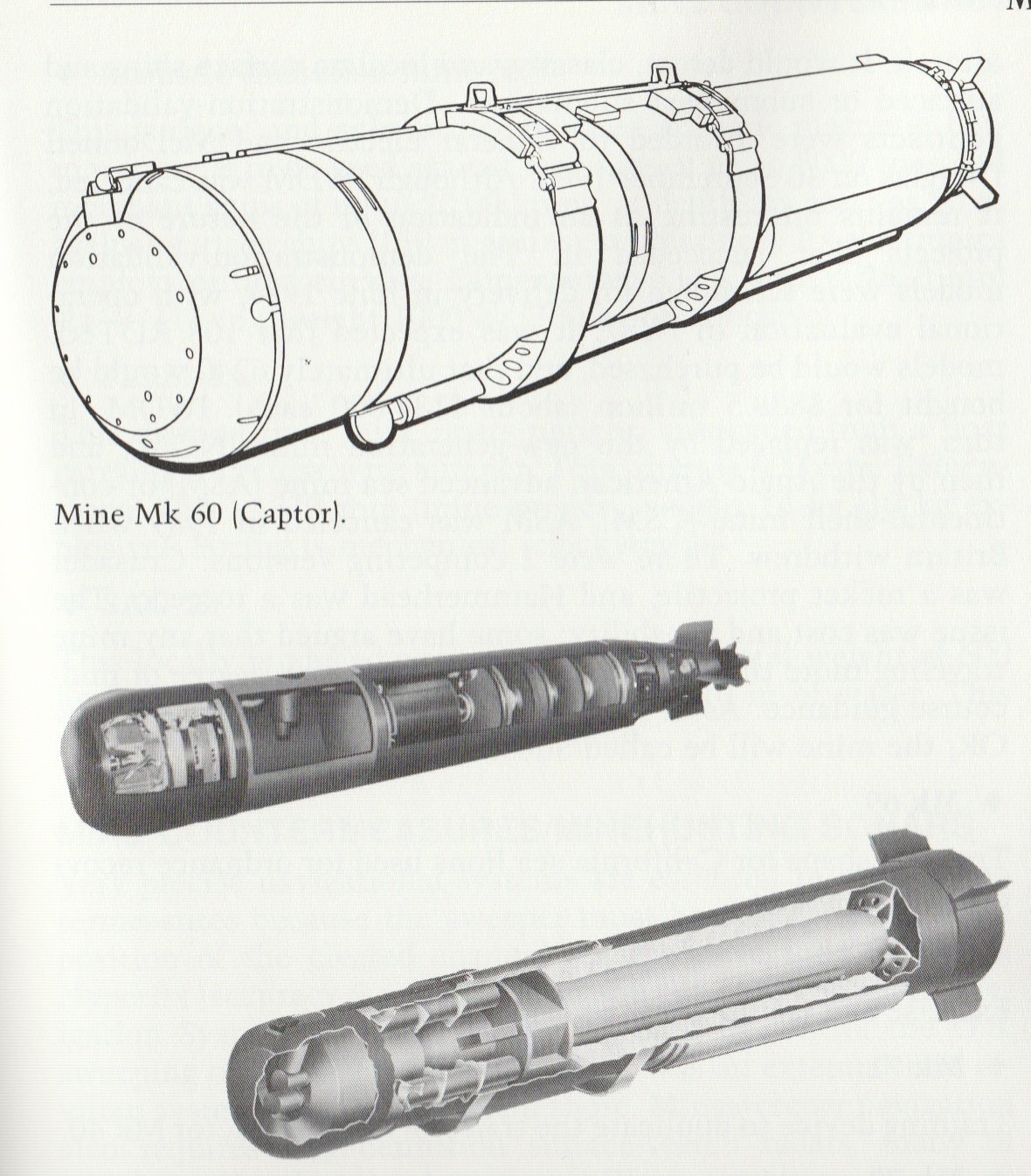
Mark-60 CAPTOR seem to have a passive sonar that can distinguish between difference kind of surface vessels and submarines and launch a torpedo when enemy vessels come near :dev2: so will it work against modern submarine that is very silent ?,can it launch Mark 54 or MU90 torpedo instead of Mark 46 ,the mine have something like maximum depth of 940 meter what does that mean:confused:

By: Wanshan - 20th June 2012 at 08:44
CAPTOR =
Aircraft, ship or submarine laid magnetically moored mine. More specifically, a deepwater moored torpedo launcher. It is (self) anchored to the ocean floor, where it lies dormant until a target is detected, at which time the torpedo swims out of its capsule to attack and destroy its target. Lifetime is several weeks or months. I suppose it doesn’t come with a mooring cable of unlimited length. Hence, the maximum depth. (But you could have googled that yourself too….)

http://www.fas.org/man/dod-101/sys/dumb/mk60.htm
http://en.wikipedia.org/wiki/Mark_60_CAPTOR
Originally used Mark 46 Mod 4 torpedo with aluminum case, but was then modified to accept a Mk 46 Mod 5 (NEARTIP) torpedo as its warhead. The hardware design for this Mod 1 version was completed under a FY88 program.
So, I don’t think MK60 CAPTOR was/is produced with anything other than MK46. However, I suppose the principle could be applied with any lightweight ASW torpedo.
Similar to the US Navy’s CAPTOR mine is USSR/russian federation PMR/PMK-1. PMR is a 21” diameter submarine-laid mine designed to actively attack shipping. The PMR sits horizontally on the seabed; a passive sonar hydrophone compares shipping sounds to a stored threat library and if a target signature is detected; a smaller subcaliber torpedo launches and attacks the target. After 1991, Russia redesignated the weapon PMK-1.
China is working on a similar design.
http://www.usnwc.edu/Research—Gaming/China-Maritime-Studies-Institute/Publications/documents/CMS3_Mine-Warfare.aspx
By: moon_light - 18th June 2012 at 16:20
:confused::confused: u haven’t answer some questions , what does this mean by ” maximum depth “, and can the Mark 60 carry any other torpedo apart from Mark-46
By: Wanshan - 15th June 2012 at 16:47
Mk 62/63 (Quickstrike)…conversions of standard streamlined bombs (Mks 82, 83, 84, respectively: 500, 1000, 2000 lb) supersede Destructors EX-52 through -54. The Destructors were magnetic-fuzed. These weapons can be dropped either on land (where they can be exploded by the magnetic signatures of vehicles) or in shallow water. Assembled very quickly using stored fuzes, Mk 62/ 64 are called Quickstrikes. All have standard thick-walled bomb casings, and their tails are adaptable to parachutes.
…These weapons use 2 alternative target-detection devices (TDDs): Mk 57 (magnetic-seismic) and Mk 58 (magnetic-seismic-pressure). Presumably, seismic is, in effect, an acoustic sensor using sound as transmitted through the sea floor rather than directly through the water. These units are to be replaced by new Mk 70 and Mk 71 TDDs.
The QUICKSTRIKE Service Mine Mk 62 is an explosive-loaded (H-6 fill) bottom mine operationally planted by personnel flying B-52H Stratofortress, F/A-18A/D Hornet, F-14A/D Tomcat, B-1B Lancer, B-2A Spirit, or P-3C Orion aircraft. This mine is currently being flight tested on the F/A-18E/F Super Hornet with carriage approval expected in the near future.
This 500-pound mine consists of a thick-walled general purpose (GP) Bomb Mk 82 incorporating an Arming Device Mk 32, and a Fin Mk 15, Fin BSU-86/B, or Tail Section Mk 16. The mine uses a Target Detection Device (TDD) Mk 57 (magnetic and seismic sensors) to detect stimuli generated by enemy vessels. The mine case is painted either olive drab or gray (new color).
…
The QUICKSTRIKE Service Mine Mk 63 is an explosive-loaded (H-6 fill) bottom mine operationally planted by personnel flying B-52H Stratofortress, F/A-18A/D Hornet, or P-3C Orion aircraft. This mine is currently being flight tested on the F/A-18E/F Super Hornet with carriage approval expected in the near future.This 1,000-pound mine consists of a thick-walled general purpose (GP) Bomb Mk 83 incorporating an Arming Device Mk 32 and a Fin MAU-91A/B or Tail Section Mk 12. The mine uses a Target Detection Device (TDD) Mk 57 (magnetic and seismic sensors) to detect stimuli generated by enemy vessels. The mine case is painted either olive drab or gray (new color).
http://www.hartshorn.us/Navy/navy-mines-12.htm
http://www.fas.org/man/dod-101/sys/dumb/mk62.htm
http://articles.janes.com/articles/Janes-Air-Launched-Weapons/Mk-62-63-64-and-65-Quickstrike-Mines-United-States.html
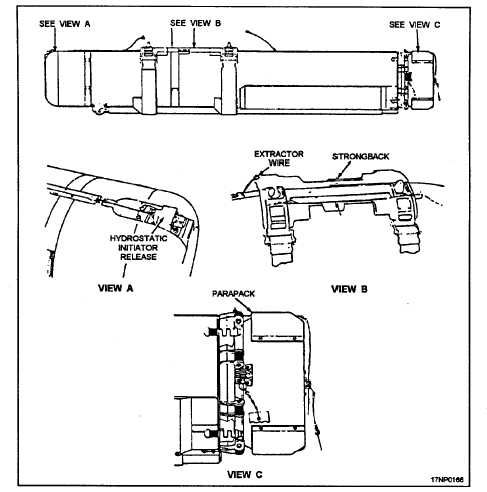
Mk 60 Captor Mine The Mk 60 captor mine (fig. 5-12) is an air-laid antisubmarine mine. This mine, when triggered by the influence of a submarine, launches a homing torpedo. A strongback assembly is used to attach the mine to aircraft bomb racks. Two Mk 3 suspension lugs threaded into the strongback provide a 30-inch suspension. The mine uses a parachute pack to slow descent and reduce impact when the mine enters the water. An explosive fitting actuated by a single arming wire opens the parachute. After entering the water, the parachute pack and strongback separate from the mine, and the stabilizer deploys. The mine is armed by a hydrostatic initiator, which is held in the safe position by a single arming wire. The Mk 60 configuration requires arming wire installation prior to aircraft loading


 Sign In








 June 14, 2012 at 11:32 pm