IT WAS A FORTRESS COMING HOME
They Could Hear It Before They Could See it By Allen Ostrom
They could hear it before they could see it!
Not all that unusual in those days as the personnel at Station 131 gathered around the tower and scattered hardstands to await the return of the B-17’s sent out earlier that morning.
First comes the far off rumble and drone of the Cyclones. Then a spec on the East Anglia horizon. Soon a small cluster indicating the lead squadron.
Finally, the group.
Then the counting. 1-2-3-4-5… ..
But that would have been normal. Today was different! It was too early for the group to return.
“They’re 20 minutes early. Can’t be the 398th.”
They could hear it before they could see it! Something was coming home.
But what?
All eyes turned toward the northeast, aligning with the main runway, each ground guy and stood-down airman straining to make out this “wail of a Banshee,” as one called it.
Not like a single B-17 with its characteristic deep roar of the engines blended with four thrashing propellers. This was a howl! Like a powerful wind blowing into a huge whistle.
Then it came into view. It WAS a B-17!
Low and pointing her nose at the 6,000 foot runway, it appeared for all the world to be crawling toward the earth, screaming in protest.
No need for the red flares. All who saw this Fort knew there was death aboard.
“Look at that nose!” they said as all eyes stared in amazement as this single, shattered remnant of a once beautiful airplane glided in for an unrealistic “hot” landing. She took all the runway as the “Banshee” noise finally abated, and came to an inglorious stop in the mud just beyond the concrete runway.
Men and machines raced to the now silent and lonely aircraft. The ambulance and medical staff were there first. The fire truck….ground and air personnel… .jeeps, truck, bikes…..
Out came one of the crew members from the waist door, then another.
Strangely quiet. The scene was almost weird. Men stood by as if in shock, not knowing whether to sing or cry.
Either would have been acceptable.
The medics quietly made their way to the nose by way of the waist door as the remainder of the crew began exiting. And to answer the obvious question, “what happened?”
“What happened?” was easy to see. The nose was a scene of utter destruction. It was as though some giant aerial can opener had peeled the nose like an orange, relocating shreads of metal, plexiglass, wires and tubes on the cockpit windshield and even up to the top turret. The left cheek gun hung limp, like a broken arm.
One man pointed to the crease in chin turret. No mistaking that mark! A German 88 anti-aircraft shell had exploded in the lap of the togglier.
This would be George Abbott of Mt. Labanon , PA. He had been a waist gunner before training to take over the bombardier’s role.
Still in the cockpit, physically and emotionally exhausted, were pilot Larry deLancey and co-pilot Phil Stahlman.
Navigator Ray LeDoux finally tapped deLancey on the shoulder and suggested they get out. Engineer turret gunner Ben Ruckel already had made his way to the waist was exiting along with radio operator Wendell Reed, ball turret gunner Al Albro, waist gunner Russell Lachman and tail gunner Herbert Guild.
Stahlman was flying his last scheduled mission as a replacement for regular co-pilot, Grady Cumbie. The latter had been hospitalized the day before with an ear problem. Lachman was also a “sub,” filling in for Abbott in the waist.
DeLancey made it as far as the end of the runway, where he sat down with knees drawn up, arms crossed and head down. The ordeal was over, and now the drama was beginning a mental re-play.
Then a strange scene took place.
Group CO Col. Frank P. Hunter had arrived after viewing the landing from the tower and was about to approach deLancey. He was physically restrained by flight surgeon Dr. Robert Sweet.
“Colonel, that young man doesn’t want to talk now. When he is ready you can talk to him, but for now leave him alone.”
Sweet handed pills out to each crew member and told them to go to their huts and sleep.
No dramatics, no cameras, no interviews. The crew would depart the next day for “flak leave” to shake off the stress. And then be expected back early in November. (Just in time to resume “normal” activities on a mission to Merseburg!)
Mission No. 98 from Nuthampstead had begun at 0400 that morning of October 15, 1944. It would be Cologne (again), led by CA pilots Robert Templeman of the 602nd, Frank Schofield of the 601st and Charles Khourie of the 603rd.
Tragedy and death appeared quickly and early that day. Templeman and pilot Bill Scott got the 602nd off at the scheduled 0630 hour, but at approximately 0645 Khouri and pilot Bill Meyran and their entire crew crashed on takeoff in the town of Anstey . All were killed. Schofield and Harold Stallcup followed successfully with the 601st, with deLancey flying on their left wing in the lead element.
The ride to the target was routine, until the flak started becoming “unroutinely” accurate.
“We were going through heavy flak on the bomb run,” remembered deLancey.
“I felt the plane begin to lift as the bombs were dropped, then all of a sudden we were rocked by a violent explosion. My first thought – ‘a bomb exploded in the bomb bay’ – was immediately discarded as the top of the nose section peeled back over the cockpit blocking the forward view.”
“It seemed like the whole world exploded in front of us,” added Stahlman. “The instrument panel all but disintegrated and layers of quilted batting exploded in a million pieces. It was like a momentary snowstorm in the cockpit.”
It had been a direct hit in the nose. Killed instantly was the togglier, Abbott. Navigator LeDoux, only three feet behind Abbott, was knocked unconscious for a moment, but was miraculously was alive.
Although stunned and bleeding, LeDoux made his way to the cockpit to find the two pilots struggling to maintain control of an airplane that by all rights should have been in its death plunge. LeDoux said there was nothing anyone could do for Abbott, while Ruckel opened the door to the bomb bay and signaled to the four crewman in the radio room that all was OK – for the time being.
The blast had torn away the top and much of the sides of the nose. Depositing enough of the metal on the windshield to make it difficult for either of the pilots to see.
“The instrument panel was torn loose and all the flight instruments were inoperative with the exception of the magnetic compass mounted in the panel above the windshield. And its accuracy was questionable. The radio and intercom were gone, the oxygen lines broken, and there was a ruptured hydraulic line under my rudder pedals,” said deLancey.
All this complicated by the sub-zero temperature at 27,000 feet blasting into the cockpit.
“It was apparent that the damage was severe enough that we could not continue to fly in formation or at high altitude. My first concern was to avoid the other aircraft in the formation, and to get clear of the other planes in case we had to bail out. We eased out of formation, and at the same time removed our oxygen masks as they were collapsing on our faces as the tanks were empty.”
At this point the formation continued on its prescribed course for home – a long, slow turn southeast of Cologne and finally westward.
DeLancey and Stahlman turned left, descending rapidly and hoping, they were heading west. (And also, not into the gun sights of German fighters.) Without maps and navigation aids, they had difficulty getting a fix. By this time they were down to 2,000 feet.
“We finally agreed that we were over Belgium and were flying in a southwesterly direction,” said the pilot.
“About this time a pair of P-51’s showed up and flew a loose formation on us across Belgium . I often wondered what they thought as they looked at the mess up front.”
“We hit the coast right along the Belgium-Holland border, a bit farther north than we had estimated. Ray said we were just south of Walcheren Island .”
Still in an area of ground fighting, the plane received some small arms fire. This gesture was returned in kind by Albro, shooting from one of the waist guns.
“We might have tried for one of the airfields in France , but having no maps this also was questionable. Besides, the controls and engines seemed to be OK, so I made the decision to try for home.”
“Once over England , LeDoux soon picked up landmarks and gave me course corrections taking us directly to Nuthampstead. It was just a great bit of navigation. Ray just stood there on the flight deck and gave us the headings from memory.”
Nearing the field, Stahlman let the landing gear down. That was an assurance. But a check of the hydraulic pump sent another spray of oil to the cockpit floor. Probably no brakes!
Nevertheless, a flare from Ruckel’s pistol had to announce the “ready or not” landing. No “downwind leg” and “final approach” this time. Straight in!
“The landing was strictly by guess and feel,” said DeLancey. “Without instruments, I suspect I came in a little hot. Also, I had to lean to the left to see straight ahead. The landing was satisfactory, and I had sufficient braking to slow the plane down some. However, as I neared the taxiway, I could feel the brakes getting ‘soft’. I felt that losing control and blocking the taxiway would cause more problems than leaving the plane at the end of the runway.”
That consideration was for the rest of the group. Soon three squadrons of B-17’s would be returning, and they didn’t need a derelict airplane blocking the way to their respective hardstands.
Stahlman, supremely thankful that his career with the 398th had come to an end, soon returned home and in due course became a captain with Eastern Airlines. Retired in 1984, Stahlman said his final Eastern flight “was a bit more routine” than the one 40 years before.
DeLancey and LeDoux received decorations on December 11, 1944 for their parts in the October 15 drama. DeLancey was awarded the Silver Star for his “miraculous feat of flying skill and ability” on behalf of General Doolittle , CO of the Eighth Air Force. LeDoux for his “extraordinary navigation skill”, received the Distinguished Flying Cross.
The following deLancey 1944 article was transcribed from the 398th BG Historical Microfilm. Note: due to wartime security, Nuthampstead is not mentioned, and the route deLancey flew home is referred to in general terms.
TO: STARS AND STRIPES FOR GENERAL RELEASE
AN EIGHTH AIR FORCE BOMBER STATION, ENGLAND – After literally losing the nose of his B-17 Flying Fortress as the result of a direct hit by flak over Cologne , Germany on October 15, 1944, 1st Lt. Lawrence M. deLancey, 25, of Corvallis , Oregon returned to England and landed the crew safely at his home base. Each man walked away from the plane except the togglier, Staff Sergeant George E. Abbott, Mt. Lebanon , Pennsylvania , who was killed instantly when the flak struck.
It was only the combined skill and teamwork of Lt. deLancey and 2nd Lt. Raymond J. LeDoux, of Mt. Angel , Oregon , navigator, that enabled the plane and crew to return safely.
“Just after we dropped our bombs and started to turn away from the target”, Lt. deLancey explained, “a flak burst hit directly in the nose and blew practically the entire nose section to threads. Part of the nose peeled back and obstructed my vision and that of my co-pilot, 1st Lt. Phillip H. Stahlman of Shippenville , Pennsylvania . What little there was left in front of me looked like a scrap heap. The wind was rushing through. Our feet were exposed to the open air at nearly 30,000 feet above the ground the temperature was unbearable.
“There we were in a heavily defended flak area with no nose, and practically no instruments. The instrument panel was bent toward me as the result of the impact. My altimeter and magnetic compass were about the only instruments still operating and I couldn’t depend on their accuracy too well. Naturally I headed for home immediately. The hit which had killed S/Sgt. Abbott also knocked Lt. LeDoux back in the catwalk (just below where I was sitting). Our oxygen system also was out so I descended to a safe altitude.
“Lt. LeDoux who had lost all his instruments and maps in the nose did a superb piece of navigating to even find England .”
During the route home flak again was encountered but due to evasive action Lt. deLancey was able to return to friendly territory. Lt. LeDoux navigated the ship directly to his home field.
Although the plane was off balance without any nose section, without any brakes (there was no hydraulic pressure left), and with obstructed vision, Lt. deLancey made a beautiful landing to the complete amazement of all personnel at this field who still are wondering how the feat was accomplished.
The other members of the crew include:
1. Technical Sergeant Benjamin H. Ruckel, Roscoe , California , engineer top turret gunner;
2. Technical Sergeant Wendell A. Reed, Shelby , Michigan , radio operator gunner;
3. Technical Sergeant Russell A. Lachman, Rockport , Mass. , waist gunner;
4. Staff Sergeant Albert Albro, Antioch , California , ball turret gunner and
5. Staff Sergeant Herbert D. Guild, Bronx , New York , tail gunner.
Originally printed in 398th Bomb Group Remembrances

By: bazv - 26th October 2014 at 10:15
Just bumping this old thread to see if anybody has seen the original (untouched) photograph of the P38 F5/Halifax ground collision yet 🙂
Would be great to see the original and also be able to read the accident report !
rgds baz
By: bazv - 3rd November 2010 at 12:23
With reference to my post 49 and other posters remarks/ideas,anybody any further information on when/where/why this P38/F5/Halifax incident photo was ‘retouched’ cough cough !!
Didnt want to let this thread die out
rgds baz
By: merlin70 - 29th March 2010 at 07:35
Looks to me like the P38 had an incident…
Following said incident photos were taken, the background was removed and a Halifax fin fin was added for good measure.
By: DL Sheley - 29th March 2010 at 06:27

TBM-3 Avenger from Torpedo Squadron Eighty-Two (VT-82), flying from the carrier USS Bennington (CV-20). The plane in formation above this one was hit by AAA and fell down into it. I don’t know what happened after this photo was taken.
By: DL Sheley - 29th March 2010 at 06:05
There are a lot wild crash photos out there.

B-24M-5-FO serial number 44-50468 from the 740th Bomb Squadron, 455th Bomb Group, 15th Air Force. Crashed on take-off from San Giovanni Field, Italy on April 12,1945. Six of the crew were killed.
By: Moggy C - 28th March 2010 at 23:55
Another amazing tale
Charlie Brown’s story
I seem to recall reading somewhere that the tale above contains considerable ‘enhancement’ compared to the actual events.
Moggy
By: PeterVerney - 1st January 2010 at 14:27
Sorry, to my eye the P38 was stationary on the ground. Note that the starboard spinner and upper engine cowling are also damaged, possibly the fuselage nosecone as well. A mid air would have curled up the prop, not just a simple bend, and the resultant landing would have been catastrophic. Taxying accident for sure.
By: Richard gray - 1st January 2010 at 13:54
Lets look at another option, the P38 had engine failure was coming in for emergency landing, unfortunatly he chose the runway where the Halifax was taking off from.
By: trumper - 1st January 2010 at 11:07
🙂 An interesting thread but anyone wonder why the thread starter makes a copy/paste posting then never replies or adds any input.
I wonder whether he has any personal interest in his posts [all 4 or 5 threads ] at all.
Most people ask because they want to know or have a tale to tell about something related.
Some fascinating answers so thanks to everyone for their searching and some horrific damage photos.
When designing war planes was damage resistance built into them or was it luck of the design?.
By: bazv - 1st January 2010 at 10:41
Just an after thought. The Americans had lots of film for their cameras. They would have photographed that aeroplane from every angle. A shot from the port side showing just how and where the Halifax fin was embedded would almost certainly have been taken. I suspect the reason we haven’t seen it is because it would show the whole airborne collision story to be fake.
I also touched on this on a previous post,it would be much more interesting to see a pic from the other side,but hey why ruin a good story by letting the facts get in the way 😀
By: bazv - 1st January 2010 at 10:35
Sam…it was a Halifax…they were built like a brick ‘outhouse’ :D,trust me the prop blade would have ‘twisted’ if the engine was under power at the time.
All of this is pure conjecture but did you look closely at the positioning of the fin behind the port prop,it looks like it is actually touching the trailing edge of one of the blades,but it has no damage apparently.
And also as AM said previously you can almost ‘see’ the rest of the Halifax sitting at its normal ground angle 😀
rgds baz
By: bazv - 1st January 2010 at 10:30
Hi AM
Apparently (sources websites) the F5 was ‘written off’ at Speke,but I suppose that could have been the admin side of it since it was a U.S equivalent of an RAF MU.
However I did tentatively suggest that if the collision did occur at Speke and looking at the ‘newness’ of the Hali fin then I speculated that it might have been a new Hali under test from speke.A new a/c pre delivery might not be so easy to trace on normal RAF accident reports.
Even something simple like a brake failure etc could cause a ‘coming together’ like this
rgds baz
By: slipperysam - 1st January 2010 at 10:22
Sorry Sam but props do not normally stop instantly,they usually keep turning for a little while and also are bent in more than one direction,neither prop shows any ‘twist’ as it would if it had been under power from the engine.
I have not mentioned this yet but also both props are set at exactly the same angle in true tiddly military fashion,ie as if somebody with a tidy military mind has placed them both at a symmetrical angle.
This also may support the argument that the F5 was parked on an airfield minding its own business.
The ‘sweep back’ of the stbd wing I believe was approx 26 deg.
The “curling” of the blades is typical when an aircraft comes in contact with the ground during forward motion in a gradual type decent… like when landing wheels up.
The blades wouldnt have curled hitting the thin skin of the wellington…. And yes it would stop instantly if it hit an object hard enough, like a wing spar, engine…..
The fact the blades stopped in the same position means nothing…. The light twin i used to fly many years ago would stop both blades in the same position 99% of the time, so i would never have to “park” the blades at night!
If something hit the F5 while on the ground it would unlikely be on its undercarriage anymore….
By: Arabella-Cox - 1st January 2010 at 10:17
Quote:
Originally Posted by bazv View Post
As regards the F5/Halifax photo above,after looking at it again,I thought hmmm … possible to fly with that damage ??
So I did a bit of googling and there has been some discussion on at least one website as to whether it might have been a ground collision at Speke !!
Anybody know anything about it ??
Wouldn’t surprise me!About the only place I can think of Halifaxes (churned out of Rootes) and P38’s (being assembled in the Hangars on the other side of the field) operating in close proximity in daytime.
Also the picture has been retouched to remove any background detail, so the location is clearly sensitive – I wonder if it had something like Garston gasworks in the background!
One other thought then, can anyone tie it up with a Halifax loss in December 1943? The date coming from some reserach on the internet.
Jon
Call me a cynic by nature if you will, but every time I look at that picture, I can “see” the rest of the Halifax behind it, that the photographer had to, or chose to, censor out for whatever reason.
The angle of the Halifax fin and its height off the ground, all seem about right for it to have been a (fairly fast) ground collision in which the two became entangled.
I imagine the Halifax looked pretty rough after the collision, too.
Whether the Halifax was censored out for security as JonH suggests, or whether someone thought that it would make a good propaganda story if the facts were “adjusted” in the F5’s favour, or whether it was just a prank by some bored official photographer, I don’t know. I’m fairly sure it wasn’t an airborne collision, though.
I think it may have been me who suggested Speke as a location. I just made the connection between a Lockheed F5 and a Halifax write-off that apparently couldn’t be traced in RAF records. I hadn’t seen the photo at the time. Now I have, my vote goes to accident on the ground, not in the air.
Just an after thought. The Americans had lots of film for their cameras. They would have photographed that aeroplane from every angle. A shot from the port side showing just how and where the Halifax fin was embedded would almost certainly have been taken. I suspect the reason we haven’t seen it is because it would show the whole airborne collision story to be fake.
By: bazv - 1st January 2010 at 09:48
Sorry Sam but props do not normally stop instantly,they usually keep turning for a little while and also are bent in more than one direction,neither prop shows any ‘twist’ as it would if it had been under power from the engine.
I have not mentioned this yet but also both props are set at exactly the same angle in true tiddly military fashion,ie as if somebody with a tidy military mind has placed them both at a symmetrical angle.
This also may support the argument that the F5 was parked on an airfield minding its own business.
The ‘sweep back’ of the stbd wing I believe was approx 26 deg.
By: slipperysam - 1st January 2010 at 09:36
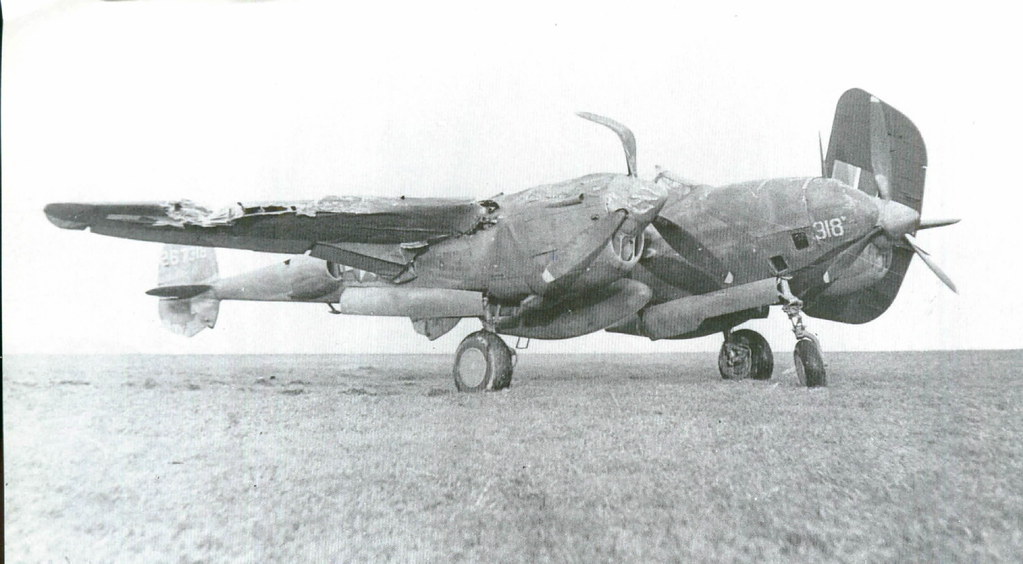
Looking at the pic a bit closer the right wing is pushed back quite a bit. Look at the gap in the leading edge wing root fairing and the flap and rear wing section pushed downwards. Also note the big hit in the leading edge of the right wing as well. That would appear to be where the other vertical tail hit the aircraft?
The fact that one blade is only bent could be because the engine stopped instantly it was hit?
I wouldnt dispell the picture as some sort of myth or fakery yet……
By: Wyvernfan - 1st January 2010 at 09:31
What an absolutely wonderful story. Thanks for sharing and making my new years day.
By: SqL Scramble. - 31st December 2009 at 18:52
Another amazing tale
Charlie Brown’s story
Charlie Brown was a B-17 Flying Fortress pilot with the 379th Bomber Group at Kimbolton, England. His B-17 was called ‘Ye Old Pub’ and was in a terrible state, having been hit by flak and fighters. The compass was damaged and they were flying deeper over enemy territory instead of heading home to Kimbolton.
After flying over an enemy airfield, a pilot called Franz Steigler was ordered to take off and shoot down the B-17. When he got near the B-17, he could not believe his eyes. In his words, he ‘had never seen a plane in such a bad state’. The tail and rear section was severely damaged, and the tail gunner wounded. The top gunner was all over the top of the fuselage. The nose was smashed and there were holes everywhere.
Despite having ammunition, Franz flew to the side of the B-17 and looked at Charlie Brown, the pilot. Brown was scared and struggling to control his damaged and blood-stained plane.
Aware that they had no idea where they were going, Franz waved at Charlie to turn 180 degrees. Franz escorted and guided the stricken plane to and slightly over the North Sea towards England. He then saluted Charlie Brown and turned away, back to Europe.
When Franz landed he told the c/o that the plane had been shot down over the sea, and never told the truth to anybody. Charlie Brown and the remains of his crew told all at their briefing, but were ordered never to talk about it.
More than 40 years later, Charlie Brown wanted to find the Luftwaffe pilot who saved the crew. After years of research, Franz was found. He had never talked about the incident, not even at post-war reunions.
They met in the USA at a 379th Bomber Group reunion, together with 25 people who are alive now – all because Franz never fired his guns.
By: CeBro - 30th December 2009 at 19:02
WOT!!!, No nose?
Pics shamefully pinched from the Nanton Museum site.
Cees
By: Beermat - 30th December 2009 at 16:39
Apparently, this site has more info… and it was indeed a mid-air!
http://forum.armyairforces.com/Lightning-Collision-with-RAF-Bomber-December-1943-m168150.aspx
Another site has this:
forum.armyairforces.com doesn’t confirm anything about it being mid-air, however. What it does (through a heated discussion) reveal is that the aircraft had no visible service record, just a very short spell (Nov – Dec 1943) in the UK, before one source quoted there has the aircraft as “salvaged non battle damage at Speke, Lancashire on 22nd December”
The aircraft MAY have been repaired and sent back into service – it wasn’t written off until June 1944, apparently.


 Sign In








 December 27, 2009 at 9:08 pm