Here’s a brief overview of latest Russian AshMs from different classes.
Kh-35U, Kh-31AD, Kh-41 Moskit, P-900 Alfa, Yakhont-M.
The first two, the Kh-35 and Kh-31AD are both lighter weight, around a 600kg launch weight. The Kh-35 is subsonic, sopposidely a range of 130km at a lower altitude, while the Kh-31AD is supersonic with a speed of mach 3.5 and range approximately 100km, not sure what altitude. What do you guys think of these two missiles and which one is better. The Kh-31AD seems to carry a smaller warhead(90kg while Kh-35 145kg), but is a lot faster and less vulnerable to defenses.
As it appears the latter 3 are heavy and longer ranged. The Moskit has a launch weight I think exceeding 4000kg and a speed of mach 5 with a low altitude range of something like 250km. The Yakhont-M has a range of 300km and speed of mach 3+ and launch weight of approx 2500kg. The Alfa has a range of 250km on a high flight and then drops to low altitude, it has a launch weight of 1700kg.

By: Severodvinsk - 20th November 2004 at 18:00
If you want the real scale of Granit:
Not Air-Launched though. Would be too heavy for most aircraft.
By: Jai - 20th November 2004 at 15:42
Yakhont-M photos from MAKS-2003.
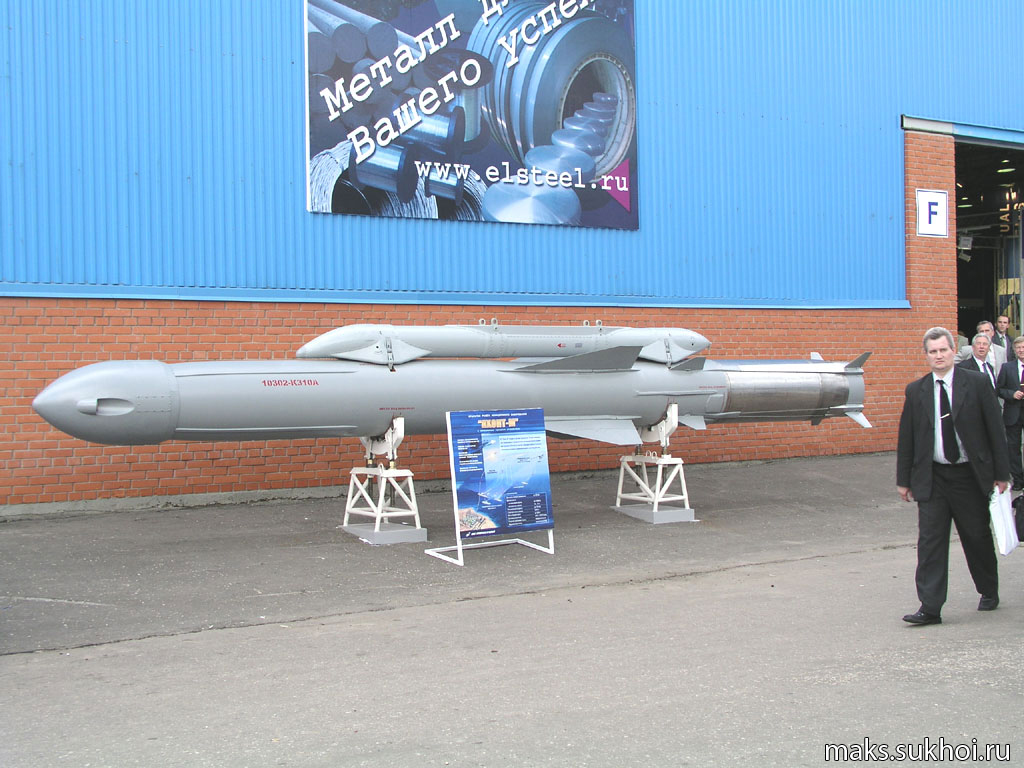
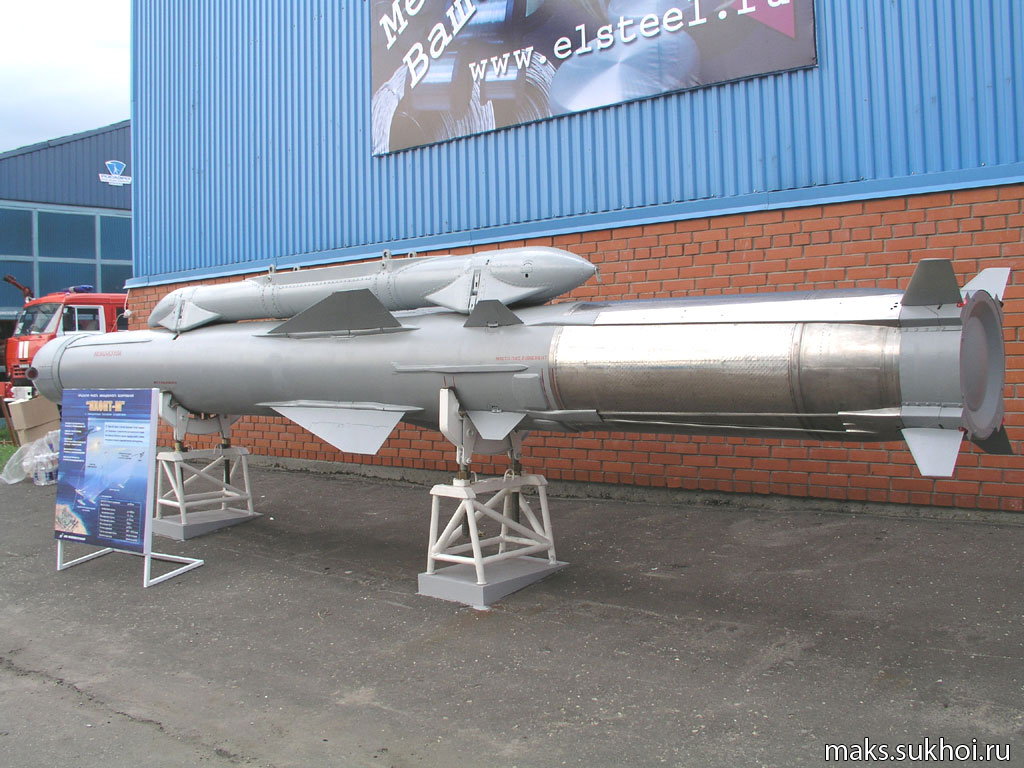
By: heeroyui - 9th November 2004 at 20:24
Hello
Granit missiles in class Oscar II submarine
Source: Getty Images
376159 03: (UNDATED FILE PHOTO) The Russian nuclear submarine “Kursk” docked at a northern Russian home base port Zapadnaya Lista, in Bellona, displayes its onboard nuclear weapons. The Russian sub sank August 12, 2000 as a result of a torpedo room explosion, 118 crew men remain trapped inside at the Barrent’s Sea floor. Rescue attempts are still under way. (Photo by Laski Diffusion/Liaison)

376509 04: (UNDATED FILE PHOTO) (USA SALES ONLY) A rocket launches from an Oscar class submarine, the same class as the stricken submarine Kursk. Norwegian officials said August 21, 2000 that none of the 118 crew of the sunken Kursk submarine had survived an accident nine days ago after divers found the vessel flooded. (Photo by Laski Diffusion/Liaison

376161 01: (UNDATED FILE PHOTO) The Russian submarine Kursk, docked in Severomorsk, Russia, opens its hull to reveal four missile tubes capable of launching nuclear-tipped cruise missiles. The nuclear submarine can be armed with Granit cruise missiles in two banks of 12 tubes positioned between the outer and inner hulls. The missiles, code named Shipwreck by NATO, are designed to strike aircraft carrier groups. (Photo by Oleg Nikishin/Newsmakers)

By: Srbin - 8th November 2004 at 00:49
I would like to for example compare the P-900 Alfa and the Yakhont-M.
The P-900 Alfa, flies subsonically at around 10-15 metres for most of it’s flight profile then for like last 20km it drops below 5ms and speeds past m2+. It’s range is some 250kms. It has a launch weight of 1600kg and a warhead of some 200-400kg
Then you have the Yakhont-M, which is supersonic high flying m2-2.5 missile with range of some 300kms. It can also fly low with a range of 130kms. It has a launch weight of some 2500kg and a warhead weight of 300kg.
Now, the Russians are buying the Yakhont-M and it seems to be their preffered choice. If a lower flying missile like the Alfa will have a better chance of hitting a Carrier group, why are the Russians so preffering to get the Yakhont-M. If they hit a Carrier or any other ship, they will have equal chances of quickly sinking it because their warheads are similar in weights as well as speeds. The real difference is that the Alfa is a little shorter ranged, and MUCH lighter, more of them will be carried than Yakhonts by probably any platform, which allows better saturation attacks with more missiles.
By: nuke1 - 7th November 2004 at 19:02
hi, someone has info about the AS-6 Kingfish or the other huge ASM like the As 4 or 5?
By: Arabella-Cox - 27th October 2004 at 08:10
Garry, when is the Yakhont-M supposed to be operational ?
There was an article about it posted here with lots of other stuff about MAKS. It will make its first flight in 2005 or something with perhaps operational availability a few years after that. It is a multi sensor dual purpose system for sea and land targets.
As for Moskit, I guess ANYONE would have trouble against this missile, not only it flies very low, but for a extremely long range and extremely fast, making it extremely hard to detect and even when it is detected there will be a lot of trouble intercepting it.
It needs that performance because its primary target is AEGIS ships.
I guess, but wait, does the Yakhont-M dive on the target from a higher altitude or does it drop low a distance ahead and then attack?
I would assume that would depend upon the target… flying high all the way and diving on the target maximises range but is vulnerable to modern air defences. If the target has little or no air defences or they have been engaged with ARMs already then a dive would probably offer better kill performance with an extra bit of kinetic energy and the ability to hit the centre of the target rather than having to punch in from the side.
By: Jai - 22nd October 2004 at 15:02
Garry, when is the Yakhont-M supposed to be operational ?
By: Srbin - 22nd October 2004 at 14:02
I guess, but wait, does the Yakhont-M dive on the target from a higher altitude or does it drop low a distance ahead and then attack?
As for Moskit, I guess ANYONE would have trouble against this missile, not only it flies very low, but for a extremely long range and extremely fast, making it extremely hard to detect and even when it is detected there will be a lot of trouble intercepting it.
By: Severodvinsk - 22nd October 2004 at 13:07
I don’t think there are any pictures around, although I expected that of the Viyuga and Vodopad too. Yet it’s the ship-based version of the Kh-55 (iirc) air launched cruise missile.
By: Arabella-Cox - 22nd October 2004 at 09:36
The Alfa which flies high subsonically then drops very low and boosts itself to m3+ and it has a 250km range with 1700kg launch weight.
The Club flys at high subsonic speeds at low altitude… if it flew at high altitudes its range would be much greater as the subsonic turbojet engine it uses is of course rather more efficient than a rocket. Think of it as an enlarged Harpoon that delivers a warhead that consists of a seeker and rocket and HE warhead to within 20km of a target.
The Yakhont-M weighs 2500kg, has a speed of m3+, flies very high and of course has a range of 300km. So which one is better?
Consider them different solutions to the same problem. The Club is designed to be sneaky… it assumes the target won’t see it coming and doesn’t know the launch platform is there so the missile stays low. It makes a break for the line so to speak over the last 20km because it expects to be spotted then anyway.
The Yakhont on the other hand is for when the target is very well equipped and wary. It is for engaging targets that probably know the launch platform is nearby and hostile. It is for a surprise attack… ie like a well supported group that might even include carriers… the idea is that you probably already know I am here and you have good surveillance that would detect a long range but slow weapon like Club and you could scramble fighters to intercept it… so instead I am going to send a very fast weapon flying high at first for max speed but dropping down low for the last leg to make your interception by SAM more difficult by dropping below the radar horizon of your ships for about 1/3rd of my range. For the last 50-100km of my flight I will be a very low very fast target… fighter aircraft generally have trouble engaging targets that are more than 10,000ft below or above them… radar angles etc. If a fighter can only fly at 10,000ft then it might just get one shot at a mach 2.5 target at less than 7m above the wave caps… against a club they could close in and engage with IR missiles and have multiple shots as most jet fighters can fly at mach 0.9 at sea level for a long distance.
Also what about the aeroballistic Kh-15 AshM, with 150km range and m5 speed, how well would this get through Anti-Ship defences since it flies so high and fast?
As far as I know only the nuclear SEAD version is actually in service. An anti ship model would fly over most defences, though a diving target would probably be interceptible on its own by modern SAMs. 5-10 of them and perhaps with jammers or decoys or other tricks however…
By: Arabella-Cox - 22nd October 2004 at 08:12
Hi
does anyone have any picture, drawing, of the SS-N-21 Granat
Thank you for collaboration
http://www.astronautix.com/lvs/granat.htm
Look for SSM SS-N-21 Sampson , SLCM. For use from TR 53.3
By: heeroyui - 22nd October 2004 at 01:19
Hi
does anyone have any picture, drawing, of the SS-N-21 Granat
Thank you for collaboration
By: Arabella-Cox - 21st October 2004 at 21:50
Which one is the Granit? Apperantly I’ve heard this name on 2-3 other missiles.
http://www.globalsecurity.org/military/world/russia/ss-n-19.htm 🙂
By: Severodvinsk - 21st October 2004 at 21:45
Granit is SS-N-19 Shipwreck.
The other one you heard is Granat, the 3,000km-cruise missile, I think SS-N-21.
By: Srbin - 21st October 2004 at 20:52
Which one is the Granit? Apperantly I’ve heard this name on 2-3 other missiles.
By: dionis - 21st October 2004 at 20:17
yea the Granit is nasty. 24 firing at a US fleet (from ONE Oscar II would give them some serious hell)
By: Severodvinsk - 21st October 2004 at 19:05
Any Soviet/Russian missile is hard to stop. There was a case in which a Drone, a converted Styx missile (P-15) sank a patrol boat “Musson” of the Russian Navy, after the missile was HIT by a SA-N-4 missile.
Their hardest-to-hit drone was the converted KSR-5 (Kingfish) missile, which was converted to fly low at a speed of about 300m/s, simulating a Harpoon. The RCS was reasonable supposed to be about the same.
P-35 (Bazalt) conversion was also used as a drone.
If you want the best and hardest to hit Anti-ship missile, my bets go to Granit. Titanium protection for vital parts (that’s to avoid these CIWS from taking it out), low flying with only one missile of the group flying high (in a certain mode that is), fast and heavily armed.
Didn’t the Klub have a range of only 200km?
By: Srbin - 21st October 2004 at 14:33
Low level data to what Sea-state.
huh?
By: Arabella-Cox - 21st October 2004 at 14:18
The Alfa which flies high subsonically then drops very low and boosts itself to m3+ and it has a 250km range with 1700kg launch weight. The Yakhont-M weighs 2500kg, has a speed of m3+, flies very high and of course has a range of 300km. So which one is better? I am sure that the Alfa is going to have a MUCH better chance of getting through than the Yakhont-M. Also what about the aeroballistic Kh-15 AshM, with 150km range and m5 speed, how well would this get through Anti-Ship defences since it flies so high and fast?
Low level data to what Sea-state. 🙂
By: Srbin - 21st October 2004 at 13:39
The Alfa which flies high subsonically then drops very low and boosts itself to m3+ and it has a 250km range with 1700kg launch weight. The Yakhont-M weighs 2500kg, has a speed of m3+, flies very high and of course has a range of 300km. So which one is better? I am sure that the Alfa is going to have a MUCH better chance of getting through than the Yakhont-M. Also what about the aeroballistic Kh-15 AshM, with 150km range and m5 speed, how well would this get through Anti-Ship defences since it flies so high and fast?


 Sign In








 October 15, 2004 at 9:30 pm