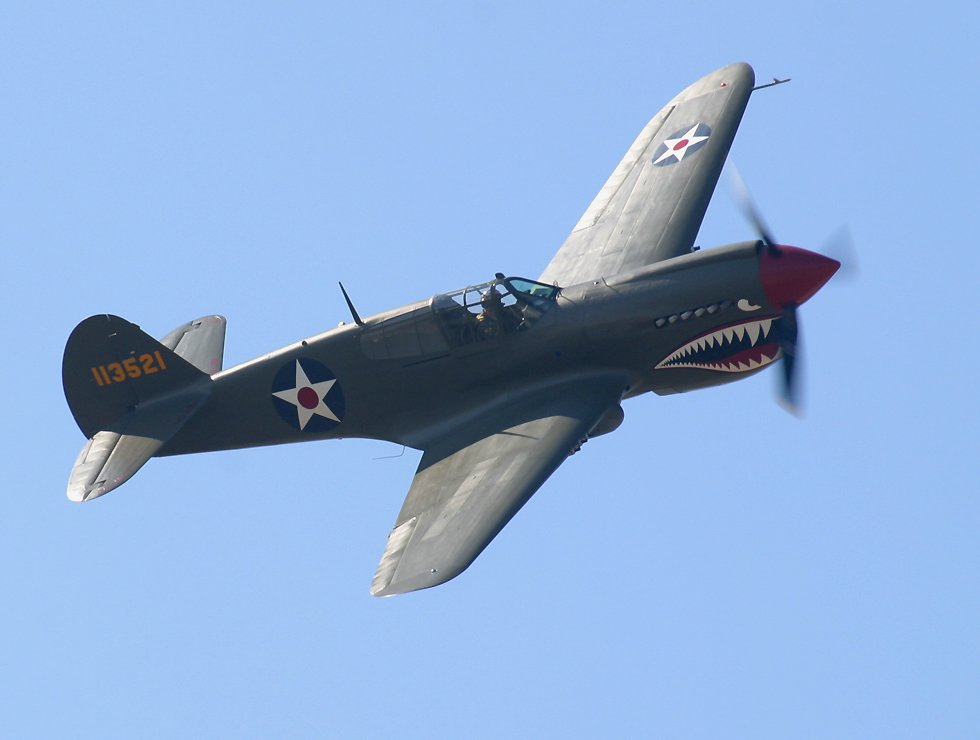
I did this topic a good while back, but obviously new members have joined and I want to see what people consider to be the most underrated fighter or World War II. There are several candidates, but I would have to say I believe the single most underrated fighter of World War II is undoubtedly the Curtiss P-40 Warhawk series. The P-40 was, along with the Bell P-39 Airacobra, the only thing available to stem the tide of the Japanese advance in the Pacific. It provided a readily available source of fighters for the British (who made extensive use of it as a fighter and fighter/bomber in the North African desert as well as a reconaissance airplane over Europe) as well as for Russia who was reeling in the face of stiff German opposition. It of course as everyone knows also provided the mount for the American Volunteer Group, the famed Flying Tigers. I must stress that the AVG was not the only unit to have lots of success flying the P-40. Other famed groups include the 23rd Fighter Group, which absorbed the remnants of the AVG after their disbandment in 1942, as well as the 325th Fighter Group, the famed Checkertail Clan. It was squadrons of the 325th flying P-40’s that were primarily responsible for the rather famous Palm Sunday Massacre in which dozens of Luftwaffe transport aircraft were destroyed while on their way to deliver troops to the desert. Additionally, the fighter escort was successfully fought off, but the supposed “inferior” P-40’s (along with a few Spitfires as well). Additionally, there are at least two other incidents where 325th P-40’s fought off Bf-109’s with two-to-one odds (the P-40’s being outnumbered in both cases by about 2 to 1), and not only did they fight them off, but they were successful in destroying slightly over half of the attacking enemy force in each case. Now, the 325th had some damn fine pilots, but if the P-40 was really that bad would they have succeeded as they did? I believe it was a combination of the two. The P-40 was also rather successful in the service of the Royal New Zealand Air Force, where it was credited with around 100 Japanese planes destroyed, for relatively few losses in exchange. The P-40 was also quite a capable fighter-bomber, and was capable of carrying a fairly wide variety of weapons including bombs of anywhere from 100 pounds to 1,000 pound weapons. 3.5-inch rockets were also carried in three-round “Bazooka” type tubes. Recon cameras were carried on some models as well as the usual drop tanks to increase range. A fighter group in the Pacific experimented with P-40N models to fit them with two 1,000 pound bombs, one 75-gallon drop tank, and they were able to hit targets several hundred miles from their base with little trouble. While most sources would claim the P-40’s maximum load carrying capability to be in the area of 500 to 1,000 pounds, loads of over 2,500 pounds were routinely carried in the later stages of the war. In fact, the standard air-to-ground load was two 500-lb. bombs and a drop tank, at least on all later models. It was the P-40 (along with the Hurricane and others) that was a huge contributing factor to Field Marshall Erwin Rommel’s ultimate defeat in the sands of North Africa. P-40’s launched from carriers in the Mediterranean helped to resupply Allied forces under the code name Operation Torch, while on the Eastern European Front, Russian pilots waged fierce battles against the Nazi war machine. In their Lend-Lease Hurricanes, P-40’s, and P-39’s (the Airacobra being a favorite among Russian pilots), they were able to hold off the Germans and ultimately push them back. Of course newer planes soon joined the fray, but the P-40 was a very important part of the defense of the Soviet Union, and many aces flew her. In the Pacific, P-40 fighter groups slugged it out with the Japanese until the very end of the war, with Warhawks being used in all manner of missions. The very first American ace of the war achieved that fame using the P-40. The P-40’s air-to-air combat performance is often questioned, and in many run-of-the-mill “history” books, it isn’t highly regarded, but I challenge people to seek out the truth. In reality, the P-40 had several positive aspects to its performance. Often said to not be very agile, this in reality was not the case. The P-40 had the tightest turning radius of ANY American fighter…yes, even the P-51. It also has a very fast rate of roll, yes even faster than that of the Mustang. At low altitudes to medium altitudes the performance of the P-40 is in fact very good. It is only when it reaches the higher altitudes (above 20,000 feet generally) that performance starts to fall off, namely in rate of climb. This also plagued the P-39 Airacobra. It wasn’t so much the design of the airplane was it was the simple fact that the Allison engines that powered the P-40 (and P-39) were not equipped with two-stage turbo superchargers. At altitudes below 20,000 feet, the P-40 was actually very good. In fact, the famed Japanese Zero ace Saburo Sakai has been quoted as saying that Japanese pilots generally felt the P-40 was the most dangerous Allied opponent they faced at low-altitudes. (They considered the P-38 the most dangerous up high and the F4U Corsair the most dangerous overall.) In fact, when facing the Bf-109 in particular, P-40 pilots soon learned that they could turn tighter and roll much faster than the Bf-109. It wasn’t until the later models that the speed advantage on the Bf-109 was so marked as to be a serious disadvantage (The E/F models were the most typical Bf-109’s and the F model was no more than 20 miles per hour faster than the fastest P-40 variants). The biggest advantage the Bf-109 had was in rate of climb, and of course this can be an important part of battle. Nonetheless, the P-40 more than proved itself to be a worthy opponent for the Bf-109. The Fw-190 was a much greater challenge, but the P-40 even managed to score victories against the Focke-Wulf from time to time if flown right. The Japanese Zero is one of the few airplanes of the time able to turn tighter than the P-40, but as such it was slower and obviously much less durable. P-40 pilots learned to play to their respective strengths (speed, dive, and concentrated armament) to defeat the Zero. (Take note the AVG actually never faced the Zero…they faced the Ki-43 Oscar which was very similar in appearance to the Zero although slightly more agile yet a bit slower and more lightly armed…and flown by the Japanese Army Air Force and not the Japanese Navy.) The P-40 was also durable, with many of its pilots making it home with tremendous battle damage. It could certainly take more damage than the P-51, although not as much as the P-47 (which also had the advantage of having a radial engine which didn’t require coolant….in any in-line engined plane if the coolant is hit and leaks out the engine will seize). The P-40, beginning with the AVG, was well-known to be a very good diving airplane, and airspeeds of over 500 miles per hour were reached, with the airplane being strong enough to pull out of such dives. This goes back to the incredible durability of the airplane. The armament was also good, at least beginning with the P-40E, which had six .50 caliber machine guns. The earlier P-40B and P-40C models (as used by the AVG) were armed with two .50 caliber guns and four .30 caliber guns, which was more than enough to deal with most Japanese aircraft of the era. The six .50 cal. guns on the F and later models (aside from the L which had four) were plenty to deal with the German and Italian fighters the P-40 would encounter.
Sorry for the long-winded post, but I genuinely feel that the P-40 is greatly mistreated by many books and some historians, and I feel it is my duty to defend her. I hope I can change at least one person’s opinion about her.
So, what’s your choice for World War II’s most underrated fighter plane?
As an aside I also would like to have honorable mention go to the Bell P-39 Airacobra, Hawker Hurricane and Messerschmitt Bf-110.

By: PhantomII - 4th May 2005 at 14:42
I suppose I should have clarified what I meant. I meant to say is that the P-400 (otherwise known as Airacobra I’s to the Brits) wasn’t modified for U.S. service. They were simply diverted from the British order and pressed into USAAF service. You could say the Airacobra I itself was a development of the P-39, but as far as being modified for USAAF service, this was not the case, as the airplanes were built with the Hispano gun in the first place.
That was all I mean.
P-39 being another good candidate for one of World War II’s most underrated….
By: Helican - 4th May 2005 at 13:49
To nitpick….again. I know the -400 was intended for the brits with a Hispano, but if you take an airplane and stick a different gun in it..isn’t it then developed further? Or is it just a modification?? Are they mutually exclusive? Where is the border drawn between the two?
Honestly curious.
By: PhantomII - 4th May 2005 at 06:06
You’re a funny man Helican. I’ve actually heard that one before (P-40 buffs like me tend to hear it a lot lol).
To nitpick the P-400 was actually not a development. It was just Airacobras intended for the Brits that got pressed into USAAF service in the Pacific because we neeed every plane we could get over there. They were probably the only USAAF Airacobras to have 20-mm Hispano cannons instead of the 37-mm Oldsmobile cannon of a tyipcal ‘Cobra.
By: Helican - 4th May 2005 at 03:05
A wartime joke for you Phantom II.
Q: What is a P-400?
A: A P-40 with a Zero on his ass.
(the -400 actually being a development of the P-39)
By: JDK - 3rd May 2005 at 23:40
Thetrouble with Irony Gnome, is it’s difficult for some of our readers to spot. Unlike Brassy and Goldy.
I’ll get me coat.
By: PhantomII - 3rd May 2005 at 17:20
Corsair, it’s funny you mention an improved P-40.
The P-40Q (although it would have used an Allison, not a Merlin engine) looks similar to the P-51 in a few areas.

I think she would have been a fine fighter plane, and truly the P-40 would be a lot more respected nowadays (she should get that respect now, but sadly with some people she doesn’t).
By: Smith - 3rd May 2005 at 12:09
Ah yes, the Merlin. Was it really that significant? I mean, how would the BoB have gone without it? Alright I guess, given Sir Keith Park was on the job. :rolleyes:
Really you guys – do you have to be within 3 paces before you can spot irony? JDK, your point was about parochialism so I interjected a quick jest re. Sir Keith Park. There’s a nice green sward in Auckland named after him – the Keith Park Park I presume. 😎
By: Corsair166b - 3rd May 2005 at 02:51
A Mustang without a Merlin, ie an Allison engine powering it? An improved P-40…end of story.
M
By: JDK - 3rd May 2005 at 02:43
I was saying that in Britain, the important part of the Mustang is in front of the firewall, in the US, aft. Neither’s right, both views are my country(‘s inventions) right or wrong. (See the Rolls Royce attempts to put the Merlin in the mustang. Ugh.)
By: Smith - 3rd May 2005 at 02:40
Ah yes, the Merlin. Was it really that significant? I mean, how would the BoB have gone without it? Alright I guess, given Sir Keith Park was on the job. :rolleyes:
By: JDK - 3rd May 2005 at 02:20
I guess it also depends where you are. In Australia, the Boomer’s hardly underated, and the Russians give a lot of credit to their fighters – arguably too much, and neglect the input of the Lend Lease a/c the west gave them; but that’s the point. While here in the west, we underestimate the Russian a/c from the I-16 to the La-11 because the war was on another front, and the propoganda by both the western allies and the Russians distorted the facts beyond recovery.
Fighter fame sufferes from the ‘Not invented here’ syndrome as much as many other things. Few stand back and look at the situation globally. Empires are the worst; reading W.W.II era British and current US you’d think the rest of the world were lucky to have managed dugout canoes! I presume the Portuguese were as bad talking about Man-o-wars, way back in the C17th…
In Britain, within the first 15 seconds of commentry on the Mustang the Merlin engine is mentioned. Every time. In the US, funnily enough, a lot less often.
By: Helican - 3rd May 2005 at 02:04
How about the Commonwealth Boomerang?? Designed in weeks, buildt and flown in less than 14..and still did a good job…mostly ground attack..but still.
Maybe not the most underrated…but the fact that it is hardly mentioned would make it count?? Right?
I personally think it proves that with imagination you can even make the Harvard/Texan look good 😉
By: Charley - 2nd May 2005 at 23:49
I’ll put forward Westland Whirlwinds. If it had been available in time for the BofB the Whirlwind could have taken a toll on German bombers (which is what fighters are for?) and had the range to harass bombers over their bases. The Whirlwind was capable of mixing it with 190s so would it have been even more effective against the 109s and 110s acting as bomber escorts? Instead, the Whirlwind arrived too late for BofB and often spent it’s time being employed at relatively isolated airfields like Drem with less chance to prove itself. It also missed out on the massive air-battles at Dieppe.
By: PhantomII - 1st May 2005 at 03:24
It’s a good effort, and I appreciate your comments Dragonfly. I would have to agree many Soviet aircraft are underrated. I always like the looks of the race-car like MiG-3 myself. Oddly enough it was the opposite of the P-40 in that it performed very well at high altitude, but at lower altitudes it didn’t perform very well.
Another plane that deserves mention is the Dewoitine D.520. By far the best French fighter of the war, and in the hands of a good pilot, it was easily capable of handling the Bf-109.
The Curtiss P-36 Hawk series is another plane good for at least honorable mention. The French shot down scores of German planes with it before the capitulation.
By: DragonflyDH90 - 1st May 2005 at 00:32
I agree with PhantomII, there needs to be a bit more lateral thinking amongst the watchers, I am one of the first ones to admit that the Spitfire and Mustang are fantastic aircraft and without them the War may have taken a few, rather unpleasant, turns.
But as far as underatted aircraft go the russians win hands down, from the early Polikarpovs (very advanced for their time) through to the Yak’s and Lavochkin’s, leading the charge with speed and agility far outreaching most of the others.
One aircraft I forgot, which probably deserves a mention, is the Romanian IAR-80 and 81, from all reports an excellent fighter.
As you can see Im a little biased towards Soviet aircraft, a little strange for a “Colonial” but I just love the look, simplicity, functionality of the aircraft.
Plus the fact the Soviets had some great pilots, seldom mentioned, including the “Night Witches”.
I hope this rekindles the thread a bit.
By: PhantomII - 30th April 2005 at 20:20
No one? (For those that are new to the board or don’t know me I’m always trying to incite discussion on the planes that are never mentioned around here….which generally includes anything that’s not a Spitfire or Mustang.)
Surely there are more opinions and insight to go around.
By: PhantomII - 29th April 2005 at 20:47
Wow this thread died quickly. Not enough mention of the Spit or the Mustang for you blokes here? 🙂
Come on, surely others have opinions on this matter and perhaps other planes can be nominated?
Or perhaps others have opinions on the planes already mentioned?
By: PhantomII - 28th April 2005 at 02:19
As gnome pointed out with the He-219, I believe the same holds true of the Yak-3 series of fighters from Russian. Most sources you see will state that the aircraft were excellent performers, but in the case of the P-40, most (or at least I say many) sources will simply state that it just was not a very good airplane. I don’t think this is the case at all. If I was to do a thread about most overlooked fighters then the Yak-1/3/9 (as well as the La-5/7) would certainly fit those categories, but I think you’ll find most sources stating they were good fighters. The same holds true of other airplanes like the Tempest and F6F Hellcat (which are overshadowed by the Spitfire and F4U Corsair respectively). Not underrated, but overlooked. The P-40, I feel is actually under-rated.
By: Smith - 28th April 2005 at 01:31
JDK – I take it you’re saying the lack of priority accorded the HE219 cannot be seen as an endorsement, even implicit, of the BF110. Interesting, and on reflection I think maybe I have encountered that argument before. You may be right.
All the same, I do think the 110 was a good nightfighter, particularly after shrage musik was fitted.
As for the HE219, it was a formidable weapon and I would argue is not a candidate for the label “underrated”, but is nevertheless often overlooked.
By: Eddie - 28th April 2005 at 00:38
My guess is Brewster Buffalo. They were exceptionally successful in Finland…


 Sign In








 April 27, 2005 at 2:46 am