Missile Defense Goes to Sea
A recent conversation with Ron Kadish, former head of the U.S. Missile Defense Agency (MDA) and now an adviser for Booz-Allen Hamilton, underlined the fact that ballistic missile defense (BMD) advocates are more confident in their basic technology. However, Kadish says, “You can’t declare victory.” In his view it is important to keep deploying systems and developing technology to stay ahead of threats.

He notes that North Korea has developed missile technology and is using it as a negotiating tool “despite our efforts against the proliferation of missiles and weapons of mass destruction.” Kadish argued for continuing the plan to deploy radars in the Czech Republic and Ground Based Interceptor (GBI) missiles in Poland. “People don’t realize that it’s not there to protect Poland and the Czechs. They’re going out on a limb, as friends, to allow us to protect ourselves.” He also advocated continuing work on the high-performance Kinetic Energy Interceptor missile.
None of these initiatives is being pursued by the Obama administration. That’s not to say that missile defense is dead or permanently on the back burner. Rather, shifts in doctrine and technology may be driving BMD toward a maritime-centric model.
For example, it seems likely that whatever new surface combatant follows the Navy’s trio of Zumwalt-class destroyers will have a BMD-capable radar suite, inherently better adapted to the role than today’s Aegis. Programs to upgrade the Aegis system and the associated Standard Missile to improve their BMD capability have not been terminated. Links are being reinforced between one of the MDA’s successes, the transportable TPY-2 X-band radar and the SM-3 missile, including development of a land-based version.
This development is in line with a strategic shift in U.S. BMD to ascent-phase intercept (API). Aimed mainly at medium- and intermediate-range missiles, API fits between the boost and mid-course phases in the high-endo- and low-exoatmospheric realm. The engagement takes place before the target missile can deploy decoys, and does not need such a high-performance interceptor as a mid-course shot. Warning and response times, however, are less stressing than a boost-phase engagement. What it does require is a forward-located interceptor.
The program to improve the Standard Missile’s suitability for BMD continues. Raytheon’s SM-3 Block 1B cleared its critical design review in July, paving the way for a first test flight in 2010. It features a two-color seeker and new thruster system for its kill vehicle, and is expected to be better able to distinguish between decoys and real targets than the in-service Block 1A.
The U.S. and Japan are funding the SM-3 Block IIA, which has a larger motor: The entire missile is expanded to fill the 21-in. diameter of the launch tube. Burnout velocity is up to 60% higher than that of the Block 1B. The missile is expected to fly in 2012 and enter service in 2015.
Another missile development for the Navy is the sea-based terminal capability, aimed to a great extent at the threat of antiship ballistic missiles under development by China. The first phase in the program was deployment of new software and SM-2 Block IV missiles on board Aegis ships. The third and latest test of the Block IV took place in March off Point Mugu, Calif. The next phase is the integration of a new interceptor missile.
Ship modernization is proceeding apace. The Navy announced in July that the Ticonderoga-class cruiser USS Lake Erie completed the first installation of the BMD 4.0.1 configuration of Aegis, including the new BMD Signal Processor. This is an upgrade beyond Block 3.6.1, which supports the terminal-intercept SM-2 Block IV missile, and will allow ships to take advantage of the SM-3 Block 1B high-altitude interceptor. Japan is modifying four Aegis destroyers with the BMD midcourse system and will equip them with the Block IIA missile.
The merging of land- and sea-based BMD is following two tracks. One of these is the use of forward-based TPY-2 radars to cue and even target sea-launched missiles. An MDA brief last year presented an analysis that showed with X-band radar cueing, sea-based SM-3 Block IIA missiles could cover Europe against an attack from Iran, and substitute for land-based missiles in central Europe.
The other track is development of a land-based SM-3 missile, with the TPY-2 for targeting, which has initial funding from the MDA in the Fiscal 2010 budget and could be operational in 2014 following a 2012 flight test. Israel is the initial deployment target for the system, which is designed as a straightforward adaptation of the basic sea-based weapon, with vertical launch system tubes in a structure installed on a fixed base. According to Mike Booen, Raytheon’s vice president of advanced security and directed energy systems, the combination of TPY-2 and the land-based SM-3 in the Negev Desert would provide a “shoot-look-shoot” engagement capability over every potential launch path from Iran to Israel. The land-based launcher could also be installed as an extension of the Lockheed Martin Thaad (Terminal High Altitude Area Defense) system, and is compatible with the Block IIA missile.

There is also a strong Navy angle to another Raytheon system funded in the FY10 budget: the Network Centric Airborne Defense Element (NCADE) based on the advanced medium-range air-to-air missile (Amraam) airframe, with an upper-stage kill vehicle using elements of the SM-3. A key feature of NCADE is that it can be carried and launched by any Amraam shooter, but what may be significant in terms of Navy missile defense is the associated cueing system.
The starting point for NCADE was conceptually similar to the Raptor/Talon concept explored by the MDA in the 1990s, using an air-launched interceptor fired from a high-altitude, long-endurance drone. The concept has changed. Planners now envision that fighters on combat air patrol will carry NCADE missiles in place of one or more Amraams, while an MQ-9A Reaper UAV would provide surveillance and tracking data with its MTS-B sensor ball, or a more sensitive, classified seeker developed under an MDA program. In either case, the airborne warning and tracking capability appears to be in a position to be deployed within a couple of years.

This implies that the airborne sensor would provide targeting-quality tracking data, which has an important effect on maritime missile defense. The airborne sensor would provide resolution and discrimination similar to an X-band radar, but at considerable standoff range and long before a missile rose above the horizon of a sea- or land-based radar.
Further in the future, the Navy could be looking at a different long-endurance platform for an airborne sensor and even an NCADE-type weapon: the Navy Unmanned Combat Air System (UCAS). Aside from being organic to the carrier group, UCAS would be more survivable and able to stand closer to the threat. A Raytheon briefing shows NCADE being used twice in an engagement against a maneuvering antiship ballistic missile—once from a UCAS in the ascent phase and once from an F/A-18 fighter in the high-endoatmospheric regime, before the weapon reached its full maneuvering performance.
Navy officials have told Congress that “off-board” sensors—including a UAV system—could affect the design of the next-generation combatant. Early designs for the CG-X next-generation cruiser were based on the DDG-1000 hull form, but with a new superstructure carrying a more powerful dual-band radar, including an S-band volume sensor and X-band tracking radar to manage missile intercepts. The need for radar range and power, however, was driving up the size of the ship.
This makes it significant that study contracts for the successor to Aegis—the dual-band Air and Missile Defense Radar (AMDR), which were let to Northrop Grumman, Raytheon and Lockheed Martin in July—focus on the control suite and the S-band active electronically scanned array rather than the X-band array. Aside from X-band technology being available as an offshoot of fighter-radar developments, the Navy may be looking at the results of off-board sensor technology before deciding how large and powerful the X-band element of AMDR needs to be. Those decisions will presumably be taken before the next phase of the AMDR program starts next year.
The Navy has left open one question: Whether AMDR will be retrofittable to DDG-51 Burke-class destroyers, which are still being ordered. “The customer has not given us a positive or negative indication,” says an industry source.
One way or another, however, missile defense is increasingly taking place on or above the oceans.
http://www.aviationweek.com/aw/generic/story_generic.jsp?channel=dti&id=news/DTIBMD080309.xml

By: Bager1968 - 14th March 2010 at 21:35
Will you guys please post on the new thread?
By: Obi Wan Russell - 14th March 2010 at 21:32
I’ve seen Cavour’s potential air group as being up to 22 aircraft, if that helps.
Certainly sounds more realistic.
By: kev 99 - 14th March 2010 at 21:26
I’ve seen Cavour’s potential air group as being up to 22 aircraft, if that helps.
By: Obi Wan Russell - 14th March 2010 at 20:20
Wanshan: Fair enough, but government sources aren’t always the most reliable. Prior to 1982, the Invincible class were said to be able to support Five Sea Harriers and nine Sea Kings. In the South Atlantic Invincible herself operated up to ten Sea Harriers without difficulty in addition to her helos. For most of the last two decades they have more reasonably been quoted as carrying up to twenty two aircraft of varying compositional mixes. Cavour is comparable in size to HMS Hermes, which could easily accomodate up to thirty Harriers as well as a sqn of helos. I appreciate Cavour’s flight deck layout is far less efficient than Hermes but even so if the figures they are quoting are true then the Italian Navy were truly stiffed when they accepted this ship!:eek:
By: Wanshan - 14th March 2010 at 19:43
Hangar capacity does not equal air group size. Aircraft are only taken down to the hangar for maintenance, normally between sorties they stay parked on deck, so only a percentage of the air group needs to be accomodated in the hangar. Aircraft are also only moved between hangar and flight deck in an unfuelled and unarmed condition, so Maximum takeoff weight should not be used when measuring lift capacity. F-35Bs can be moved on the lifts of an Invincible class CVS for example, which have a capacity of 18.5tonnes. whilst this is less than MTOW, it is more than empty weight, and the aircrafts dimensions allow it to fit on the lifts as well. A ship the size of Cavour should have no difficulty in operating an air group of up to twenty F-35Bs PLUS a sqn of Helos (6 ASW Merlins and three AEW Merlins), though this would be a war load. In peacetime about twelve Lightnings and nine Merlins would be normal.
Just telling you what I’m finding out there.
Note http://www.marina.difesa.it/unita/portaerei.asp appears to be an official Italian government defence website.
In addition
Aircraft carrier function
The vessel is equipped with a flight deck suitable both for operations with helicopters and with short launch, vertical take-off fighter planes. It has a hangar / garage of approximately 2,500m² which can also accommodate wheeled and tracked land vehicles.The ship can support eight VTOL (vertical take-off and landing) aircraft such as AV-8B Harrier or F-35 joint strike fighter VTOL variant, or 12 helicopters, such as the EH101, NH 90 or SH-3D, or a mix of platforms.
http://www.naval-technology.com/projects/num/
Alterenatively, however
Airplanes 8 AV-8B Harrier and JSF, 12 helicopters [EH101, AB212, NH 90, SH3D]
http://www.globalsecurity.org/military/world/europe/num-specs.htm
Further, I also found this:
Air group: The ship hasn’t assigned a fixed air group but is fixed according to the mission, will be a mix of 20-24 short takeoff vertical landingHarrier AV-8B plus 2 (F35B when available) and helicopters EH-101 (including Mk.112 AEW/HEW, Mk.110 ASW/ASV, Mk.410 TTH/utility e Mk.413 ASH), NH-90 NFH or TTH and SH3D
Flight-deck: is long 232,6 m and width 34,5 m (surface 6.800+ m2). It has a runway for takeoff short long 183,0 m for 14,2 m, ski-jump with 12° of elevation, a parking area (starboard side) to 10/12 aircraft, 6 spot for helicopters type EH-101 plus a dedicated spot for SAR missions to bow.
Hangar: is long 134,2 m, width 21,0 m e high 7,2 m (8,5 max.). It is connected to the flight deck with 2 elevators from 30 tons of which aft an “deck-edge” after the island size 15 m to 14 m, the second forward internal long 21.6 m for 14 m. There are also 2 elevators from 15 tons for ammunition and 2 service elevators from 7 tons.
Cavour with 12 F35B and 8 EH 101, expected typical air group
http://digilander.libero.it/en_mezzi_militari/html/en_cavour2.html
By: radar - 14th March 2010 at 17:58
http://www.marina.difesa.it/unita/portaerei.asp
It’s what the hangar accommodates. And that hanger may also be allocated to non-aviation uses depending on role (e.g. vehicle deck)
i think this is not the maximal hangar accommodation capacity. the same website quotes the hangar size to be 134 x 21 m. this might be a typical peacetime loadout but if i match this to the footprints of the f-35 and eh-101 i’m pretty sure the hangar can hold more than 8 f-35 or 12 eh-101. (of course we hae to keep in mind that the forward lift eats up some hangar space.)
for comparison: the hangar of the ins vikramaditya is quoted to be 130 х 23 m.
By: Obi Wan Russell - 14th March 2010 at 17:28
Hangar capacity does not equal air group size. Aircraft are only taken down to the hangar for maintenance, normally between sorties they stay parked on deck, so only a percentage of the air group needs to be accomodated in the hangar. Aircraft are also only moved between hangar and flight deck in an unfuelled and unarmed condition, so Maximum takeoff weight should not be used when measuring lift capacity. F-35Bs can be moved on the lifts of an Invincible class CVS for example, which have a capacity of 18.5tonnes. whilst this is less than MTOW, it is more than empty weight, and the aircrafts dimensions allow it to fit on the lifts as well. A ship the size of Cavour should have no difficulty in operating an air group of up to twenty F-35Bs PLUS a sqn of Helos (6 ASW Merlins and three AEW Merlins), though this would be a war load. In peacetime about twelve Lightnings and nine Merlins would be normal.
By: Wanshan - 14th March 2010 at 16:24
8 f-35 or 12 helis? i’m pretty sure that cavour can handle more than 8 f-35 OR 12 helis.
L’hangar è dimensionato per accogliere fino a 12 elicotteri oppure, in alternativa, 8 aerei.
…
L’hangar potrà essere impiegato, parzialmente o totalmente, per il trasporto di mezzi ruotati o cingolati.
…
L’hangar può ospitare in alternativa o contemporaneamente aeromobili e veicoli terrestri, separando se necessario le aree di lavoro e di parcheggio con cortine taglia-fuoco.La composizione di mezzi aerei e terrestri trasportati e delle componenti Comando Complesso, Truppe e Volo può essere comunque distribuita fino al totale utilizzo degli spazi disponibili.
Parcheggio aeromobili: 12 Elicotteri EH-101 oppure 8 AV-8B / Joint Strike Fighter
http://www.marina.difesa.it/unita/portaerei.asp
It’s what the hangar accommodates. And that hanger may also be allocated to non-aviation uses depending on role (e.g. vehicle deck)
By: Tango III - 9th March 2010 at 10:50
It’s time to close this thread.
By: Tango III - 8th March 2010 at 12:58
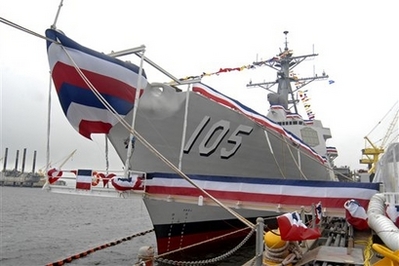
USS Dewey Commissioned at Seal Beach
The Navy commissioned the newest guided-missile destroyer, the USS Dewey, to its fleet today at a ceremony steeped in naval symbolism and tradition.
At the Naval Weapons Station here, Navy Adm. Mike Mullen, chairman of the Joint Chiefs of Staff, delivered remarks to a crowd of thousands before the admiral’s wife Deborah Mullen, the ship’s sponsor, called the order that brought the $1 billion warship to life.
“You’re getting a true gem: a ship as well built and well-tested as they come and manned by performance-proven, highly motivated sailors. May you deploy Dewey to the tip of the spear.” Mullen said from a podium aboard its quarterdeck.
USS Dewey, the 55th Arleigh Burke-class destroyer, can conduct an array of operations, officials said, including the capability to fight simultaneous air, surface and subsurface battles. Considered part of the Navy’s Aegis combat warship fleet, the Dewey can detect threats nearly 100 miles away.
Full Story
By: Hammer - 7th March 2010 at 03:39
We`ve been inside both Absalon and Frankfort am main recently, lots of pictures on these links. Enjoy!
Hammer
By: Stonewall - 6th March 2010 at 11:43
Felgenhauer…:rolleyes:
I bet for him 13 of the 12 launches were a failure :dev2:
By: Tango III - 5th March 2010 at 17:21
Russian military yet to identify causes of Bulava missile’s woes
The Russian military is still working to establish the reasons for the misfiring of the troubled Bulava ballistic missile, Defense Minister Anatoly Serdyukov said on Friday.
The Bulava submarine-launched ballistic missile (SLBM) has officially suffered seven failures in 12 tests. Some analysts suggest that in reality the number of failures was considerably larger, with Russian military expert Pavel Felgenhauer contending that of the Bulava’s 12 test launches, only one was entirely successful.
Full Story
By: radar - 5th March 2010 at 17:11
8 f-35 or 12 helis? i’m pretty sure that cavour can handle more than 8 f-35 OR 12 helis.
By: Wanshan - 5th March 2010 at 09:58
😀 2,35 + 1,2….
3,55 billion $ for the refit of a 1968-1971′ design era aircraft carrier + airwing
In the early 2000’s, the italian paid 1,8 billion € (+/- 2,1 billion $) for the highly modern “conte di cavour” design 😀
:dev2:
Of course, Cavour is only 27,100t fld (as compared to 45,000 tons fld for a Kiev class ship), and can’t operate fixed wing aircraft (whereas the modified Gorshkov can).
Plus you can think about which airwing would be more effective: 16 Mig29K+ 10 Ka-31 Helix versus 8 VTOL aircraft (AV-8B Harrier or in future F-35B joint strike fighter) or 12 helicopters (EH101, NH 90) or a mix.
By: Colombamike - 4th March 2010 at 16:21
A $2.35-billion contract between Russia’s state-controlled arms exporter Rosoboronexport and the Indian Defense Ministry on refitting the INS Vikramaditya (Admiral Gorshkov) and the $1.2-billion contract on delivery of MiG-29K/KUB carrier-based fighters will be signed during Putin’s visit to India on March 11-12.[/I]Full Story
😀 2,35 + 1,2….
3,55 billion $ for the refit of a 1968-1971′ design era aircraft carrier + airwing
In the early 2000’s, the italian paid 1,8 billion € (+/- 2,1 billion $) for the highly modern “conte di cavour” design 😀
:dev2:
By: Tango III - 4th March 2010 at 15:32
Russia, India to sign $4 billion military technical cooperation contracts

Russia and India are expected to sign three contracts in military technical cooperation totaling $4 billion, including retrofitting the Admiral Gorshkov aircraft carrier during Russian Prime Minister Vladimir Putin’s visit to India, Vedomosti Russian daily reported.
A $2.35-billion contract between Russia’s state-controlled arms exporter Rosoboronexport and the Indian Defense Ministry on refitting the INS Vikramaditya (Admiral Gorshkov) and the $1.2-billion contract on delivery of MiG-29K/KUB carrier-based fighters will be signed during Putin’s visit to India on March 11-12.
Full Story
By: Tango III - 4th March 2010 at 15:22
Russia carries out successful test of Sineva ICBM
Russia successfully test-launched a Sineva intercontinental ballistic missile from a submarine in the Barents Sea on Thursday, a Defense Ministry spokesman said.
He said the missile was launched at 7:50 a.m. Moscow time (04:50 GMT) from the Tula (Delta IV-class) submarine.
The RSM-54 Sineva (NATO designation SS-N-23 Skiff) is a liquid-propellant submarine-launched ballistic missile (SLBM) designed for Delta IV-class submarines that can carry up to 16 missiles each.
Full Story
By: Wanshan - 3rd March 2010 at 23:31
I think I ought to point out a couple of things here.
The ro-ro ramp can’t be used for amphibious assault. It needs a quay for unloading.
Nor can the very small SRC90E be used for amphibious assault from Absalon. She carries two of them, each capable of carrying 10 soldiers. 20 soldiers – with no vehicles – is a raid, not an amphibious assault.
http://www.storebro.se/Nav.aspx?pageid=79
You’ld think she’s not intended for amphib assault then, wouldn’t you….. Or, as you may recall, these ships were referred to by the Danes as ‘flexible support ships’ and now are referred to “command and support ship” / Kommandostøtteskib
(that doesn’t include ‘assault’ or ‘amphib’, does it?)
.
By: Distiller - 3rd March 2010 at 23:13
Aha…..take a look…
http://www.fsg-ship.de/2product/pdf/702.pdf
I’m aware of that. Mein Kommentar zielte eher darauf ab, dasz “combat” im Zusammenhang mit Bundeswehr und Bundesmarine als eher relativ anzusehen ist …
Im Uebrigen heiszt es ja auch “Einsatzgruppenversorger”.


 Sign In








 August 5, 2009 at 11:14 am