Britain considered selling Harrier to China
Arms sale ‘sparked Soviet ire’
LONDON: British efforts to boost relations with China by selling it military equipment during the Cold War provoked fury from the Soviet Union, the declassified documents showed yesterday.
Britain thought selling Harrier aircraft to China, which was boosting its military capacity after Mao Zedong’s death, could improve ties between the countries as officials started to think about the future of Hong Kong.
It was also seen as way of helping British industry, while prime minister Callaghan was concerned that Britain was falling behind France in relations with China.
But the plan hit trouble when the professional head of Britain’s armed forces, Sir Neil Cameron, said that Britain and China “have an enemy at our door whose capital city is Moscow,” prompting a furious Soviet response.
Relations between China and the Soviet Union were poor at the time as officials believed China was trying to match its massive military presence.
In October 1977, Callaghan said he wanted then foreign secretary David Owen to look at “reducing the qualitative discrepancy between UK/Chinese and Franco/Chinese relations.”
As part of this, Cameron was to visit Beijing in April 1978 and Britain decided that it should promote arms sales within certain limits.
Shortly before Cameron went to China, British officials in Moscow warned London that the Soviets would see any British military sales to China as “an unfriendly act” which could cause a “sharp” deterioration in relations.
The situation got worse when, responding to a toast at a dinner in Beijing, Cameron said: “Our two countries are coming more and more together.
“This must be good, because we both have an enemy at our door whose capital city is Moscow.”
But by August, Callaghan was stressing the need for a more cautious approach.
http://www.gulf-daily-news.com/Story.asp?Article=238921&Sn=WORL&IssueID=31285

By: Tango III - 4th August 2009 at 18:11
CVN 70’s Carl Vinson Checks in for Maintenance 1 Month after Return to Service
The nuclear-powered aircraft carrier USS Carl Vinson [CVN 70] is returning to Northrop Grumman Shipbuilding in Newport News, VA this month for $50 million worth of maintenance work following completion of its refueling and complex overhaul (RCOH) and return to service in July.
Northrop Grumman expects to complete the maintenance work by December 2009. The work is being performed under a modification to a previously awarded contract (N62793-03-G-0001). Contract funds of $30.7 million will expire at the end of the current fiscal year. The Supervisor of Shipbuilding, Conversion and Repair in Newport News, VA manages the contract.
Northrop Grumman explained that the maintenance, known as the ship’s Post Shakedown Availability, is a typical step to resolve any issues that came up during the RCOH process…
Northrop Grumman Shipbuilding redelivered USS Carl Vinson to the Navy on July 11/09, following a 3 1/2 RCOH. The RCOH is performed only once in a carrier’s 50-year life and includes extensive modernization work to more than 2,300 compartments, hundreds of system upgrades, and over 20 million man-hours of work, which includes defueling and refueling the nuclear reactors.
USS Carl Vinson is the 3rd Nimitz-class aircraft carrier to complete RCOH at Northrop Grumman Shipbuilding. USS Theodore Roosevelt [CVN 71] is scheduled to begin her RCOH this summer and planning is currently underway for the USS Abraham Lincoln’s [CVN 72] RCOH.
By: Tango III - 4th August 2009 at 09:24
Google translate online
Russia is negotiating with France to purchase Mistral type ship
Russia is negotiating with France to purchase a landing amphibious assault ships type Mistral for the Navy. This is July 4, writes Kommersant, earlier reported the French business newspaper La Tribune. Moscow officially comment on this information to the Russian edition refused, however, according to multiple sources of Kommersant, the probability of such negotiations is extremely high.
According to the French journalists, the outcome of negotiations will be concluded in September 2009, and in October French President Nicolas Sarkozy may visit Russia. However, as noted by La Tribune, while differences remain between the parties. Moscow insists on buying a ship and the construction of three more at the Russian shipyards, but, according to the source of the French edition, “the transfer of such technologies may be relatively limited.”
Kommersant said that the first time the possibility of acquiring foreign technology announced in October 2008, Navy Chief Admiral Vladimir Vysotsky during a visit to a naval Euronaval salon in France. According to Admiral, the Russian fleet “as a common interest development, as well as direct purchases of certain types of French equipment. Press also noted the interest of Chief landing ship Mistral type of DCNS.
However, in the main headquarters of the Navy of Russia and other interested agencies and companies in the Russian “Kommersant” refused to comment on the purchase of a French ship. The publication stresses that the situation evolved, and unmanned aerial vehicles Israeli production, which initially also buy officially denied.
Note that in the present composition of the French fleet was composed of two types vertoletonostsa Mistral, and the construction of another is not yet completed. Ships of this project are designed to transport troops and cargo, landing, and can also be used as a headquarters. Their total tonnage of 21,300 tons, length 199 meters, width – 32 m, speed – 18.8 knots, and range up to 19800 miles.

By: Tango III - 4th August 2009 at 08:51
All at sea – China’s navy develops fast attack craft
When analysing China’s naval development, international media naturally focus on the headline-grabbing platforms. The potential for an aircraft carrier and the Type 094 ballistic missile submarine garner the most attention.
While eye-catching, these stories are an inadequate reflection of China’s actual military capabilities. Of more importance to the People’s Liberation Army are the lower-profile projects that will be used in day-to-day operations.
To this end, the Type 022 (Houbei-class) guided-missile fast attack craft (FAC) is one of the most significant recent developments of the People’s Liberation Army Navy (PLAN).
The FAC is perhaps the primary platform to be used in the asymmetrical warfare that China could expect to fight in the medium term, and is the only naval modernisation project that has achieved large-scale production. Moreover, the most likely role of the Type 022 is for active defence of China’s ‘near seas’, representing the country’s attempts to gain greater sea control further from its landmass.
http://www.janes.com/news/defence/naval/jir/jir090730_1_n.shtml
By: Tango III - 4th August 2009 at 08:41
Yury Dolgoruky sub to undergo 5-6 tests before commissioning
MOSCOW, August 3 (RIA Novosti) – Russia’s newest Borey class strategic nuclear submarine, the Yury Dolgoruky, will undergo up to six more sea trials before being commissioned with the Russian Navy, the Sevmash plant said on Monday.
The submarine, which is expected to be armed with the new Bulava sea-launched ballistic missiles (SLBM), successfully completed its first round of sea trials in the White Sea on July 10.
“According to our estimates, the submarine still needs at least five or six sea trials before commissioning,” said Anastasia Nikitinskaya, a spokesperson for Sevmash plant.
The vessel is 170 meters (580 feet) long, has a hull diameter of 13 meters (42 feet), a crew of 107, including 55 officers, a maximum depth of 450 meters (about 1,500 feet) and a submerged speed of about 29 knots. It can carry up to 16 ballistic missiles and torpedoes.
The construction cost of the submarine totaled 23 billion rubles (about $713 mln), including 9 billion rubles ($280 mln) for research and development.
Two other Borey class nuclear submarines, the Alexander Nevsky and the Vladimir Monomakh, are currently under construction at the Sevmash plant and are expected to be completed in 2009 and 2011. Russia is planning to build eight of these submarines by 2015.
According to Navy officials, fourth-generation Borey class nuclear-powered submarines will form the core of Russia’s fleet of modern strategic submarines, and will be deployed with Russia’s Northern and Pacific fleets.
However, the commissioning of the submarine could be delayed by setbacks in the development of the troubled Bulava missile, which has suffered six failures in 11 tests.
The future development of the Bulava has been questioned by some lawmakers and defense industry officials, who have suggested that all efforts should be focused on the existing Sineva SLBM.
But the Russian military has insisted that there is no alternative to the Bulava and pledged to continue testing the missile until it is ready to be put in service with the Navy.
By: gunner5" - 4th August 2009 at 08:15
First Assembly of Euro Hawk Unmanned Aircraft for Germany
Northrop Grumman Corporation has finished assembling the first Euro Hawk unmanned aircraft system (UAS) for the German Ministry of Defence (MoD). With a wing span larger than a commercial airliner and endurance projected at up to 30 hours, the Euro Hawk will serve as the German Air Force’s and Navy´s high-altitude, long-endurance signals intelligence (SIGINT) system.
The Euro Hawk is a derivative of the Block 20 Global Hawk, and will be equipped with a new SIGINT mission system developed by EADS Defence & Security (DS). The SIGINT system provides standoff capability to detect electronic intelligence radar and communications intelligence emitters. EADS DS will also provide the ground stations that will receive and analyze the data from Euro Hawk as part of an integrated system solution.
“This on-time assembly of the Euro Hawk demonstrator reinforces our commitment to providing ground-breaking technology to our customers and solidifies our transatlantic cooperation with Germany and EADS DS,” said Jim Kohn, Northrop Grumman Euro Hawk program director. “We’re also on track for the Euro Hawk unveiling later this year at our Palmdale, Calif. manufacturing facility after additional checkout and systems testing, followed by first flight and delivery in 2010 in Germany.”
Following successful testing and introduction in German operational service, Northrop Grumman anticipates subsequent systems will be delivered between 2016 and 2017. The Euro Hawk will replace the naval fleet of Breguet Atlantic aircraft, which have been in service since 1972.
“We’re eager to receive the Euro Hawk and can’t wait to have this unmatched capability flying high above European skies at more than 60,000 feet and improving our troops’ safety during military deployments,” said Heiko Weiss, Euro Hawk program manager of the German Federal Office for Defence Technology and Procurement. “Developed to meet Germany’s need for airborne wide-area surveillance and reconnaissance, this system will surely transform the region’s situational awareness on land, air, and sea.”
“This collaborative effort between Northrop Grumman and EADS DS on this first Euro Hawk is a great success and an excellent example of our transatlantic partnership,” said Heinz-Juergen Rommel, chief executive officer of the EuroHawk GmbH. “We are excited to welcome this magnificent UAS here in Germany.”
On Jan. 31, 2007, the German MoD awarded a $559 million contract to EuroHawk GmbH, a 50-50 joint venture company formed by Northrop Grumman and EADS, for the development, test and support of the Euro Hawk unmanned SIGINT surveillance and reconnaissance system. Under the contract, EuroHawk GmbH will also provide aircraft modifications, mission control and launch and recovery ground segments, flight test and logistics support.
EuroHawk GmbH is the national prime contractor for the German MoD through the entire lifecycle of the Euro Hawk system. The limited liability company is based in Immenstaad, Germany.
By: Jonesy - 4th August 2009 at 05:22
Wilk,
Call it quits. ASW choppers more likely to get an SSN?. If a surge operation is underway would it be done without massive air superiority established over the narrows?. No. If Russian SSN’s are making an opposed transit through those waters Turkish air and naval surface forces are already gone. The SSN couldnt hope to make transit otherwise.
Nuclear torpedo’s being sent into the straits first?. So in other words you accept that SSK’s are an overriding threat to an SSN transitting tight waters like the Aegean entry?. Why not accept that in the first instance?. Why concoct all this spurious nonsense about noisemakers and accoustic barrages if you know that the SSK’s would have to be cleared?.
Still, as we hear so often from posters with new login names, it would never happen anyway so lets brush it under the carpet and hope no one ever mentions it again eh?.:rolleyes:
By: Bager1968 - 4th August 2009 at 05:19
Dardanelles strait: minimum width of 1.2 kilometers (0.75 mi) wide, averaging 55 meters (180 ft) deep with a maximum depth of 82 meters (300 ft).
Bosphorus strait: minimum width of 700 m (2,297 ft) between Kandilli and Aşiyan; and 750 m (2,461 ft) between Anadoluhisarı and Rumelihisarı. The depth varies from 36 to 124 m (118 to 407 ft) in midstream.
A 1970s frigate with a towed array could find a SSN… or any other sub… in those waters.
By: JFC Fuller - 3rd August 2009 at 22:26
See above. Also, I’m not aware of any exercises that involved Turkish/Greek SSKs hunting 4th gen SSNs in those waters, so I’m not sure where you got that they are “well versed in operating in that scenario.”
I never said they were well versed in hunting SSN’s, I said they were well versed to operating in the littoral space where they technically excel in a way that SSN’s do not which is the point that everyone here has been making but that you have been ignoring in your rush to pick a fight with Jonesey.
By: Wilk - 3rd August 2009 at 22:05
Swerve,
I did not once claim that transiting the straits during hostilities would be easy, in fact as far as I’m concerned it would be extremely difficult. I merely pointed out the claim that the SSKs “murdering” the SSN had no credibility behind it. As I pointed out, we have no reason to believe that SSKs using passive sonar would detect that SSN unless they were about to collide into it. The SSN is far, far more likely to get taken out by a mine or ASW Helicopter rather than stumbling into a Greek or Turkish SSK. And that doesn’t affect my original point, since I never claimed that it would be immune from mines or other threats.
The options I gave for the Russians to try in the event of hostilities are just that – options. I never suggested that they were guaranteed to work. As far as I’m concerned, a Russia-Turkey-Greece war is a WW3 scenario and all bets are off at that point. For example, the Russians could just fire nuclear torpedoes into the straits to clear them out in that case.
So in conclusion, there is nothing silly about the Russians deploying a few new SSNs into the area. During any time when Russia is not at war with Turkey (basically, all the time unless WW3 starts), they can sail into the Mediterranean at will, giving them another option for sending an SSN into the region.
By: swerve - 3rd August 2009 at 20:10
…. If by some chance Russia does go to war with Turkey, the Russians would likely bombard and attempt to capture the area around the straights before trying to send anything through. If they wanted to pass anything through, they would launch mobile noisemakers to worsen the already poor acoustic conditions. They could also attempt a combined surface and subsurface transit in order to increase the chance of something getting through. But in any of those scenarios the greatest threat would not be SSKs, but mines. And again, that’s extremely unlikely to happen anyway.
Look at a map. What is on both sides of the Bosporus? And having captured it, you still have to capture the Dardanelles. You are talking about a major campaign in its own right, not a mere prelude to getting some subs through a choke point. BTW, remember the last time someone tried it?
Again, LOOK AT A CHART! The poor acoustic conditions of the straits are pretty irrelevant as far as the transit of an SSN is concerned. Their narrowness and depth are such that there are points where there is, quite literally, nowhere to hide an SSN. It wouldn’t matter how many noisemakers were launched: if the Turks were alert, any SSN trying to pass through would die.
Remember, these are straits narrow enough to be bridged. Getting under the bridges unobserved would be no mean feat – and navigating the sharp bends, underwater, without using sonar (coz if you do they’ll hear you . . . ), while allowing for the currents in different directions at different depths, & varying speed . . . . rather you than me.
By: Wilk - 3rd August 2009 at 19:28
Littoral environment. Small subs are far more effective in confined waters. Exiting the Dardanelles/Aegean entry is prime territory for SSK’s. I would image that the Turks are reasonably well practised putting their SSK’s into the Sea of Marmara as well.
The Russians have said that their new SSNs will be ~5000 tons, so there will not be a great difference in size here. You have made a claim that the SSKs will be able to target and destroy such a hypothetical SSN in these waters, without having any data to backup the claim that those SSKs will actually be able to detect it unless it is right on top of them. Whilst it’s a nuke vs nuke example, I suggest reading about the 1992 Baton Rouge/Sierra collision, or the recent French-British SSBN collision to show just how limited detection ranges against modern nuke boats at low speeds really are.
Your first post on this site seemed to indicate you knew all about the challenges offered by SSK’s in tight waters. I find it amazing that you can’t see how seaspace as extreme as the Aegean entry would be tailor made for SSK’s?.
Yes, challenges offered in finding those SSKs. Trying to find a small 4th gen SSN isn’t going to be any easier. Just because an SSK can hide well doesn’t mean it suddenly has the mystical ability to find other SSKs and SSNs that can also hide well.
Would it quell your ‘righteous fury’ if I added that I think anybody’s SSN’s would get murdered in there….not just Russia’s?. Its just that the article specifically listed the Russians putting SSN’s into the Black Sea not anyone else!.
This has little to do with Russia vs whomever. Although the new Russian SSNs will be smaller, if this scenario was changed and it was USN Virginia’s vs the SSKs in those waters my argument would not change (i.e. The SSKs would have a hard time actually finding the Virginia).
If one somehow did get through, it would be trying to survive against smaller, sneakier subs in waters perfectly made for such subs to have the edge
They will have the edge in acoustic detection vs a submarine that isn’t even built yet? Prove it.
Seriously? Do you actually know what the waters in that area are like? Shallow and confined, the idea hunting ground for SSK’s, especially ones well versed in operating in that scenario
See above. Also, I’m not aware of any exercises that involved Turkish/Greek SSKs hunting 4th gen SSNs in those waters, so I’m not sure where you got that they are “well versed in operating in that scenario.”
Let’s get something straight here; the odds that Russia will be at war with Turkey and/or Greece are miniscule. So the premise that they will get “murdered” by Turkish and Greek SSKs if they try to pass through the actual straits has little to do with reality. In peacetime, the SSNs will get through just fine in order to support operations and exercises in the Mediterranean. Since peacetime is almost certain to be all the time, I don’t see any “murdering” going on. If by some chance Russia does go to war with Turkey, the Russians would likely bombard and attempt to capture the area around the straights before trying to send anything through. If they wanted to pass anything through, they would launch mobile noisemakers to worsen the already poor acoustic conditions. They could also attempt a combined surface and subsurface transit in order to increase the chance of something getting through. But in any of those scenarios the greatest threat would not be SSKs, but mines. And again, that’s extremely unlikely to happen anyway.
By: Tango III - 3rd August 2009 at 15:39
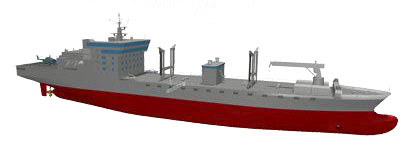
A corvette for the United Arab Emirates Navy and a fleet tanker for the Indian Navy.
Double Order from India and U.A.E. for Fincantieri
TRIESTE, Italy — Fincantieri has gained new important orders from foreign navies: a corvette for the United Arab Emirates Navy of and a fleet tanker for the Indian Navy. The vessels, worth 250 million Euros, will be built at Fincantieri’s Italian shipyards.
The “Abu Dhabi class” design of the corvette for the U.A.E., due for delivery early 2011, has been developed from the “Cigala Fulgosi”, on the basis of which four “Comandanti” class vessels were built for the Italian Navy.
In addition to an option for a second sister ship, the contract also comprises provision to the U.A.E. Navy of logistical support and training for crew. What makes the order even more important for Italian industry is that the ship’s combat system will be supplied by Selex Sistemi Integrati, a company in the Finmeccanica group.
The Indian Navy, on the other hand, has exercised its option for a second fleet tanker which was included in the contract signed in 2008, with delivery in the last half of 2011, a sister ship to the first fleet tanker currently under construction and due for delivery in 2010.
Fincantieri has been following the Indian market closely. Following delivery in 2007 of the Sagar Nidhi, an oceanographic vessel for the National Institute of Ocean Technology (NIOT) of Madras, the company has continued its co-operation – drawing on the strength of its experience building the Cavour, the flagship of the Italian Navy – with the shipyard of Cochin for the design of the engine, technology transfer and the provision of complementary services for the construction of the Indigenous Aircraft Carrier (IAC) currently under construction. Fincantieri has completed the functional and detailed design of the propulsion system and assistance at the Indian shipyard is soon due to start up.
Commenting on the announcement of the orders, Giuseppe Bono, Chief Executive Officer of Fincantieri said: “We are beginning to reap what we have sown. These important orders constitute for our Group a significant signal of recovery in the naval export market, especially in view of the current crisis. They come on the heels of the recent awarding of the first orders in the Littoral Combat Ship program which involves our shipyards in the USA, and confirm that the company was right to take the strategic decision to be present in all sectors, from civilian to military.”
Since January this year Fincantieri has gained orders in the naval sector for a total value of over 500 million Euros.
TECHNICAL CHARACTERISTICS
— The corvette for the U.A.E. will be 88 metres long, 12m broad and have a displacement at full load of 1,650 tonnes. The ship will be able to reach a speed of 25 knots with an endurance of over 3,000 nautical miles at 14 knots, thanks to 2 diesel engines of 7,000 kW. Accommodation will be available for a crew of approximately 70.
This cutting edge ship will mainly carry out patrolling and surveillance activities and may be employed in anti-submarine, anti-aircraft and surface activities. She will be able to exchange tactical data in real time with other naval vessels, helicopters and bases on shore and will be able to provide support and shelter for helicopters of the Emirate Navy. In addition to highly flexible operational capabilities, the vessel will also feature high standards of safety and living conditions for the comfort for the crew.
— The Indian fleet tanker on the other hand will be 175 metres long, 25 m broad, for a height of 19 metres and have a displacement at full load of 27,500 tonnes. Powered by two diesel engines of 10,000 kW the ship will be able to reach a maximum speed of 20 knots.
As for the first fleet tanker, the propulsion system will be made up of a shaft with an adjustable pitch propeller and the vessel will have a flight deck for medium-heavy helicopters (up to 10 tons). Thanks to her double hatches, it will be possible to carry out refueling of four ships at the same time. She will be able to accommodate approximately 250 people, including crew and supplementary personnel.
Last but not least she will feature a double hull, which can guarantee greater protection of the fuel tanks against the risk of pollution in case of collision or damage, in accordance with the new Marpol environmental protection regulations of the International Maritime Organization.
By: JFC Fuller - 3rd August 2009 at 11:43
You heard it here first, folks! Jonesy knows for a fact that a hypothetical Russian forth gen SSN that’s not yet even built will get “murdered” by Turkish and Greek SSKs.
Why are you posting here and not making millions off the stock markets?
Seriously? Do you actually know what the waters in that area are like? Shallow and confined, the idea hunting ground for SSK’s, especially ones well versed in operating in that scenario. No SSN’s of any ilk would stand much of a chance trying to make a transit from the Black Sea to the Med in a hostiel scenario.
By: swerve - 3rd August 2009 at 11:05
You heard it here first, folks! Jonesy knows for a fact that a hypothetical Russian forth gen SSN that’s not yet even built will get “murdered” by Turkish and Greek SSKs.
Why are you posting here and not making millions off the stock markets?
Don’t be silly. Go away & look at charts of the Dardanelles & Bosporus. Look at some photos. Go there & take a look (I have done). Then try to imagine an SSN trying to sneak through. Chance of survival? Approximately nil. Nothing to do with being Russian, or of any particular generation, just a question of the space available.
If one somehow did get through, it would be trying to survive against smaller, sneakier subs in waters perfectly made for such subs to have the edge, & waters which their skippers know intimately, & where the Russians have never operated. i.e. conditions which the best crew in the world, in the best SSN in the world, would approach with dread & foreboding.
By: Jonesy - 3rd August 2009 at 05:03
You heard it here first, folks! Jonesy knows for a fact that a hypothetical Russian forth gen SSN that’s not yet even built will get “murdered” by Turkish and Greek SSKs.
Why are you posting here and not making millions off the stock markets?
Littoral environment. Small subs are far more effective in confined waters. Exiting the Dardanelles/Aegean entry is prime territory for SSK’s. I would image that the Turks are reasonably well practised putting their SSK’s into the Sea of Marmara as well.
Your first post on this site seemed to indicate you knew all about the challenges offered by SSK’s in tight waters. I find it amazing that you can’t see how seaspace as extreme as the Aegean entry would be tailor made for SSK’s?.
Would it quell your ‘righteous fury’ if I added that I think anybody’s SSN’s would get murdered in there….not just Russia’s?. Its just that the article specifically listed the Russians putting SSN’s into the Black Sea not anyone else!.
By: Wilk - 3rd August 2009 at 02:05
That would imply deployments against NATO and Turkish or Greek SSK’s would murder them when they tried to break out into the Aegean.
You heard it here first, folks! Jonesy knows for a fact that a hypothetical Russian forth gen SSN that’s not yet even built will get “murdered” by Turkish and Greek SSKs.
Why are you posting here and not making millions off the stock markets?
By: StevoJH - 2nd August 2009 at 13:00
I assume they could transfer the crew to one of the partially crewed ones and be at sea VERY quickly if needed. 😉
By: Tango III - 1st August 2009 at 09:37
Navy submarine breaks down
The Navy’s submarine fleet has struck more problems, with one submarine taken in for repairs.
The Defence Department says HMAS Collins is being repaired in Adelaide, but will not say why it broke down.
Neil James from the Australia Defence Association says the submarine had engine trouble during training south of the Great Australian Bight.
“I understand it’s got something to do with the propulsion,” he said.
“We just have to wait and see how serious it is.”
The Defence Department says the submarine is one of two active in a fleet of six.
The others are in maintenance or used for training.
The 45 crew members are stranded in Adelaide.
Former senior defence official Alan Behm says the shortage puts the Australian Navy at a disadvantage should Australia go to war.
“If it were serious ocean warfare though, we would be in a pretty poor position,” he said.
“It has a terrible effect on crew morale because the crews are not doing what they’re trained to do.”
The department says most of the crew will return to base in Western Australia within the next month.
It says the submarine is expected to be back at sea later this year.
A spokesman for the Defence Minister, John Faulkner, did not return the ABC’s calls.

By: Tango III - 31st July 2009 at 15:28
Russian military plans to resume Bulava missile tests in August
KHABAROVSK, July 31 (RIA Novosti) – The Russian Defense Ministry said on Friday it would not abandon the development of the troubled Bulava ballistic missile, and that tests could resume in August.
The missile, which is being developed by the Moscow-based Institute of Thermal Technology (MITT), has suffered six failures in 11 tests. The general director of the institute resigned last week over the failures, which are believed to represent a severe setback in the development of Russia’s nuclear deterrent.
“Everything depends on the conclusions reached by an investigation commission,” Deputy Defense Minister Vladimir Popovkin said, adding that the probe could be finalized as early as next week.
The Bulava (SS-NX-30) submarine-launched ballistic missile (SLBM) carries up to 10 MIRV warheads and has an estimated range of over 8,000 kilometers (5,000 miles). The three-stage solid-propellant ballistic missile is designed for deployment on new Borey class nuclear-powered strategic submarines.
The Russian military expects the Bulava, along with Topol-M land-based ballistic missiles, to become the core of Russia’s nuclear triad.
Popovkin said more work has to be done to correct flaws in the Bulava’s development, but that there was no alternative to the missile for a number of reasons.
“We have no choice – we already have one [Borey class] submarine, and have laid down more, so to start a new R&D project would be unrealistic,” the official said.
Russia’s newest Borey class strategic nuclear submarine, the Yury Dolgoruky, has completed the first round of sea trials in early July.
Two other Borey class nuclear submarines, the Alexander Nevsky and the Vladimir Monomakh, are currently under construction at the Sevmash plant and are expected to be completed in 2009 and 2011. Russia is planning to build eight of these submarines by 2015.
“A submarine costs about 60 billion rubles [about $2 bln], and the development of a new missile would cost up to 30 billion rubles [$1 bln] – these are serious expenses.”
“But the most important thing is the years [spent on development], because we urgently need to change our sea-based strategic delivery vehicles,” Popovkin said.
The future development of the Bulava has been questioned by some lawmakers and defense industry officials, who have suggested that all efforts should be focused on the existing Sineva SLBM.
The RSM-54 Sineva (NATO designation SS-N-23 Skiff) is a third-generation liquid-propellant submarine-launched ballistic missile (SLBM) that entered service with the Russian Navy in July 2007. It can carry four or 10 nuclear warheads, depending on the modification, and has a maximum range of over 11,500 kilometers (about 7,100 miles).
Russia carried out successful test launches of two Sineva missiles from two Delta IV class nuclear-powered submarines in service with the Northern Fleet, located under an ice floe near the North Pole, on July 13-14.
The results of the tests confirmed that the Sineva would stay in service with the Russian Navy until at least 2015.
By: Tango III - 30th July 2009 at 19:30
China Delivers Frigate To Pakistan: Navy
KARACHI – China on July 30 delivered the first of four state-of-the-art frigates commissioned by nuclear-armed Pakistan from top ally Beijing, a naval spokesman said.
“The first F-22P Frigate constructed for the Pakistan navy at the Hudong Zhonghua Shipyard in Shanghai was delivered to Pakistan on Thursday,” said Lt. Cmdr. Shakeel Ahmed.
In keeping with contracts signed between China and Pakistan in 2005, the frigates will be equipped with anti-submarine helicopters, surface-to-surface and surface-to-air missiles and other defense systems.
“The F-22P frigates will not only enhance the war fighting potential of the Pakistan navy but will also strengthen the indigenous ship-building capability of the country,” said Ahmed.
The announcement came two days after Pakistan hit out at India, branding its rival’s first nuclear-powered submarine “detrimental” to regional peace and vowing to take “appropriate steps” to maintain a “strategic balance”.
Relations between nuclear-armed rivals India and Pakistan have plummeted since Islamist gunmen killed 166 people in Mumbai last November, attacks that New Delhi blamed on banned Pakistani group Lashkar-e-Taiba (LeT).
India on Sunday launched the first of five planned submarines by naming the 6,000-tonne INS Arihant (Destroyer of Enemies), powered by an 85-megawatt nuclear reactor that can reach 44 kilometers an hour (24 knots).
China is Pakistan’s strongest ally and Islamabad relies heavily on Beijing for its defense needs.
Many Chinese companies operate in Pakistan and China is involved in the construction of a deep-sea port at Gwadar on the Arabian Sea.


 Sign In








 January 1, 2009 at 8:55 am