Being majority government owned (since the middle of WW2) and being based in Belfast has made Short and Harland a special case when allocation of manufacturing contracts was being decided.
If Shorts Bros., Ltd had formed a company with another shipbuilder outside of Northern Ireland, rather than with Harland and Wolff, what changes in allocation of production contracts would you expect to see?

By: Pondskater - 10th January 2009 at 16:15
Ooo – why did I say the Sperrin flew first. 😮
I must check dates when tired and not type stuff from from memory on the mobile!
By: alertken - 10th January 2009 at 14:13
Design ITPs: 19/11/47 Victor, first flight: 24/12/52;
27/11/47 Vulcan, first flight: 20/8/52;
11/12/47 Sperrin, first flight: 10/8/51;
16/4/48 Valiant; first flight 18/5/51; 2 prots. ITP: 2/2/49; 9/2/51: production ITP, 25 Valiant B.1 (50% MDAP $ funds).
1946 first draft ASR for a high, fast Medium had been rejected by RAE as Wellsian fantasy. Concepts then funded included flying-wing A.W.52 (f/f 13/11/47) and Avro (Tudor-derived) C.102 (to be Jetliner), f/f 10/8/49.
Sperrin had been rejected, 7/47, in part as its Napier E-113 was deemed likely to be late. Big-Avon was funded with its 12/47 ITP, which caused Hives to commit, with Geo.Edwards, to early first flight, the trigger to fund Valiant in April,1948. Short disruption as design/drawing moved from Rochester then put Valiant ahead.
By: Pondskater - 10th January 2009 at 13:08
Assuming that they would not know if the Valiant was suitable until it had been test flown is a bit of a shorthand – although sometimes useful.
A better approach is to consider when the Ministry placed the order for the production of the aircraft – and compare it with when they ordered the two Sperrins. Unfortunately I don’t have the dates for the Valiant – but somebody will.
By: pagen01 - 9th January 2009 at 22:16
Pagen, the two Sperrins were ordered as a “low tech” alternative to the three V bombers – only to progress if the advanced designs failed. Sperrin flew first but the Valiant (and others) all worked so no more Sperrins were needed.[/QUOTE]
I know that, but the Sperrin was a lower tech version of the lower tech V bomber (Valiant), seemed strange to continue on the belt and braces route once it was realised that the Valiant was adequate. Seemed alot of effort and money for what would become a flying test bed for a failed engine type.
The SB3 and SB6 prototypes also seem now to have been superflous, with no real requirement (though a spec existred for the later) for them.
By: Pondskater - 9th January 2009 at 19:56
In 1940 Dundee was being considered for a “dispersal” factory, new buildings and sending men etc from Rochester to set up a new works. But no partnerships with ship builders were proposed {that I’ve found}. Remember that Dundee had been used by the RAF to base 210 squadron during the Munich crisis.
The Fylde Coast was also investigated (mile of mud flats so not much good for big flying boats) and the dispersal went to Windermere.
Pagen, the two Sperrins were ordered as a “low tech” alternative to the three V bombers – only to progress if the advanced designs failed. Sperrin flew first but the Valiant (and others) all worked so no more Sperrins were needed.
By: alertken - 9th January 2009 at 15:18
None left: the non-State owned ones had other Aero commitments:
John Brown salvaged Westland (7/35);
Denny linked up with Blackburn;
Laird, Scottish Avn.;
Swan Hunter invested 8/34 in Airspeed;
Vickers: Weybridge, and Supermarine.
Others were either vulnerable to German Air, or far from any labour pool.
Just think: if we’d had no WW1 or 2: so NW England shadow Munitions work; so no Irish influx; so no Gallaghers or McCartneys: no Oasis or Beatles.
By: PMN1 - 8th January 2009 at 19:10
I Short and Harland Ltd. had been shot-gunned by Minister Swinton 6/36 as part of his shadow system. To liberate Rochester to do Stirling, Sunderland was to be built by shipwrights, as it floated and its wing sat more on a keel than a spar.
Any other shipbuilders considered?
By: pagen01 - 2nd January 2009 at 13:06
I think wires are crossed over the Belfast, and the HP design, surely different types to different specifications. Originally it was preferred to have used the Bristol design, bits of Britannia finding themselves on the Belfast. Very capable aircraft all the same.
Back to original Q, I’m guessing it was politics that ensured that 2 Sperrins were built, in the face of safe but more advanced Valiant?
By: PMN1 - 2nd January 2009 at 11:52
Having gone back and looked at what I have on the British proposed/cancelled jet transports/airliners of the 1950s, I find the following statement:
“Handley Page tried again in 1958 with the revised HP.111, this featured a new ‘widebody’ fuselage of circular section and was proposed to the RAF as a strategic transport and to BOAC as a 200 passenger medium range or 150 passenger transatlantic transport and civil freighter. In this form it was actually selected by the RAF but politics intervened and the Govt insisted the order went to the Short Belfast and HP never offered a large transport again.”.So you are absolutely correct, PNM1. My only question is… what was the planned cargo payload of the HP111? Could it have carried the floor weight/item size that the Belfast did?
That’s the bit that surprised me, the two aircraft look to be designed for two different roles??
By: alertken - 2nd January 2009 at 11:03
Thank you. Francis. I had forgotten that diminutives come in braces.
By: Pondskater - 2nd January 2009 at 01:10
Thanks Ken – good stuff
It’s not the right Q: Oswald Short had no say in any of it. Short and Harland Ltd. had been shot-gunned by Minister Swinton 6/36 as part of his shadow system. To liberate Rochester to do Stirling, Sunderland was to be built by shipwrights, as it floated and its wing sat more on a keel than a spar.
Gouge, a former chippie, always said any carpenter or boatbuilder could build a Sunderland. Perhaps optimistic, as proved at Windermere but they did it, eventually.
By late-42 Oswald as businessman had lost the confidence of his customer:
Oswald or Gouge? Oswald Short was bitter towards Arthur Gouge after the war – many years later Short’s letter to the RAeS had to be considerably edited. Gouge was General Manager at Shorts but appears to have been a much better designer than manager – particularly irritating Whitehall mandarins. But Oswald appointed him. Oswald cared for his workers (and paid them too much) even paid for his own air raid shelters – the tunnels in the chalk behind the Seaplane works.
Stirling Prodn Group had “virtually collapsed (makes) no worth-while contribution to our war effort in return for their overheads (should) be a wholesale sacking of the incompetents who have turned out (c)50% rogue a/c from (Harland…
The Board of Trade review of Short Brothers in June 43 sought to find answers to why aircraft cost so much and why output was so low for the size of the labour force – these were the failings of the pre-nationalisation management. Wages were too high for hours worked (Taking home pay but working on 70% hours paid for) and effort put in was too low – and varied too much across the works
The Stirling problems were well known within Shorts – the test pilots drew up a list of complaints in Aug 1942. In Mar 43 three aircraft were produced in two weeks then NINE in the next fortnight to hit a monthly target – but aircraft with faults.
The company’s response to criticism was a document (Feb 43) which started with a list of excuses (Swindon and Airport Works only open one year, 50% of workers recruited within a year) yet they tried to argue that the cost of Stirling matched the Lancaster when cost per ton of bombs was the measure. “Extracting the digit” would have been more effective long term.
The incompetent drunk who ran (Short).” AM Harris to new Minister Cripps 30/12/42, C.Bryant,Stafford Cripps,Hodder,1997,P330.
Francis Short was known to be the drunk – died from drink, but was shoved out of Kent, out of the way. One of his offices was Windermere.
Oswald failed to extricate the digit, so he and his Board were ejected, his firm sequestered. Only himself to blame.
Production increased after the new management (under Heaton) got to grips with the details. If Oswald was to blame, it was in building a management team who understood shipbuilding, not mass production.
What Arthur Gouge was working on, and took with him to Saro, was Shetland:
The Shetland was a joint Saro/Shorts project and designed to be built in sections. Saro designed (and to build) the wings, Shorts the ten sections to make the hull. Gouge (where else could he go?) took ideas with him to Saro. In 1943 Saro (ie Gouge) published the report “The Future of the Flying Boat” to ensure it was included in the post-war civil aircraft plans. Ideas for 200,000lbs flying boats were proposed. He would surely have done that at Shorts, and taken them up the same dead-end as he took Saro.
If Oswald had improved in early-43, as others like Sir Richard Fairey did, staving off nationalisation, his firm would have been destroyed by Shetland, Sturgeon and expired just about when Rochester actually did.
Oswald could diversify when needed – by mid 30s Shorts had built over 5,000 buses, plus many boats, yet we think they are an aircraft company.
The reputation was destroyed pre-Shetland – it started with the Stirling troubles and then the Sunderland IV debacle, ignoring Air Council directives. That’s when the digit got stuck. If the IV and Shetland were on time and had met expectations, who knows – what if’s become too big when you go that far.
Allan
By: alertken - 1st January 2009 at 22:26
It’s not the right Q: Oswald Short had no say in any of it. Short and Harland Ltd. had been shot-gunned by Minister Swinton 6/36 as part of his shadow system. To liberate Rochester to do Stirling, Sunderland was to be built by shipwrights, as it floated and its wing sat more on a keel than a spar. Denny was Supervised by Blackburn-on-contract, but Harland was put into JV (Short, 60%) because HMG owned it, a legacy from the politics of Partition and the founding of Eire. Harland had been a fine HP 0/400 producer, whose men had been seen by 1917 Air Minister Churchill as “sturdy and ardent”. They re-learnt Aero on Bombay and Hereford, despite Short (reluctantly-)seconded Supervisors, who had to look them up in Jane’s. By late-42 Oswald as businessman had lost the confidence of his customer: Stirling Prodn Group had “virtually collapsed (makes) no worth-while contribution to our war effort in return for their overheads (should) be a wholesale sacking of the incompetents who have turned out (c)50% rogue a/c from (Harland…T)he incompetent drunk who ran (Short).” AM Harris to new Minister Cripps 30/12/42, C.Bryant,Stafford Cripps,Hodder,1997,P330. Cripps’ task, Nov.1942, was to produce the Heavies which WSC had represented to Stalin as The Second Front. Oswald failed to extricate the digit, so he and his Board were ejected, his firm sequestered. Only himself to blame. Sunderlands and Stirlings had been flowing quicker, cheaper from Harland, into which Cripps subsumed his Rochester acquisition faute de mieux: where else could management be found? All other aeronauts were floundering in their own problems.
What Arthur Gouge was working on, and took with him to Saro, was Shetland: notions of entrusting Shorts with any Super Heavy, had long since lapsed. After March,1943 the Sydenham entity had no corporate memory or other continuity with the Kent entity, which HMG allowed to expire mid-1948 as surplus to any National need, its designers and seniors migrating to Ulster (few) or leaving (many). The name might better have been The Ulster Aero-Ordnance Works. And that’s why it was Protected until 1989: a social service unifying employer during the troubles. Bar Skyvan et al sheds, everything it did was assigned, not won. Sperrin, an exercise to bed down the new design team: “we know how unreliable that firm is” CAS Tedder; VCAS AM {to be MRAF CDS Sir}W.Dickson “from knowledge (of Stirling/Shetland) it is probable (Sperrin’s) performance will drop still further” H.Wynn,RAF Nuclear Deterrent Forces, HMSO,1994,P55. Geo.Edwards came raging into the Minister when RAF VC10 fuselages were assigned there, to offer to pay the intended programme labourforce to sit idle, all fabrication to remain with him, at a cheaper price than by taking product from Ulster. Comet, Swift, Canberra…endless – even unto WAH64. Absent the political special case, then the Sydenham aero shadow would have reverted to marine late-45. If Oswald had improved in early-43, as others like Sir Richard Fairey did, staving off nationalisation, his firm would have been destroyed by Shetland, Sturgeon and expired just about when Rochester actually did.
By: Bager1968 - 1st January 2009 at 21:52
Having gone back and looked at what I have on the British proposed/cancelled jet transports/airliners of the 1950s, I find the following statement:
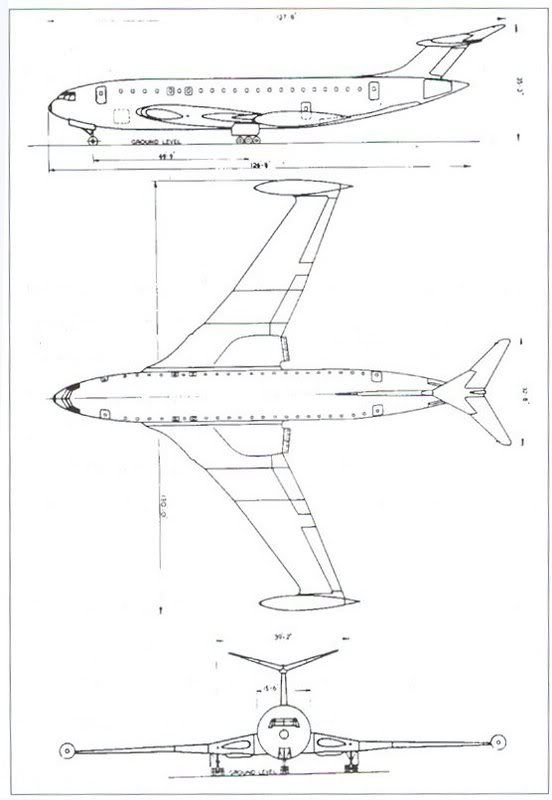
“Handley Page tried again in 1958 with the revised HP.111, this featured a new ‘widebody’ fuselage of circular section and was proposed to the RAF as a strategic transport and to BOAC as a 200 passenger medium range or 150 passenger transatlantic transport and civil freighter. In this form it was actually selected by the RAF but politics intervened and the Govt insisted the order went to the Short Belfast and HP never offered a large transport again.”.
So you are absolutely correct, PNM1. My only question is… what was the planned cargo payload of the HP111? Could it have carried the floor weight/item size that the Belfast did?
By: Pondskater - 1st January 2009 at 19:09
Hmm, an interesting but complex “what if”. The two events you mention combined to create a lot of changes in the company.
The new company was set up with with Harland and Woolf in June 1936, but was separate to the main firm, Short Brothers (Rochester and Bedford) Ltd. Short and Harland was jointly owned by Shorts and H&W.
The Nationalisation in March 1943 was as a result of the company not bringing in the efficiencies of mass production demanded by the Ministry. Arthur Gouge, the Sunderland/Shetland designer and general manager of the company, left for Saunders Roe – so had they not been nationalised it is logical to assume that he might have pursued his flying boat ambitions at Shorts and the Princess might have been launched at Belfast?
Without nationalisation Oswald Short’s influence might have kept up the pioneering element of the firm from the 20s and 30s. Would Short Brothers have been a proper contender in the V-bomber force, rather than asked to build the back-up design? How would his influence and insight have guided them into the expansion of post war civil aviation – more than just converting Sunderlands IMHO.
Had they not been nationalised there is one thing I believe – Short Brothers would have continued in Kent. The closure of Rochester’s Seaplane works in 1948 and moving the main base to Belfast was political. I think the Swindon and Windermere works were owned by MAP/MoS so their future is unlikely to have changed.
But you asked about the Northern Ireland company. Well, it is certain that the Government wanted to be seen to keep employment in Northern Ireland, but other areas of the country benefitted from similar political motivations. I’m not enough of an expert in the politics of aviation post war to judge, but the only effect of being in Northern Ireland, I suspect, has been Short Brothers insulation from the giant mergers of the industry into Hawker Siddeley and BAc. There may have only been small differences in the contracts granted.
By: PMN1 - 1st January 2009 at 13:02
The contract to design & build the Belfast is given to Bristol, for one.
Richard Payne’s ‘Stuck on the Drawing Board’ suggests the RAF wanted the Handley Page HP111 but political considerations forced them to have the Belfast.
By: Bager1968 - 31st December 2008 at 23:51
The contract to design & build the Belfast is given to Bristol, for one.


 Sign In








 December 31, 2008 at 7:23 pm