Hello,
I came across this on another forum, where it was discussed.
http://www.ascho.wpafb.af.mil/ARMING/CHAP2.HTM
“By the end of 1943, there were well over 800 major and thousands of minor projects ongoing at Wright Field. Studying the technology from a captured German Heinkel He 178, the first jet-powered aircraft, engineers and scientists refined and tested the jet engine, culminating in the production of the Bell XP-59A Airacomet, the Army Air Forces’ first jet.”
As far as i have read, there was only one He-178 and that was destroyed in a Berlin air raid in 1943.
How come Wright Field claim to have tested one later the same year?
Please not that the above website is a .mil site, which means its officially connected to the US military and not just a fake site (although the info might be).

By: Resmoroh - 10th May 2008 at 12:41
I’m not trying to hi-jack this thread, but I don’t suppose there is any record in either collection of Spitfire AB131 which was landed in occupied Europe in -as far as we are aware – a fully serviceable condition after a long Met PAMPA flight.
Just grasping at straws!!
Rgds
Resmoroh
By: Arabella-Cox - 10th May 2008 at 11:54
In the January and February 2007 issues of “Klassiker der Luftfahrt” is a two-part article about the DLS (Deutsche Luftfahrtsammlung) which is chock-full of pictures. There is also a picture of a captured Hurricane (PA-A; W9???) on display which carries a sky spinner and fuselage-band which dates this picture from 1941. There is no mention of an He 178 also being on display and there isn’t one to be seen in the pictures either. Is it clear that there WAS an He 178 there? Also in the article it is said that by Nov. 1943 the collection had already been severly damaged by bombing raids. It says that 24 of the most valuable aircraft and artefacts were then moved to Poland.
Peter
By: Arthur - 10th May 2008 at 11:27
That’s the brochure you can download? Got that one too.
While the 1937 collection already was very impressive, by 1941 it would have been absolutely fantastic. Quite a few rare aircraft found their way into the collection as war booty. They definately had a Fokker G-1, D-XXI, Czech, Polish, French and Belgian stuff, possibly some plunderings from Russia… The nazis certainly had enough sense of history (perverted as it was) to preserve captured aircraft rather than just massively scrap them.
By: Mondariz - 10th May 2008 at 10:59
I’m now in possession of a PDF published by “Luftfahrtsammlung” in 1937. Although it contains no list, there is a drawing of the exhibit area, with aircraft marked. There is also a number of pictures.
Anyone interested can drop me a private message with their mail and i will send a copy.
By: Mondariz - 10th May 2008 at 10:37
On topic of the Luftfahrtsammlung; does anybody have a full list of what aircraft they had by the time the museum was evacuated? Some absolute gems were found after the war, but the bulk of the collection is still missing. If anyone has the details, I’d be much obliged.
This is as close as i have gotten.
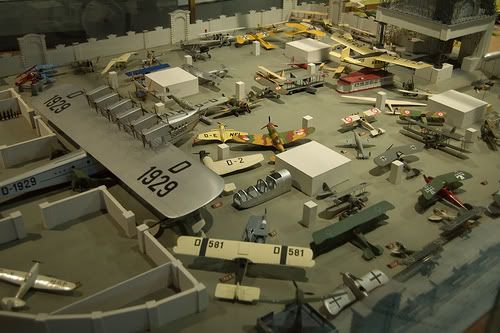
I have written to Holger Steinie regarding the He-178 and a list of missing aircraft. Maybe i will get an answer…..
By: Mondariz - 10th May 2008 at 10:34
I don’t know who got what mistaken. The “Luftfahrtsammlung” is/was a totally different institution than the “Deutsches Technikmuseum” which was founded after the war and is still in existence today.
“…then we might be looking at a another story (compared to the destroyed by air raid)…”
What story?Peter
The most common story about the fate of the He-178 is, that it was destroyed in an air raid. Most sources i have seen, refer to the “Deutsches Technikmuseum” as the place of destruction (among them wikipedia. I know wikipedia might not be an academic source, but misinformation is very likely to be changed, so if a lot of people knew the difference between Deutsches Technikmuseum and Luftfahrtsammlung, one of them would change the Wiki).
If you read my post, it will become appearent that about 100 aircraft went missing from “Luftfahrtsammlung” during the war, in attempt to save the aircraft from destruction. The article does not mention any air raid destruction (its written by Holger Steinie who is in the aviation department of “Deutsches Technikmuseum” so it must be assumed, that he knows a thing, or two)
Thats what i mean about another story.
Maybe the He-178 went missing, rather than being destroyed.
By: Arthur - 10th May 2008 at 10:16
On topic of the Luftfahrtsammlung; does anybody have a full list of what aircraft they had by the time the museum was evacuated? Some absolute gems were found after the war, but the bulk of the collection is still missing. If anyone has the details, I’d be much obliged.
By: Arabella-Cox - 10th May 2008 at 08:20
Now if “Deutsche Luftfahrtsammlung” (German Aviation Collection) have been mistaken for “Deutsches Technikmuseum” (“German Technical Museum”) then we might be lookning at another story (compared to the destroyed by air raid).
I don’t know who got what mistaken. The “Luftfahrtsammlung” is/was a totally different institution than the “Deutsches Technikmuseum” which was founded after the war and is still in existence today.
“…then we might be looking at a another story (compared to the destroyed by air raid)…”
What story?
Peter
By: Mondariz - 8th May 2008 at 16:19
I was following the He-178 story and came across this:
“BERLIN AVIATION COLLECTION LOST WITHOUT TRACE IN POMERANIA
The aeroplane motor collection of which parts are exhibited in Cracow The largest aviation museum in the world was once situated in Berlin, which is largely unknown today. The “Deutsche Luftfahrtsammlung” (German Aviation Collection) was in Alt-Moabit Street near Lehrter Station, housing more than 120 planes, 200 engines, pictures, models, cups and many other things. When Berlin became more and more threatened with bombing raids by the allies, a plan was developed to transfer this museum. Fritz Petereit, who was born in Treptow on the Rega river, an employee at the airport’s society was commissioned to plan the transfer. Due to his origins he was convinced that Pomerania was one of the safest areas in the German Reich. Thus, in June and July 1943 the museum was evacuated to a great extent and everything was shifted either by train or trucks to safe places. Petereit remembered in this context transportations to Treptow, where three or four aeroplanes were stored in the pottery Ernst Bordt of Bollenburg and in the storeroom of the Laabs Brothers carpentry in Großen Küte Street. Many aeroplane engines were kept in the dance hall of a restaurant in Darsow, between Gummishof, Levetzow and Dargislaff. Two aeroplanes were removed to Hammer, between Schonlanke and Scharnikau; further aeroplanes were likewise taken out to Schlachau, possibly to the drying places of a brickyard. Several aeroplanes were stored in Ratzebuhr, north of Schneidemühl. Finally, the Quast Guest House of Neuhofen, between Fihiene and Scharnikau, was the storing place of three or four aeroplanes. After 40 years Petereit understandably could not remember further storing places.
For at the end of the war only 24 aeroplanes of the “Deutsche Luftfahrtsammhmg” were discovered by the Poles, the question arises what has happened to the remaining ca. 100 planes. Surely many were destroyed during fights. Since the museum also housed quite modern airplanes, some of them may have been taken away by the Russian Army. It would be of great importance to know whether the reader can remember anything relating to this matter. Who possibly had noticed in the summer of 1943 something concerning the transportation of aeroplanes? Did anybody notice aeroplanes in the storerooms or dance halls of their villages?
In connection with the museum’s further extension and the current negotiations between the Federal Government and the Polish Government concerning the return of cultural objects, it would be of great importance to obtain more information and perhaps to receive some pictures, too.
Holger Steinie, German Museum of Technique, Berlin “
http://spoils.libfl.ru/spoils/eng/spoil5_2.html
Now if “Deutsche Luftfahrtsammlung” (German Aviation Collection) have been mistaken for “Deutsches Technikmuseum” (“German Technical Museum”) then we might be lookning at another story (compared to the destroyed by air raid).
By: Mondariz - 6th May 2008 at 16:57
Hmmm, somebody would know who wrote it and why…..
Maybe a secret group of hackers and aviation history rewriters have ganged up 😉
By: RPSmith - 6th May 2008 at 16:05
Mondariz – I thought I might send an e-mail too until I saw this on their homepage:
“Beginning June 2004, the ASC History Office will no longer actively manage this public web page. The information and photographs provided here remain available for use by researchers, but we regret that we will be unable to respond to requests for further information.”
Roger Smith.
By: Mondariz - 6th May 2008 at 15:47
Yes two He-178, but only one ever flew (again, as far as I know).
I wonder how that information would end on that page. It seems to be an otherwise well informed website.
Maybe i’ll write them a mail.
Any hangar fanatic, who can tell us anything about the doors on the picture (from the website) are they truely German doors? 😉
By: JDK - 6th May 2008 at 14:38
You are plainly ignoring the one in the Pont de l’Alma tunnel.
At least Flugkapitan Erich Warsitz knew seatbelts weren’t mythical in their utility.
By: Moggy C - 6th May 2008 at 09:33
IIRC, two He-178s were built but neither survived the war
You are plainly ignoring the one in the Pont de l’Alma tunnel.
Moggy
By: JDK - 6th May 2008 at 08:55
“By the end of 1943, there were well over 800 major and thousands of minor projects ongoing at Wright Field. Studying the technology from a captured German Heinkel He 178, the first jet-powered aircraft, engineers and scientists refined and tested the jet engine, culminating in the production of the Bell XP-59A Airacomet, the Army Air Forces’ first jet.”
Utter rubbish.
The XP-59 was based on British centrifugal flow jet engines and technology, while the Heinkel used (essentially) axial flow Ohan engine design. IIRC, two He-178s were built but neither survived the war, left Germany or were used by the Americans (or anyone else.) By 1945, everyone was interested in recent jet technology and developments, not 1939 first test model jets.
A photo of the Ohan engine will clearly show it wasn’t anything more than a test module, just like Whittle’s earliest efforts.
Both Heinkel / Ohan deserve credit for their achievements, as do Whittle and his team / colleagues for parallel but incompatible developments, the swift growth of the early US designs was originally based entirely on UK developments, then later on 1945 captured, current data.
…awaits conspiracy theorist with tinfoil beanie and ‘there’s stuff they don’t want us to know’ mumble…
By: RPSmith - 6th May 2008 at 08:40
Yes, there’s something badly wrong with that statement.
There was, I believe, no connection between the He 178 and it’s von Ohain designed Heinkel jet unit and the P-59 which was powered by a Whittle engine. In fact I would go on to question that anything on the Airacomet came from German technology.
Roger Smith.


 Sign In








 May 6, 2008 at 8:22 am