Back in the 1970’s my family moved into a council house in Neston which is on the Wirral in between Chester and Birkenhead. The garden was terribly overgrown so mum started sorting it out. Over the next few years she unearthed bike frames, wriggly tin, pain cans and all sorts of other metal rubbish. She also found three of these:
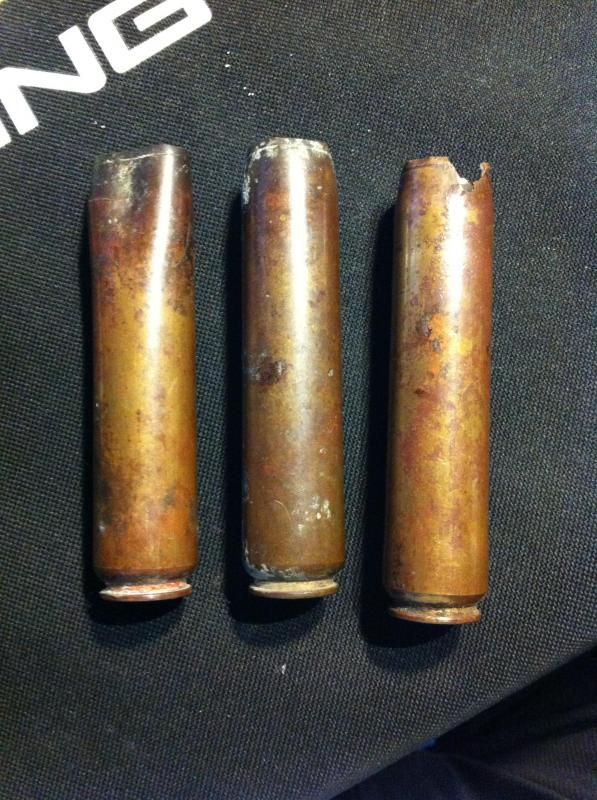 [/URL]
which I now think are 1944 dated 20mm Oerlikon cannon cases.
My question really is how did these come to be buried in our back garden? Presumably they fell from an aircraft but 1944?

By: mike currill - 5th November 2014 at 18:53
Slightly off topic. I knew I should recognise that belted rimless round but couldn’t place it. Having had a look through some of my reference stuff at home I realised it is most likely to be a .416 Rigby. At first I couldn’t get my head around the idea that someone had removed the neck of a .375 H&H to make that round as that was the only round with that type of case which immediately came to mind..
By: PeterVerney - 5th November 2014 at 15:26
Another daft memory from the early 1950s of course is that, while air to ground firing on the range at Shallufa in the Suez Canal Zone, watching women and children rushing about under the aircraft as we fired and picking up the cases as they fell. Valuable brass which could be used for all sorts of domestic and commercial purposes by people who lived in abject poverty.
By: PeterVerney - 5th November 2014 at 15:16
I was 7 in 1939 and from then on an avid collector of aviation related crap. I left home in 1948 and a few years ago met the current owners of our house. They were puzzled in that they had dug up in the garden a real mixture of stuff, including both British, German and American cases, but I explained they most likely came from where my mother had disposed of my junk.
By: Atcham Tower - 5th November 2014 at 14:36
There was a ground-to-air firing range out in the Dee Marshes, its boundary not much more than a mile from Neston. It was used, amongst others, by No 60 OTU’s Mosquitoes for night intruder training. They sometimes dropped flares to illuminate the target. I doubt if three shells would fall together like that but there might be a connection. Overflying Neston was a no no in theory, but in a wartime blackout it was easily done! A Mossie operating over the range crashed in a field just outside Neston killing two New Zealanders.
By: JDH1976 - 5th November 2014 at 09:41
[ATTACH=CONFIG]232963[/ATTACH]
on the left a British Hispano 20mm case which I am sure is the only aircraft 20mm ammunition used by the British,notice it is a different shape to the oerlikon cases. This one dated 1940 which is early as few aircraft in 1940 were fitted with cannon. On the right a 1940 dated German 20mm. It is similar in shape to the oerlikon cannon case but much shorter. This maybe why the OP had them identified as German by his local museum.
By: mike currill - 4th November 2014 at 19:36
Not quite the same as the one shown – but…
[ATTACH=CONFIG]232909[/ATTACH]
Thank you for reminding me of one of the rounds with that type of case. I seem to recall some bullet weights in that round were RNJ rather than spire points.
By: N.Wotherspoon - 4th November 2014 at 09:39
Guys, there is no doubt about the identity of my cases (I have quite a large collection of similar items) the question is how did they come to be in the garden.
A few years ago I was searching a back garden and found a 20mm Hispano case and on showing the owner he promptly produced two more – now we were searching for the crash site of a P-51K – definitely not a candidate! so I was a bit puzzled (BTW it turned out to be under the front garden anyway!).
Looking in detail I noted my case had come from the edge of a fenced ménage area and both his had been found whilst raking the sand covering the ménage itself – so I asked where the sand had come from – turned out due to the quantity required it had come direct from the extraction company working off Southport beach and the Ribble estuary – an area used for ground to air and air to ground firing training during WWII (HMS Queen Charlotte land based gunnery school, Ainsdale, Southport, and Banks Air to Ground Firing Range).
So mystery solved and probably lucky their was nothing more substantial in his bulk delivery! 😀
By: Creaking Door - 4th November 2014 at 09:04
I’m guessing that these three 20mm cases got into the garden the same way the rest of your collection got to where it is now; I’ve got a box of old cases in the garage that I’ve had for years (decades actually).
I think we can rule-out them falling from an aircraft as, so far, nobody can think of any (Allied) aircraft that carried Oerlikon cannon.
What is stamped on the base of these cases?
By: Rockhopper - 4th November 2014 at 07:58
Guys, there is no doubt about the identity of my cases (I have quite a large collection of similar items) the question is how did they come to be in the garden.
By: Bager1968 - 4th November 2014 at 04:39
Not quite the same as the one shown – but…
[ATTACH=CONFIG]232909[/ATTACH]
By: mike currill - 4th November 2014 at 02:20
The fact that it’s belted rimless makes it unusual anyway as there weren’t many guns that used that type of round to my knowledge.
By: Creaking Door - 30th October 2014 at 23:36
.303 6th from left.
What the hell is that round second from the right?
Rifle round, belted rimless, about .44, full-jacket…..do you own an elephant gun?
By: Creaking Door - 30th October 2014 at 23:29
Nope, the cases couldn’t be any of those in the photograph; all those rounds have tapered cases.
Most rounds have the calibre stamped into the base of the case; I’m guessing we can take it as read that these rounds are stamped 20mm on their base.
By: stukno - 30th October 2014 at 22:47
.303 6th from left.
My point being that from the initial photo we can have no idea if we are looking at case from the smallest round in your pic or the biggest or something bigger altogether. As has been pointed out, a pic of the cartidge base would help or one alongside a ruler. It just seemed to me that all the speculation in the thread was pretty pointless until the cases were properly identified. – Which is not that hard given easily obtainable information.
stu k
By: ZRX61 - 30th October 2014 at 22:36
without something to give a sense of scale, it is not possible to say what these are from at all. Sure that they are not .303?
.303 6th from left.

By: Creaking Door - 30th October 2014 at 20:20
Interestingly I took them to the curator at the Chester castle museum many years ago and he identified them as German!
Some of the German cannon of World War Two were based on Oerlikon designs so the ammunition is probably similar enough to cause confusion.
By: Creaking Door - 30th October 2014 at 19:24
Definitely not 303. The 303 cartridge cases were ‘rimmed’ in the old style; unlike the ‘rimless’ rimmed cartridge cases of more modern weapons.
By: stukno - 30th October 2014 at 17:21
without something to give a sense of scale, it is not possible to say what these are from at all. Sure that they are not .303?
By: Rockhopper - 30th October 2014 at 12:19
Interesting. I’ll have to find out who used to live in the house and see if they had any connection with the docks although really the house is around fifteen miles from the nearest place any decent sized ships might have berthed. Would people have traveled that far to work?
By: piston power! - 30th October 2014 at 04:56
Oerlikon Cannons were fitted on Merchant ships ran by the crew of Royal Navy, My grandfather were a gunner on such ships.
I suspect these came from a vessel in the harbour and spent shells were brought home for the kids.


 Sign In








 October 28, 2014 at 9:43 pm