I’m working on a P-61 Black Widow project, and I’m wondering if anybody has any reasonably knowledgeable insights about the airplane as a combat machine. I say “combat” because some of the most useful things the airplane did came after WWII. And I specify “reasonably knowledgeable” because I recently read a thread on a well-regarded World War II aviation forum re. “What was the best night fighter of WWII?” that had after a dozen pages resolved itself into arguing the merits of the Mosquito NF XXX and the Ju-88G-6 when a latecomer posted, “I nominate the Black Widow, because it’s so cool.” It was difficult to convince him that coolness was not a meaningful parameter.
Not to prejudge anybody’s opinions, but let me say that I think the airplane’s capability has been exaggerated among latter-day enthusiasts largely because of its brutish looks and size. Plus a PR-dream nickname and lots of room for self-congratulatory nose art…

By: Flanker_man - 8th September 2014 at 09:50
The only thing I can contribute are these photos wot I took of the restored(!) P-61 in the Beijing University of Aeronautics and Astronautics Museum last year…
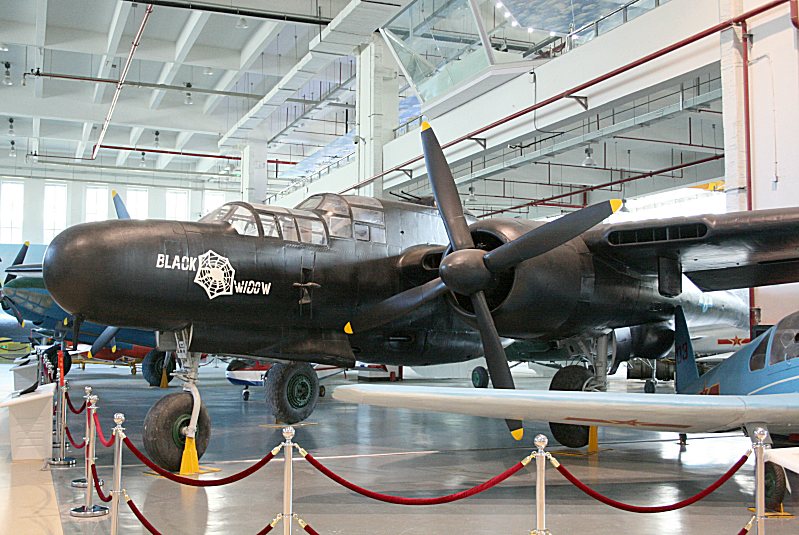
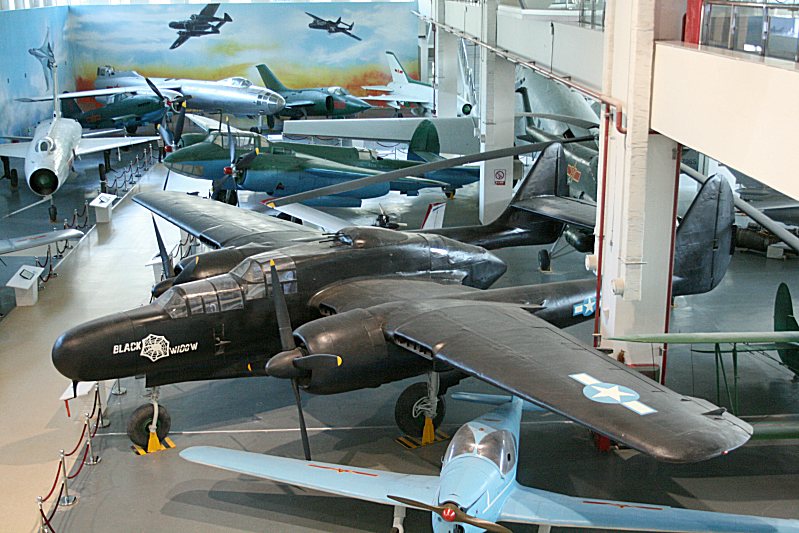
Ken
By: Duggy - 7th September 2014 at 16:11
“. I haven’t read your link–I don’t bother with model-maker and flight-simmer sites as legitimate sources of accurate aviation history”
WOW :stupid::stupid::stupid:
Really this site has some of the most accurate history out there, & one of the best photo collections on the web.
By: mhuxt - 7th September 2014 at 10:26
If you only paid $50, you got a good buy, though I don’t know what shipping costs will have been. I paid substantially more for my copy, though I had the privilege of being at the Wright-Patterson USAF Museum bookshop when I got it.
Here’s what the book has to say in terms of facts and figures, including performance:

Note the number produced with/without the turret, and when


Top speed no great shakes, though not much different from the Mosquito NF.XVII (1942-vintage) against which it was apparently tested. Against the XIX it would have suffered low down against the Merlin 25s, against the NF.XXX it would have suffered even more up high, against the two-stage Merlins.

That roll rate is very slow – especially given that it’s measured against a 90 (!) lb force.
As for the famed fly-off (apparently July 5, 1944), as noted above, it was against a 1942-vintage NF.XVII (NF.XXX was on the point of going into service), apparently flown by S/L Eric Barwell, of 125 Sqn. I’ve never seen anything written about it from the RAF side. The one person who appears to have actually researched the event is a guy named Dana Bell, who at one point worked for the US National Air and Space Museum. Many years ago, he posted this on one of the earliest aviation-related message boards. I once asked him if he was going to publish – he wasnt’ sure, but as he put this on a public message board, I suppose there won’t be any issue copying it here:
While I can’t prove to anyone that one aircraft was “better” than the
other, I’ve done a lot of research on the great nightfighter flyoff. I can
confirm that the results were rigged to give the American crews more faith in
the P-61s they were about to take into combat.
Carl Spaatz had requested Mossie Mk.30s to replace P-61s, citing the Black
Widow’s poor performance at altitudes over 20,000 feet, lack of range, and
short mission duration. The Brits at that time were havein problems
producing the Mk.30s, and had to decline. The American units (422d & 425th
NFSs) were only aware of the possible change, and didn’t want to give up
their aircraft for something British. It was into this arena that two
“contestants” were thrown. I am sure that the “contest” was rigged for the
following reasons:
1 – If the Mosquito had won, the Brits could not have provided any aircraft
until October or November: it was not in their interest to win.
2 – The American crews were so hopped up about having a chance to prove
their worth that there was a drawing among the top crews to see who would
have the honor of picking up the gauntlet.
3 – The American aircraft was specially tuned by factory representatives to
be capable of its best performance.
4 – The British crew was never told they were in a contest – they were told
to go up and evaluate the relative merits of the two aircraft.
5 – The British aircraft used single-stage Merlins (it was a Mk.XIX, I
belive) and was taken off the line without special servicing.
6 – The tests were flown at 5,000, 10,000, 15,000, and 20,000 feet, below
the altitude were the P-61’s speed deficiencies became so apparent.
7 – The tests were flown in daylight, with both aircraft approaching from
head on, then turning to try to get on each other’s tail. (The P-61 had an
ability to turn very quickly, but the tactic was rarely of any use to a night
fighter.)
8 – The final report was never shown to one of the two American evaluators.
Fourty years later, he still thought the Mosquito had won, and was surprised
to see a report recommending the P-61, a report onto which his signature had
been forged.
9 – The report itself never said the P-61 was superior, only that it would
be adequate. The report cited one of the main reasons the P-61 was so good
was the remotely operated turret, which overcame many other disadvanages. On
the last page, the same report resommended removal of that turret to make
room for more fuel, the only means of improving endurance.
I know this is a very short version of the story, which needs to be written
up in full one day, but, personally, I have little doubt that the Mosquito
was the more capable night fighter. The P-61 was just the best available to
the AAF for most of the war.
-Dana
By: Bager1968 - 7th September 2014 at 04:00
The Japanese attack on Pearl Harbor WAS the declaration of war by Japan – the first shot fired constituted the first act of the US-Japan part of the war.
In addition, the US Declaration of War was back-dated to the day and time of that first shot.
By: Vacca - 7th September 2014 at 02:07
Technically the B-32 kills were the first “post-WW2” kills, as Japan surrendered on 15 August 1945.
While the signing of the surrender documents did not take place until 2 September 1945, 15 August (in Japan – 14 August in the US) is the accepted “end of WW2”.
In comparison, note that the accepted end of WW1 was 11 November 1918 – but there was still a formal state of war between the two sides for another seven months, until the signing of the Treaty of Versailles with Germany on 28 June 1919.
Just saying…
So, by your logic, the attack on Pearl Harbor isn’t included in World War Two then since no declaration of war existed?
Officially, Anthony Marchione is the last American to die in World War Two, in the attack on the B32’s on the 18th August. That attack is officially listed as the last engagement of World War two. Period. The signing of the a document is meaningless until the military lays downs it’s arms.
Just saying….
By: alertken - 6th September 2014 at 22:10
Stirling: “could not make a decent operational height (a) pig (on) taking off and landing (but) in the air it was a darling – it could turn inside a Spitfire” D.Richards,The Hardest Victory,Hodder,94,P.311.
By: Bager1968 - 6th September 2014 at 11:51
The final two air kills of WW2 were achieved by a Consolidated B32 Dominator on the 18th August 1945. The P61 kills came on the 14/15th August 1945.
.
Technically the B-32 kills were the first “post-WW2” kills, as Japan surrendered on 15 August 1945.
While the signing of the surrender documents did not take place until 2 September 1945, 15 August (in Japan – 14 August in the US) is the accepted “end of WW2”.
In comparison, note that the accepted end of WW1 was 11 November 1918 – but there was still a formal state of war between the two sides for another seven months, until the signing of the Treaty of Versailles with Germany on 28 June 1919.
Just saying…
By: Stepwilk - 6th September 2014 at 06:18
Why would it dogfight ????
I never said it would. I simply said that one notable flying quality it happened to have was that it could out-turn a number of more agile (in other ways) fighters.
So yes, you’re absolutely right: one of the P-61’s “strengths” was irrelevant to its mission.
By: Vacca - 6th September 2014 at 04:36
The P-61 will always be remembered for the the final two kills of WWII.
The final two air kills of WW2 were achieved by a Consolidated B32 Dominator on the 18th August 1945. The P61 kills came on the 14/15th August 1945.
.
By: Duggy - 6th September 2014 at 02:30
Quite simple the P-61 was designed as a night fighter.
Why would it dogfight ????
By: Stepwilk - 6th September 2014 at 02:01
I don’t know. Could a Stirling out turn a Hurricane? Beats me.
P-61s and a variety of other fighters–pretty much everything but the Brewster Buffalo– were extensively tested against each other at the Joint Fighter Conference at Pax River, in October 1944. Multiple experienced pilots, maneuvers specifically choreographed. “Tactics and skill” were removed from the equation as much as possible. The P-61 did very poorly, except for turn radius.
It’s fine to be remembered for “the final two kills of World War II,” but that’s more a matter of coincidence, location and timing than any remarkable quality of the P-61. I haven’t read your link–I don’t bother with model-maker and flight-simmer sites as legitimate sources of accurate aviation history–but as I remember, only one of the two victories has been officially accepted.
By: Duggy - 6th September 2014 at 01:24
A Stirling could out turn a Hurricane?
Again this comes down to tactics & the pilots skill.
The P-61 will always be remembered for the the final two kills of WWII.
LINK – http://www.axis-and-allies-paintworks.com/e107_plugins/forum/forum_viewtopic.php?420.0
By: Stepwilk - 6th September 2014 at 00:40
The story that has come down through the years, whether it’s true or not, is that the RAF crew flying the Mosquito -wanted- to lose to the P-61. They did not want the USAAF deciding that the Mosquito NF XXX was just the airplane they needed. since the Brits wanted to keep every one they could. I suspect it’s true, since all of the performance information I’ve seen on the P-61B puts it well behind the Mosquito in nearly every parameter. The P-61 was famously “too slow and low,” and the whole reason the P-61/Mosquito flyoff came about was that a number of U. S. high officers felt the P-61 was a dud.
The one thing I do think might be quite true is that the P-61 out-turned the Mosquito. Despite the fact that the P-61 was not particularly maneuverable by classic standards, it had an incredible turn rate, particularly at relatively low speeds.
By: Alan Clark - 5th September 2014 at 23:53
I think to get the RAF’s view from the time as written someone needs to go down to the National Archives and take a look at AIR 64/38, “Night flying and radar trials in a Black Widow aircraft: (F.I.D.S. report No.270) Report No. 36” dated May 1945.
By: QldSpitty - 5th September 2014 at 23:47
From the website http://www.usaaf.net/ww2/night/nightpg5.htm
Lt. Col. Winston W. Kratz, director of night fighter training in the United States, bet $500 that the Mosquito could outperform the Widow. According to the 422d NFS historian, the competing P-61, “tweaked” to get maximum performance, proved faster at all altitudes, “outturned the Mossie at every altitude and by a big margin and far surpassed the Mossie in rate of climb.” All in all, the historian noted, “a most enjoyable afternoon-Kratz paid off.”
This a case of public relations of national pride?
By: Stepwilk - 5th September 2014 at 22:56
Yes, it has a great deal of excellent info on the P-61, most of it fairly negative. Which is helpful, because I went into this thinking that it was one of the more overrated airplanes of the war, the subject of a myth built largely on its hulking appearance.
By: Bradburger - 5th September 2014 at 20:35
Paul, many thanks for that recommendation. The book has arrived, and it is a stunningly comprehensive resource. Not cheap–$50 from Amazon–but worth many times that amount.
Glad you are impressed by it Stephan!
As you say, it’s a great resource for those interested in not only the flying qualities and handling of these fighters, but also in their systems, performance, and their construction.
Whilst these days copies of the manuals and wartime test reports are easier to find and readily available on the internet, it’s worth remembering that when this book was first published, that wasn’t the case!
I just hope that it has some useful info on the P-61 for you! (I must admit, that’s the one aircraft in the book that I haven’t read so much!) 😮
Cheers
Paul
By: Stepwilk - 5th September 2014 at 09:09
if you can get hold of the excellent, ‘America’s Hundred Thousand’ by Francis H.Dean, you’ll find a lot of good, factual info and technical data in there regarding its performance, handling, systems, and what its pilot’s thought of it as a combat aeroplane.
Paul, many thanks for that recommendation. The book has arrived, and it is a stunningly comprehensive resource. Not cheap–$50 from Amazon–but worth many times that amount.
By: Duggy - 4th September 2014 at 18:32
From Joebaugher link – http://www.joebaugher.com/usaf_fighters/p61_2.html
” Only the first thirty-seven of the 45 P-61A-1s were actually equipped with the dorsal turrets. In fact, more than half of all P-61As built actually had this turret deleted. One reason for this omission was that the General Electric remotely-controlled turret mechanism was urgently needed for the B-29 program. However, the primary reason was the occurrence of severe aerodynamic buffeting when the turret was being either elevated or rotated in azimuth during flight. Many flight-test hours were spent in trying to solve this problem, but it was never completely eliminated. In fact, this problem was often so severe that many P-61As in the field had the four 0.50-inch machine guns in the top turret permanently locked into the forward-firing position, being fired only by the pilot, with the gunner having no control at all. In many cases, the top turret was completely removed from the aircraft, and the cavity left behind by the deletion of the gun turret was filled up by an extra fuel tank and was faired over. In a few cases, the turret mechanism was completely removed from the aircraft and the four dorsal machine guns were secured in the upper portion of the turret cavity and covered by a nonstandard turret cover. Some of these modifications were made in the field, but others were made at forward depots before the aircraft were delivered to their operational squadrons.
Since the gunner of these re-equipped Black Widows now had no guns that he could fire, he was sometimes left at home when these planes went out on operational missions, and many Black Widow operational missions carried only two crew members–the pilot and the radar operator. However, on other occasions, the gunner was nevertheless included on operational missions, if only to act as another pair of eyes.
Most of the P-61A-1-NOs went to the USAAF night fighter squadrons in the Pacific. The 6th Night Fighter Squadron was the first to receive the new fighter.
The P-61 was quite docile despite its size. Full control of the aircraft could be maintained with one engine out, even when fully loaded. The plane could be slow-rolled into a dead engine, a maneuver which would ordinarily have been suicidal.
P-61A-1-NO 42-5496 was supplied to the RAF for tests. It was in British hands between March 21, 1944 and February 22, 1945. The RAF was not too enthusiastic about its performance, and never bothered to order any Black Widows for its own use, finding that the night fighter version of the de Havilland Mosquito was more than adequate for the task at hand. “
By: mike currill - 4th September 2014 at 17:27
Yes, if you don’t count the WWI types….but you7’re correct, I shouldn’t have included the word “warplanes”.
But in terms of overall experience, I believe my intent is clear. That incarnation of Northrup (as opposed to the earlier firm (basically a Douglas subsidiary) that built the Alphas, Deltas and Gammas) was an untried organization.
And I’d also argue that the P-61 was more of a technological leap than the Mosquito in terms of airframe design and innovations.
After al, the Mossie was another in the long line of wooden dH’s.
It’s excellent performance had more to deal with a light, small-ish airframe powered by excellent, powerful engines. Hardly a unknown way to make a outstanding performance aircraft. 🙂
Not forgetting the Mosquito’s beautifully streamlined shape. By comparison the P-61 disregarded the whole idea.


 Sign In








 September 1, 2014 at 10:41 pm