
By: danrh - 21st November 2005 at 04:10
from JMR Dec 2005
Pakistan develops air-bursting RPG-7
Doug Richardson
Pakistan Ordnance Factories (POF) has developed an air-burst anti-personnel round for the locally produced derivative of the Russian RPG-7, writes Doug Richardson. The new RPG-7AP has a warhead that contains 850 steel balls packed around a high-explosive charge. It has a maximum range of 1,500 m and, according to the POF, is designed “to kill soldiers and damage equipment within 15 metres’ radius”.
In general configuration, it closely resembles the Type 69 40 mm air-burst anti-personnel grenade that China has developed for its Type 69-1 40 mm anti-tank grenade launcher. Like the Chinese round, it is propelled upwards by a jump mechanism when it strikes the ground. Once it reaches a height of about 2 m, the warhead detonates, scattering its steel balls.
The main difference between the Pakistani and Chinese rounds is that the muzzle velocity of the former is 95 m/s, slightly lower than the 102 m/s of its Chinese equivalent. Projectile weight is slightly higher – 2.85 kg rather than 2.8 kg – while the payload contains 850 steel balls rather than about 800.
Although the POF cites a calibre of 40 mm compared with the 75 mm of the Chinese round, in practice the Pakistani figure refers to the calibre of the launcher rather than the diameter of the warhead. The latter is about 75-80 mm in diameter.
By: mirza2003 - 13th May 2005 at 04:45
Please stop repeating, if people have answers they’ll post it, if they dont, then sorry, and if you’re so curious, maybe you could search the internet and get your answers and let us know what all you found.
if i can find there than what is the need to post it here. :dev2:
but in my view some pak poster knew but they did not want to disclose. 😡
By: phrozenflame - 12th May 2005 at 16:44
Please stop repeating, if people have answers they’ll post it, if they dont, then sorry, and if you’re so curious, maybe you could search the internet and get your answers and let us know what all you found.
By: mirza2003 - 9th May 2005 at 19:38
hey but nobody give me answer about my question pls read my above post.
By: Wolffy - 7th May 2005 at 20:10
Some great news For the pak navy
Pentagon moves to sell Pakistan anti-ship missiles
06 May 2005 22:30:32 GMTSource: Reuters
By Jim Wolf
WASHINGTON, May 6 (Reuters) – The Pentagon notified congress on Friday of a proposed sale to Pakistan of 40 air-launched and 20 ground-launched Harpoon Block II anti-ship missiles and related materials valued at up to $180 million.
Pakistan, a key ally in the U.S.-declared war on terrorism, plans to use the equipment to modernize its existing Harpoon missile capability, the announcement said.The Pakistani Navy already has AGM-84 Block I air/surface/subsurface launch capability, it said.
“The modernization will enhance Pakistan’s legitimate self-defense capability,” the Pentagon told congress, which has 30 days to move to block any such government-to-government arms sale.
The sale would not affect the basic military balance in the region, the notice said.
“This proposed sale will contribute to the foreign policy and national security of the United States by helping to improve the security of a friendly country that continues to be a key ally in the global war on terrorism,” it said.The principal contractors are Chicago-based Boeing and Delex Systems, Inc., of Vienna, Virginia, the Pentagon’s Defense Security Cooperation Agency said in the mandatory notice.
On March 25, President George W. Bush authorized the sale of Lockheed Martin (LMT) F-16 fighter jets to Pakistan in a reversal of 15 years of U.S. policy aimed at curbing Pakistan’s nuclear weapons program.
At the same time, the administration announced it would let U.S. firms supply India multi-role combat aircraft, including upgraded F-16s and F-18s, as well as Patriot missile defense systems.
The AGM-84 Harpoon Block II missile features satellite-guidance systems designed to attack targets in congested off-shore locations.
the capture of Abu Faraj al-Libbi must have made uncle sam really happy.
By: Sameer - 7th May 2005 at 19:33
Alot of “Incarnations” lately, i thought it was forbidden to use multiple ID’s ?
I take it you are either a moderator or a hacker who can establish this with proof or I will take it as yet another comment by the pakdef team?
By: aditya - 7th May 2005 at 12:42
Some relevant X-Posts from TankNet regarding.
Simon Tan
ilkim posted 06 Jul 2004 10:02 Log:
——————————————————————————–
At the end of May, the malaysian Army AD Group(GAPU) went to Tanjung Siang in Johor for a LIVEX. They brought ALL the gear, including the recently acquired Igla/Djigit and Anza MkII VHSORADS.
The highlight of the Ex was the live firings of both new systems. The results were….interesting.
Targets for both were Paraflares from a 105mm howitzer and banshee Drones fitted with Hotnose IR beacons.
The Anzas which equip 33 AD Regiment, Royal Artillery and 361 Para Battery were able to acquire and hit all the targets they fired at.
Igla on the other hand could only acquire the paraflare and could not acquire the Banshees! In fact they quit trying to fire the Igla in both MANPADS and Djigit launcher formats after these repeated failures.
The Malaysian Army uses Igla-1
Sardaukar
Cynical Finnish Elk Eating Ilk posted 07 Jul 2004 06:48 Log:
——————————————————————————–
Since my job in FDF was to work with Igla-missiles, (SA-18 and SA-16), I can probably shed some light into this.
Main reason probably is that Igla’s auxiliary seeker channel that is designed to work on area sensitive to flares and such, thus to block them away, will block the beacon wavelenght.
There is constant confusion on net which missile is the latter and which former One with button on lauching device to override IR ECCM is the latter It’s large rubber covered button on left side of launching device, not the small one in missile tube itself..which is used to select between closing targets and targets that are moving away.
Using the latter variant (which we call ItO 86M) in test-firing is bit complicated, since it was hard to find suitable decoys, not to mention expensive. Earlier variant, ItO 86 is no longer in use, last been fired in excercise 2003 and then rest decommissioned. ItO 78 (SA-7 Strela) was decommissioned in late 90’s.
Cheers,
M.S.
swerve
Self-preservation society member posted 07 Jul 2004 07:46 Log:
——————————————————————————–
So, Sardaukar, what you’re saying is that the Iglas aren’t crap, but too good to be fooled by the beacons? Nice!
Sardaukar
Cynical Finnish Elk Eating Ilk posted 07 Jul 2004 09:03 Log:
Basicly yes . Iglas are veryeasy to use and seekers are quite effective. Newer (Igla-S ?) is supposed to have even “3-colour” seeker, making it even more resistant to flares and such.
Igla has tendency to ignore targets that emit on wavelength of the secondary “seeker channel” which is adjusted to match IR jammers and flares. Thus, latter model was also equipped with switch to disengage the ECCM if necessary. We never had any problems engaging modified 132 mm rockets used as test targets.
Due to flight characteristics and having contact fuze, direct hit’s to targets that small were rare, though..and that wasn’t the point anyway…since the “corkscrew” flying path has diameter of 1 m seen from behind.
Cheers,
M.S.
By: Indian_bomb - 7th May 2005 at 11:45
Alot of “Incarnations” lately, i thought it was forbidden to use multiple ID’s ?
What do you mean?
By: Arshad - 7th May 2005 at 00:54
OHH!!
Golden Arrow dont talk without any reference. How can you say all this.
Dont say probbably/may be/should be/would be, this or that.We people on this forum want facts. We are not here to illustrate our dreams.
1. Shaheen 2 and Chinese M-18 are two different missiles.Specifications for M-18
Payload: 400kg
Warhead: HE, chemical, submunitions
Length: 12.00 m
Diameter: 1.10 m
Launch Weight: 7,000 kg
Range: 1,000 kmSpecifications for Shaheen-2
Payload: 1,050 kg
Warhead: 750 kg; Nuclear 15 to 35 kT, HE, chemical, FAE, submunitions
Length: 17.00 m
Diameter: 1.40 m
Launch Weight: 25,000 kg
Range: 2,500 km
________________________________________________________________
Shaheen-2 Chinese M-18[I]Warhead 750 kg = 400 kg
Length 17.00 m = 12.00 m
Diameter: 1.40 m = 1.10 m
Launch Weight: 25,000 kg = 7,000 kg
Range: 2,500 km = 1,000 kmAfter this comparsion, you mean to say that Shaheen-2 = PRC M-18 ??????
http://www.missilethreat.com/missiles/
Alot of “Incarnations” lately, i thought it was forbidden to use multiple ID’s ?
By: Indian_bomb - 6th May 2005 at 19:59
Ghauri = NoDong
Shaheen-1 = Chinese M-9 or DF-18
Shaheen-2 = Chinese M-18
OHH!!
Golden Arrow dont talk without any reference. How can you say all this.
Dont say probbably/may be/should be/would be, this or that.We people on this forum want facts. We are not here to illustrate our dreams.
1. Shaheen 2 and Chinese M-18 are two different missiles.
Specifications for M-18
Payload: 400kg
Warhead: HE, chemical, submunitions
Length: 12.00 m
Diameter: 1.10 m
Launch Weight: 7,000 kg
Range: 1,000 km
Specifications for Shaheen-2
Payload: 1,050 kg
Warhead: 750 kg; Nuclear 15 to 35 kT, HE, chemical, FAE, submunitions
Length: 17.00 m
Diameter: 1.40 m
Launch Weight: 25,000 kg
Range: 2,500 km
________________________________________________________________
Shaheen-2 Chinese M-18[I]
Warhead 750 kg = 400 kg
Length 17.00 m = 12.00 m
Diameter: 1.40 m = 1.10 m
Launch Weight: 25,000 kg = 7,000 kg
Range: 2,500 km = 1,000 km
After this comparsion, you mean to say that Shaheen-2 = PRC M-18 ??????
http://www.missilethreat.com/missiles/
By: mirza2003 - 30th April 2005 at 10:21
technical specs… why?
it flies and lands on the ground thats enough… be practical buddyi have seen the test firing af all the missiles, the latter missiles seems to have
more stable flight path. but i was stunned to see the HAFT-1 flight…it was horribly spinning in the flight… forget the accuracy…
it is not easy to say that “be practical “
testing site and impact site is equely important. you himself say that missile is spinning so what if missile failed and fell on city thess could create mess.
🙂
and for my Question. there is report that these missile first tested from jehlum area to undisclosed loction. tell me an country could take such risk to test fly missile from sky of habited citys.
did not you noticed that your the only one give me reply [but on wrong topic]
no pak members really want to tell that.
how ever now there is claim that missile are tested from karachi but impact point is not disclosed this news is really for few missiles test not all.
:dev2: :dev2: :diablo:
By: Kreep - 30th April 2005 at 09:27
technical specs… why?
it flies and lands on the ground thats enough… be practical buddy
i have seen the test firing af all the missiles, the latter missiles seems to have
more stable flight path. but i was stunned to see the HAFT-1 flight…
it was horribly spinning in the flight… forget the accuracy…
By: mirza2003 - 11th April 2005 at 07:52
no body want to open pandara box..ha..ha….ha……….
By: mirza2003 - 1st April 2005 at 08:27
[QUOTE=mirza2003]hello mirko filipovic and all meambers of this thread can you give me details of pak misille test like loction of test to impact of the test.[/QUOTE
plz mr
hello mirko filipovic and all meambers of this thread can you give me details of pak misille test like loction of test to impact of the test.
i know you can provide let every body know the loction and impact point
By: Mirko_Filipovic - 31st March 2005 at 13:45
Pakistan test fires short-range Abdali missile
(DPA)
31 March 2005
Islamabad – Pakistan on Thursday successfully test fired its indigenously developed short-range surface-to-surface Abdali (HATF-II) ballistic missile which can hit targets up to 180 kilometres away, an government statement said.
“The missile can carry all types of warheads,” said the statement, issued in Islamabad after the test from an undisclosed location.
“The test validated all desired technical parameters,” said the statement, which added that as part of the usual confidence-building measures, prior notification of the test was provided to all neighbouring countries.
It was the second missile test by Pakistani scientists this month. On March 19, Pakistan successfully test fired a nuclear-capable missile called Shaheen 2 or Hatf VI, which has a range of 2,000 kilometres.
Pakistan, which has fought three wars with India, is currently engaged in a peace process with its South Asian neighbour to resolve outstanding differences, including the dispute over Jammu and Kashmir.
The two nuclear-armed rivals routinely conduct tit-for-tat missile tests.
Haft-III (Ghaznavi), Haft-V (Ghauri) and Hatf-IV (Shaheen) have already been handed over to the country’s Army Strategic Forces Command.
By: Mirko_Filipovic - 31st March 2005 at 12:48
Pakistan’s Long Range Ballistic Missiles: A View From IDEAS 2004
by Richard Fisher, Jr.
Published on November 1st, 2004
ARMS SHOW REPORTS
The Strategic Forces Command did not entertain questions about these missiles, but did offer a video that both summarized previously released missile test footage and provided new information.
Pakistan’s Missile Progress
The Pakistan Army Strategic Forces Command has used the all of the IDEAS shows to display its nuclear capable missiles. The 2004 IDEAS show offered the only opportunity this year for Pakistan to publicly display its nuclear-capable missiles, as their appearance had been cancelled for the usual May military parade due to security concerns. This was also the first time for Pakistan to display its Ghaznavi short-range ballistic missile (SRBM). The solid-fueled Ghaznavi, and longer range Shaheen 1 and Shaheen 2 missiles are all widely reported to be based on Chinese missiles or Chinese missile technology. The Ghauri is widely reported to be based on the North Korean liquid-fueled Nodong missile. The Strategic Forces Command did not entertain questions about these missiles, but did offer a useful video which provided some new information, while also gathering together previously released missile test footage.
The most useful new data point offered by the video was that the Chinese-source missiles were capable of very high accuracy. Inasmuch Chinese sources have disclosed to the author in the mid-1990s their seeking to develop terminal guidance and satellite navigation assisted guidance system for its short to medium range missiles, it would follow that such technologies have been transferred to Pakistan. If Pakistan’s missiles are so equipped, that would raise the prospect of their not requiring nuclear warheads to achieve “strategic” results against military targets. While the prospect of non-nuclear options may be slightly comforting to some, this capability may also increase the temptation to use these missiles inasmuch as there might be a diminished the chance of nuclear retaliation.
Pakistan’s largest and most capable ballistic missile is the two-stage Shaheen 2, or Hatf 6, reported by the U.S. intelligence community to have been developed with China’s assistance. To date, this missile has no publicly identified counterpart in the Chinese missile arsenal, but one possibility might be the DF-25, a reported two-stage 1,700-2,500km range solid-fuel missile. Revealed during the 2000 Republic Day parade, it was not launched for the first time until March 9, 2004. Before that it had been displayed with two sets of guidance fins for each stage. But the missile tested in March, and the one displayed at IDEAS, had no fins at the second stage. Pakistani placards stated its range is 2,000km, but other sources note that this might be extended to 2,500km with a lighter warhead.[5] While published sources give this missile an accuracy measured in circular error probability (CEP) of 350m,[6] a Pakistani video claims it is capable of “surgical precision.” This may indicate that it incorporates a warhead post-separation correction system and/or a satellite navigation update system, which may indicate a CEP of much less than 300m. Reports also indicate there may be a 4,000km range Shaheen 3 in development that would also serve as a space launch vehicle.[7]
Shaheen 2 : Pakistan’s largest and most capable ballistic missile is the two-stage Shaheen 2, or Hatf 6. At this point it has no known counterpart in the Chinese missile arsenal, but is reported by the U.S. intelligence community to have been assisted by China.(To date, this missile has no publicly identified counterpart in the Chinese missile arsenal, but one possibility might be the DF-25, a reported two-stage 1,700-2,500km range solid-fuel missile.)The IDEAS show very likely featured an operational example of this missile, which was only launched for the first time on March 9, 2004. This missile was also displayed without the second-stage guidance fins, which had been a feature on this missile first being displayed in 2000. Pakistani placards stated its range is 2,000km, but other sources note that this might be extended to 2,500km with a lighter warhead. While published sources give this missile accuracy measured in circular error probability (CEP) of 300m, a Pakistani video claims it is capable of “surgical precision.” This may indicate that this missile incorporates a satellite navigation update system, which may indicate a CEP much less than 300m. . Reports also indicate there may be a 4,000km range Shaheen 3 in development that would also serve as a space launch vehicle.
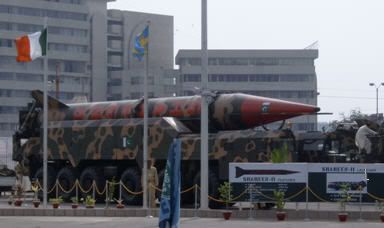
Shaheen 2
Range : 2000-2500km
Weight : 15,000kg
Re-entry vehicle Weight: 1,000kg
Warheads: Nuclear, HE
Tech Source : China
Shaheen 1 First revealed in 1999, the Shaheen 1, or Hatf 4, also has no known Chinese equivalent, but its Chinese origins are more apparent than the Shaheen 2. Its nose section is very clearly a copy of that seen on the Chinese DF-11 Mod 1 missile first revealed in their October 1999 military parade. But the Shaheen 1 is longer than the DF-11 Mod 1 and at 750km, very likely has a longer range. The warhead stage has what a Pakistani video calls a “post-separation attitude correction system,” meaning that the Shaheen-1 is capable of high accuracy and some degree of maneuvering to evade missile defenses. In addition, both the Shaheen I and its relation, the Ghaznavi, employ stealthy warhead shaping to delay detection and complicate targeting. This very likely refers to technology was first developed for the DF-15 SRBM. It consists of small thrusters which can adjust the warhead trajectory for the purpose of obtaining greater accuracy or for out-foxing early U.S. Patriot PAC-2 missile interceptors.
Shaheen 1
Range: 750km
Weight: 9,500kg
Warhead Weight: 850kg
Warheads: Nuclear, HE
Tech Source: China
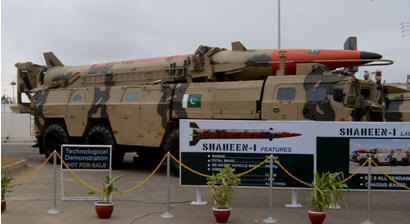
Photo: RD Fisher
Ghaznavi The latest missile to be adopted by Pakistan is their Ghaznavi, or Hatf 3. It was formally adopted by the Strategic Forces Command on February 22, 2004. This missile appears to be an exact copy of the latest version of the DF-11 Mod 2. Like more recent versions of the Chinese missile, the Ghaznavi employs an “aerospike” on tip of the nose cone. This serves to push away air, creating less aerodynamic drag for the remainder of the missile. This is also useful for extending the range of the missile if it employed a “depressed trajectory” or low altitude flight profile, where denser air would create more drag. The DF-11 Mod 2 is also suspected of using a “depressed trajectory” in order to evade missile defenses. A Pakistani video also notes this missile employs a “post separation attitude correction system” to ensure high warhead accuracy. The missile also features flat antenna arrays near the warhead stage, all indications that it employs highly accurate satellite navigation assisted guidance systems. And like the DF-11 Mod 1, the Ghaznavi very likely employs a range of warheads, to include nuclear, high explosives, cluster munitions, and thermobaric warheads.
Ghaznavi
Range: 290km
Weight: 5,256kg
Warheads: Nuclear, HE, Cluster, Thermobaric, Radio Frequency
Tech Source: China
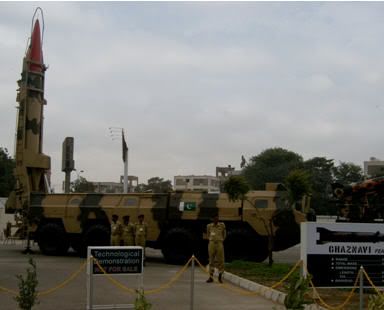
Photo: RD Fisher
Ghauri Also on display was the Ghauri, or Hatf 5, widely reported to be based on North Korea’s Nodong liquid fueled missile. It has a range of 1,500km which it can cover in about 10 minutes. It is said to be armed with nuclear and high explosive warheads. There are reports of a Ghauri 3 in development, a two-stage liquid fuel missile with a range of 3,500km. This program may benefit from North Korea’s Russian technology derived Makeyev R-27-based MRBMs.
Ghauri
Range: 1,500km
Weight: 15,852kg
Warhead Weight: 900kg
Warheads: Nuclear, HE
Tech Source: North Korea
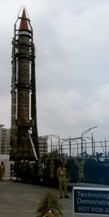
Photo : RD Fisher
High Accuracy
One useful new data point was that the Chinese-source missiles were capable of very high accuracy. Published reports have noted that Pakistan’s Shaheen 1, Shaheen 2 and Ghaznavi missiles may have a post-separation booster system to provide course corrections to improve accuracy, or maneuver capability for evading missile defenses. The video confirmed that there is such a system. It was at the Zhuhai Airshow in 1996 that a Chinese source inadvertently disclosed that China was developing a terminal and satellite-navigation-assisted guidance system for its short- to medium-range missiles. The PLA also developed a post-separation warhead attitude correction system for its DF-15 short-range missile. This consists of small thrusters that can adjust the warhead trajectory for greater accuracy or for out-foxing early U.S. Patriot PAC-2 interceptors. This system very likely is also on the DF-11 Mod 1 SRBM.
Shaheen 2 Warhead Stage: May use a post-separation course correction system that enables very high accuracy.

Photo: RD Fisher
If Pakistan’s missiles are so equipped, the prospect of their not requiring nuclear warheads to achieve “strategic” results against military targets is more likely. While this might be slightly comforting to some, the capability might also increase the temptation to use such missiles, inasmuch as Pakistani leaders might view their use as carrying a diminished risk of Indian nuclear retaliation.
Possible antennae on a Shaheen-1 warhead stage:The black patches near the small stabilizing fins may be antennae intended to service very accurate satellite navigation systems.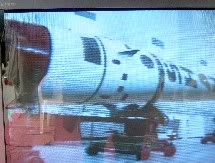
Photo: RD Fisher
However, such a terminal guidance capability would also require a sophisticated targeting system capable of providing real-time image or electronic target location data to missile commanders. Pakistan will soon have short-range unmanned reconnaissance aircraft capable of supplying such data. Pakistan can be assumed to be a consumer of commercially available high-resolution satellite imagery. And when China soon launches its constellation of 1-meter or better resolution Russian-influenced electro-optical and radar image satellites, it is a safe assumption that Pakistan will gain useful access to their data. The irony here is that Indian space officials have disclosed that China had offered India the opportunity to invest in this satellite constellation.[3] India wisely refused, because its investment might have amounted to a “subsidy” benefiting China’s and Pakistan’s missile targeting capabilities.
China’s Future HJ-1 and HJ-1C reconnaissance satellites: These Russian influenced satellites are due to be launched soon, and could provide Pakistan with all-weather 1-meter imagery. India wisely chose not to participate in this program.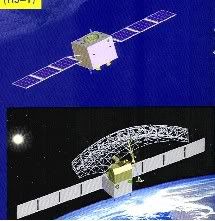
Photo: RD Fisher
Warheads
All of the SRBMs and MRBMs on display at IDEAS were said to be capable of carrying nuclear and non-nuclear warheads. Pakistan’s capability to build small plutonium warheads is widely reported to have developed thanks to the assistance of the PRC. China is very likely the source for a range of non-nuclear warheads for the Shaheen 2, Shaheen 1 and Ghaznavi missiles. For its DF-11 Mod 1 SRBM, China is reported to have developed high-explosive cluster warheads, which use a large number of small warheads for attacking soft targets, and thermobaric warheads, which destroy by producing fantastic heat and pressure. And according to a U.S. source, Pakistan is a suspected recipient for new Chinese radio-frequency (RF) missile warheads.[4] These can produce a large electromagnetic pulse via a conventional explosion and are used to attack electronic infrastructure.
Links :
http://www.strategycenter.net/research/pubID.47/pub_detail.asp
http://www.strategycenter.net/research/pubID.48/pub_detail.asp
By: uss novice - 29th March 2005 at 07:09
Kind of difficult to find similarities Other than obvious (color) from this picture comparison. Perhaps you can give more details on the tech specs of each missile for a better comparison?
Kind Regards,
USS.
By: mirza2003 - 27th March 2005 at 09:56
you ? is here
the status/performance of Indian missiles is very much in doubt, especially after the Chief of DRDO’s (former) interview (in 2004) where he stated that nuclear delvery systems not ready :
http://www.southasianmedia.net/index_story.cfm?id=141496&category=Frontend&Country=INDIA
An earlier interview with Bharat Krnad also offered the same idea.
“We are great at fooling ourselves”
Anyways, back to topic now.
hello mirko filipovic and all meambers of this thread can you give me details of pak misille test like loction of test to impact of the test.
By: Himanshu - 27th March 2005 at 03:01
Not to bust your bubbles but Indian Agni is a carbon copy of American RM-89 Blue Scout version of ballistic missile. I think when the actual production was been done on these missiles your President Kalam was student at the research facility.
What ‘s common in them other then the color 😀
By: AC2005 - 26th March 2005 at 19:38
Sure man sure. Some people need to feel glad 😉
?


 Sign In








 February 21, 2005 at 10:54 pm