Today I was astounded by one of my colleagues, having been ‘bored to tears’ over years with my talking about historic aviation, he arrived with a supurb collection of photo albums of his grandfathers brothers (grand uncle ?) RAF career, this seems to stem from, possibly mid 1930’s, until mid 1960’s.
At the moment I would rather not suggest posting any of these superb and sometimes large, very good quality, photos but that is always a possibility.
There are photo’s from Iraq, Egypt, and many unknown locations possibly including Mildenhall ?
My Quest tonight is to give you all a taster and to answer some questions on notes I have taken on just some of these wonderful pictures ?
Photo 1. K1127 (could be K0127) is this a Westland Wapiti ?
Photo 2. Three Comper Swifts in a hangar G-ACTF, G-ABPE, and one with no visible markings ?
Photo 3. Avro Vulcan XA906, possibly at an airshow, Farnborough ?
Photo 4. XP972 P1127 ? possibly at same airshow ?
Photo 5. Two large single engined aircraft L2691 and L1414 ??????
Photo 6. G-AAUC “Horsa” HP-42E ????
Photo 7. VT-AFM “Viceroy of India’s Aircraft” ??????
Photo 8. NC12229 “American Visitor” I think this is rare ????
Photo 9. F-ALZQ Fokker F.V111b ??????
These notes are not in chronological order as you can see ! can you help with some of the ????
Keith Newsome.

By: keithnewsome - 11th January 2009 at 21:51
Pondskater, Yes at the time he visited Iwakuni he was with Far East Flying Boat Wing, Seletar, (209 Sqdn) as engineering officer, and visiting a u/s Sunderland.
Thank you for the nice comments, and please spend an hour or two reading the whole, overwhelming, thread !
Keith.
By: Pondskater - 11th January 2009 at 21:42
96 – pair of Martin Mariners
97 – pair of Sunderlands (and something else distant left), very nice photo
The Sunderlands were likely from 88 squadron, based at Kai Tak, Hong Kong from 1946, initially as a transport squadron, or a detachment of the Seletar (205 and 209) sqns who were there in the Korean war.
Actually you probably guessed that – I’ve just started looking back through the many great photos and seen the Coronation flypast shots of 205 and 209 – photos 71+72 . I must make time to read the whole thread.
By: keithnewsome - 11th January 2009 at 21:17
Oooooppps sorry John, only copying what he has entered in the albumns, I think ‘zero’ sums up my knowledge of such things ! Just one more good reason we so much enjoy your expert input 😉
Keith.
By: John Aeroclub - 11th January 2009 at 21:12
:)Your Zero is an Oscar. The US “boats” are Martin Mariners.
John
By: Flightpath - 11th January 2009 at 21:10
Do some of the crew appear to have the darker Australian uniform.
John
Hi, (interesting thread!)
I noticed the shape of the pilot’s brevet as RAAF (Australian made type) before the ‘not as dark as normal’ RAAF uniform.
The same type as the first on the left under this…… (RAAF, RAF, RNZAF & RCAF)
I wonder where the lovely ‘Alice Lorraine’ ended up? (nice boat!)
cheers,
-John
By: keithnewsome - 11th January 2009 at 20:26
I am sadly running out of photo’s to post ! Whilst so many people are studying what has gone before, and still coming up with answers !, These three small photo’s are of lower quality, lets see what you have to say …
Firstly a Zero on a pole at Clarke Field, Phillipine Is. An entry in the log book shows him having passed through here.
PHOTO 95.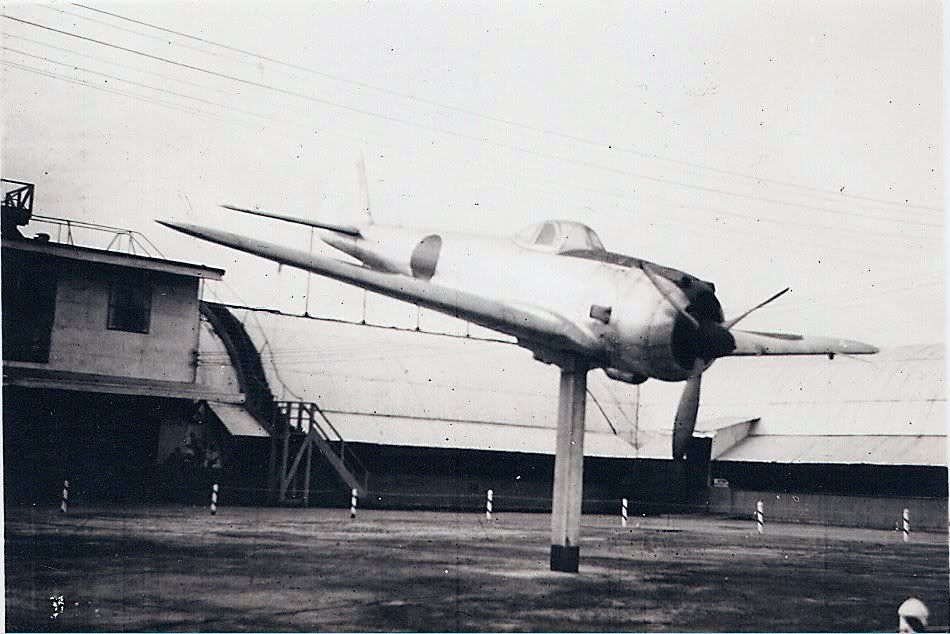
And two photos from RAF Iwakuni, Japan. Where, once again from the log book, he travelled to carry out repairs to a Sunderland.
PHOTO 96.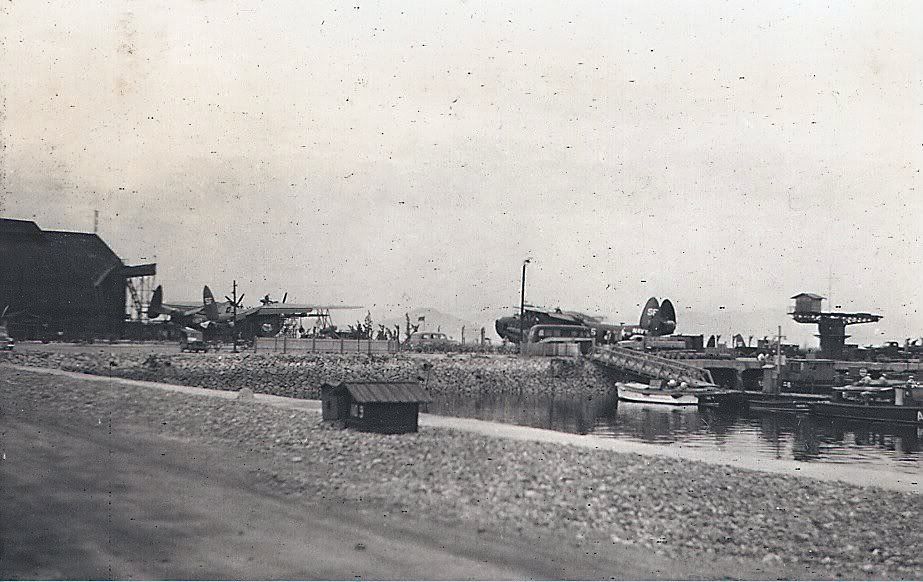
PHOTO 97.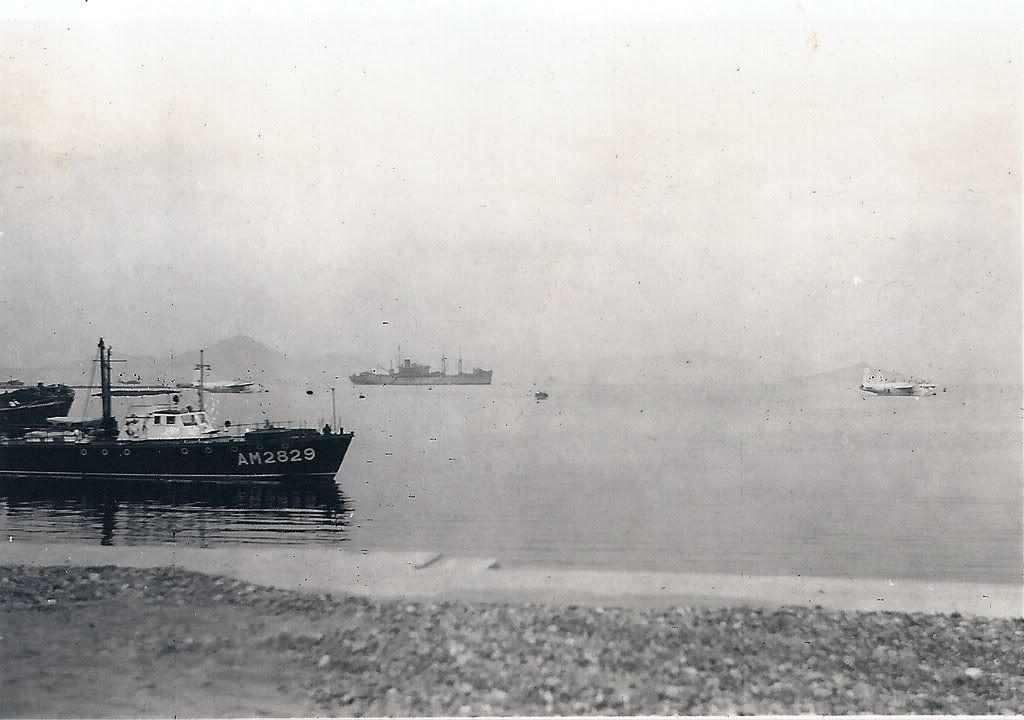
By: keithnewsome - 10th January 2009 at 15:01
John, your last post, re uniform, is possibly spot on, the last logbook entry was 03 09 44, and in the albumn the photo’s are recorded as Setember 1944.
Keith.
By: John Aeroclub - 10th January 2009 at 13:10
In the crew photos I think that the uniform is the clue to rough dating them. Mr Gallop is wearing his “best blue” and behind his back is I think hiding his peaked cap, which would be the correct dress to depart and arrive at new postings. The rest of the “boys” are in “scruff order”. So I posit that these photos were taken as Flt Lt Gallop was taking his leave of his crew and ground crew or on a visit back. I’m sure people did not disappear immediately, on the date they had flown their last tour as all stations require proper clearance for handing over secondary duties,kit returns etc.
Ref the entries in the log book mentioning formation bombing practice, this is exactly what GEE H was for as it was a blind bombing device flown on polar chart co-ordinates by a lead a/c. H2S was more of a “look through cloud device”.
Just my thoughts, team.
John
By: kev35 - 10th January 2009 at 11:53
James.
Would imagine that you have hit the nail squarely on the head and this seems to be confirmed by log book entries.
3/7/44 saw an entry for an air test of 50 minutes marked special training with G H pencilled alongside,
6/8/44 has special training flight of 2 hours 10 minutes and this is marked in pencil H2S.
Without looking back again I seem to remember that for at least two of this crew’s operations they were marked as formation or bombing leader. The extra aircrew in photo’s 93 & 94 could well be those who provided the specialists for the crew and those who trained them.
Regards,
kev35
By: JDK - 10th January 2009 at 07:25
Here’s the chute on G for George in Canberra.

Further to your last, that would seem to make sense. However, the original flare chute was actually located directly at the rear of the bomb bay along the centreline of the aircraft. One thing that puzzles me is the date though. If this forward flare chute was not introduced till October of 1944, it makes the timing very tight for the photograph. Flt Lt. Gallop’s tour ended on the 3rd of September 1944 and by October he was instructing at Chedburgh. Usually, when a crew or crew member was screened at the end of their tour, they would generally be away from the Squadron on leave very soon after. Having said all that I still can’t see anything else that opening could be used for.
It looks to me like it’s just been fitted, out of light alloy, or the paint’s worn off in the photos, rather than being a long-established item. If this was a Gee equipped aircraft, there’d be extra crew and items like new Window cutes trialled with the specialists, perhaps?
Fascinating thread. I don’t think it would be possible to do justice to the content in a magazine article, and a book wouldn’t sell enough. It might be worth setting up a website for it as a repository, though, enabling extended captions to the photos presented in chronological order and updated when new info comes in. Just a thought.
Great teamwork on the investigation too – complimentary skills clearly pay off!
By: kev35 - 9th January 2009 at 23:59
Keith.
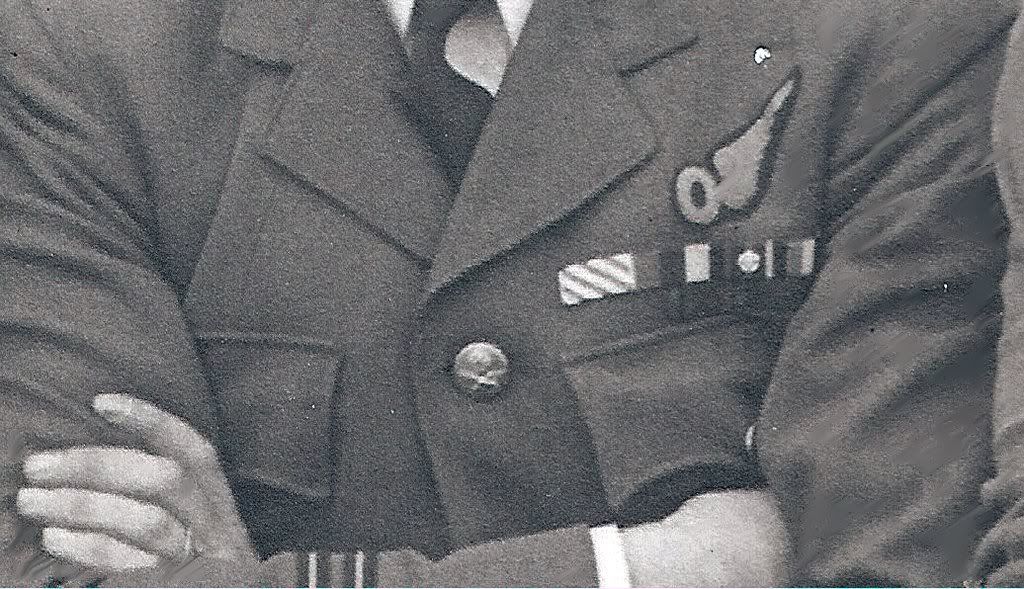
I’ve noticed something else on the last two photo’s. There’s another medal ribbon beneath the others. Though colours are indistinct, his service leads me to believe that it is the Defence Medal. He would have qualified for this on the grounds of his overseas alone. It seems I was right about the rosette denoting the Burma Star when attached to the Pacific Star ribbon as those entitled to both these medals were only awarded the medal for the theatre in which they first became eligible and a suitably inscribed clasp was affixed to the ribbon denoting the award of a further campaign medal. I think I’ve got all that right now.
John.
Further to your last, that would seem to make sense. However, the original flare chute was actually located directly at the rear of the bomb bay along the centreline of the aircraft. One thing that puzzles me is the date though. If this forward flare chute was not introduced till October of 1944, it makes the timing very tight for the photograph. Flt Lt. Gallop’s tour ended on the 3rd of September 1944 and by October he was instructing at Chedburgh. Usually, when a crew or crew member was screened at the end of their tour, they would generally be away from the Squadron on leave very soon after. Having said all that I still can’t see anything else that opening could be used for.
Regards,
kev35
By: John Aeroclub - 9th January 2009 at 22:09
Lancaster Flare chutes
Ref the possible window dispenser on the nose. I have just found reference in Mason’s “The Secret Years” (he was the skipper of the first Canberra I flew in BTW) to the very troublesome flare chute fitted to the Lanc due to up-draughts which prevented proper operation of anything put down it. Depite many mods the problem was only resolved with the fitting of a Mk V chute in the nose in October 1944 (all others were in the tail). Clear photos of this device are like hens teeth.
So I presume, unlike french micro-bore toilets, one could stick other things down it as well. Window is of course still used but now it’s called Chaff and has got smaller due to change in ever higher radio frequencies from the revolutionary centimetric wavelengths of the late war years.
John
By: keithnewsome - 9th January 2009 at 21:30
kev35,Your knowledge overwhelms me, I know the family will be pleased with this information, please keep it coming.
Postfade,Yes it seems good to be able to have access to an old albumn, but I am sure your fathers collection is in the ‘best’ other place !
I have been following, with interest, your photo postings elsewhere, and find them to be of very high quality, and are recieving the credit that is due.
Thank You.
Keith.
By: Postfade - 9th January 2009 at 21:15
Nice to see the ‘Observer’s’ brevet (hope that’s the correct title) being worn.
My father was ‘full time RAF’ when WW2 started, having joined in 1930. He was very proud that he wore that ‘Observers’ badge and not just a more ‘modern’ ‘Navigators’ one when he flew Whitleys. I still have it.
He also had a fantastic scrap book of photos from his earlier RAF years. There
were pics of the Comet racers, the KLM DC2 and others in the MacRobertson Air Race of 1934 and some wonderful ones of his Hawker Horsley sqdn at Seletar in the 30’s. He gave them all to the RAF Museum…I’d have loved to still have them.
David Taylor.
By: kev35 - 9th January 2009 at 21:11
Keith.
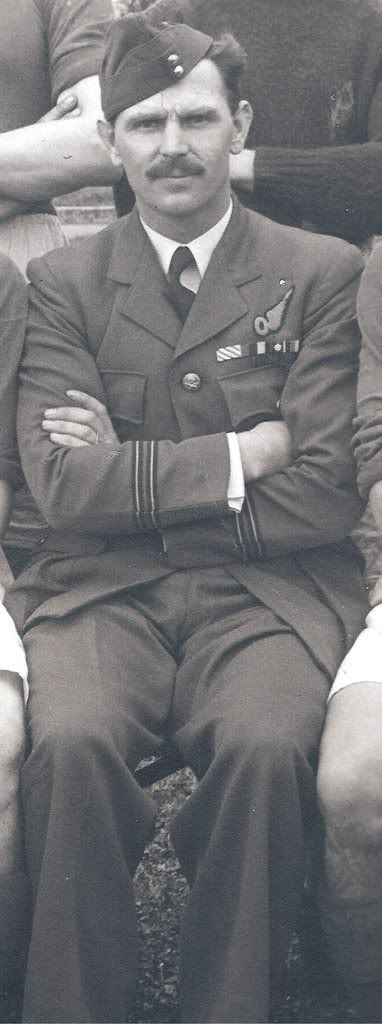
Your latest photo shows him wearing the ribbons of the DFC, 1939 – 1945 Star, Pacific Star with Burma clasp (denoted by the rosette) and the War Medal.
If you look back to the ribbon which we see beneath the Observer’s Brevet in photo’s 92, 93 and 94, it certainly doesn’t look like the ribbon of the DFC but does to me show the same tonal variations as in the 1939-1943 and 1939-1945 Star which shared the same ribbon. I have a vague memory that it was just the ribbon issued for the 1939-1943 Star, the medal itself not being struck until after the war’s end.
In your close up, the ribbon in question is the second from the left as we look at the photo and the three stripes are of equal width and as we look at them are Navy blue signifying the Navy, red for the Army and a pale, sky blue for the RAF.
Edited to add that I’ve had a bit of a rethink. I think the fourth ribbon that we can see, the one disappearing into his left armpit is in fact the France & Germany Star. Normally Bomber Command aircrew were entitled to the Aircrew Europe Star. I think, though am not 100% sure, that the entitlement to the Aircrew Europe Star was replaced by the France & Germany Star either in the few days just preceding D-Day (think I might have seen 4th June mentioned) or from D-Day itself onwards. He would still have been eligible for the War Medal but the ribbon for that would be out of sight in the crook of his arm. Sorry for any confusion.
Regards,
kev35
By: keithnewsome - 9th January 2009 at 20:44
I would like to think you kind people can imagine the enjoyment that both the family involved and myself are getting from the huge interest shown in this collection of photo’s, the attention to detailed inspection of some is overwhelming !
To you all, my friends, thank you once again.
I can offer little help, kev35 mentioned the medal ribbon, all I can find is this photo of 1945, with a slightly better view of the ribbon at that time, and a zoom into that.
Keith.
By: Ballykellybrat - 9th January 2009 at 19:26
Photos of Lancs from the starboard side are not so common, but most main force aircraft were fitted with a window chute. Of Lanc survivors W4783 (Canberra War Memorial) & DV372 (nose at the IWM) both appear (from photos) to have the fitting. Post war Lincolns had them & RF398 (RAF Museum Cosford) has one. Window was particularly useful at Christmas – looked pretty wrapped round the tree!
By: John Aeroclub - 9th January 2009 at 14:28
With the advance in higher frequency radars the window strips became much smaller and would require a more efficient dispensing system than chucking it down the flare chute as had been used previously. I’m just surmising here by the way. Quarter wavelength and all that.
John
By: kev35 - 9th January 2009 at 14:26
If the aircraft pictured is LS-R ME695, then that aircraft appears to have been delivered new to the Squadron in March of 1944. As this was some nine months after the first operational use of WINDOW, was WINDOW still being used or had the Germans developed any effective measures to counter act its effect?
I had the same thoughts as Galdri regarding the dropping of WINDOW so close to the propellor but perhaps that aided in the distribution?
Regards,
kev35
By: galdri - 9th January 2009 at 14:12
Just thinking out loud, but wouldn´t that device be too close to the prop of #3 to be useful for window dropping? It might spoil your day to have window stips wrapped around your prop.
Like I said, just thinking out loud. It might very well be a window port!


 Sign In








 October 24, 2008 at 10:38 pm