By: ZOOM - 17th January 2010 at 08:24
I think it is a significant step for a nation to achieve this. The comment of Zhi Feng that it is just noise is stupid. The entire economy of the US will be ruined if China wants to have the cash returned.
This is too mistakable sentence I mean. China’s export and overall International Trade is highly dependent upon US market, at the same time US is already going through economic recession and if according to you China choose to play any spoil sports as you have mentioned above then it will rather become as shooting on your own foot as a lesson for china.
By: Insig - 17th January 2010 at 06:11
I think it is a significant step for a nation to achieve this. The comment of Zhi Feng that it is just noise is stupid. The entire economy of the US will be ruined if China wants to have the cash returned. China is not a military superpower (which is strange cause I think it is but not based on ruling others) but surely it is the fastest growing economy. One dimensional thinking is often lack of knowledge.
By: Type59 - 16th January 2010 at 17:22
Weapons most effective against IRBM, which India has. US will be less worried. Plus Agni 2 failed its night test, suggesting there are key problems needing to be solved.
SRBM which are operational in Indian arsenal can be taken out by HQ 9 or S 300 PMU2.
By: matt - 12th January 2010 at 19:04
With Defense Test, China Shows Displeasure of U.S.
http://www.nytimes.com/2010/01/13/world/asia/13china.html
Published: January 12, 2010
BEIJING — China said it had successfully tested the nation’s first land-based missile defense system, announcing the news late Monday in a brief dispatch by Xinhua, the official news agency. “The test is defensive in nature and is not targeted at any country,” the item said.
Skip to next paragraph
Related
Clinton, Starting Trip, Acknowledges Possible Tensions With China (January 12, 2010) Even if news accounts on Tuesday did not provide details about the test — and whether it destroyed its intended target — Chinese and Western analysts say there is no mistaking that the timing of the test, coming amid Beijing’s fury over American arms sales to Taiwan, was largely aimed at the White House.
In recent days, state media outlets have been producing a torrent of articles condemning the sale of Patriot air defense equipment to Taiwan. China views the self-ruled island as a breakaway province, separated since the civil war of the 1940s, and sees arms sales as interference in an internal matter.
The Defense and Foreign Ministries have released a half-dozen warnings over the weapons deal, saying it would have grave consequences for United States-China relations. The state-run Global Times newspaper urged readers to come up with ways to retaliate against the United States.
Writing in the Study Times newspaper, Maj. Gen. Jun Yinan said that China had the power to strike back. “We must take countermeasures to make the other side pay a corresponding price and suffering corresponding punishment,” wrote General Jun, a professor at China’s National Defense University.
Although most analysts doubt the Chinese will seek to punish the United States in a significant way — retaliatory measures over past arms sales have included the suspension of military talks — the especially vociferous response may herald rockier relations between the countries as they confront differences over monetary policy, trade issues, Iran and North Korea.
“For the Chinese, selling arms to Taiwan feels like a slap in the face,” said Shi Yinhong, a professor of United States-Chinese relations at People’s University in Beijing. “I think the government expected something different from Obama, especially so soon after his visit to China.”
The White House said it was simply fulfilling a deal that was negotiated during the Bush administration. It also pointed out that the sale, approved by the Pentagon last week, omits F-16 fighter jets and Black Hawk helicopters, a concession to Beijing.
Secretary of State Hillary Rodham Clinton, speaking in California on Monday, said she thought the strain in relations would be brief and mild. “It doesn’t go off the rails when we have differences of opinions,” she said of the relationship with China.
Relations may get bumpier in the coming weeks when President Obama meets with the Dalai Lama, the Tibetan spiritual leader whom China accuses of being a separatist, and President Ma Ying-jeou of Taiwan makes a brief visit to the United States. Overseas visits by Taiwanese officials invariably irk Beijing.
Arthur Ding, a research fellow at the Institute of International Relations in Taipei, the Taiwanese capital, said China may have thought its growing economic might and the improving cross-strait relations fostered by President Ma during his 20 months in office might have persuaded the United States to put off any weapons deal.
“Perhaps Beijing has unrealistic expectations,” he said. “I think they imagined their influence is greater than it is.”
For all the saber-rattling over the arms sale, some analysts say the official invective and anti-missile demonstration may have been largely aimed at domestic audiences, who increasingly expect their leaders to stand up to the West.
Zhu Feng, deputy director of the Center for Strategic and International Studies at Peking University, described China’s missile defense system as experimental and “not really meaningful” and said the test’s real purpose was an opportunity for the People’s Liberation Army to strut.
Despite China’s newfound confidence, he said the government is increasingly frustrated by its inability to influence the United States on an issue that has bedeviled Beijing for decades.
“China still lacks the leverage to force the White House to stop these sales,” he said. “So they feel like they must make a lot of noise.”
Jonathan Ansfield contributed reporting, and Li Bibo contributed research
By: QuantumFX - 12th January 2010 at 04:30
Well, well, well….. Something unexpected.. PRC has been very silent about its anti-missile plans.
China conducts test on ground-based midcourse missile interception – http://news.xinhuanet.com/english/2010-01/11/content_12792329.htm
http://news.xinhuanet.com/world/2010-01/11/content_12792321.htm
http://www.theglobeandmail.com/news/world/china-says-missile-defence-test-a-success/article1427275/
By: Jonesy - 28th November 2009 at 08:03
Aha, here comes Jonesy again, so judged from your wording, it seems Admiral Gary Roughead, chief of U.S. naval operations’s 2008 decision to cut the DDG-1000 destroyer program from eight ships to three because the vessels lack a missile-defense capability, which factored in the ASBM, is rather “sloppy”, and the reaction towards such a cut should be mildly even billions bucks invested in the RnD of the machine?
So the US military intel is sloppy as well, but do you believe PLA’s ASAT test because it is also 1st revealed to the world by US intel?
Now Pinko play nicely – I could have made some comment about you banging this rubbish up again despite the fact you are well aware of the very real complexities with this that the article wholly glosses over. Did I say any such thing?.
Yes because DDG-1000 lacks a missile defence capability that is why it was cut. Nothing to do with the wince-inducing costs or the fact that the USN needs to replace the Tico’s and Perry’s more urgently than it needs new destroyers?!.
Why wouldnt I believe that the PLA managed an ASAT shot?. Is this some wonderous achievement that the Russians didnt, in fact, manage three decades ago and the US can now do, seemingly at whim, with a modified shipboard SAM?.
How that relates to something which, as yet, has not been done by anyone i.e the full engagement cycle of a moving ship target from initial detection, tracking, identification and engagement I’m not really sure?.
By: QuantumFX - 28th November 2009 at 00:08
Anybody have the dimensions and weights for this version? One can’t help but be reminded of the Pershing II when looking at it. (Always thought the Pershing II would make a good antiship missile if they could figure out the targeting.)
[IMG-r]http://i573.photobucket.com/albums/ss180/sferrin/Pershingii.jpg[/IMG]
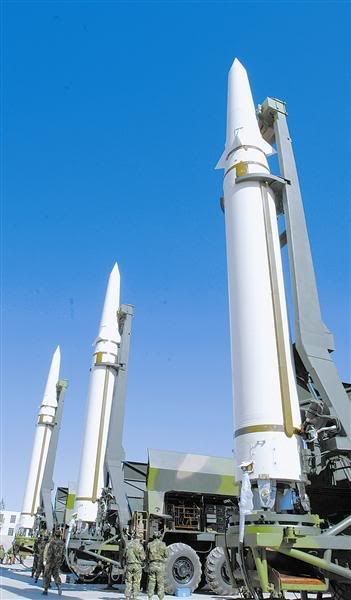
DF-15B is a modification of the original DF-15. Just has a different warhead. There is another one DF-15C
Roughly, the DF-15 is 9m in length and 1m diameter. 600km (DF-15)
By: sferrin - 27th November 2009 at 18:59
Anybody have the dimensions and weights for this version? One can’t help but be reminded of the Pershing II when looking at it. (Always thought the Pershing II would make a good antiship missile if they could figure out the targeting.)

By: Pinko - 27th November 2009 at 17:25
Oh come on Pinko this is just a rehash of old news you have to see that?.
Skywave radar that is ‘under development’ yet the whole ASBM missile system is nearly ready to field?. Its gibberish. The US commentators are trying to re-use the ‘missile gap’ strategy from the Cold War days!. No more no less.
‘Oh look China is introducing fearsome new weapons that will stop our navy dead in its tracks – we must surely need more money for the navy to offset this’
Its hardly a subtle or sophisticated approach!
So 11 satellites that are ‘capable’ of conducting ocean surveillance…..claptrap. A realtime-transmission optical imaging bird is ‘capable’ of performing ocean surveillance it doesnt mean its very useful at it. An ELINT bird is ‘capable’ of performing ocean surveillance but you aren’t targetting an ASBM off the output from one!.
Sloppy article to put it mildly!.
Aha, here comes Jonesy again, so judged from your wording, it seems Admiral Gary Roughead, chief of U.S. naval operations’s 2008 decision to cut the DDG-1000 destroyer program from eight ships to three because the vessels lack a missile-defense capability, which factored in the ASBM, is rather “sloppy”, and the reaction towards such a cut should be mildly even billions bucks invested in the RnD of the machine?
So the US military intel is sloppy as well, but do you believe PLA’s ASAT test because it is also 1st revealed to the world by US intel?
By: Arabella-Cox - 20th November 2009 at 07:22
you can find here more number of missiles
Thank you, my friend.
By: QuantumFX - 20th November 2009 at 02:19
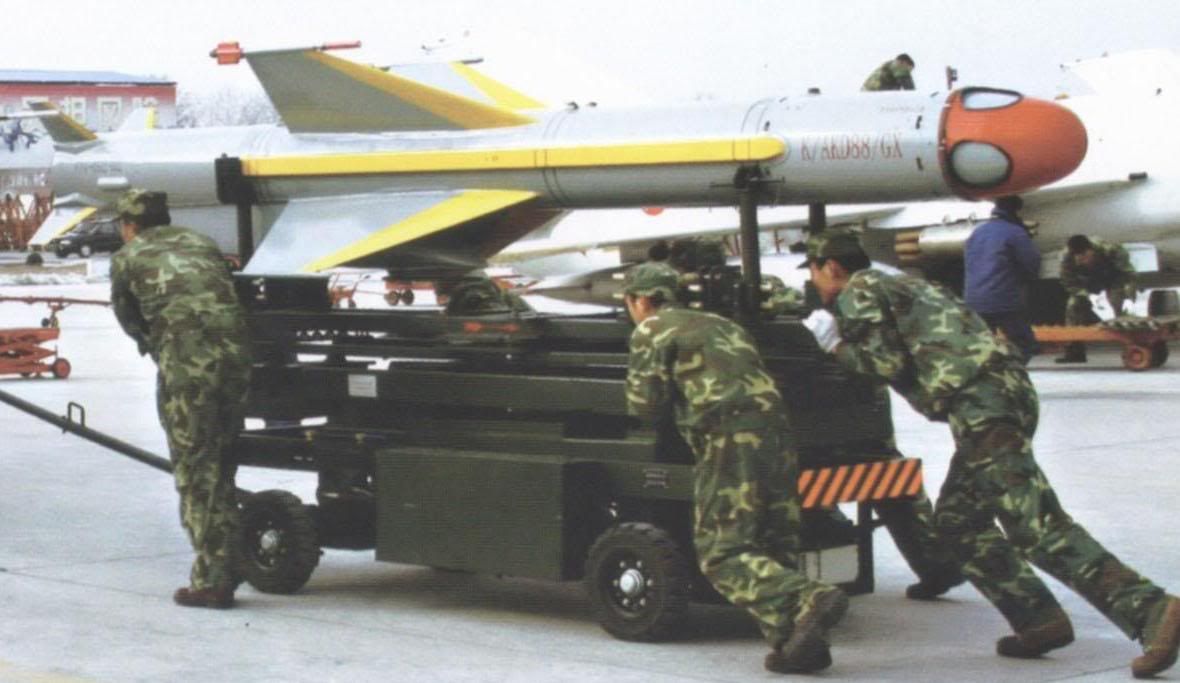
K/AKD-88/GX? New variant of the KD-88?
DF-15B
By: Jonesy - 19th November 2009 at 10:13
Oh come on Pinko this is just a rehash of old news you have to see that?.
Skywave radar that is ‘under development’ yet the whole ASBM missile system is nearly ready to field?. Its gibberish. The US commentators are trying to re-use the ‘missile gap’ strategy from the Cold War days!. No more no less.
‘Oh look China is introducing fearsome new weapons that will stop our navy dead in its tracks – we must surely need more money for the navy to offset this’
Its hardly a subtle or sophisticated approach!
There are 33 in orbit and that number may grow to 65 by 2014, 11 of which would be capable of conducting ocean surveillance, he said.
So 11 satellites that are ‘capable’ of conducting ocean surveillance…..claptrap. A realtime-transmission optical imaging bird is ‘capable’ of performing ocean surveillance it doesnt mean its very useful at it. An ELINT bird is ‘capable’ of performing ocean surveillance but you aren’t targetting an ASBM off the output from one!.
Sloppy article to put it mildly!.
By: Pinko - 18th November 2009 at 06:15
ASBM, it seems almost official:
China’s New Missile May Create a ‘No-Go Zone’ for U.S. Fleet
Share Business ExchangeTwitterFacebook| Email | Print | A A A
By Tony Capaccio
http://www.bloomberg.com/apps/news?pid=20601080&sid=annrZr9ybk7A
Nov. 17 (Bloomberg) — China’s military is close to fielding the world’s first anti-ship ballistic missile, according to U.S. Navy intelligence.
The missile, with a range of almost 900 miles (1,500 kilometers), would be fired from mobile, land-based launchers and is “specifically designed to defeat U.S. carrier strike groups,” the Office of Naval Intelligence reported.
Five of the U.S. Navy’s 11 carriers are based in the Pacific and operate freely in international waters near China. Their mission includes defending Taiwan should China seek to exercise by force its claim to the island democracy, which it considers a breakaway province.
The missile could turn this region into a “no-go zone” for U.S. carriers, said Andrew Krepinevich, president of the Center for Strategic and Budget Assessments in Washington.
Scott Bray, who wrote the ONI report on China’s Navy, said China has made “remarkable progress” on the missile. “In little over a decade, China has taken the program from the conceptual phase” to “near fielding a combat-ready missile,” he said. Bray’s report, issued in July, was provided to Bloomberg News on request.
China also is developing an over-the-horizon radar network to spot U.S. ships at great distances from its mainland, and its navy since 2000 has tripled to 36 from 12 the number of vessels carrying anti-ship weapons, Bray, the ONI’s senior officer for intelligence on China, said in an e-mail.
China’s Strategy
The new missile would support China’s “anti-access” strategy to detect and if necessary attack U.S. warships “at progressively greater distances” from its mainland, Krepinevich said.
Defense Secretary Robert Gates, in a Sept. 16 speech, said China’s “investments in anti-ship weaponry and ballistic missiles could threaten America’s primary way to project power and help allies in the Pacific — particularly our forward bases and carrier strike groups.”
Admiral Gary Roughead, chief of U.S. naval operations, says the new Chinese missile was one factor in his 2008 decision to cut the DDG-1000 destroyer program from eight ships to three because the vessels lack a missile-defense capability.
The Navy instead plans to build up to seven more Lockheed Martin Corp. Aegis-class DDG-51 destroyers and equip them with the newest radar and missiles.
China’s ballistic missile “portends the sophistication of the threats that we’re going to see,” Roughead said in an interview earlier this year.
China has ground-tested the missile three times since 2006 and conducted no flight tests yet, Navy officials said.
‘Limited Capability’
General Xu Caihou, China’s No. 2 military official, played down the weapon’s significance.
“It is a limited capability” to meet “the minimum requirement of” China’s national security, Xu, vice chairman of China’s Central Military Commission, said in response to a question following an Oct. 26 speech in Washington.
Mark Stokes, an analyst who has studied the missile program, said the Navy’s assessment indicates China started to develop the weapon after the March 1996 Taiwan “crisis.” That’s when the Clinton administration sent two aircraft carriers and escort warships into the Taiwan Strait and the surrounding area after China fired missiles near the island before its presidential election, Stokes said.
Stokes just published a study of the weapon for the non- profit Project 2049 Institute in Arlington, Virginia, that studies Asia security issues.
Alter Rules
An article in the May 2009 edition of Proceedings, a magazine published by the U.S. Naval Institute, said the missile “could alter the rules in the Pacific and place U.S. Navy carrier strike groups in jeopardy.”
“The mere perception that China might have an anti-ship ballistic missile capability could be a game-changer, with profound consequences for deterrence, military operations and the balance of power in the Western Pacific,” the article said.
Paul Giarra, a defense consultant who studies China’s weapons, called the missile “a remarkably asymmetric Chinese attempt to control the sea from the shore.”
“No American military operations — air or ground — are feasible in a region where the U.S. Navy cannot operate,” Giarra, president of Global Strategies and Transformation, based in Herndon, Virginia, said in an e-mail.
The missiles are intended for launch to a general location where their guidance systems take over and spot carriers for attack with warheads intended to neutralize the ships’ threat by destroying aircraft on decks, launching gear and control towers, Giarra said.
The Pentagon, in its latest annual report on China’s military, for the first time included a sketch of the notional flight profile of the new Chinese missile but gave little additional detail.
Sky Wave
Bray said China has the initial elements of its new over- the-horizon radar that can provide the general location of U.S. vessels before launching the new missile.
Stokes said the so-called Sky Wave radar can spot U.S. vessels as far away as 1,860 miles (3,000 kilometers).
Unlike traditional radar that fires radio waves off objects straight ahead, over-the-horizon radar bounces signals off the ionosphere, the uppermost layer of the atmosphere, which can pick up objects at greater distances.
The radar is supplemented by reconnaissance satellites, another Navy official said, requesting anonymity. There are 33 in orbit and that number may grow to 65 by 2014, 11 of which would be capable of conducting ocean surveillance, he said.
To contact the reporters on this story: Tony Capaccio in Washington at [email]acapaccio@bloomberg.net[/email]
Last Updated: November 16, 2009 16:11 EST
By: Rodolfo - 17th November 2009 at 22:52
Chinese ASAT programs
http://www.scribd.com/doc/19784912/The-Great-Game-in-Space-Chinas-ASAT-Program
By: SOC - 9th November 2009 at 18:36
Yes, those are S-300PMU-2 components. The system uses the same TEL as the S-400, as well as the 96L6 radar. Both can be seen in the first image.
By: QuantumFX - 8th November 2009 at 07:09
1st images of the S-300PMU2 in PLA service?
http://i988.photobucket.com/albums/af8/My-Military-Photos/PRC/Missiles%20-%20Munitions/S-300/S300PMU2_1.jpg
http://i988.photobucket.com/albums/af8/My-Military-Photos/PRC/Missiles%20-%20Munitions/S-300/S300PMU2_2.jpg
http://i988.photobucket.com/albums/af8/My-Military-Photos/PRC/Missiles%20-%20Munitions/S-300/S300PMU2_3.jpg
http://i988.photobucket.com/albums/af8/My-Military-Photos/PRC/Missiles%20-%20Munitions/S-300/S300PMU2_4.jpg
http://i988.photobucket.com/albums/af8/My-Military-Photos/PRC/Missiles%20-%20Munitions/S-300/S300PMU2_5.jpg
By: QuantumFX - 8th November 2009 at 03:29
HHQ-16 fired from a test ship
http://i988.photobucket.com/albums/af8/My-Military-Photos/PRC/Missiles%20-%20Munitions/HQ-16/HQ16_1.jpg
HHQ-9 fired from a 052C
http://i988.photobucket.com/albums/af8/My-Military-Photos/PRC/Missiles%20-%20Munitions/HQ-9/HQ9_3.jpg
http://i988.photobucket.com/albums/af8/My-Military-Photos/PRC/Missiles%20-%20Munitions/HQ-9/HQ9_4.jpg
By: QuantumFX - 8th November 2009 at 03:08
HQ-2, HQ-6, HQ-7, HQ-9, HQ-12, S-300PMU, S-300MU1
—–
HQ-9
http://i988.photobucket.com/albums/af8/My-Military-Photos/PRC/Missiles%20-%20Munitions/HQ-9/HQ9_Command_6.jpg
http://i988.photobucket.com/albums/af8/My-Military-Photos/PRC/Missiles%20-%20Munitions/HQ-9/HQ9_Command_7.jpg
http://i988.photobucket.com/albums/af8/My-Military-Photos/PRC/Missiles%20-%20Munitions/HQ-9/HQ9_Command_1.jpg
http://i988.photobucket.com/albums/af8/My-Military-Photos/PRC/Missiles%20-%20Munitions/HQ-9/HQ9_Command_2.jpg
http://i988.photobucket.com/albums/af8/My-Military-Photos/PRC/Missiles%20-%20Munitions/HQ-9/HQ9_Command_3.jpg
http://i988.photobucket.com/albums/af8/My-Military-Photos/PRC/Missiles%20-%20Munitions/HQ-9/HQ9_Command_4.jpg
http://i988.photobucket.com/albums/af8/My-Military-Photos/PRC/Missiles%20-%20Munitions/HQ-9/HQ9_Command_5.jpg
By: QuantumFX - 9th October 2009 at 23:39
1st three images posted by Thierry @ CDF : Official Designation HQ-7B
Does anyone know the specifications for this? Is it a land-based version of the FM-90N (at the bottom of this post) or something newer?
http://i988.photobucket.com/albums/af8/My-Military-Photos/PRC/Missiles%20-%20Munitions/HQ-7/HQ7B_1.jpg
http://i988.photobucket.com/albums/af8/My-Military-Photos/PRC/Missiles%20-%20Munitions/HQ-7/HQ7B_3.jpg
http://i988.photobucket.com/albums/af8/My-Military-Photos/PRC/Missiles%20-%20Munitions/HQ-7/HQ7B_2.jpg
* FM-90N ==========
By: QuantumFX - 4th October 2009 at 05:13
DF-31A
http://i988.photobucket.com/albums/af8/My-Military-Photos/PRC/Missiles%20-%20Munitions/DF-31/DF31A_6.jpg
http://i988.photobucket.com/albums/af8/My-Military-Photos/PRC/Missiles%20-%20Munitions/DF-31/DF31A_5.jpg
http://i988.photobucket.com/albums/af8/My-Military-Photos/PRC/Missiles%20-%20Munitions/DF-31/DF31A_12.jpg
http://i988.photobucket.com/albums/af8/My-Military-Photos/PRC/Missiles%20-%20Munitions/DF-31/DF31A_11.jpg
http://i988.photobucket.com/albums/af8/My-Military-Photos/PRC/Missiles%20-%20Munitions/DF-31/DF31A_1.jpg
http://i988.photobucket.com/albums/af8/My-Military-Photos/PRC/Missiles%20-%20Munitions/DF-31/DF31A_2.jpg


 Sign In








 June 8, 2008 at 7:49 pm