I just came across this article from The Press newspaper (Christchurch, New Zealand), from 23 January 1971:
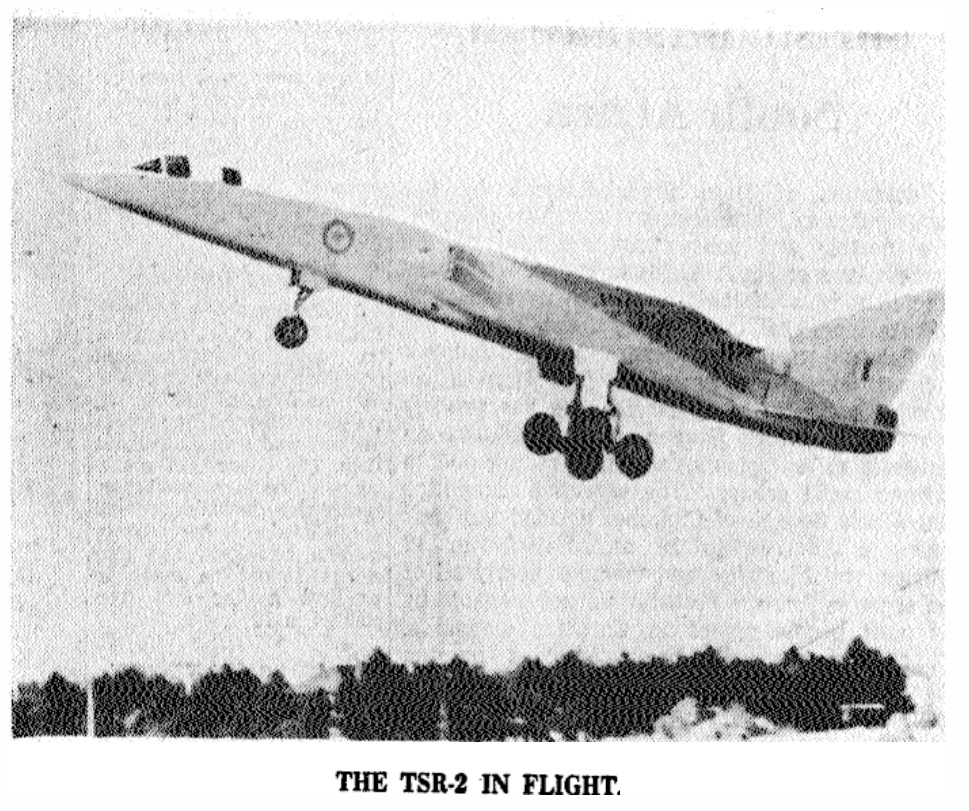
Possible resurrection of the TSR-2
(By JOSEPH MARSHALL)
In a deserted aircraft hangar in a remote corner of Bedfordshire 40 miles from London, engineers of the Royal Air Force are piecing together a huge jigsaw.
They are rebuilding a hush-hush aircraft which, in theory, should no longer exist. In 1965, the British Government issued a “destruction” order, consigning it and its four prototype sisters to a premature grave after 10 years of development, costing the taxpayer £200 million.
Now, five years after being sent into oblivion, the TSR-2—hailed at the time as a “flying miracle” and the most sophisticated warplane ever built—may still become the king of Britain’s skies. Officially, the aircraft was killed off by the then British Prime Minister, Mr Harold Wilson, amid a tidal wave of angry protests.
Mystery
But unknown to anyone, it seems, the R.A.F. secretly saved one of the prototypes and put it under protective covering at Boscombe Down. Recently, the wraps came off, and it was taken by lorry to the R.A.F. base at Henlow, and work is now under way to get the needle-nosed aircraft fit to fly.
Exactly why the affair is surrounded in mystery the Defence Ministry is not saying. They are refusing to commit themselves on the TSR-2 flying potential in case it should raise false hopes. Instead, a close watch is being kept on the rebuilding project. But once the resurrected plane is airworthy, the giant Olympus 320 engines will be fitted for a trial run.
If there should be plans to put the controversial aircraft into production, however, a political decision will have to be taken by the Government. And already a campaign has begun for the Tories to reactivate the project, although many feel it is doomed to failure.
Why did the former Labour Government cancel what was undoubtedly one of Britain’s biggest prestige projects? That is still the subject of bitter argument among politicians and aviationmen.
The plane began as a scribble on a piece of paper in 1955, went on to the drawing boards soon afterwards, before springing into life in the British Aircraft Corporation workshops at Weybridge, Surrey. It gave employment to thousands. Sub-contractors switched almost their entire production lines to manufacture components for the wonder plane.
And the TSR-2 was indeed a wonder plane, according to its designers and test pilots. It was designed to land conventional weapons on pinpoint targets, and could cruise at tree-top height out of enemy radar range, and was controlled by radar-fed computers.
“The safest aircraft ever built,” said chief test pilot, Wing Commander Roland Beaumont, who later hit out at the Government’s “ruthless” scrapping of the plane. “It is a brilliantly successful aircraft—far ahead of anything in the world.”
Soaring costs
In all, five TSR-2s were built. Another seven were on the way, forerunners of a planned fleet of 150. But the soaring development costs nagged at the Government. And when costs threatened to reach £250 million they decided to call a halt. Some critics say the Air Ministry helped to kill off the project by insisting on complicated improvements. They wanted planes capable of carrying H-bombs into Russia, and so keep Bomber Command alive.
At the same time, claimed the Parliamentary Opposition, Mr Wilson wanted to throw a bone to his party’s Left— which was agitating for an end to nuclear weapons.
Whatever the reasons, the project was cancelled in 1965, and the Chancellor, Mr James Callaghan, defended the decision by saying Britain would save at least £35 million that year alone.
Big row
And so the TSR-2 went down amid a big row in the House of Commons, and a mass protest march by the men in the B.A.C. factories. The cancellation, when it came, almost wrecked the British aviation industry and scores of top-line scientists and technicians joined the brain drain to Europe and America in disillusion.
Of the completed TSR-2s, one engineless shell was given to the museum of the College of Aeronautics at Cranfield, Bedfordshire. Another was stripped down and given for experimental work to the Department of Aero Design. Two others were dumped at the Army firing range at Shoeburyness for target practice, and one was “spirited away” by the R.A.F.
As a final step in the cancellation —some say to ensure the plans would never be resurrected—the Government destroyed or sold all the jigs and tools made for the project. And they paid out £125 million compensation to the 1200 companies and factories that had been taking part in the development work.
But the Labour Government had clearly reckoned without the Royal Air Force.
Meanwhile the Government still had the task of finding a replacement, and went off shopping to America. They came back with a contract for the TSR-2’s rival, the swingwing F-111.
Will it fly?
But once again, the R.A.F. intervened. The American machine, they said, did not meet their performance requirements, and the contract was rescinded.
Will the TSR-2 fly again? Most experts say “no.” Too much water has passed under the bridge in the last five years. Cost is another factor, and so is the fear of obsolesence. The aircraft’s role is also questioned. The plane was designed as a long-range strike aircraft, but now the R.A.F.’s task is short-range tactical operations in Europe.
Finally—and most telling of the arguments against reviving the aircraft—Britain is already committed to reequipping her air force with multi-role combat planes in co-operation with West Germany. But the shadow of the “dead” TSR-2 is undeniably looming large over Whitehall. Given the will, it could still become a reality in Britain’s skies.

By: hypersonic - 6th October 2024 at 17:26
An individual proposed the idea, in 1979, to restart the TSR-2 project. Reportedly with updated systems. The plan was to use XR220 and XR222 as prototypes.
It is my considered believe that the idea was never going to work because:-
There would be no sales (or builds) because:-
So, it is not surprising his fanciful idea came to nothing.
One final point. A few years ago, I read an article in a Key Pubs magazine (Aeroplane?) about the TSR-2 project. They claimed the type was to be allocated the name “Merlin”. I had never heard that fact before. Or seen it mentioned since. Other sources have since mentioned the name “Eagle”. Also never heard before.
H
By: dhfan - 5th October 2024 at 17:31
Nobody knows, JB.
Certainly, when resurrection was suggested in the early ’80s, it was said to be still superior to the Tornado in some respects.
Was there a long-term requirement for an aircraft that was rock-solid stable and supersonic at ground level? Possibly, but who knows?.
On one flight the Lightning chase pilot had to climb to get out of turbulence. The TSR2 pilot said “what turbulence?” On another flight, as I recall the only supersonic one, the TSR2 engaged partial reheat on one engine. The Lightning needed full reheat on both engines to catch up.
Avionics updates wouldn’t have been a problem. The avionics bay was huge – I’ve seen smaller rooms – and of course it predated integrated circuits or microchips but only by a few years so there would have been room to spare.
A few years ago I downloaded a paper from the RAF Historical Society – Journal-17B-TSR2-with-Hindsight – which seems to be still available.
A search found it straight away.
By: J Boyle - 5th October 2024 at 00:14
It seems that despite the decade of bemoaning the cancellation, no one (at least of what I’ve read) has answered the question as to whether or not in the long run the cancellation was a good thing.
If it was going to have a ten year career (because of an inability to adapt to other roles) then perhaps it was money well saved.
By: R6915 - 3rd October 2024 at 16:15
Further to my earlier ‘piece’ above, I wrote B.A.E. Of course it was B.A.C. ! But thinking further I then remembered a superb paper written for ‘The Aviation Historian’ quarterly journal published by subscription only. Please see, issue 44, published July 2023. www.theaviationhistorian.com
The paper is entitled Healey’s Axe The Cancellation Of The TSR.2. The author is Professor Keith Hayward FRAeS. The Professor gave a lecture on the TSR.2 in May 2023 at RAF Museum Midlands for the Royal Aeronautical Society Conferance on the TSR.2. As a source of information he used official papers from the then newly elected Labour Government of 1965. These document sources are included as a detailed addendum at the end of his paper.
The journal, I understand, is about to change its format and the editors may still have copies to remainder. May I suggest check their website!
I appreciate that this may seem to be thread creep. I apologise if that is so, but this paper, I suggest, is quite far reaching and also looks internationaly at the politics and the types of aircraft emerging in the USA and elsewhere at the time. It may also make it easier to confirm what happened to some of the part constructed aircraft that were on the Brooklands production line at the time.
By: R6915 - 3rd October 2024 at 12:34
I suggest these strings are a very welcome arrival for a couple of reasons. Firstly does this series of correspondence hint at the maturation of this Forum after too many years of wilderness? I do hope so. Next, there are stil too many unknowns about the TSR 2. It’s possible future development after all this time and isn’t it possible some discrete files could now be opened?
I had the great pleasure in exchanging letters years ago with one of the long retired office managers at BAE Brooklands where a big chunk of the design work was carried out. Some of the senior personel even came from R.J Mitchell’s team at Supermarine and remember they created the Spitfire. They stayed with the company for many years and retired from the BAE group after this debacle.
The tears of frustration that afternoon when the cancellation news came through caused great despondency. I have a short unpublished chapter written by my contact of his memories from 1928 via his management apprenticeship starting in 1928 on that day. It that tells the whole team’s despondency. That same team contributed to the Concord design.
I think Contributor J. Boyle’s question is so timely and welcome and this is what this Forum used to do so well. Please let’s have more well informed debate with an eye on the Resurection of TSR2 story – or whatever is really going on!
By: dhfan - 3rd October 2024 at 12:25
I think it was Stanley Hooker that said the Operational Requirements Board(?) kept pulling numbers out of thin air for the specification with no thought as to whether it was feasible or even genuinely necessary. For examples, supersonic at low-level, then they added an extra 100 miles out of the blue to the range required.
What amazes me until this day is despite the complete dog’s dinner of management – BAC being lead contractors on what was basically an English Electric design, massively over-stuffed committees continually interfering… – they seemed to be well on their way to meeting most if not all of the specification.
By: NewQldSpitty - 3rd October 2024 at 11:31
Think it was a great idea but I dont think the technology back then was mature enough at that time.
By: J Boyle - 3rd October 2024 at 00:12
I previously asked this question here (back in the well attended “glory days” of the forum): I never received an answer, which I took as I was asking a question best left unanswered.
Was the TSR-2 airframe capable of the “growth” (or maturation) necessary to become a successful multi-million type in the 1970s-90s?
Could it have been a Tornado a decade or so earlier…or was its airframe optimized for the low/fast delivery of nukes and it didn’t have a place in a world where types had to do various missions?
To put it bluntly, could it do what the Phantom and Buccaneers did?
(If it couldn’t, don’t feel bad…Many good types were cancelled because of a change in technology and tactics.
The Canadian CF-105 came around the time when the UK said all interceptors would be missiles and even the U.S. cut back its F-106 buy and never fielded another purpose built interceptor (sensing ICBMs were the threat) and the XB-70 came when it was clear that the advent of SAMs meant high flying bombers were at risk, whatever their speed.).
By: hypersonic - 29th September 2024 at 21:28
Indeed it was – XA894 on 3 Dec 1962.
XA903 went on to do flight trials, of the Olympus, for the Concorde project.
…..That’s if I can manage to read my own notes on the subject.
H
By: Sabrejet - 29th September 2024 at 17:04
Was it a TSR.2 Olympus that took out the test-bed Vulcan at Filton?
By: dhfan - 29th September 2024 at 16:32
The hydraulic leak on the day of cancellation was only the latest mishap to XR220.
On delivery to Boscombe Down the lorry jacknifed after entering the site and the fuselage half fell off the trailer, damaging the extreme rear. After hurried design of lifting equipment it was assembled and examined. The damage, originally thought to be superficial, was more substantial although still able to be repaired at Boscombe Down. After repairs were completed there was a further delay waiting for flight-capable engines.
Although the original dry Olympus was a model of reliability and development, Bristol really struggled with the TSR.2 version to start with.
By: hypersonic - 27th September 2024 at 20:24
dhfan you are correct – sort of. I read in a book several years ago. That XR220 was due to fly on the morning of the cancellation. It was delayed by technical issues. The flight was reprogrammed for the afternoon. However, the announcement of the project cancellation was made mid-morning in parliament. That was the first BAC or anybody else, outside of the government, had heard of the idea. The minister stated the project was to stop immediately. Hence XR220 never got its chance to fly.
I believe the book in question is Testing Years by Roland “Bee” Beamont (1980). If that is true then its straight from the horse’s mouth – so to speak.
XR220, stayed at Boscombe Down and was authorised, by the government, to complete some engine ground running trials in support of the Concorde project. This occurred throu’ late 1965 and into early 1966. The airframe was then disposed of. So, the story about the RAF hiding it away is a little wide of the mark!!!
H
By: dhfan - 27th September 2024 at 17:55
XR220, now at Cosford, was complete and planned for its first flight on the afternoon of the day it was cancelled. I have heard, although I don’t know if it’s true, that the wiring looms were deliberately cut when it was prepared for transport.
My father was one of the police escort motorcycle outriders when it was delivered to Henlow.
XR222, now at Duxford, was never completed although is now cosmetically complete.
XR219, the only one to fly, was maliciously sent to Shoeburyness for target practice.
IIRC, there was briefly a proposal in the early ’80s, whether serious or not I don’t know, to revive the project, as it was apparently still superior to the Tornado, but the destruction of drawings etc. made it a non-starter, apart from any other considerations.
By: Sabrejet - 27th September 2024 at 15:27
More recently, some folks who didn’t have a clue how an aircraft is designed, produced and supported resurrected this idea that the TSR.2 might be put into production.
I’m not sure how the ‘five’ produced aircraft figure was arrived at, but I recall quite a few substantial fuselage sections ended up at P&EE Foulness. When I was at Halton there was an awful lot of TSR.2 stuff used for teaching there too. We were in awe: I trust it all survived…
By: hypersonic - 27th September 2024 at 14:28
Yes, it is XR220 at RAFM Cosford.
In the end the RAF got the Buccaneer – which it didn’t really want. However, the type went on to serve with distinction.
Some of the TSR-2 avionic systems were used in latter types Tornado for example. As well as being further developed for use in the current Typhoon.
H
By: Dave Homewood - 27th September 2024 at 13:07
So, I am guessing this one hidden and then resurrected by the RAF must be the one at the RAF Midlands Museum at Cosford?


 Sign In








 September 27, 2024 at 1:06 pm