Hello again.. im back on the board after a bit of a holiday. With a bit of luck some of you historic buffs can help me out..
A friend of mine is a keen fisherman and regularly visits the south coast. He was in Portsmouth late last year and was given a prop blade that was caught in a fishing trawlers nets. It was an inch thich with barnacles but after a good steam clean its looking much better.
Apparently the fishing fleet down there regularly snag their nets on foreign objects and anything they find has to be taken back to land so it doesnt snag anybody elses nets. Theyve found allsorts, including sea mines.
Anyway, heres some pics of the blade. Can anybody identify from which aircraft it came?
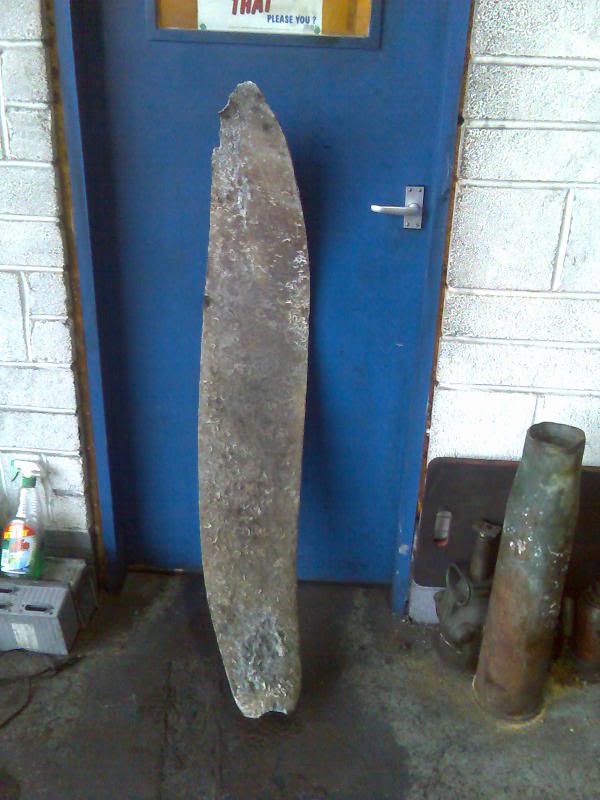
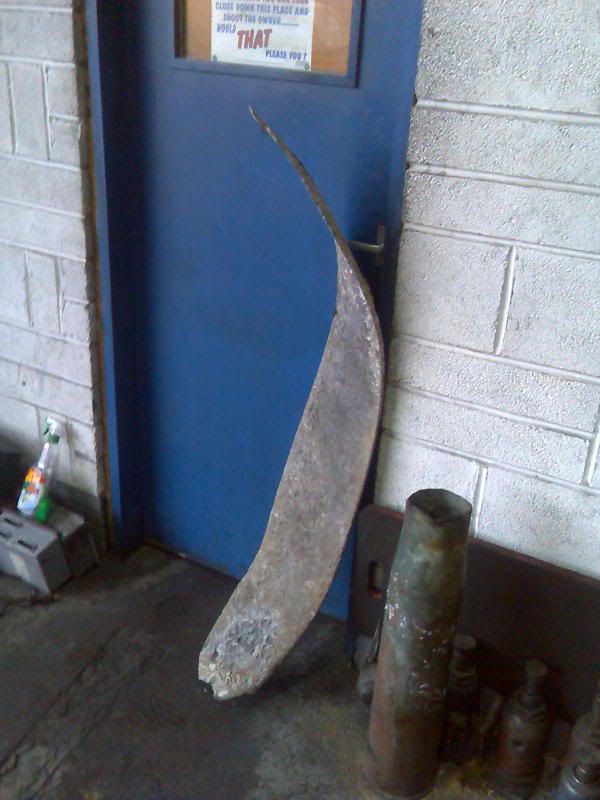
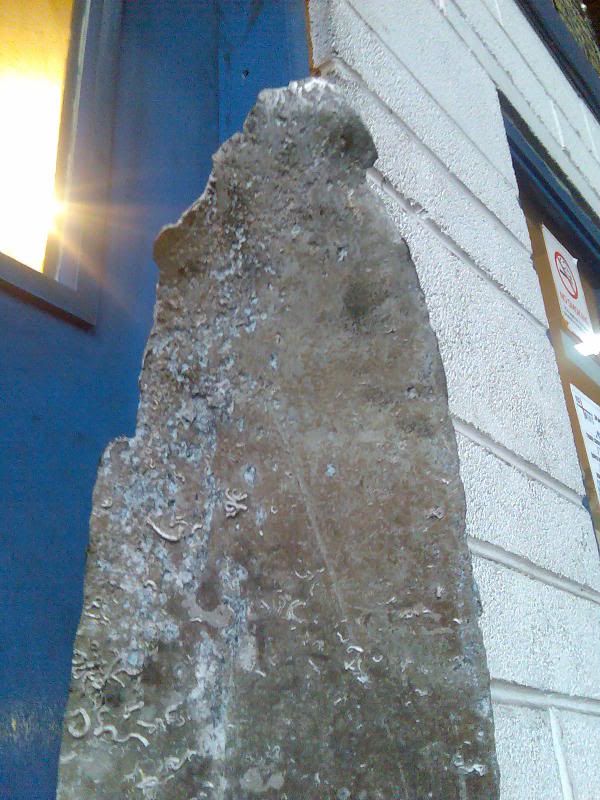
The shell case next to the blade was also found in a trawlermans nets!
Many thanks,
Tim

By: lankytim - 16th January 2009 at 15:50
Ill take a tape measure next time I go up. It will be difficult to measure the overall length as the root is missing but ill do my best. The width will be no problem though.
I saw my friend today and told him the the opinions of the forum “I thought it was from a spitfire… pity”…. Oh well, you cant please everybody. As R.J Mitchell came from the Stoke area there is much interest and pride surrounding spitfires in this part of the country. Maybe it was shot down by spitfires? I told him that if he ever wants to get rid he knows where I am. 🙂
By: JägerMarty - 16th January 2009 at 04:38
Aye, it does look like a 109 prop, some measurements might help
By: Arabella-Cox - 15th January 2009 at 19:52
Possibly from a Fairey Swordfish? Fairey Barracuda? perhaps a rare Fairey Spearfish Divebomber?
Type identification depends on knowing the nets mesh size, depth, coastal location and burley used?
Note: These should all be checked for legal size, or kissed and released.
Perhaps a Douglas Dolfin?, Blackburn Shark or Supermarine Walrus that got caught up in the net unintentionally?, these normally all get thrown back.
Smiles, “and gets my hat and coat”
Mark Pilkington
Mark….definitely German! No doubt. If it ain’t, then I’ll eat my flying helmet!
By: lankytim - 15th January 2009 at 16:09
Mark, I thought you were serious until I got to the “These should all be checked for legal size, or kissed and release” part!
Many thanks for the help guys. Im seeing the prop blades owner tomorrow and ill tell him the forums findings. He was amazed when I told him I knew of some people that could probably tell me the blades origins. Hel be delighted that the “mystery prop blade” is now a bit less of a mystery.
By: mark_pilkington - 15th January 2009 at 11:19
and was given a prop blade that was caught in a fishing trawlers nets.
Possibly from a Fairey Swordfish? Fairey Barracuda? perhaps a rare Fairey Spearfish Divebomber?
Type identification depends on knowing the nets mesh size, depth, coastal location and burley used?
Note: These should all be checked for legal size, or kissed and released.
Perhaps a Douglas Dolfin?, Blackburn Shark or Supermarine Walrus that got caught up in the net unintentionally?, these normally all get thrown back.
Smiles, “and gets my hat and coat”
Mark Pilkington
By: Arabella-Cox - 15th January 2009 at 10:30
Red primer
I’d say it was a red anodised layer, produced by pickling the aluminium component in a chemical bath, to provide a corrosion resistant layer before painting.
Anon.
By: Augsburgeagle - 15th January 2009 at 02:16
A red sprayed primer base is very common on prop blades but not on the rest of the A/C. A red putty was used on the rest of the aircraft to fill seams and gaps and after the paint has gone can often still be found clinging onto parts.
By: brewerjerry - 15th January 2009 at 00:03
I would agree. Certainly a German VDM blade from the shape/profile and also the reddish primer.
Hi
Apologies for butting into the thread..
A ‘sillly’ question…
Was ‘ reddish primer ‘ commonly used thro’ WW2 on german a/c.
And was it just used on metal ?
Cheers
Jerry
By: Arabella-Cox - 14th January 2009 at 22:37
Portsmouth….hmmm…probably from Helmut Wick’s Me 109 then!
By: John Aeroclub - 14th January 2009 at 19:45
The shell case could be a 4.7 standard naval deck gun munition.
John
By: lankytim - 14th January 2009 at 19:34
That is interesting! Thanks for the info, Its a great pity that it would be impossible to trace the exact aircraft that the blade was once attatched to and how it came to be at the bottom of the channel. The trawlers cover a huge area and there is no way of knowing at what time the blade was picked up. No doubt the blade has a story to tell….
The blade has a “fresh” break at the base, suggesting it was broken off the propeller hub by the trawlers nets rather than by the impact of hitting the water. Maybe the propeller was still attatched to the engine, pointing towards a forced landing rather than a crash…. All speculation of course, the truth will never be known!
Does anybody have any tips on cleaning the blade up? Perhaps the corrosion should be filled, smoothed over and the blade repainted. Maybe it should be left “as found”.
By: Arabella-Cox - 14th January 2009 at 18:33
I would agree. Certainly a German VDM blade from the shape/profile and also the reddish primer.
By: lankytim - 14th January 2009 at 18:08
Humm, early 109?

The profile does look similar.
By: Arabella-Cox - 14th January 2009 at 18:00
Prop blade i/d
Looking at the profile and the colour it appears to be German and off an early Bf109 or Me110.
It is probably a Battle of Britain relic as it looks to be the VDM type as fitted to DB601 engine.
Anon.


 Sign In








 January 14, 2009 at 5:46 pm