Hi, does anyone know if the Mossie had washout in the wings?
My reason for asking is because a friend has sent me an old video clip of them being made in Australia and in the flying clip it shows one landing on one engine doing what is pretty close to a slow three pointer landing. The wing shape is similar to the Comet which was originaly built without washout and had tip stall problems at slow speeds and I just wondered if they cured it on the Mossie with washout
Thanks
Ken

By: boguing - 23rd March 2013 at 19:52
There’s a good description of the alarming nature of checking-out on a Mosquito in this book, Mosquito Racer, by Don McVicar http://www.donmcvicar.com/revmosqu.htm
Dave
Just ordered that. Any other tips (see what I did there?) for a Mos worshipper?
By: skyskooter - 23rd March 2013 at 15:33
Yes but both the Me 210 and the Ar 240 relied on slats to maintain airflow over the outer wings. In fact the Germans seem to have had a thing about slats on many of their designs – Messerschmitt especially.
By: Graham Boak - 23rd March 2013 at 14:42
The He111 and He177 were both bombers so not likely to be flown exuberantly hence tip stall was less likely to be a problem for their flight envelope.
Not flying exuberantly? True, but also true about the DH89/86 which were troubled by tip stall.
More important, I feel, is that both designs (and indeed the He100) predate what seems to have been an industry-wide adoption of the planform rather than an improvement credited to one design team. What is also relevant is that neither the Me210 nor the original Ar240 design had the very pointed tips of the prewar DH types, suggesting the origins for its adoption in Germany may lie elsewhere, or at least in a wider context.
By: Dave Hadfield - 23rd March 2013 at 13:23
As was stated in an earlier post, the radiators probably had an effect on wing stall. The stall would happen there first, due to the sharpness of the leading edge at that point. This would cause buffet and other effects which the pilot would notice, and recovery would be initiated before the tips stalled.
However the point is a bit moot. Nobody flew the Mosquito slow. It’s Vmc is very high — dangerously high by modern standards — and ordinarily no one would go below that unless they were trying to get it on the ground.
The transition from an Anson, or Oxford, would have been shocking.
There’s a good description of the alarming nature of checking-out on a Mosquito in this book, Mosquito Racer, by Don McVicar http://www.donmcvicar.com/revmosqu.htm
Dave
By: skyskooter - 23rd March 2013 at 09:58
The He111 and He177 were both bombers so not likely to be flown exuberantly hence tip stall was less likely to be a problem for their flight envelope.
By: Graham Boak - 22nd March 2013 at 19:32
Re Heinkel. He doesn’t seem to have been bothered about it on such designs as the He111 and He177. However, it does seem to have been something that was highly recommended to German designers from around 1939, as it can be seen on most of their later WW2 twins eg (He219, Ta154, Hs129) and was introduced on the Ar240 and Me210 to (partially) cure their problems.
It’s certainly an interesting explanation which I hadn’t seen expressed before.
By: skyskooter - 22nd March 2013 at 19:04
Yes, 2.5 degrees leading edge sweepback. My mistake.
By: Skyraider3D - 21st March 2013 at 23:38
Thanks for your post, interesting note about the planform of the Mosquito wing and tip stalling behaviour of a forward swept wing.
I reckon you meant 2.5 degrees leading edge sweep, rather than 7.5?
Quarter-chord is indeed 2.75 degrees forward and trailing edge 18 degrees forward sweep.
By: skyskooter - 21st March 2013 at 17:19
You are all missing the point. The question was how did the Mosquito avoid the tip stall problems associated with the Comet Racer’s wing given that they both have a similar tapered profile. There is no evidence of washout but there seems to be some support for a thickening of the wing section towards the tip. RAF34 is not a symmetrical section so if indeed the thickness/chord ratio was increased at the tip then it follows that the mean camber also increases. The effect is to generate more lift at the tip and avoid tip stall.
Look at the profile of the Mosquito’s wing in planform view. Compare it to the Comet’s wing. Yes they are both sharply tapered but there the similarity ends. The Mosquito has a nearly straight leading edge and a sharply tapered trailing edge. I ran my protractor over a half decent modellers’ plan and read about 7.5 degrees sweep back for the leading edge of the outer wing panel, 18 degrees sweep forward for the trailing edge and roughly 3 degrees sweep forward at the quarter chord line. Hence the Mosquito has a swept forward wing. So what? My book “Model Aircraft Aerodynamics” by Martin Simons says “Sweep forward actually aids control at low speeds, delaying wing tip stall…” How does it do that? With any swept wing (forward or backward) there is a spanwise component of air flow, ie. the air does not just flow across the chord of the wing but tends to slip off sideways in line with the sweep. Now with a swept forward wing this spanwise flow will be towards the wing root. Therefore when the critical stalling speed is reached the wing root will stall before the wing tip. Aileron effectiveness is maintained until the whole wing stalls. I think this was the Mosquito’s advantage over the Comet Racer.
As a matter of interest Ernst Heinkel must have been a supporter of the swept forward wing planform. Just look at the wing profiles of his designs right from the He 100 up to the He 162.
But what do I know. I just fly model aircraft. Let’s hear from the real pilots.
By: Skyraider3D - 3rd February 2013 at 22:17
Does anyone know if the root and tip section of the Mosquito wing are of the same thickness?
RAF-34 has a thickness of 13%, but since it’s modified I am not sure if this is correct. This website has a description of how the Mosquito wing was (probably) modified, resulting in a 15% thickness:
http://wellssullivan.blogspot.nl/2011/06/de-havilland-mosquito-wing-section.html
This seems in line with my own research, which has the wing root at 147″ chord (confirmed) and 22″ thickness (estimated), resulting in exactly 15% thickness.
Can anybody confirm or correct any of these figures please?
By: Stuart H - 27th July 2012 at 21:29
Aileron input to raise a wing at speeds close to the stall is a recipe for disaster. Asking a nearly stalled wing to produce more lift is likely to stall that wing and induce a spin. My understanding of washout is that it encourages the centre section of the wing to stall first, as the outer wing is at a lower angle of attack, so that a stall is less likely to induce a wing to drop.
By: David Burke - 27th July 2012 at 21:12
Graham -my understanding is that asymmetric manouvers require strong rudder input to help keep the wings level due to reduced speed and the yaw effect of an engine out.
Regards the washout the idea is that if the inboard part of the wing stalls there is still control at the ailerons due to the reduced incidence there.
By: PeterVerney - 27th July 2012 at 19:30
Determining single engine safety speeds was always a necessary, and interesting, experience.:D
By: Graham Boak - 27th July 2012 at 17:00
No, they are different.
A gull wing has significant dihedral at the root, with the outer panels being flatter. The Polish PZL fighters are a notable example of this. The Ju87 and the F4U Corsair are notable examples of inverted gull wings. If the Mosquito has any gull effect it is very slight, and not visible on the upper surface.
Washout is where the outer wing near the tip is set at a lower angle of attack than the main wing. This ensures that the inner wing stalls first, else in asymmetric manoeuvres near the stall one wingtip would stall before the other creating an highly undesirable uncommanded roll. Wings with thin pointed tips are inclined to do this anyway – I’m sure that the Rapide was used as one example when I was being taught aerodynamics, many years ago. I don’t recall any mention of the Mosquito in this respect, but that would have been used as the classic example of single-engine safety speeds (or lack of same). It would be a bit unfair to pick on the same type for more than one demonstration!
By: Sutts - 27th July 2012 at 15:45
I seem to remember Tony Agar telling me the mossie has a slight gull wing. Not sure if that’s what washout is?
Does anyone know if any of the blueprints survived in Oz or NZ? I’m not sure all of them in the UK were saved.
By: Arabella-Cox - 27th July 2012 at 15:15
My two pennyworth.
Could the lips of the Mosquito’s radiator openings cause the inner wing to stall before the tips (or at least produce pre stall buffet as a warning) in the same way as the small triangular stall strips on other aircraft do?
By: powerandpassion - 27th July 2012 at 14:49
Aerodynamic washout
Not an expert but thought I’d guess a few things :
1) Single engine Mosquito landing was probably Geoffrey De Havilland demonstrating something serenely that finsished off a lot of other blokes.
2) Comet was designed and built in months, with some radical ideas given their head and boundaries pushed. The same tapering wing concept is in the contemporay DH Dragon Rapide (and later DH Albatross) without the stalling reputation, perhaps a total wing area issue. My (flimsy) understanding is that the tapering section (both in plan and end view) altered the aerofoil section across the wing creating aerodynamic washout. Different to a non tapering wing concept (DH Tiger Moth ?) that would require wing tip washout. Maybe the Comet wing just wasn’t big enough. Looking at the Mosquito doing a wing over always shows a big, generous, sexy, wing area.
3) I have never read anything about DH98 wingtip washout, all descriptions, plans and images show a consistent tapering section.
As an Australian I am fascinated about Mosquito manufacture in Australia. Most manufacturing information seems to come from Canada, it would be great to fill the gap with the Australian manufacturing story, particularly sub contractors making components:
Apart from General Motors Pagewood NSW making Mosquito wings and fuselages so far I have identified :
Armoured windshield glass – ACI Geelong plant, VIC
Metal pressings – Richardsons Industries, SA, later Chrysler Australia
Hydraulic Rams – James N Kirby Pty Ltd NSW
Undercarriage assemblies – A&P Engineering QLD (Alexander & Peter Usinski)
Bakelite plastic items – Commonwealth Moulding, Arncliffe, NSW
A lot of these places were just small workshops that might not have found it remarkable to be forming horseshoes at one end and aircraft parts at another.
By: Arabella-Cox - 20th July 2012 at 10:31
It’s difficult to tell from a photo, but it doesn’t look like it in this picture, or if there is, it’s not very much.
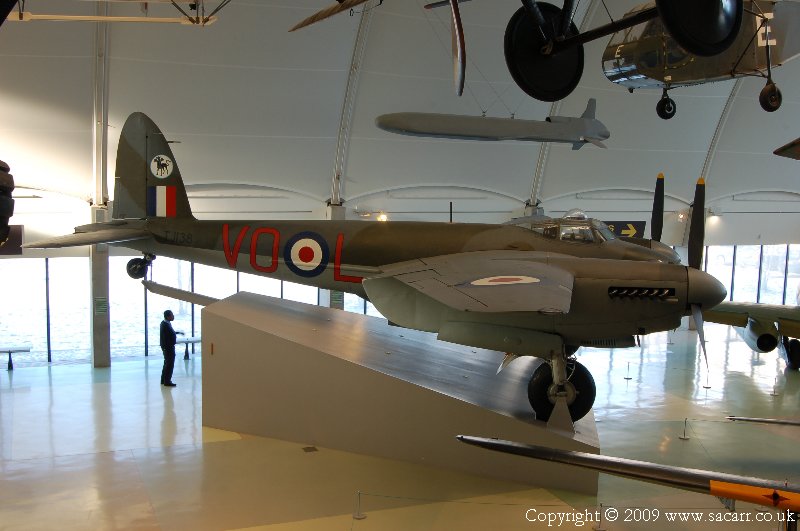
By: Ken - 20th July 2012 at 06:43
Its interesting the Mosquito had the same wing section as the Comet.
The Comets as built had the wings flat with no washout and with the tapered wings this caused it to tip stall at low speeds and old news reels show some hairy landings. Grosvenor House when restored was done as original and the flight test reports state that it has a wing drop at the stall which is why they try to do a ‘wheeler ‘landng. When the american replica was built they incorporated 3 degrees of washout in the wing which does seem to have improved it.. if you look at the post on you tube of it flying at Airventure in 2009 you see it doing a perfect ‘three pointer landing’
http://www.youtube.com/watch?v=X7xm7jTyZ-w
I just wondered if the mosquito had a similar set up
Ken
By: HP111 - 19th July 2012 at 14:48
Hi, does anyone know if the Mossie had washout in the wings?
….. I just wondered if they cured it on the Mossie …..
Ken
Did the fullsize Mosquito ever have a problem? I know modellers complain about snap stalls, but then models tend to suffer from inaccurate construction, too slow flying, too tight turnng and so on, quite apart from being in a different, more adverse aerodynamic regime. I am not aware of any particular problems with the fullsize aircraft.


 Sign In








 July 19, 2012 at 9:07 am