Last Friday I saw the episode on the BC/8th AF bombing of Germany of the old (but excellent) series World at War.
I hadn’t seen it since its original broadcast back in the mid 70s and was still impressed by it. The fact that they had interviews with a lot of greats who have since passed away is really amazing. That episode (#12) had Arthur Harris, Ira Eaker, Jimmy Stewart, Adolph Galland and a Lancaster pilot who won the VC and lived to talk about it (IIRC his last name was Reed). I’d highly recommend it to anyone who has never seen it. It’s now out on DVD.
Which leads me to a question.
BC switched to night missions to stem losses…correct?
If so, it didn’t seem to work.
In the current thread about a Lancaster being found in Germany, someone makes the point of saying BC lost 57,000 personnel in ops.
The US 8th AF lost 26,000…plus thousands from the 15th and 9th AFs. One source has a total of 30,000 KIA. It’s hard to separate U.S. bomber crew losses since the 8th and 15th AFs had fighter units…so if anyone has bomber crew numbers only, I’d like to know them.
According to various sources on the web:
BC flew 364,000 sorties.
U.S. bombers 8th, 9th and 15th AF flew 463,000 sorties.
Again, if anyone has better numbers….please feel free to share.
Clearly, the night did not prove to be an advantage in preventing losses.
Now, this is not meant to start a flaming war, I’m not criticizing RAF &
Commonwealth aircrew or aircraft.
Rather, I’d like to ask whether my hypothesis is correct about the “safety” of night missions not being proven by the statistics.
Any thoughts on this?

By: mhuxt - 7th April 2010 at 22:20
It would be interesting to see the loss rates plotted on the same chart (please!)
Ask, and it shall be given you.

As for the Mossies, you’ll find no greater Mosquito fan than myself, however I think Don Bennett was incorrect (Hubris!) when he said the Mosquito could carry as much to Berlin as the B-17s. When the Forts had a lot of incendiaries aboard, their load to Berlin was in fact less than 4,000 lbs. However when loaded only with HE they seem to have been around 5,000 lbs per aircraft.
Have a look at some of the Berlin mission reports here:
By: WebPilot - 7th April 2010 at 22:12
Eddie – Don’t forget that post-D Day the bombers were turned to short range tactical operations in an area of virtual air superiority which would also influence the loss rates, before the area bombing campaign resumed. It’s very hard to draw direct conclusions as the variables are so large.
By: J Boyle - 7th April 2010 at 21:02
Excellent graphs – thanks – it’s clear that before the run up to D-day and the loss of early warning systems that followed, the loss rates for the USAAF were generally significantly higher than those for the RAF at the same time.
Again, you may not want to read too much into that, you have to give the USAAF a period to gain combat experience and figure out real-world tactics.
Somewhat similar to the the period of high causualties suffered by BC early in the war.
By: Eddie - 7th April 2010 at 20:31
Excellent graphs – thanks – it’s clear that before the run up to D-day and the loss of early warning systems that followed, the loss rates for the USAAF were generally significantly higher than those for the RAF at the same time. Post D-day, the loss rates appear to have more or less fallen together. It would be interesting to see the loss rates plotted on the same chart (please!)
By: PeterVerney - 7th April 2010 at 15:35
Thanks mhuxt for a pair of most informative graphs.
May I also point out that the Mossie cut the loss rate in two ways.
One, by the high speed evasion of the defences to drop its bombs, but just as important
Two, 100 Group nightfighters sorting out the German night fighters, resulting in the wonderful word “Mosquitopanik”
By: mhuxt - 7th April 2010 at 13:37
BC Sorties & FTR Rates via Hastings:

8th AF Attacked & FTR Rates via Davis (excludes aircraft returned early)
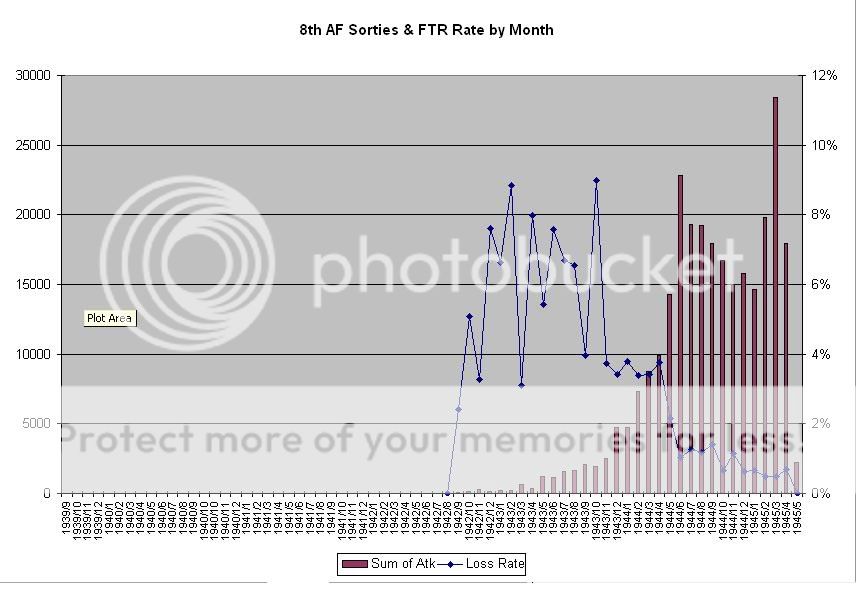
By: WebPilot - 7th April 2010 at 12:14
Sharpe and Bowyer’s ‘Mosquito’ gives the following figures:
Bomber Command Mosquito sorties (total, not just the LNSF): 39,795
Failed to return: 254
That’s a loss rate of just 0.6%.
By: Mo Botwood - 7th April 2010 at 12:03
This might be in the later stages of the night campaign, but historically, the German night defences had never caught the Mosquito to any great extent.
“The Mossie has a special place in the RAF’s history
The Light Night Striking Force of Mosquitos during one phase of the war made bombing raids to Berlin on 43 consecutive occasions without a break. Sometimes the same aircraft would make a second raid on the same night. The Light Night Striking Force flew 553 sorties during April 1943 for the loss of only one aircraft.
The LNSF used to operate in the most appalling weather and one night Air Vice Marshal Donald Bennett was visited by Mrs. Ogden Reid of the New York Herald Tribune. She had asked to witness the start of a raid. This distinguished lady of the American press arrived with a member of the British Government and was immediately driven to the end of the runway by Bennett. Fog caused heavy bomber raids to be cancelled but as the mist swirled around the signal caravan at the end of the runway Mosquitos could be seen taxying on from both directions to save time, lining up and taking off for Berlin in quick succession. She turned to Bennett and said, “I see they have got a bulge – they’re carrying a “Blockbuster” aren’t they?” She asked what it weighed and Bennett told her 4000 lbs which was 500 lbs more than a B-17 Flying Fortress could carry to Berlin. In any case, he pointed out, a Fortress would not accommodate a 4000 lb “cookie” because it was too large for its bomb bay. The famous Press lady pondered for a few moments before replying “I only hope the American public never realises these facts.”
One young Mosquito pilot of those days was Wing Commander 1. G. Broom (later Air Marshal Sir Ivor Broom DSO, DFC and two bars, AFC). “We did 25 nights to Berlin. You could fly there and be back in the mess before the bar closed. We could carry more to Berlin with a crew of two in a Mosquito than could a Flying Fortress with a crew of ten. They had to fight their way there and back in daylight. We went fast at night, at 28,000 ft.”
By: Creaking Door - 7th April 2010 at 11:14
…I compared the total number of sorties with aircrew losses (because 65 years on, it’s the lives lost, not the number of planes that matters)…
But wasn’t your original question about why Bomber Command sought the ‘safety’ of night?
When this decision was made there was no comparison to be made, the US hadn’t even entered the war, and 70 years ago the decision certainly wouldn’t have been made in terms of crew KIA but in terms of aircraft lost. Even if crew losses were considered those crew that survived the shooting-down of a US bomber would still be ‘lost’ to the war effort as for the most part they would survive in POW camps.
I do not have any figures to contradict yours but I seem to recall that the US bombing effort from Britain incurred more overall ‘losses’ than Bomber Command, for fewer sorties and a vastly smaller tonnage of bombs dropped.
Of course comparisons of ‘tonnage dropped’ do not necessarily equate directly to ‘damage done’ (militarily speaking or collateral).
By: WebPilot - 7th April 2010 at 11:12
Surely, the quantum of lives lost is vitally important in human terms, but of less value when plotting effectiveness and comparison – which is intrinsically somewhat inhuman. I’m not sure the sortie rates are directly comparable either. If one includes the 8th, 9th and 15th Air Forces, one should probably also include the bomber elements of DAF, 2TAF, AEF and so on as not all the RAF bombers were under Bomber Command control. A direct comparison between the two forces is very hard for this reason as you and I both noted at the start.
The Americans had fighter cover from the beginnning, which was one reason that they stuck to shallow penetration raids at the start of their campaign, staying within the fighter cover available. It would be hard, if not impossible, to determine exactly how much the fighter toll did drop off as most aircraft lost, particularly at night, simply didn’t come home and cause cannot generally be established. However the fighter threat did begin fall away as the German defences became exhausted and over-extended and Bomber Commmand began to fly by day again, initially on tactical missions over the French battle fields but the Luftwaffe remained a threat right into 1945 and losses didn’t fall away until 1945. Certainly Bomber Command’s strategy did not give the defensive advantage of massed fire power but I think some of the numbers quoted previously shows that this was not always necessarily to the disadvantage of the RAF. Both strategies had advantages and disadvantages and both had degrees of success and failure; there would not appear to be any evidence that either was misconceived or better than the other.
Bomber Command casualties by year
1939: 321
1940: 2714
1941: 5435
1942: 9441
1943: 16209
1944: 18237
1945: 4748
(total 56925)
The following is of interest and a comparison with the American figures would be valuable
Statistical Summary of Bomber Command’s Operations
Total sorties: 392,137
Total aircraft lost: 10,724
Loss Rate: 2.73%
Tons Dropped: 955,044
Total mines laid: 47,307
This next is a heartbreaking and terrible set of figures:
For any given 100 aircrew in Bomber Command, 1939-1945, the statistical breakdown was:
Killed on operations: 51
Killed in crashes in England: 9
Seriously injured: 3
Prisoner of War: 12
Evaded capture: 1
Survived unharmed 24
By: J Boyle - 7th April 2010 at 10:48
Even the Operation Gommorrah raids on Hamburg in 1943 in which both Bomber Command and the 8th AF were involved in successive days can’t really be an exact comparison as the following shows and in fact the American casualties are some of the highest recorded.
Quite. As your point out there is a huge number of variables that could be taken into account.
That’s why, at the risk of over simplification, I compared the total number of sorties with aircrew losses (because 65 years on, it’s the lives lost, not the number of planes that matters).
It would be interesting to see comparable figures for later in the war when
the 8th AF FC escorted the bombers deep into Germany.
It would show the Americans with the benefit of fighter escort which lessened bomber losses.
Did BC losses to fighters also drop late in the war?
If so was it because of overall Luftwaffe attrition…or did the losses stay constant because of technical improvemets by defending night fighters?
Overall, the defensive advantages touted by the USAAF…tight bomber formations to discourage enemy fighters and escort fighters…weren’t available to the RAF during night missions.
By: WebPilot - 7th April 2010 at 10:27
Thanks. At a superficial level this would appear to vindicate the RAF’s strategy of night attacks in such numbers as to swamp the defences, but it also shows the importance of technological advances and the adverse effect that weather could have. However I suspect chaos theory and basic Sod’s Law also had major impacts so I am not sure that would want to make that an absolute conclusion.
By: Moggy C - 7th April 2010 at 10:15
Middlebrook and Everitt give 17 aircraft lost, 2.2%
Moggy
By: WebPilot - 7th April 2010 at 09:59
I’d be interested to compare the loss rates at the same periods of the war, and on similarly long range targets…
I suspect any comparison on a target by target basis wouldn’t have much validity either as there are too many other variables – the weather, success of any decoy or diversionary operations and so on.
Even the Operation Gommorrah raids on Hamburg in 1943 in which both Bomber Command and the 8th AF were involved in successive days can’t really be an exact comparison as the following shows and in fact the American casualties are some of the highest recorded.
Night – 24/25 July: 791 RAF aircraft attacked, using Window for the first time. 12 aircraft lost (1.5%).
Day – 25 July: 123 B17 attacked, 15 aircraft lost (12.2%)
Day – 26 July: 121 B17 attacked Hamburg & Hannover, 24 aircraft lost (19.8%)
Night – 27/28 July: 787 aircraft attacked (this was the Firestorm raid) – not sure of loss figure for this raid.
Night – 29/30 July: 777 aircraft attacked. 28 losses (3.6%)
Night – 2/3 August: Bad weather disrupted the bomber stream, 777 aircraft attacked various targets, 30 aircraft lost (4.1%)
There is a very good website on Bomber Command here:
http://www.rafbombercommand.com
By: Creaking Door - 7th April 2010 at 00:25
…BC lost 57,000 personnel in ops.
The US 8th AF lost 26,000…plus thousands from the 15th and 9th AFs. One source has a total of 30,000 KIA. It’s hard to separate U.S. bomber crew losses since the 8th and 15th AFs had fighter units…so if anyone has bomber crew numbers only, I’d like to know them.
Comparing the number of crew KIA can be misleading as there was quite a difference in crew survivability between a shot-down B-17 and Lancaster (for example) and those who made the decision for Bomber Command to bomb at night were concerned with aircraft losses, not crew losses.
By: Eddie - 7th April 2010 at 00:08
I’d be interested to compare the loss rates at the same periods of the war, and on similarly long range targets. I think it’s fair to say that until early 1944, the USAAF was not routinely conducting deep penetration raids, whereas RAF Bomber Command was. Overall loss rates for the war are not terribly illuminating.
By: alertken - 6th April 2010 at 22:43
None of the aircraft types mounting the Combined Bomber Offensive was designed for the role in the way it was actually performed.
AVM Freeman funded the 1935/36 Heavies to leap over the Maginot Line, to deploy the standard British means of warfare – visiting mass destruction on the enemy’s war-making infrastructure. That had been RN, interdicting supply and bombarding bases: to that would be added HE rained inland, by Warwick, VS.316, Stirling, Halifax and Manchester. By April,1938 that led to take-up of non-Aero production capacity such as in the auto industry, to build apace. Daylight, big bombloads, much armament. By the time, 1941-42, volume deliveries were underway of the 3 types worth buying, night was RAF’s only chance of surviving intercepts starting overhead main base.
USAAC’s Martin B-10 was for Dependency Protection; B-17A was to attack the Imperial Navy from Manila: range, not armament-over-water, small bombs released to be walked over narrow vessels, later to be aided by the Norden sight. Consolidated LB-30 was funded by France with range to reach Baku oilfields, not taken up as B-24 until 1939. 1940-funded B-29, B-32 were not so much Very Heavy as Very Long Range so that US could defend Panama, Philippines without access to bases denied to it by no-longer-combatant British Commonwealth. Overwater, again; it never crossed USAAC’s mind to contemplate night operation, or to rain down deep inland.
During early-1941 US/UK poured money, industry and men into preparing for a UK/N.Africa-based, Germany-First Strategic Bombing Campaign, which became Allied High Policy on 21/1/43 at Symbol Summit, Casablanca: “progressive destruction of the German military industrial and economic system (,) undermining the morale of the German people to a point where their armed resistance is fatally weakened.” The hope was to avoid beach bloodbaths. UK chose to do night until day might became tolerable; US chose to do day, on by-now porcupine formations, for your choice of reasons. Mine is that clear skies, Great Plains training of young men, done in months, not years, was hard enough, preparing for Euro-day-clag, forget night. I dispute the “precision target” notion.
By the time the balsa bomber ceased to be Freeman’s Folly, and was recognised as a flexible weapon, UK was committed in every way to the Heavy, and was trying to invent Very Heavies. Just too hard to contemplate undoing all that to rely instead on long range, good warload Light Bombers. So we did both.
By: WebPilot - 6th April 2010 at 16:39
There is some doubt on the exact figure. The 55,500 figure was given by the Air Ministry in the late 40s; Wikipedia gives a figure of 55,573 while other sources suggests that the total is around 57,000. In some cases there may be a lack of clarity – for example aircrew deaths from natural causes while in service, crew being lent to other commands etc.
By: Blue_2 - 6th April 2010 at 16:30
The Memorial stone in Lincoln Cathederal states ‘over 55,000’
By: WebPilot - 6th April 2010 at 15:14
Peter,
This is only a partial answer to your last post as for many of the KIA we will never know whether the loss was due to enemy action or some other cause, but ‘Bomber Command War Diaries’ (Middlebrook and Everitt) gives the following breakdown of casualties:
Killed in action or died while prisoners of war 47,268
Killed in flying or ground accidents 8,195
Killed in ground-battle action 37
Total fatal casualties to aircrew 55,500


 Sign In








 April 6, 2010 at 5:17 am