Does anyone have any pictures of this airfield when it was an active RAF station, or do you know of any websites which have any pictures, its only a couple of miles from where I live in Loughborough and I’d really like to find out a bit more about it.
Regards, Dazza.:)

By: ianjayne - 14th September 2018 at 19:30
RKADE and I have made contact – today !
By: ianjayne - 13th January 2016 at 19:06
Are you kidding? In the RAF! It was a case of new toys and a new learning curve.
Incidentally the one that caught fire from the cartridge splitting and cracking the fuel tanks. The aircraft was in the middle of a line of 12 Hunters and the cartridge started the engine but the pilot decided to exit the aircraft and let it burn! As I understand it the ground crew guy kicked the chock out from under the nosewheel and clambered into the cockpit and taxied the aircraft clear of the other aircraft and shut the engine down. Guess who got the pat on the back? Not the ground crew guy. He was lucky that he did not get put on a charge for illegally taxiing an aircraft! As ground crew we were not supposed to move the aircraft except as was required to align them with the prevailing wind when carrying out engine runs.
Why am I am not surprised?
By: Deryck - 11th January 2016 at 21:42
Thanks for that Deryck – did you get danger money?
Are you kidding? In the RAF! It was a case of new toys and a new learning curve.
Incidentally the one that caught fire from the cartridge splitting and cracking the fuel tanks. The aircraft was in the middle of a line of 12 Hunters and the cartridge started the engine but the pilot decided to exit the aircraft and let it burn! As I understand it the ground crew guy kicked the chock out from under the nosewheel and clambered into the cockpit and taxied the aircraft clear of the other aircraft and shut the engine down. Guess who got the pat on the back? Not the ground crew guy. He was lucky that he did not get put on a charge for illegally taxiing an aircraft! As ground crew we were not supposed to move the aircraft except as was required to align them with the prevailing wind when carrying out engine runs.
By: ianjayne - 11th January 2016 at 13:03
Both the Avons and the Sapphires were cartridge started. The Sapphires used two 20 pound cartridges which were about 6 inches in diameter and 10 or 12 inches long. The access for loading was through a panel in the bottom of the aircraft and the cartridge was hopefully correctly inserted into the threads as the cartridge got heavier by the second. The starter was a dual cartridge unit and the cartridges had a safety switch which engaged when the cartridge was in the fully inserted position. The final tweeks of the cartridges were left until both cartridges were engaged in the threads as the system had a nasty habit of firing prematurely when the safety switch was engaged. The unit design was such that the exhaust from the cartridge starter was just by your neck as you reached, up, at arms length, to put the final pressure on the cartridges to engage the safety switches. Incidentally the cartridge starter was located between the fuel tanks! I only recollect one problem when a cartridge exploded and set fire to the tanks.
The Avon starters were a 3 cartridge unit and I thought them to be more sophisticated than the Sapphire units.
Thanks for that Deryck – did you get danger money?
By: Deryck - 8th January 2016 at 14:03
It must have been from memory the Sapphires then that started up with a deep groan as they spooled up. Maybe powered up from trollyacs – the others presumably the Avons started up with a whoosh from the cartridges and a plume of black smoke reaching up over the fuselage.
Both the Avons and the Sapphires were cartridge started. The Sapphires used two 20 pound cartridges which were about 6 inches in diameter and 10 or 12 inches long. The access for loading was through a panel in the bottom of the aircraft and the cartridge was hopefully correctly inserted into the threads as the cartridge got heavier by the second. The starter was a dual cartridge unit and the cartridges had a safety switch which engaged when the cartridge was in the fully inserted position. The final tweeks of the cartridges were left until both cartridges were engaged in the threads as the system had a nasty habit of firing prematurely when the safety switch was engaged. The unit design was such that the exhaust from the cartridge starter was just by your neck as you reached, up, at arms length, to put the final pressure on the cartridges to engage the safety switches. Incidentally the cartridge starter was located between the fuel tanks! I only recollect one problem when a cartridge exploded and set fire to the tanks.
The Avon starters were a 3 cartridge unit and I thought them to be more sophisticated than the Sapphire units.
By: ianjayne - 7th January 2016 at 19:28
It must have been from memory the Sapphires then that started up with a deep groan as they spooled up. Maybe powered up from trollyacs – the others presumably the Avons started up with a whoosh from the cartridges and a plume of black smoke reaching up over the fuselage.
By: John Aeroclub - 7th January 2016 at 15:10
The wings would be no problem to remove. Yes the Hunters based for a while at Wymeswold were Hunter 5’s with Sapphire engines. If my memory isn’t playing tricks I seem to recall one of the Sqns with F.5’s was No. 257 with the Chinthe (A Burmese lion) badge. It is 60 years ago. The Avon Hunters were cartridge started, not sure about the Sapphire ones.
John
By: ianjayne - 7th January 2016 at 14:05
Wouldn’t they have had to remove the wings for road transportation? I seem to recall some of these Hunters were AS Sapphire powered as opposed to RR Avons. You could always tell which they were from the start up noise, I think some were cartridge fired but can’t remember which.
By: John Aeroclub - 6th January 2016 at 22:59
The photos were definitely taken at RAF Newton, I think in 1960. So in all probability this aircraft had come by road and had come from the hangars or had been allocated as a fire practice airframe. Flying was still being carried out at Newton, mainly Chipmunks and Ansons. The only jets I saw operated from there were the occasional Meteors and the occasional Vampire FB.5. I have found another photo so I can now confirm that the Hunter is coded O oscar.
John
By: Steve Bond - 6th January 2016 at 17:15
The Hunter would have been taken to Newton by road after its mishap at Biggin Hill and positioned as you see it for crash rescue training.
By: TwinOtter23 - 6th January 2016 at 13:36
I have been around RAF Newton several times and there were concrete taxiways and several pan-handle (lollipop) style dispersal points around the perimeter. Many of these are clearly visible in photographs in Tim O’Brien’s excellent book – “Last Post At Newton”.
Addendum: Regarding grass runways, don’t forget that Vulcan XA908 was flown into RAF Newton.
By: ianjayne - 6th January 2016 at 11:35
So was this taken at Biggin Hill? Or was it at Newton? I’m confused, if Newton only has grass it could not land surely so how did it get there with wings attached? If the former I understand. Wherever it was was it ever fully recovered or just left like that cockpit open to the elements etc? My erstwhile son in law told me yesterday he did his RAF Police dog training at Newton but cannot recall any aircraft using it but that was in 1985 I think.
By: Steve Bond - 6th January 2016 at 09:06
That’s it then, WP192 it is.
By: T-21 - 5th January 2016 at 22:49
WP192 was coded “O” with 34 Squadron.
By: John Aeroclub - 5th January 2016 at 22:01
Yes the F.5 was taken at Newton. It certainly hadn’t landed there as it was still a grass airfield. I remember at the Airshow at Wymeswold one hangar was full of Hunter F.5’s. and the other hangar was 504 Meteors. I wondered if this Hunter could have come from Wymeswold.
Steve. I have had a glass on the picture and I think I can just discern a curved top to the letter on the fin.
John
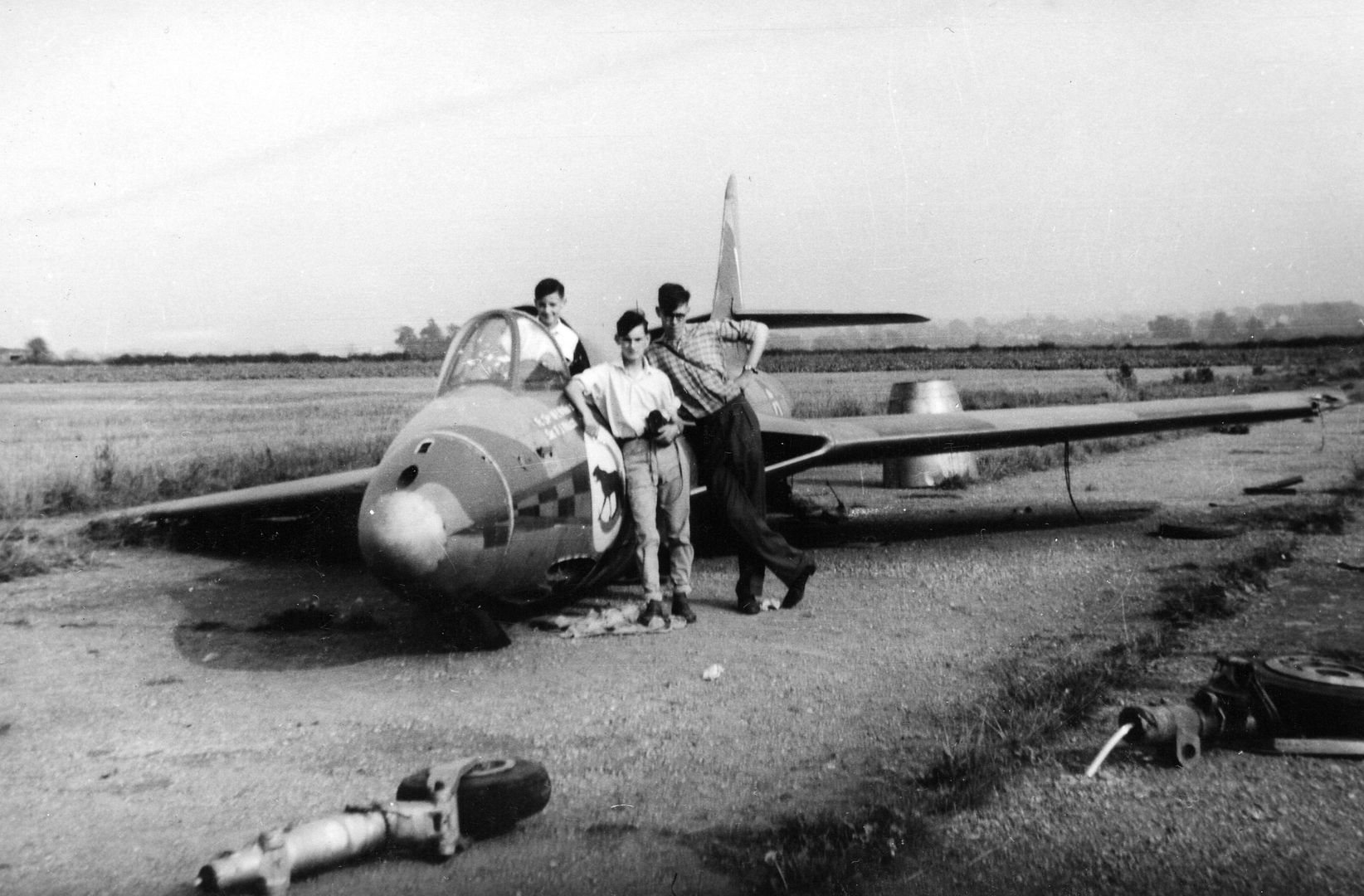
The guys are my brother in the cockpit, me and my pal Derek and we had just walked through the sparse hedge.
I’ve just played with the contrast on a copy and I think the nose door letter might be an O. Another play and Yes it’s an O.
By: Steve Bond - 5th January 2016 at 18:39
On delving into the archives, one candidate is WP192 which overshot and abandoned take off at Biggin Hill on 2 September 1957 and was relegated for ground instructional (GI) use as 7471M. Newton had several GI Hunter F.5s but this is the only one that last served with 34 Sqn. Not definitive, but a good chance this is it in my view.
By: Steve Bond - 5th January 2016 at 18:31
Thanks anyway John.
It’s 34 Sqn which flew the Hunter F.5 from Tangmere from 1955 to 58.
By: VARSITY - 5th January 2016 at 13:01
Newton is all grass which could mean it was not taken there.
By: ianjayne - 5th January 2016 at 10:47
AOG = Aircraft on Ground. In other words can’t return to base until fixed. I too remember the Airshow at Wymeswold. A long bike ride from Calverton but worth it to see the Hunter 5’s, 504’s Meteor 8’s, the Thunderbirds Thunderjets and the Attackers and the Dart Kitten.
I wonder if this was your Hunter. Taken at Newton circa 1960.John
[ATTACH=CONFIG]243010[/ATTACH]
The squadron motif looks like a ‘wolf in the moon’ should identify its ownership? Were any based at Newton? The one I saw belly down was at WYMESWOLD or more to the point just leaving the perimeter fence.
By: John Aeroclub - 4th January 2016 at 16:16
Hi Steve, Unfortunately no, It’s one of the few photos in some old albums which does not have an identity. I have a nose shot and the two names on it are F/O N.E.N Waller (or Walker) and SAC Keeler. I think that the fin letter was a yellow ‘L’. Now amended to an O after a play with the original poor photo.
John


 Sign In








 October 14, 2003 at 6:22 pm