See main topic for explanation of project:
http://forum.keypublishing.co.uk/showthread.php?p=1280414#post1280414
I shall stop counting the votes after 7 days or 20 votes whichever is sooner.
Please pick 3 choices in the order of preference.
CIWS choices
a) None, rely on main SAM battery
b) Goalkeeper
c) RAM
d) Oerlikon Skyshield 35mm with AHEAD ammo
e) BAE/Bofors Mk 110 57mm with programmable Mk 295 ammunition.
f) OTO-Melara 76mm “Strales” with Dart guided ammo
g) Phalanx 20mm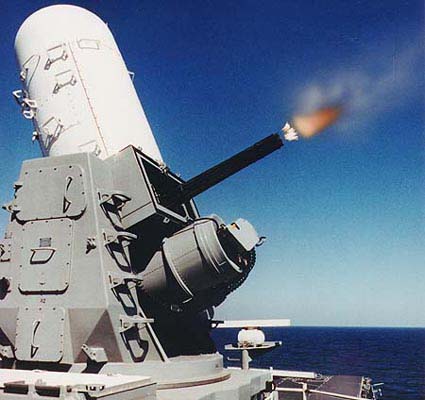
h) Starstreak laser-guided HVM modified for CIWS use

By: skyflott - 23rd August 2008 at 04:38
E)
E)
E)
😀

By: Arabella-Cox - 14th August 2008 at 23:19
H) Starstreak
E) With modification, use Dardo twin mount 40mmL70 with 3P capability
And an airburst round for a 155mm main gun
By: Sintra - 14th August 2008 at 21:29
d) Oerlikon Skyshield 35mm with AHEAD ammo (bloody good)
b) Goalkeeper (just good)
g) Phalanx 20mm (hmmmmm, second hand, cheap…)
And please, throw in a few CAAM´s 😉
By: Jezza - 10th August 2008 at 14:22
c
e
g
:p
By: EdLaw - 6th August 2008 at 17:29
A logical option would, of course, as Jonesy says, be the Phalanx 1B, if nothing else, because it would give a fairly straightforward upgrade path to the SeaRAM. The SeaRAM basically recycles most of the Phalanx, replacing the gun and ammunition modules with an 11-cell RAM launcher. It is intended to be a straightforward upgrade path, so if all the ships in the RN standardised on Phalanx 1B, they could be upgraded to SeaRAM as needed. You obviously still need a basic gun system, for use on the lower-end targets (small craft etc…), and this could easily be provided by the 30mm Bushmaster cannon, as used on the Type 23.
Another thing to consider is the Army’s use of the C-RAM, i.e. land based Phalanx. It might be an idea to make any future CIWS a joint project, or just buy more Phalanx units, to allow the RN and Army (and RAF Regiment perhaps, for airfield defence, which seems to be taking a back seat nowadays) to have a common fleet, with common upgrades. The Army needs the gun-based version more than the missile based version, but common training might be useful.
Does anyone know how many Phalanx units does Britain actually owns?
By: Ja Worsley - 6th August 2008 at 16:53
I am surprised again here. Given that this is a mythical “Follow on” design, why not incorporate new technologies that are being tested now!
My choices would be reflective of this and are as follows:
A) Metal Storm
B) Rail Gun concept
C) Laser system in a reduced form of that being used on the ABL-1 for the USAF.
By: harryRIEDL - 6th August 2008 at 10:31
The reason why I don’t think that 20mm Phalanx is completely inadequate these days is its inability to defend against massed attacks. It is designed to kill the target by directly hitting it, which means that one turret has to stay on target till destruction, and given it’s rather smallish engagement envelope (outer edge > inner edge) it might well be busy with one single missile all the way through this envelope, giving the others a free ride.
Thus the reason why I favour 35mm Millennium is its ability to put a lead cloud in the flightpath of a target and then switch to the next, giving it true multi-engagement capability, but at the same time its ability to stay on a target till destruction. And that is something a missile like RAM can’t do (basically it doesn’t matter which missile, it’s a basic characteristic of missile-CIWS). You can never be sure to destroy a target, as long as the missle hasn’t exploded it (and even then it might not have effected the target enough). This results in the need to fire multiple missiles to be sure (even with high single-kill probabilities). Thus you can’t go for neither missile OR gun alone, you need both.
Other questions for CIWS design are placement of turrets/launchers and sensors, and stand-alone capability/survivability.
For a number of reasons I strongly believe that sensors and turrets/launchers should be seperated (bit not exclusively with centralized C2, like the Russians do/did). Of course a system like Phalanx is easier to install, but it’s the quick’n-dirty solution.
For a distributed CIWS solution to work and survive it has to be battle damage tolerent, meaning distributed, networked, independent C2 and data network (e.g. fibre optical, incl own power supply) and local power supplies for the turrets/launchers to keep going even after the ship loses main power. As this is just an emergency configuration, it could be designed for only limited duration (20/30 minutes?), running off power packs (preferably batteries). No idea how far this is already done, but I think even Phalanx is connected to the ship power grid (for sure RAM) and doesn’t have its own integrated supply.
the massed attacks arguments very difficult to justifies as there has never been a massed anti-ship missile attack ever the only time ASM have been successful has been when critical systems have been off line and the vessel hasn’t be expecting an attack. Massed attacks are only plausible from the PRC and Russia and possibly India would have enough assets to plan track and pull off such a difficult operation. So by planning your last ditch defense on something that is very unlikely seems unfordable so i would want to move to a RAM/typhoon systems for close in attacks and CWIS. as both are based on systems already in service.
By: Distiller - 6th August 2008 at 06:30
The reason why I don’t think that 20mm Phalanx is completely inadequate these days is its inability to defend against massed attacks. It is designed to kill the target by directly hitting it, which means that one turret has to stay on target till destruction, and given it’s rather smallish engagement envelope (outer edge > inner edge) it might well be busy with one single missile all the way through this envelope, giving the others a free ride.
Thus the reason why I favour 35mm Millennium is its ability to put a lead cloud in the flightpath of a target and then switch to the next, giving it true multi-engagement capability, but at the same time its ability to stay on a target till destruction. And that is something a missile like RAM can’t do (basically it doesn’t matter which missile, it’s a basic characteristic of missile-CIWS). You can never be sure to destroy a target, as long as the missle hasn’t exploded it (and even then it might not have effected the target enough). This results in the need to fire multiple missiles to be sure (even with high single-kill probabilities). Thus you can’t go for neither missile OR gun alone, you need both.
Other questions for CIWS design are placement of turrets/launchers and sensors, and stand-alone capability/survivability.
For a number of reasons I strongly believe that sensors and turrets/launchers should be seperated (bit not exclusively with centralized C2, like the Russians do/did). Of course a system like Phalanx is easier to install, but it’s the quick’n-dirty solution.
For a distributed CIWS solution to work and survive it has to be battle damage tolerent, meaning distributed, networked, independent C2 and data network (e.g. fibre optical, incl own power supply) and local power supplies for the turrets/launchers to keep going even after the ship loses main power. As this is just an emergency configuration, it could be designed for only limited duration (20/30 minutes?), running off power packs (preferably batteries). No idea how far this is already done, but I think even Phalanx is connected to the ship power grid (for sure RAM) and doesn’t have its own integrated supply.
By: Jonesy - 4th August 2008 at 23:23
You’d have to agree with Distiller that, money no object, the Millenium mount would likely be the optimal system. This may not be for the immediately accepted reasoning though. Its performance, by all accounts, is good and the weapon offers as much to the close-in surface threat as the close-in air threat.
What puts it aside from most of the rest of the systems listed though is its ship impact or, rather, lack of it. Any new CIWS solution for the C1/T4x would have to offer pull-through to the rest of the surface fleet – the RN are unlikely to specify a new CIWS for just one class of vessel. Millenium is a very easy mount to spot on a ship….spotting a director to service it might be a bit more of a challenge in integration terms, but, a lightweight LIROD2-type mount per beam should be feasible, with good arcs, on most RN vessels moving forward.
Seeings that money like that isnt going to be available anytime in the foreseeable future my ‘vote’ here would be for G – the Phalanx 1B because it is available, easy to mount, has some capability against the ‘legacy’ AGM-84/AM39/Uran type threat and, as has been stated, offers a good augment to soft-kill. I’m not sure we’d ever hold-back an Aster from an inbound Harpoon or Exocet due to a concept of it being ‘too easy a target’ – we would certainly look at Aster as being the principle line of defence against all antiship missiles – especially the larger supersonic ones – though.
By: Distiller - 4th August 2008 at 12:01
“D” – Millennium
But not alone. Give it the full SSDS!
My old fav VL-Mica, plus 35mm Millennium, plus MASS for the aerial part.
But don’t forget some close-in sub/surface sensors, counter-measures and counter-effectors.
By: Unicorn - 4th August 2008 at 09:43
A layered defence system, to whit;
C. RAM for the long range point defence;
E. BAE/Bofors Mk 110 57mm with programmable Mk 295 ammunition with its longer range; and
G. Phalanx 20mm as last ditch defence
Unicorn
By: StevoJH - 4th August 2008 at 04:55
My choices.
I) canister mounted version of CAAM, similar to RAM
G) Phalanx
C) RAM
One of the main reason for this being that none of these systems would require penetration of the deck.
By: planeman6000 - 4th August 2008 at 03:56
interesting lines of thought but not enough voting!!!! 😉
Just to clarify this isn’t about Type-45, it’s about the *completely fictional concept* follow-on class which we, by form of committee voting, will design together.
Re the Starstreak “CIWS” I agree with what people have said; I can’t see it being any good. Great system against aircraft but surely not missiles.
As for the 76mm super-rapid, the Italian and no French navy’s are using it essentially as a CIWS. Andrea Doria with three 76mm guns for air-defence:
The older Durand de la Penne with three 76mm guns in addition to the main 127mm gun:
PS. Jonesy mate you are wayyyy over thinking this, EdLaw is right there 😉
By: ppp - 4th August 2008 at 01:56
I’d certainly support using the existing CIWS systems and just refitting them to the newer platforms as old ones go out. Regarding Starstreak as a CIWS, it uses 3 darts to penetrate the target then explode, this gives the impression they would be highly effective against vehicles/aircraft/helicopters, but against missiles they might not explode. It also depends on the attack pattern of a Starstreak, if they spread into a formation to strike a target, a missile might simply slip through the center or brush by!
By: Fedaykin - 4th August 2008 at 01:32
Again, without trying to urinate on the parade, there are two seperate questions here. What is the best CIWS and what is the best CIWS for the Royal Navy in the fiscal environment she finds herself in?.
The two questions will produce totally different answers. Not least because primary defence against the more advanced missiles will be the preserve of the Asters aboard our T45’s and not a job for the CIWS.
I have to agree with Jonesy in respect of the best CIWS and the fiscal environment that the RN works in.
To flesh out my answer we also need to consider what the RN’s conclusions were post the Falklands war a conflict that affects the RN’s thinking to the present day in respect of anti air warfare. There are certainly some miss conceptions about this area especially in respect of RN CIWS.
To look at some of the points:
1) Effectiveness of decoys.
The RN found that decoys such as chaff to be effective in fooling the Exocet system. After the war there has been improved decoy systems due to this conclusion.
2) Effectiveness of radar.
The RN found radar coverage problems close into land. Radar systems were improved to deal with this and a crash AEW program launched.
3) Latest generation systems found to have floors in respect of tracking (tied into the radar problem) and performance especially close into land. This lead to a rolling program of improvements to Sea Dart and Sea Wolf.
4)Lack of small to medium calibre gun systems capable of engaging low flying fast jets. – This is a very important point in respect of CIWS systems within the RN.
To look at point 4 more closely this is one of the major reasons why Phalanx and later Goalkeeper were rushed into service. At the time (and to this day)the RN and USN for that matter were skeptical about the performance of Phalanx in respect of a Sea Skimmer. Its performance was optimised for engaging first generation anti ship missile systems like Styx. The RN’s solution to dealing with new generation Sea Skimmers is to detect and take out the launch platform early but if the missile got off then through experience it was found that decoys were an effective defensive measure.
To go back to the low flying fast jet problem the RN was caught completely by surprise! They had not expected to engage an enemy prepared to attack them with dumb bombs. There was a complete lack of adequate rapid fire canon in the fleet. After the war the RN rushed these systems into service from this experience, manual 20m canon through to 30mm auto canon. Certainly if the various canon systems the RN has available in service now like Phalanx San Carlos water would of been a very different story. Also Hms Coventry would more then likely survived the war, Phalanx was designed for just the scenario she faced. Further to that the woefully under armed Type 21 would of been much better served with a single Phalanx on the aft hanger much the same as the Pakistan navy did then the Sea Cat and 40mm bofors.
The thing is the public imagination has been caught by the idea of CIWS and its capabilities against missiles even if the reality view isn’t shared by the navy.
As for now well Aster is the big boy now and will be the main fleet defense until F35 enters service. Decoys will still be a big player, any CIWS systems will more then likely be taken from current stocks so its Phalanx we are talking about. I don’t see any money being released for any other system.
By: swerve - 4th August 2008 at 01:07
I just worry that penny pinching may come home to roost when we end up putting the ships genuinely in harm’s way – “sorry, that system was too expensive, so they planned to install it in the mid-life update in five years time” won’t go down too well in a combat situation! 🙁
Agree, agree. Ideally, I’d like them to be well equipped with excellent back-ups to PAAMS. But in the current combination of lousy financial & low threat environment, I think that realistically, we have to settle for “fitted for but not with” a top-notch CIWS, & stick on whatever we can that won’t cause conniptions in the counting-house. That’s much better, IMO, than great CIWS but a half-backsided (sorry, attack of euphemitis when I remembered the censoring software) main AAW system, because a better CIWS can be fitted much more quickly than a major upgrade to a primary AAW system.
By: Hyperwarp - 4th August 2008 at 00:34
What about a gun missile combo?
Goalkeeper + Starstreak CIWS Or Sea-RAM
On a side note:
A “what if/fanboy-fun” 😮 for the gun could be a variant of the Myriad CIWS (twin 7 barrelled, 25 mm Gatling gun at 10,000 round/minute)
By: EdLaw - 4th August 2008 at 00:23
I agree, Swerve, up to a point, though I would definitely count RAM as a CIWS, it is just a missile based one, since pretty much none of the gun-based ones have a hope of downing a supersonic AShM. I have some degree of confidence in PAAMS, but I would definitely want the reassurance of having a good CIWS. Remember, we were all told how wonderful Sea Dart was, and yet it simply wasn’t a cure-all. Ideally, I would love to see the T-45s having a proper layered defence, with Aster 30, possibly something other than A-15 (perhaps some form of quad-packed VL-Meteor?), RAM, and then finally a dual-use gun-based system. Failing that, at the very least A-30, RAM, and some simple remote weapons (I know their failings, but they do have the advantage of being controlled from a nice warm room, with coffee close to hand…..).
I just worry that penny pinching may come home to roost when we end up putting the ships genuinely in harm’s way – “sorry, that system was too expensive, so they planned to install it in the mid-life update in five years time” won’t go down too well in a combat situation! 🙁
By: swerve - 4th August 2008 at 00:09
Again, without trying to urinate on the parade, there are two seperate questions here. What is the best CIWS and what is the best CIWS for the Royal Navy in the fiscal environment she finds herself in?.
The two questions will produce totally different answers. Not least because primary defence against the more advanced missiles will be the preserve of the Asters aboard our T45’s and not a job for the CIWS.
Yes, which is why I think a any CIWS for the Type 45 should be a true close-in system, for (1) low-threat, not-worth-an-Aster targets & (2) a last-ditch, emergency-only, system with a chance of catching a leaker when PAAMS has been overloaded, which we hope never happens, & we shouldn’t spend lots of money on a state of the art “M(edium)IWS” which can hit tricky targets several km out. Nice to have something more capable, but given the likely threat for the foreseeable future, is it worth it? The likelihood is that if the threat environment becomes harsher, it will not happen overnight, & there will be time (provided there is the awareness & will – big if) to upgrade secondary systems. Primary systems, such as PAAMS, have a much longer lead time.
By: EdLaw - 4th August 2008 at 00:07
Assuming a straightforward ‘which is best’, then I have to say that it is difficult to say. I would certainly not count either the 57mm or 76mm systems as genuine CIWS – they are main guns (except on truly huge ships like the DDG-1000) that can also do some anti-missile work.
I would certainly want two layers ideally, and those two layers would consist of RAM; and either the 35mm Millenium gun with AHEAD ammunition, or the Dutch 30mm Goalkeeper.
I don’t really rate the Starstreak for the role, especially given its lack of a proximity fuse. The 20mm Phalanx is good, especially with the updates, but I prefer the more advanced ammo options available for the larger calibres. The 57mm is certainly attractive, but as I say, its really a main gun for most ships. The 76mm even more so; I also don’t like the slow rate of fire, even with the fancy ammunition; the 57mm would certainly be my pick if I had to choose just between the 57mm or the 76mm.
So basically, put me down for RAM and Goalkeeper or the 35mm Oerlikon!


 Sign In








 August 3, 2008 at 8:16 pm