Hello,
I am looking for pictures and specifications that show actual dispersion of rockets (especially different warheads, sizes and conditions like wind and launch range).
For some reason there are almost no pictures of rockets actually impacting (instead of just being fired).
Does anyone know of online pictures showing dispersion or impacts?
Does anyone have good references?
Thank you

By: Arabella-Cox - 19th May 2008 at 13:14
The advent of low cost optical seekers means that laser homng add on packages for rockets is becoming a viable option. Your average 80mm rocket will cost a few thousand dollars each… often adding a guidance package that will allow it to home in on reflected laser beams or hit a target that is distinct on its own might only increase that cost per rocket by 3-5 times. For max range shooting (which offers the helo the best protection from fire from the target) the increase in accuracy would be huge and the near ballistic range of the rocket could be used instead of the effective range. For the 80mm Soviet unguided rocket depending upon the rocket type max range could be from 2km to 4km. With laser guidance kits fitted that max range could be up to 6km with better accuracy. This means better standoff range performance plus much fewer rockets fired or more targets hit.
For every tank on the battlefield there will be dozens of trucks or light support vehicles that don’t require an ATGMs warhead to defeat. Flying an Mi-28N for example having 16 ATGMs plus two 20 round 80mm Rocket pods means 36 point targets can be hit plus the 300 x 30mm cannon shells. If necessary you can leave the 16 ATGMs at home and carry 80 x 80mm rockets.
When considering launches from a helicopter there are two additional factors that need to be considered. One is rotorwash which can deflect the course of a barrage and also tends to generally increase inaccuracy.
Very true though Soviet helo tactics normally involved attacking targets in a diving attack in forward flight rather than from a hover like western helos.
Experience in Iraq and Afghanistan seems to have led western pilots to do the same as hovering, even behind a tree makes you a sitting duck for ground fire… most of which will not be stopped by a tree.
Equally there might be a tree between your helo and the target but is there a tree beside and behind you too to protect your flanks and rear from small arms fire?
By: Schorsch - 19th May 2008 at 09:43
It appears to me that unguided rockets are still better than bombs (and helicopters cannot really drop bombs), but a mostly used due to the lack of guided missiles or their complexity and cost. If a huge platform is available (Mi-24) it can deliver quite a barrage. Against small point targets such as tanks the Mi-24 with unguided rockets seems rather useless.
For a air artillery it looks very useful on the other hand.
In case of aircraft the chance to hit something with unguided missiles is still far higher than with simple bomb aims. But with CCIP technology now integrated into most aircraft I think the unguided rocket is gone, at least from the inventory of developed nations. A cluster bomb is far more effective and unguided missiles have the disadvantage of causing huge drag on the aircraft before and after shooting.
By: Avimimus - 19th May 2008 at 04:37
Its nice to see this thread started now. Here is what I’ve dug up in the past couple of years:
Its interesting to note that the S-24 and S-25 use deflected thrust nozzels to spin up the rocket during the first few seconds of flight (the S-25 also uses rifling. I’m not sure if its fins actually play any role in producing spin – it has eight of them I think and they are very narrow spring loaded things).
The S-8 was considerably more accurate than the S-5. I believe that both the S-8 and S-13 supposedly would land within a 6m radius circle at 2000m range (not sure what this is in angular mils).
When considering launches from a helicopter there are two additional factors that need to be considered. One is rotorwash which can deflect the course of a barrage and also tends to generally increase inaccuracy.
The other, arguably more important factor, has to do with velocity: Aerodynamic surfaces (stabilisers) on the rocket will be ineffective at near zero airspeed. A set of fins that would generate considerable spin if dropped from an aircraft traveling at 600kph (even if the rocket engine didn’t ignite) will be almost totally ineffective if launched from a platform going 60kph. So, a lot of error is introduced during the first couple of seconds before the rocket achieves velocity under its own power.
I get the strong impression that Mi-24 pilots are trained to fire at near maximum range. Russian pods fire a salvo of rockets within one second, then the pilot watches for effect, if the target is missed in the area barrage a second salvo is fired (sometimes, but not always with corrected aim).
I get the impression that unguided rocket accuracy is a fairly sensitive subject. The only in cockpit “down the boresite” footage I’ve seen comes from a few Mi-24s and Mi-8s and Vietnam era American aircraft.
I’ve heard the British 60lb rock achieved 8 mils dispersion while Russian rockets from the same era (RS-82, RS-13) were around twice that at 16 mils.
S!
By: Arabella-Cox - 18th May 2008 at 04:01
One of the more popular rocket pods for Hind and Hip helos was the UB-57-32, because of its large capacity. It could hold 32 57mm rockets and was widely deployed because it meant you carried a lot of rockets.
In afghanistan however it was found that the warhead was just too light for the accuracy achieved… the standard warhead was about 800 grams of HE, or roughly 3-4 times heavier than the average amount of HE in a hand grenade.
From Afghanistan onwards the use of 80mm and heavier rockets was standard.
The S-24 which is a large 240mm calibre rocket with fixed fins that is not fired from a rocket pod is considered very accurate and has a useful payload of 125kgs of HE.
The most commonly used heavy unguided rocket however seems to be the S-25 rockets that are carried in their own launcher. One round per rocket pod and they use folding fins. They carry 150kg HE warheads and can be fitted with laser, optical and IIR guidance packages.
Targets are generally area targets so accuracy levels are nothing like the level required for weapons like ATGMs that have to hit precise targets.
By: fahad - 17th May 2008 at 14:22
Dear Member,
I have the photos of the Oerlikon 80mm with the fins that slide down the body on launch.
I know a USN pilot who is retired who studied the subject during the Vietnam War and after and basically fold-fin rockets are innaccurate and have a wide dispersion. The reason all the fins do not fold out evenly or at all. The Canadians worked on this problem with the CVR-7 by having some spin to force them out and a shear pin that lets them be spring loaded.
With fixed fin they are more accurate (eg the 80mm Oerlikon). But you can have problems there. During the 1967 War the Israelis learned that the French fixed fin rockets were not as accurate because the fins were not solid enough were the US 5 inch HVAR was extremely accurate because of its extremely stiff fins.
Jack E. Hammond
thank you for good lesson
By: nuedel - 18th April 2008 at 14:26
The Oerlikon 81mm unguided rockets

By: jackehammond - 15th April 2008 at 13:13
Photo of Oerlikon 80mm SURA air to ground rocket on Indonesia P-51D at museum display
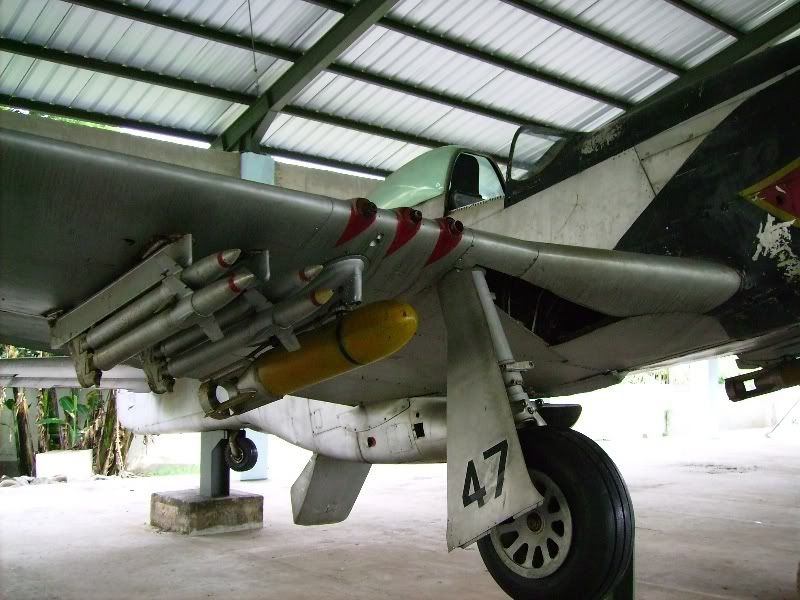
.
By: melchin - 8th November 2006 at 02:09
Oerlikon 80mm rocket
i was wondering if you could post the image of that Oerlikon rocket. i’m doing research for a film set in 1973. apparently a sura 80mm rocket was used in the attack in santiago, chile and i am looking for a pix of that type of weapon.
tahnks, melchin
By: jackehammond - 14th July 2006 at 07:28
Hello,
I am looking for pictures and specifications that show actual dispersion of rockets (especially different warheads, sizes and conditions like wind and launch range).For some reason there are almost no pictures of rockets actually impacting (instead of just being fired).
Does anyone know of online pictures showing dispersion or impacts?
Does anyone have good references?Thank you
Dear Member,
I have the photos of the Oerlikon 80mm with the fins that slide down the body on launch.
I know a USN pilot who is retired who studied the subject during the Vietnam War and after and basically fold-fin rockets are innaccurate and have a wide dispersion. The reason all the fins do not fold out evenly or at all. The Canadians worked on this problem with the CVR-7 by having some spin to force them out and a shear pin that lets them be spring loaded.
With fixed fin they are more accurate (eg the 80mm Oerlikon). But you can have problems there. During the 1967 War the Israelis learned that the French fixed fin rockets were not as accurate because the fins were not solid enough were the US 5 inch HVAR was extremely accurate because of its extremely stiff fins.
Jack E. Hammond


 Sign In








 July 13, 2006 at 8:22 pm