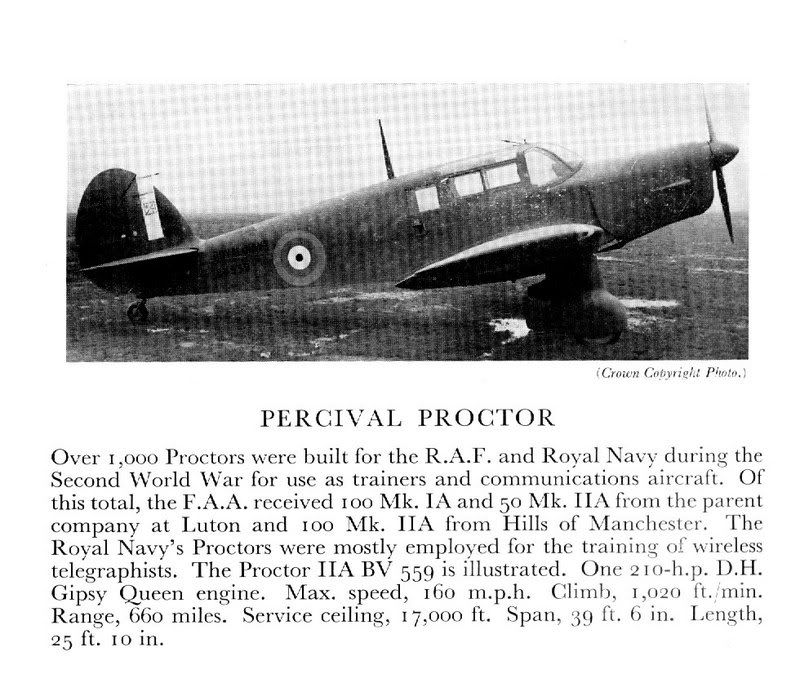
I am trying to find an unusual British military scheme for a Percival Proctor and was wondering if anyone can help? I know the Royal Navy used them and have found this photo, but I have no idea what colour it was or serial?
Does anyone know or have any photos of Royal Navy Proctors or even of RAF machines that are not silver overall or camouflaged? Apparently there was an RAF Air Commodore that had one for his personal use painted ‘pale metallic blue’ overall, but I can find no photo. Over to you?

By: Dustyone - 8th May 2007 at 10:47
RN Ptoctors
I am trying to find an unusual British military scheme for a Percival Proctor and was wondering if anyone can help? I know the Royal Navy used them and have found this photo, but I have no idea what colour it was or serial?
Does anyone know or have any photos of Royal Navy Proctors or even of RAF machines that are not silver overall or camouflaged? Apparently there was an RAF Air Commodore that had one for his personal use painted ‘pale metallic blue’ overall, but I can find no photo. Over to you?
****** Air Vice-Marshal Sir Ralph Sorley had a Mk 1V as his personal ‘Hack’, I’m not sure what colour it was though, or where it was based.
Dustyone
By: Dustyone - 8th May 2007 at 10:15
Proctor Mk 1V
Clearly the heading picture is fitted with a light carrier of some type. Where did the suggestion 500lb bombs and France come from? I would think the heaviest load would be anti-personel bombs or perhaps Sea Markers or Smoke bombs for training purposes rather than an attempt to sink the Bismark 🙂
John
******* The ‘bomb’ (or whatever you think it is), is clearly visable on one side of the underslung rack, the ‘500lb bomb to France’ was just a figure of speach to prove how futile such plans were.
The plans to arm light A/C with bombs were made prior to the fall of France in 1940, & the threat of invasion in Southern England increased, if you need an exact example, A/C such as Tiger Moth (EM 836) were adapted carry 8 + 20 lb bombs under the rear cockpit — they would’nt knock the paint off of the Bismark, but if they arrived at their target, would have given a few Germans some headaches !!! The Proctor in the heading pic. is clearly a Mk 1V which at that time was nowhere near ready to come into service, let alone be fitted with racks of any kind. for whaterever ‘hostile’ purpose, —-by the time the Mk1V came ‘on the scene’ there were far better types to carry out such duties.
By: TEXANTOMCAT - 8th May 2007 at 09:45
Imagine it would have been at least one Light Series Carrier – they fitted them to Tiger Moths in 1940 so why not Proctors?
We have an ex-TM one in the Museum,
TT
By: Dustyone - 8th May 2007 at 09:20
RN Ptoctors
Very interesting Dustyone! I assumed from the b/w photos they were in RAF camouflage of dk earth/dk green with yellow undersides, but the colours you describe make more sense. Can you confirm the undersides as ‘duck egg blue’, rather than duck egg green (alias ‘Sky type S’) and do you, or anyone have any photos?
*********It’s all a very long time ago Albatross, & sadly I cannot recall the exact shade of ‘Sky Blue’,— as I recall the ‘SKY’ would be my first choice,– but the scheme was that carried by Fleet Air Arm A/C during WW11 —- The top surfaces were not Dk Earth & Green, but Battleship Grey & Green, —Oh how I wish we were allowed to take pics. & keep records, but this was forbidden during the war years.
Dustyone
By: John Aeroclub - 5th May 2007 at 09:47
Light Stores Carriers
I work on Mk 1Vs in 1944, & never saw any ref. on the drawings for modifications to fit bomb racks, — in 1943 the allied air forces were overflowing with bomber A/C. of all shapes, & sizes, capable of carrying large bomb loads, so what would be the point of adapting a tiny little Proctor 1V to carry a 500lb bomb, — with a bomb that size what purpose would it have served ?— it would be very lucky if it reached the French coast.
Some Light training A/C (prior to the Mk 1V.), were provisionally fitted with racks when the threat of invasion hung over Britain prior to ‘The Battle of Britain’, (1940) but the idea was soon put aside as the invasion threat passed, — the Proto-type Mk 1V (LA 589) flew (long after the threat had passed), in 1942/3. & came into service some afterwards.Dustyone
Clearly the heading picture is fitted with a light carrier of some type. Where did the suggestion 500lb bombs and France come from? I would think the heaviest load would be anti-personel bombs or perhaps Sea Markers or Smoke bombs for training purposes rather than an attempt to sink the Bismark 🙂
John
By: DaveF68 - 5th May 2007 at 00:54
Very interesting Dustyone! I assumed from the b/w photos they were in RAF camouflage of dk earth/dk green with yellow undersides, but the colours you describe make more sense. Can you confirm the undersides as ‘duck egg blue’, rather than duck egg green (alias ‘Sky type S’) and do you, or anyone have any photos?
The colour shot above is in that scheme (Temperate Sea Scheme)
Admiralty Orders in 1942(ish) stated that FAA Comms types had to be painted thus (or with yellow undersides) – superceding AMOs which said Green/Earth
By: ALBERT ROSS - 4th May 2007 at 22:29
I worked on a couple of wartime R N Proctors both of which were in the Navy scheme of dark Grey & Green, Duck egg Blue underside, ROYAL NAVY was in black at the rear of fuselage, as was the A/C serial —
Dustyone
Very interesting Dustyone! I assumed from the b/w photos they were in RAF camouflage of dk earth/dk green with yellow undersides, but the colours you describe make more sense. Can you confirm the undersides as ‘duck egg blue’, rather than duck egg green (alias ‘Sky type S’) and do you, or anyone have any photos?
By: Dustyone - 4th May 2007 at 17:53
Proctor bomb racks
I work on Mk 1Vs in 1944, & never saw any ref. on the drawings for modifications to fit bomb racks, — in 1943 the allied air forces were overflowing with bomber A/C. of all shapes, & sizes, capable of carrying large bomb loads, so what would be the point of adapting a tiny little Proctor 1V to carry a 500lb bomb, — with a bomb that size what purpose would it have served ?— it would be very lucky if it reached the French coast.
Some Light training A/C (prior to the Mk 1V.), were provisionally fitted with racks when the threat of invasion hung over Britain prior to ‘The Battle of Britain’, (1940) but the idea was soon put aside as the invasion threat passed, — the Proto-type Mk 1V (LA 589) flew (long after the threat had passed), in 1942/3. & came into service some afterwards.
Dustyone
By: TEXANTOMCAT - 4th May 2007 at 16:34
Thats a jolly good idea- Middle East colours would be rather nice esp. as there is a Jimmy Hill spit buzzing about…. Mark V’s your man….
IIRC Proctors were used as Comms aircraft out of Cairo, will consult books….
TT
By: John Aeroclub - 4th May 2007 at 16:15
Again I suggest the heading photo is one of the prototype Mk IV’s fitted with a test bomb rack. Another clue is in the caption, it calls it the T9/41 which is the spec for the original Mk IV design. The Proctor 1 was T20/38.
It is possibly LA586 or LA589, one of the two Mk.IV prototypes and the reference to Royal Navy being nothing more that they were one of the sponsors to the Spec for the MkIV.
John
By: Dustyone - 4th May 2007 at 13:48
R N Proctors
I worked on a couple of wartime R N Proctors both of which were in the Navy scheme of dark Grey & Green, Duck egg Blue underside, ROYAL NAVY was in black at the rear of fuselage, as was the A/C serial — they were adapted to carry life rafts in the centre section, & use mainly for communications, I think that the RN had about 19 of them.
These A/C were the early Mks up to the Mk1V, but I never saw one of the latter in RN wartime colours, — the ‘official picture’ is strange as bomb racks appear to be fitted, & she appears to have polished cowlings & spats, not at all like any Proctors that would have served in WW11.
In 1940 a few early Mks were fitted with bomb racks without much success, I have never heard of any Mk!vs been given the same odification,therefore , to see a picture of a Mk 1V.(which did’nt enter service until about 1943), leads me to believe that this picture is not of WW 11 origin.
Dustyone
By: DaveF68 - 2nd April 2007 at 00:33
Not quite a Proctor, but there was also a Vega Gull used in the Middle East in Coastal Command colours, predominantely white.
By: CSheppardholedi - 1st April 2007 at 17:35
Here are a few links to Proctors color pics
Camo
http://www.demobbed.org.uk/images/lz766.jpg
http://www.demobbed.org.uk/images/np184.jpg
http://www.demobbed.org.uk/images/z7197.jpg
Yellow
http://www.demobbed.org.uk/images/np171.jpg
Red/silver
By: ALBERT ROSS - 1st April 2007 at 17:33
Thanks very much G-ORDY, I had already spotted that one and think it’s the same scheme as the colour photo. The real challenge would be to find a photo of this RAF Air Commodore’s ‘pale metallic blue’ Proctor, or at least pin-point a serial?
By: G-ORDY - 1st April 2007 at 17:12
There’s a picture of an RN Proctor IIA (BV559) in the Putnum book on British Naval Aircraft. Colour scheme COULD be Temparate Sea Scheme over yellow.
Similarly in Air Britain Squadrons of the Fleet Air Armhas Z7246 (mk II) of 754 Squadron and a mk IIa of 752 Squadron
Putnam scan …
By: DaveF68 - 30th March 2007 at 12:42
There’s a picture of an RN Proctor IIA (BV559) in the Putnum book on British Naval Aircraft. Colour scheme COULD be Temparate Sea Scheme over yellow.
Similarly in Air Britain Squadrons of the Fleet Air Armhas Z7246 (mk II) of 754 Squadron and a mk IIa of 752 Squadron
By: John Aeroclub - 29th March 2007 at 18:14
That may be orthochrome film in which case the dark areas are actually trainer yellow. Pre-war Magisters were in a similar yellow/aluminium finish. Equally if the areas are red primer then orthochrome would also render them dark.
I suspect you’ll have to find other pics.
The propeller tip (Yellow) is different.
John
By: ALBERT ROSS - 29th March 2007 at 07:38
This is probably not what Albert is seeking, but it might be of interest. This is G-AHMP in a field close to Exeter Airport, back in 1968.
James, that’s amazing – yes one of the options. Thanks for that. Now does anyone have a photo of this RAF Air Commodore’s ‘pale metallic blue’ Proctor?
I am providing options to the owner of a real Proctor being restored.
By: James2403 - 28th March 2007 at 23:52
Did any Proctors appear in camouflage with civil registrations?
This is probably not what Albert is seeking, but it might be of interest. This is G-AHMP in a field close to Exeter Airport, back in 1968.

By: ALBERT ROSS - 28th March 2007 at 22:57
I would suggest that the photo shows the aircraft in a red primer un-painted state. Some of the metal work on the Stbd side has a different finish. In fact I would go as far as saying that probably is the prototype Mk IV.
John
Two others have suggested this and I’m inclined to agree. Thanks John (PS why aren’t you getting on with the Fairey IIIF kit?)


 Sign In








 March 27, 2007 at 10:02 pm