Experiment in design by committee where we, the forumists here, are the committee.
The MOD/Royal Navy has a history of designing warships in a politically complex environment where cutting corners for cost reasons is the name of the game. The results are manually winched Sea-Dart launchers, no CIWS on the Type-23, no main gun on the Type-22 etc. Now each of these specific examples can be analysed in a million other threads, but the resulting widely held view is that MOD committees tend to design slightly disappointing designs.
Would the knowledgeable forumists here do any better?
Specification statement: The RN is building two new large carriers. These will have only limited self-defence capability. They will be defended by Type-45 AAW destroyers and Type-23 ASW frigates, but there are only 6-8 Type-45s being built and a follow-on class is required.
As you may have noticed I’m a visual guy who likes top draw pictures to discuss or illustrate points, and conduct “what if” design concepts. Normally the designs are 100% my own, but for this the key characteristics of the design will be driven by voting on Polls on this forum.
A selection of threads will appear to discuss and vote on key elements:
– the role profile (relative bias between AAW, ABM, ASW, ASuW and land attack)
– hull form choices
– sensor choices
– AAW weapons choices
– ASW fit choices
– CIWS choices
– etc
etc

By: Wanshan - 23rd August 2008 at 15:05
I can see a few probs with this, notably that it makes rear-access boat ramps a bit of a hot experience. Also I wonder if it transfers more engine noise into the water.
Not sure that the exhaust is IN the water (below waterline)

By: planeman6000 - 23rd August 2008 at 14:50
Its about the silliest concept I’ve ever heard of I’m afraid.
I think you might be exaggerating a little bit there mate, believe me I’m capable of sillier 😉
Steam turbines are pretty common on warships for many years, but I hear your concerns. I thing COGAS is more for increasing efficiency and reducing heat signature than boost power for obvious reasons. Wiki diagram of COGAS:
But, your argument is compelling re the trouble-benefit ratio of adding steam turbines to the mix. The question would be, if I’m going to install an exhaust heat exchanger to reduce signiture, why not go that extra step and run a turbine off the water?
What I am also interested in though is heat signature reduction. Conventional funnels just ain’t going to be very stealthy no matter what you do.
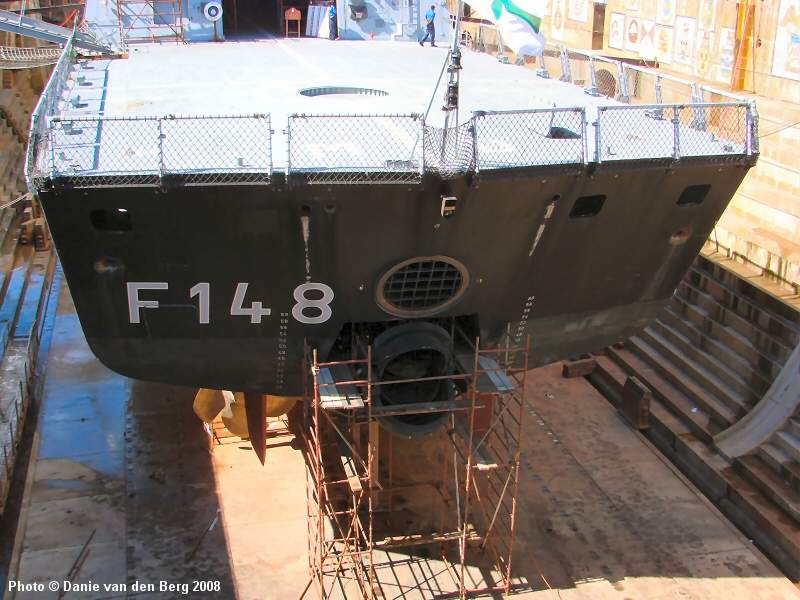
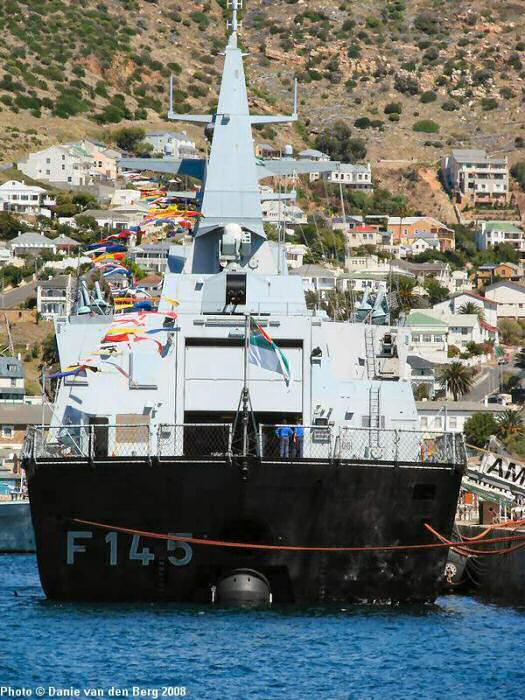
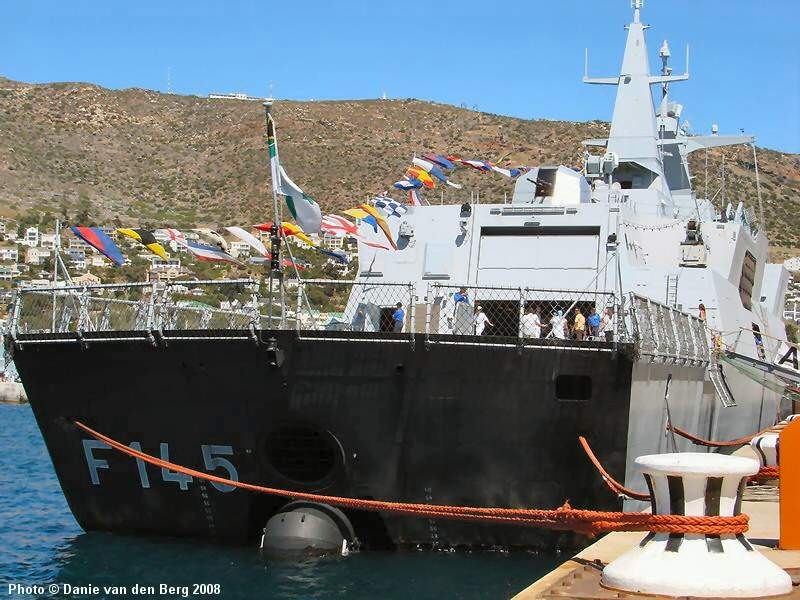
The Valour Class vent the exhausts below the water line which apparently reduces heat signature by 75%.
CODAG WARP; 1 GE LM 2500 gas turbine 26,820 hp (m) (20 MW); 2 MTU 16V 1163 TB93 diesels 16,102 hp(m) (11.84 MW; 2 shafts; acbLIPS cp props; 1 acbLIPS LJ2 10E waterjet (centreline)
Imagine that exhaust but with an all-electric drive.
I can see a few probs with this, notably that it makes rear-access boat ramps a bit of a hot experience. Also I wonder if it transfers more engine noise into the water.
By: StevoJH - 23rd August 2008 at 08:09
You mean like the excessive 181 crew of the Type-23s which have 4 diesels, two electic motors and two gas turbines and conventional gearboxes?
Sure, because you are adding a 4th gerator type, a generator type that would probably require more crew to maintain then the others put together. 😉
By: planeman6000 - 23rd August 2008 at 05:03
Ok, re re-prioritisation. A draw between ASW and up-sizing to 10,000 tons so I’ve made an executive decision to go for the up-sizing because it’ll give more options and kit to make the exercise more interesting. More reasons explained in that thread.

Also, the SAM thread seems to have drawn to a natural close with a straight draw between Aster and ESSM/SM-2. I think we can just leave the AAD fit open to tender and the whims of the “designers” (YOU LOT!!!) in the next round of proposals. For the record:
By: Jonesy - 22nd August 2008 at 18:23
re propulsion, so running steam boilers off the GT exhaust is generally a good idea?
Its about the silliest concept I’ve ever heard of I’m afraid. High pressure steam is a very unpleasant thing to have on a ship. Its very corrosive and requires intimate maintenance lest something containing it let go. High pressure steam fittings never let go in a little, modest, fashion….they go bang…loudly and can hurt people!. When you have no alternative steam is a necessary evil…its a very powerful propulsion technology and, for bigger vessels, could still be considered viable, but, if you had another option you really would take it.
In the model you have it looks like the steam turbine would be included as a form of free ‘boost’ capability. The problem with that is steam plants need time to build up a steam head to turn the turbine. If your boost capability isnt at pressure when you need it the ramifications could be quite unfortunate.
GT prime movers with nice, reliable, economical aux diesels coupled to genny sets and IEP propulsion is as good as it gets for now. The stats from T45 are very stark in this regard – 40% more range than T42 on the same fuel burn on a hull twice the displacement!. Good enough for government work!.
By: perfectgeneral - 22nd August 2008 at 12:18
Two MT30 and two diesels (one 4MW for hotel and loiter plus one 8MW for cruise – about 21+ knots) should be more than enough power for a fast destroyer that can keep up with nuclear submarines. While the pods don’t need to be azimuthal, they still bring a more efficient hull shape to the show than water jets alone. Four next generation electric motors could be 2x 20MW pods plus another 2x 20MW and whatever the steam turbine supplies for the water jets. Even 8000t powered by that is going to shift up to 35 knots. Unless you design for high speed you won’t get the most out of the water jets. Even a range of GTs are going to be less efficient than diesels for routine power.
By: planeman6000 - 22nd August 2008 at 04:37
You mean like the excessive 181 crew of the Type-23s which have 4 diesels, two electic motors and two gas turbines and conventional gearboxes?
By: StevoJH - 22nd August 2008 at 03:39
re propulsion, so running steam boilers off the GT exhaust is generally a good idea?
Also, what about carrying submarine style batteries for “silient running”?
How many crew are you planning on this thing having? every new engine and new engine types means more technicians and different training. 😉
By: planeman6000 - 22nd August 2008 at 02:20
re propulsion, so running steam boilers off the GT exhaust is generally a good idea?
Also, what about carrying submarine style batteries for “silient running”?
By: StevoJH - 21st August 2008 at 13:55
40 cells, & AFAIK no room for more. According to publicly quoted figures, range less than 60% of a Type 45. That’s what happens when you try to put more into a smaller hull.
I still think the cheapest way would be to modify the area under the flight deck of the T45 to fit a TAS, modify the hanger/boat deck to fit 2 merlins, remove the long range radar and make any modifications needed to the propulsion system for quieter operation.
You could build them in the same yards as the T45’s following on from the launching of the last T45’s. Since it is essentially the same ship with the removal of some expensive items such as the long range radar you can take advantage of the experience the workforce has from constructing the T45 to get the ships cheaper. Would also mean a fleet of almost identical system with largely similar layout and machinery. That can’t hurt training and logistics.
By: swerve - 21st August 2008 at 10:43
It was the LCF I was loosely referring to with the ‘nothing magic’ comment. With cells split off for TLAM, ABM’s and quadpack ESSM the amount left for AAW is sorely limited for anything over a modest threat level environment. Plus the range of the Zeven Provs is wholly ineadequate for RN needs
40 cells, & AFAIK no room for more. According to publicly quoted figures, range less than 60% of a Type 45. That’s what happens when you try to put more into a smaller hull.
By: Distiller - 21st August 2008 at 06:10
That’s the way to go:
http://www.rolls-royce.com/marine/downloads/propulsion/advwj_fact.pdf
Combined with one of these:
http://www.amsc.com/products/motorsgenerators/documents/USN%20AMSC-NG_HTS_BRO_1106%20FINAL.pdf
No more long shafts, far less compromises in placing the propulsors, quieter, more efficient at speed, more maneuverable. Btw, you don’t need azipods when you can do it with water jets; also lateral for snappy maneuvers, and also good for low-speed maneuverability. And finally you can take advantage of the decoupling of power generation and propulsors – you can go distributed for survivability, or place them vertically to save section length, you can go for three or five smaller turbines instead of two big ones, &c.
A word on the Type 45’s WR-21: Nice, but already obsolete; at least it doesn’t take advantage of the state-of-technology. Positive about the heat exchanger is signature reduction. Negative the volume and maintainance aspect. Main reason for that arrangement is to increase efficiency at cruising speed. The same could be done by using three (or more) smaller GTs, which could be run according to needs.
Also not to forget the hotel/system-load auxiliary generators. Don’t go for diesels here, take three of four smaller GTs. One should be capable of feeding all hotel-loads, then scale up to feed everything except propulsion. Produces enough energy to drive the ship in harbor and during docking, when the combat systems are down. Can also be used to drastically reduce the signature in combat situations.
By: planeman6000 - 21st August 2008 at 04:09
I know next to nothing about marine propulsion, but surfing Wikipedia there are a few neat ideas out there. All-Electric transmission seems to be a trend with RN leading the way, at least for the moment. Another neat idea is a steam turbine running off the hot exhaust of the gas turbine(s).
Waterjets are good for boost propulsion because they have less drag when idling.

Type-45’s all-electric drive still has shafts:
Thoughts?
By: perfectgeneral - 18th August 2008 at 01:20
Stop!
What kind of committee tries to design the ship themselves?
I expected this to go out to tender based on a loose spec and design requirements in terms of capability.
It is expected that this can be implemented in an off the shelf type 45 hull design modified to meet the spec within the same volume.
After an initial order for one, first of class, 2-3 follow up 3/4 ship batch orders depend on meeting deadlines and agreement on costs. Although there is a requirement for at least six ships and perhaps as many as 12, initial order only ensures the first of class will be built. Further contracts are negotiable.
By: Distiller - 15th August 2008 at 08:46
#1 — No way to place the CIWS gun low on the bow. Seriously increases min engagement range, can’t shoot it in heavy weather.
Too many SSDS elements concentrated aft.
Superstructure is too short for bridge/sensor/navcom, GT intake/exhausts and hangar.
#2 — No way to squeeze everything into a single ship. Gotta go for seperate versions for ASW and AAW/BMD, a 1.5-ender, as I said before.
By: StevoJH - 15th August 2008 at 06:39
CIWS on the foredeck where you located it is a no go, they tried it on one of the T42B3’s but it got to wet (and that was back further between the gun and missile launcher). The Rear CIWS is surplus to requirements as it doesnt have the same arc of fire as the hanger mounted one. The VLS cells mounted there can go with the other ones on either side of the hanger, though personally i’d rather have a hanger capable of carrying two helicopters rather then one instead.
Also, gun in front of the VLS cells please.
By: Jonesy - 15th August 2008 at 04:23
The better example perhaps is the Dutch Zeven Provincien class. 6000 tons with ABM, AAW potential for TLAM. again only one helicopter but 1000 tons under specs.
It was the LCF I was loosely referring to with the ‘nothing magic’ comment. With cells split off for TLAM, ABM’s and quadpack ESSM the amount left for AAW is sorely limited for anything over a modest threat level environment. Plus the range of the Zeven Provs is wholly ineadequate for RN needs, plus, as you indicate the ASW is nowhere near what we’d need!. 1000tons displacement isnt going to do much to change that.
Matt,
Indeed. The old witicism about an elephant being a horse as designed by commitee is well known. Seeing the big gray horse’s specs being laid down as a live process I never expected to see!.:D
By: mobryan - 15th August 2008 at 04:04
All this reminds me of the famous quote about commitees:
“The only life form to have 10 stomachs and no brains…..”
😉
Matt (a willing participant in the madness…)
By: planeman6000 - 15th August 2008 at 03:21
The better example perhaps is the Dutch Zeven Provincien class. 6000 tons with ABM, AAW potential for TLAM. again only one helicopter but 1000 tons under specs.
By: Jonesy - 15th August 2008 at 03:17
The KDX-II is a very poor example I’m afraid PM. It is a textbook example of a design that ‘looks’ more multirole than it actually is.
It does a little bit of, low-volume, area air defence…lacking the sensor fit for any better capability or ABM….which would add topweight. It has a modest land attack capability and inadequate ASW provision for the kind of escort the RN would need. Information on the vessels range seems difficult to come by, but, going by the KDX-III it doesnt look to be any great shakes. Even stretching this vessel by 1500tons in displacement is not going to address these horrible compromises.
Talking of KDX-III that is the design you need to be looking at for your baseline. That can do comprehensive area air defence plus ATBM. 128 VLS cells means an appreciable volume of LACM can be embarked sufficient to actually achieve something and it manages a towed array even if its aviation dept is, again, wholly inadequate to RN ASW requirement. That is a 10k ton hull full load and it can only manage 5500nm range!.
There’s little magical about getting a 7k ton hull to mount a 64 VLS cells, a competent MFR/VSR combination, and even a couple of light choppers in the aviation department. Getting that with the range to stay with the Darings it’ll be teamed with….circa 7500nm….isnt going to be so easy.
So, basically, your committee’s requirement is presently for a KDX-III level of sensors and firepower, with T45’s range and economy, plus an enhanced aviation department all on a hull 3000tons lower in displacement than the KDX-III. Good game, good game!.


 Sign In








 August 3, 2008 at 7:38 pm