How many targets can a sea sparrow launcher target at the same time ?
Are they effective against mass air attacks ?
E.g an average 80s destroyer has 2 sea sparrow launcher, can they take out an entire squadron of attacking aircraft armed with PGM ( assume the aircraft is a 80s VVS or AVMF su24 or mig27)

By: Jinan - 19th December 2016 at 23:23
How many targets can a sea sparrow launcher target at the same time ?
Are they effective against mass air attacks ?
E.g an average 80s destroyer has 2 sea sparrow launcher, can they take out an entire squadron of attacking aircraft armed with PGM ( assume the aircraft is a 80s VVS or AVMF su24 or mig27)
a LAUNCHER doesn’t target anything, you need to look at the fire control system: how many illuminators and are these necessarily continuously illuminating targets? In the Dutch navy, there typically were 3-4 channels (2 big Stir 2.4, sometimes plus 1 smaller STIR 1.8, and CAS/WM-25 dome).
Sea Sparrow has been fired from at least three different launchers: a modified ASROC launcher, the Mk29 GWLS and vertical launch (Mk48).
See e.g. https://en.wikipedia.org/wiki/Mark_92_Guided_Missile_Fire_Control_System
This is on the Perry class (SM1) but the principle is the same as SM1 is semi active radar homing too.
By: MadRat - 11th December 2016 at 19:17
The original question here was talking about targeting aircraft in tight formation. I feel like this conversation has become forked by multiple ADHD sycophants. People are confusing what the differences are between search, track, targeting, and illumination. Mercurius asked a question just to make sure I was claiming what I was thinking. The rest seem to be either pitiful attempts to debate nonsense or in jest without humor.
By: Distiller - 11th December 2016 at 15:29
Actually Xena’s remarks are spot on. Before larger screens and especially somewhat capable digital signal processing (at some point in the 1980’s) there was no realistic way for a system operator (i.e. pilot or shipboard operator) to utilize SARH missiles against multiple targets simultaneously. There was a reason why heavy fighters had RIOs. Against longer range targets the CW return against a formation was (and to a good degree still is) just a single blob – that’s why close formation flying was popular. And the track-while-scan and lock/illuminate logical was based on certain assumptions, like that the target does not change speed and vector too radical too fast (if it did the next “track” didn’t look at the expected location and no track happened – the lock was broken and it was back to scan). And that problem became much worse if the radar platform itself maneuvered and the angle between tracked returns became wider. With lighter and faster antennas and more powerful computers that problem became less, but only AESA really solved it. And for shipboard operations it was and still is all timing. The old systems only had a chance when they knew precisely where the anti-ship missile would come from – classical scripted excercise scenario. With only a few ten seconds max between poping up on the search radar, establishing a track amongst the heavily cluttered radar returns, have the operator confirm it really is an incoming missile (don’t want to use automatic even if available as it might shoot at friendlies or that random wave formation), activating the missile (charging batteries, spooling up giros, etc), handing over data from search to fire control (perhaps even manually still!) and firing the missile it would have been too late. As said above somewhere, there was a reason they slaved the fire control radar to optical seekers. But try an optical seeker in crappy weather or at night … The only consolation would have been that the incoming missile’s seeker also had a hard time to find and home on that ship in higher sea states with the target popping around and waves giving fake returns. Much of the Cold War stuff was big boy’s gadets and wishful thinking, and in the end not terribly important, since everyone knew that a major power confrontation would have been nuclear from the first moment on.
By: MadRat - 11th December 2016 at 12:57
The displays have nothing to do with track while scan. Your question is a garbled conjecture. I’m not sure you really understand the concept of TWS because you seem to believe it’s something it’s not.
By: xena - 11th December 2016 at 05:19
We should stay on aircrafts. Your point was that they could track dozens of targets. That’s not true. The track while scan in the 50ies and 60ies was by eyeball V1.0. TWS makes sense only with synthetic displays to show the comprehensive processed data. This kind of displays was available from the 70ies onwards. With the crude radar displays of the 50ies and 60ies there was no chance to display the data of multiple tracks and other targets together in one small display on aircrafts. It was the operator that had to discriminate from the picture the most dangerous target. And then it was his task to track this one target. The first aircraft with synthetic displays was IMHO the F-14. Please give some source for your claim!
By: MadRat - 9th December 2016 at 11:56
The navy keeps their capabilities under a pretty tight lock and key, too. Even a setup on a frigate can make the entire weapons systems of a bleeding edge fighter look silly in comparison due to much less constraints in physical size. And with frequent ship overhauls on their weapons systems, there is no perfect way to know the limits of one ship to the next. These ships have gone through constant upgrades that really don’t seem to freeze until retirement. If fighter-sized systems were so bleeding edge then ships would mount 4-6 of them around their perimeter of destroyers rather than SPY/SPG.
By: garryA - 9th December 2016 at 08:36
Facepalm!
Mad RAT : you are mismatching TWO different things, one is the search radar, whose function is to scan a large portion of air space and the SARH terminal guidance for missiles
On fighter the search/track/targeting radar is the same one , but operating in different mode usually differ in PRF and beam width.
In case of semiactive one missile have a forward receive only antenna that point the missile itself toward a target being illuminated by a CW radio source This is usually done utilizing a separate device called track radar as it need to use a narrow CW beam instead of a wide pulsating one like in the case of the search radar.
On ship search radar is the one with fan shaped beam such as AN/SPS-67
track/fire control radar is the very high power/ narrow beam width one such as SPY-1 ( and it can took on volume search role as well due to very high scan rate)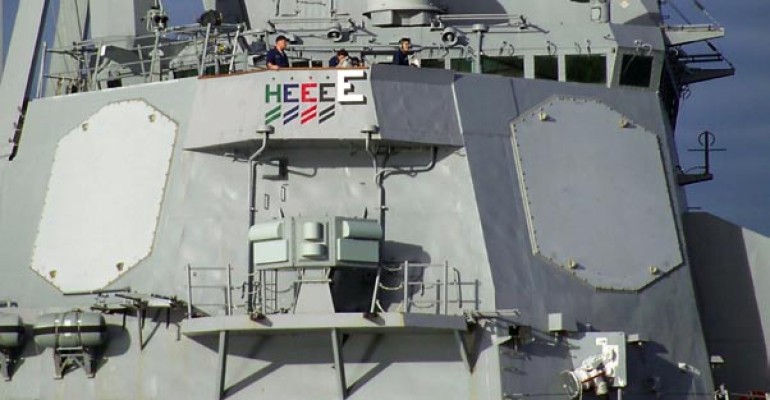
The CW illuminator is another seperate one such as AN/SPG-62 they have even narrower beamwidth than the main fire control radar but their power is much lower
The track radar and the CW illuminator are not the same one..
By: Marcellogo - 9th December 2016 at 06:30
Prove it. Because track while scan technology has been around since 1951. It’s not a new technology.
Facepalm!
Mad RAT : you are mismatching TWO different things, one is the search radar, whose function is to scan a large portion of air space and the SARH terminal guidance for missiles.
In the first case you can locate several traces with your scanning and with track while scan function follow a number of them in their course, obtaining the data concerning their own spatial location, distance and angle with 2D radar, quote also with 3D ones and by comparing a succession of such data through time also velocity.
Numbers of object respectively spotted, recognized (that’s another great problem of automated antimissile systems…) and tracked differs, sometimes also greatly as radar systems obtain their own data not immediately but through time.
In any case ater the search radar has done its own part still remain that little problem of taking the tracked object down by forcible means, planes use by preference missiles with IR and above all radar homing guidance both semiactive than active.
In case of semiactive one missile have a forward receive only antenna that point the missile itself toward a target being illuminated by a CW radio source.
This is usually done utilizing a separate device called track radar as it need to use a narrow CW beam instead of a wide pulsating one like in the case of the search radar.
So, usually you would need one of such devices for every target you intend to illuminate regardless by the numbers of track your SEARCH radar can get.
Even the AEGIS system need such devices for the terminal phase of the engagement when using SARH missiles, so in case of sea skimming missiles, that have the damning habit to pop up of a sudden well inside the space in which this phase happen have a reduced utility on that regard (also because its own radar horizon is quite low…)
By: MadRat - 9th December 2016 at 03:52
Prove it. Because track while scan technology has been around since 1951. It’s not a new technology.
By: xena - 9th December 2016 at 01:44
The missiles of that time were IMHO not able to defeat incoming missiles. The only one developed to do it was Sea Wolf. IMHO Sea Sparrow had no chance to destroy a Russian missile.
MadRat. The Fighter of the 70ies/80ies could track some targets but attack/illuminate only one at a time. F/A-18A could track 10 targets, for F-15A/C have no data, but I am sure it could track less than F-18 because it was older and F-14 could track 6 targets. Far away from the dozens. F-14 was the only one able to attack up to six targets but with Phoenix only, not with Sparrow, the main BVR weapon of that time. But Phoenix was an expensive weapon and was only allowed to be used against heavy bombers and it was not agile enough to be used against fighters.
By: MadRat - 9th December 2016 at 00:10
Can you cite an aircraft/radar combo that could do this?
You are the resident guru for this kind of information. I’m pretty sure both F-14A and F-15A had the digital registers to simultaneously track two dozen targets and the former was supposed to target 6-8 targets dependent on some factors. Surely ships in the same timeframe had less physical constraints than an airborne system.
By: garryA - 8th December 2016 at 21:12
Let me say you seriously underestimate how it was difficult to track such targets until recently: they would had to be detected by the 2D surface scan radar (not the 3D AD one) as soon as the entered in the radar horizont
The only reason the fan beam (2D) radar was used for early warning instead of fire control radar was because its wide beam width will cover the volume at quicker rate , but that does not mean target have to be detected by search radar before FCR. Moreover, it was very hard to steer a high gain FCR at high rate because they need to have big aperture, however with the invention of electronic scanned array that has been solved.
To just recognize and track it you would have needed several radar scans
Which is done very quick at short range with any ESA
begin CW illumination and wait until the missile you launched reach it to detonate charge
That is without ICWI , but with that technology , SPY-1 can provide mid course update
all of this in the heaviest clutter environment possible, as sea surface reflect radio waves
Sea surface reflect radar wave but they are relatively stationary , missiles moving quite fast so the Doppler shift will be very different
By: nastle - 8th December 2016 at 19:37
Makes sense , there has been no major fleet engagement involving a huge air sea battle since 70s closest we get is the Arab Israeli wars and that involved all small craft and one sided use in the Falklands.
Was this CIWS vs sea skimmers ever used for military simulation ?or is this classified
By: Marcellogo - 8th December 2016 at 18:23
PRF setting at close engagement like that would be ridiculously high so i dont think it takes more than micro seconds to change from detection to tracking.Moreover, once missiles is launched the engagement already started.
Let me say you seriously underestimate how it was difficult to track such targets until recently: they would had to be detected by the 2D surface scan radar (not the 3D AD one) as soon as the entered in the radar horizont.
To just recognize and track it you would have needed several radar scans, after it you would have needed to pass it to the tracking radar, repeat procedure, begin CW illumination and wait until the missile you launched reach it to detonate charge, all of this in the heaviest clutter environment possible, as sea surface reflect radio waves.
Most of dedicated antimissile systems used and still use optical devices to track missiles and command guidance/beam riding instead of RH for just this reason, you know.
By: garryA - 8th December 2016 at 17:38
It would probably detected at such a distance, tracking would require some second and some other would be needed for the missile to be launched and reach the target
PRF setting at close engagement like that would be ridiculously high so i dont think it takes more than micro seconds to change from detection to tracking.Moreover, once missiles is launched the engagement already started.
By: Marcellogo - 8th December 2016 at 16:49
We actually doesn’t know much about effectiveness of the most of such systems, unfortunately.
Actually, antiship missiles were used just an handful of times and not anytime against Soviet/ Russian ships greater than a corvette.
Same could be said against Italian, that also featured an integrated multilayer system or against any ship using the RAM system.
So actually the great part of antimissile/CIWS weapons are still never challenged and also the other were so scarcely that one couldn’t get a statistic from them.
By: nastle - 8th December 2016 at 16:13
Was there more benefit against antiship missiles in using the layered system of defences as the Kara and udaloy classes did ?
By: nastle - 8th December 2016 at 16:09
How effective was the CIWS and gatling guns mounted on soviet ships against sea skimmers like Harpoon ?
By: Mercurius - 8th December 2016 at 13:18
And aircraft fielded in the 70’s could illuminate a half dozen targets supersonic or otherwise, AND track while scanning with the same unit.
Can you cite an aircraft/radar combo that could do this?
By: MadRat - 8th December 2016 at 11:42
I guess when we are talking 80’s people keep exercising their selective memories. Illuminators in the 80’s were fielded in the 70’s and were far more capable than the initial designs from the 50’s and 60’s. Ships were getting overhauls on their weapon system parts practically every five years. Sometimes even more often. And we are talking a large mechanical mechanism not as restricted in capability to that mounted on aircraft. And aircraft fielded in the 70’s could illuminate a half dozen targets supersonic or otherwise, AND track while scanning with the same unit. But (zOMG!) one missile per shipped launched missile was the limit. Poppycock.


 Sign In








 December 2, 2016 at 6:12 pm