Generally, float was used as a flotage to small seaplane, but for flying boat, the aeroframe IS a float, which usually was used on bigger seaplane.
Here is a curious question for enthusiasts:
Which was the smallest flying boat, and which was the biggest float plane ever appeared?
As I known, the Hansa-Brandenberg C.C. was the one for previous and He-115 was the one for after. What do you think?

By: pagen01 - 18th February 2009 at 15:50
Well said James, you can’t beat the CANT!
By: JDK - 18th February 2009 at 11:52
As my teachers used to say, if you aren’t answering the question, you get no points. 😉
It’s all good fun, but the question of largest floatplane and smallest flying boat is an interestingly different one to ‘the usual’, so worth being specific with, IMHO.
By: WP840 - 18th February 2009 at 11:18
Biggest….how about the Saunders Roe Princess? Bigger than Spruce Goose IIRC. And it flew properly.
The Princess had a maximum take off weight of 345,025lb whereas the Spruce Goose had a maximum take off weight of 400,000lb.
I think the Spruce Goose can therefore be classed as the largest flying boat.
Picture from www.strangecosmos.com
By: avion ancien - 18th February 2009 at 10:17
Rather than drift this thread any further, it might be the best thing – if you do I’ll dig out that cutting and put it up there.
I’ll do so when I get back to France next week.
By: Pondskater - 17th February 2009 at 19:20
I haven’t seen that type of operational info for this glider. I’m not sure if it has ever been recorded (formally or otherwise). I did meet one of the workers who was involved in the conversion but the two pilots had died some years before and the stories I’ve heard (including the second hand ones) were more to do with the conversion rather than difficiculties of towing from water.
I have recently seen a contemporary press cutting which states that the glider only made it to 150-200 feet up – but I’m away from my files right now.
probably, I should revive the ‘floatplane gliders’ thread
Rather than drift this thread any further, it might be the best thing – if you do I’ll dig out that cutting and put it up there.
Allan
By: dhfan - 17th February 2009 at 15:24
But not a floatplane. The ones on the wingtips don’t count.
By: old shape - 16th February 2009 at 20:33
Biggest….how about the Saunders Roe Princess? Bigger than Spruce Goose IIRC. And it flew properly.
By: avion ancien - 16th February 2009 at 20:26
The founder of the museum was the son of one of the instigators of the project and I had the good fortune to meet him before he died. The glider was indeed offered as a land plane to Windermere ATC but they did not have a suitable area from which to fly it. Wavell Wakefield (whose uncle had built the first float plane to fly in the UK) and Capt Cooper Pattinson DFC, a WWI flying boat pilot, took charge and decided to have it converted.
It was towed by a speedboat, as you suspected. I haven’t got figures for its take off run but apparently the tow rope was hemp and, being wet, was too heavy preventing the glider getting much height (a few hundred feet). It was also winter and there were no good thermals (although more height should have found good ridge lift). It flew but not much before being stored (fortunately) until the 70s when it was restored and put in the museum.
The story is told in a book about Windermere’s aircraft industry to be published very soon. 😉
There are other flying boat/float plane gliders – we had an interesting chat about them in this thread: Floatplane Gliders
I wouldn’t say a failed experiment, but a branch of the tree of aviation which didn’t quite blossom.
Looks like a duck wearing Wellingtons 🙂
I know that, probably, I should revive the ‘floatplane gliders’ thread but………….. wouldn’t the recovery of the cable/tow rope have been a bit of a b****r in that it is likely to have sunk, before being recovered onto the tow vessel, and run the risk of snagging on an underwater obstacle. And a cable break must have been something of a nightmare! But maybe I should await the book for all to be revealed.
By: Pondskater - 15th February 2009 at 19:37
The founder of the museum was the son of one of the instigators of the project and I had the good fortune to meet him before he died. The glider was indeed offered as a land plane to Windermere ATC but they did not have a suitable area from which to fly it. Wavell Wakefield (whose uncle had built the first float plane to fly in the UK) and Capt Cooper Pattinson DFC, a WWI flying boat pilot, took charge and decided to have it converted.
It was towed by a speedboat, as you suspected. I haven’t got figures for its take off run but apparently the tow rope was hemp and, being wet, was too heavy preventing the glider getting much height (a few hundred feet). It was also winter and there were no good thermals (although more height should have found good ridge lift). It flew but not much before being stored (fortunately) until the 70s when it was restored and put in the museum.
The story is told in a book about Windermere’s aircraft industry to be published very soon. 😉
There are other flying boat/float plane gliders – we had an interesting chat about them in this thread: Floatplane Gliders
I wouldn’t say a failed experiment, but a branch of the tree of aviation which didn’t quite blossom.
Not the biggest or the smallest, but certainly the prettiest….! :diablo:
Looks like a duck wearing Wellingtons 🙂
By: avion ancien - 15th February 2009 at 19:04
Ah, the Slingsby Falcon. Sorry for the pic quality – the museum is currently closed for a major redevelopment and the building was cluttered with boats brought out the water. It was a private conversion from a landplane. I don’t have its specifications, though it is quite small.
Pondskater, can you tell us anything about the operational history of the Falcon waterglider? I understand that it was converted by the local ATC squadron in 1943. Did it fly off water? If so, presumably it was launched by a cable tow attached to a speedboat (a sort of aquatic version of the the Ford F.100 truck that was used to give about a 1500 foot launch using the full length of the longest runway at Keevil when I flew there, with the Bath & Wilts GC, long ago!). What sort of distance was used along the lake before the glider released? What sort of launch height was achieved? Launched by such a method, flying a circuit amongst the Lakeland peaks must have been quite an experience! How easy was it to land a glider on water? Presumably the landing run was negligible and a motor boat retrieval method was employed. Was there anywhere else in the UK that flew gliders off water? Or was the Falcon just an interesting but failed experiment? I’lll be fascinated to have answers to all or any of these questions.
By: DazDaMan - 15th February 2009 at 18:25
Not the biggest or the smallest, but certainly the prettiest….! :diablo:

By: RPSmith - 15th February 2009 at 17:10
It won’t beat John’s CANT but there is an Italian tri-motor on floats preserved at the Italian A.F. Museum – wonderful looking machine.
As for smallest – what about the Wet Wot or the Sea(?) Turbulent :diablo:??
Roger Smith.
By: Pondskater - 15th February 2009 at 16:45
Ah, the Slingsby Falcon. Sorry for the pic quality – the museum is currently closed for a major redevelopment and the building was cluttered with boats brought out the water. It was a private conversion from a landplane. I don’t have its specifications, though it is quite small.

Thanks for the details of the Cant Z.511 – actually heavier AUW than a Sunderland. The stress loading on the float struts must be quite interesting.
By: avion ancien - 15th February 2009 at 14:33
Does it have to be a powered aircraft? If not then I suspect that the the converted Slingsby Falcon, in the museum at Windermere, must weigh in a the lighter end of the scale and thus be a contender for the smallest (if light = small) flying boat.
By: Finny - 15th February 2009 at 07:42
The smallest flying boat flown was the Eklund TE-1, sole example of which (OH-TEA) is preserved in the Finnish Aviation Museum near Helsinki-Vantaa airport.
Edit: Found some numbers, engine was a 40 hp Continental A-40, length 5,2 meters, span 7,5 m and empty weight 190 kg. First flight was in 1949 and it was cancelled from the Finnish register in 1969. Obviously, this was a single seater!
BTW I have heard a claim that the TE-1 was the first ever T-tailed airplane, but this is another topic….
By: franc - 15th February 2009 at 07:11
What size the ONR is?
The Hansa-Brandenberg C.C.’s crew was only one.
By: Bager1968 - 15th February 2009 at 06:46
What category is the Goodyear Inflatoplane in?

By: JDK - 15th February 2009 at 06:37
As John’s said, the CANT Z.511 at 74,000lb loaded weight (45,106 lb empty) is the one to beat. Good looking too.
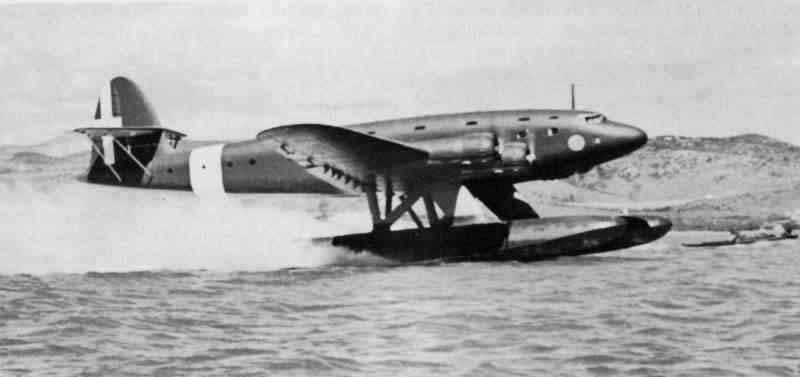
By: D1566 - 15th February 2009 at 06:22
I’ll get my coat then ….
By: bloodnok - 14th February 2009 at 19:54
There was an artists impression knocking round of a C-130 on twin floats, I don’t think it ever got built though.
http://www.dougronan.com/ontario/images/OSAinteresting_floatplane_pictures.htm


 Sign In








 February 14, 2009 at 10:16 am