Further to an earlier posting on a different thread, I would like to open a new thread to ask for more information about a strange incident in the 1950s. This is the story so far:
I remember reading a newspaper article years ago when I was a kid about the loss of two Shackletons in mysterious circumstances. I recently googled around the subject and came up with the aircraft involved. As far as I can tell, this is what is known;
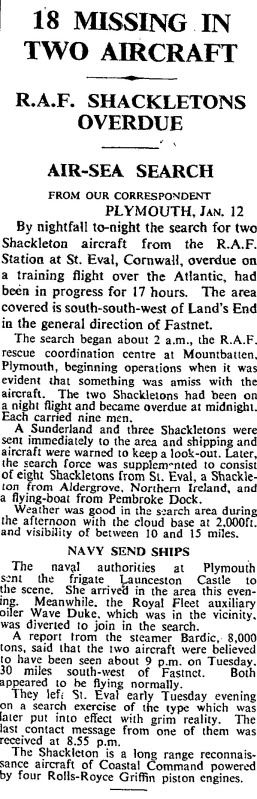
On January 11th 1955, Shackletons WG531 and WL743 of 42 squadron set off from RAF St Eval on a routine exercise over the Irish Sea. They never came back.
The last transmission from either aircraft came shortly before 2100 hours on the night of 11th January, and a search was instigated approximately 1 hour later. There was an intensive search for several days by both aircraft and ship, but no trace was found of either aircraft; no wreckage, no bodies, nothing. Two large, modern (at the time) aircraft with eighteen highly trained crewmen vanished without a trace.
Not to labour the point too much, but setting aside black holes, devil’s triangles, UFOs and all the other oddball explanations, it seems likely that at some point both aircraft plunged out of the sky and into the sea. The most likely explanation, and one which seems to be commonly used to explain the disappearance, is that the aircraft collided. A witness on a merchant ship later reported hearing large aircraft and seeing two sets of navigation lights which appeared to be following one another on the night of the accident.
What seems peculiar about the collision explaination is this; why would maritime patrol aircraft be flying in formation in the middle of the sea and in the middle of the night? It would seem to serve no purpose. Surely this sort of aircraft operates alone in order to cover the maximum amount of ocean. If they were not in formation but happened to “bump” into one another, this would seem extremely unfortunate considering the size of the Irish Sea and the fact that both aircraft were equipped with radar.
Also, why was no wreckage ever found? A searching aircraft apparently sighted orange wreckage floating on the sea around this time, but as this was not recovered due to the weather it could not be proven to come from the aircraft. Presumably a mid air collision would scatter wreckage over a wide area, and one imagines at least some of it would float. These aircraft carried life rafts to drop to shipwrecked sailors for a start.
One possibility is that they did a “Flight 19” and got lost, heading out into the Atlantic until they ran out of fuel and ditched. This seems unlikely for a number of reasons; one navigator losing his way is possible, but for two to do so seems downright impossible. Also, why no radio message from either plane? Even in the event of radio failure, there are proceedures for aircraft in this situation.
One assumes these aircraft would have been visible on radar at some point, unless of course they were flying at very low level. None of the sources I have looked at in researching this have mentioned whether they were tracked at any point, but if they were not then this again suggests a collision at low level.
Flypast ran an article in June 1995 which I have used as a source for some of the information here. It was noted in this article that an engine from one of the aircraft was trawled up in 1966, 11 years after the disappearence and some 100 miles NNW of the area the Shackletons were supposed to be operating in. This would indicate that either the current in this area is strong enough to move an engine several tons in weight many miles, or that at least one of the aircraft was way off course.
If anyone knows more about this incident, I would be very interested to hear about it.

By: B Sheppard - 24th June 2014 at 11:51
I was a crew member of HMS Launceston Castle and was aboard during the search for the crew members of the two missing Shackleton s.
On the 11th Jan we were designated Emergency Destroyer moored in Portland Harbor and received the order to search, we left Portland in a force 9 gale, at Plymouth it blew 10-11, as we rounded the Lizard
it went 12-13 and then off scale as we neared the Irish Sea. The ship had difficulties with the conditions and had to go to X Stations, we lost the Radar and Wireless mast so lost all shore communication.
We rode the storm out for about the next 18-20 hours until it abated and we could go on deck to physically see the damage to the ship and the sea condition. From horizon to horizon the sea was covered in Pit Props
apparently loosed from some tramp steamers which had jettisoned their deck cargoes to maintain their sea worthiness in the storm.
No one could have survived in that sea especially with the added hazard of those great wooden timbers.
At Biggin Hill in the early 1950’s it was the custom for a variety of RAF, RN and USAF aircraft to be flown in so the Royal Observer Corps and the Army Anti-Aircraft Command (then an integral part of the UK’s air defences) could examine up close on the ground the friendly aircraft they were expected to recognise in the air.
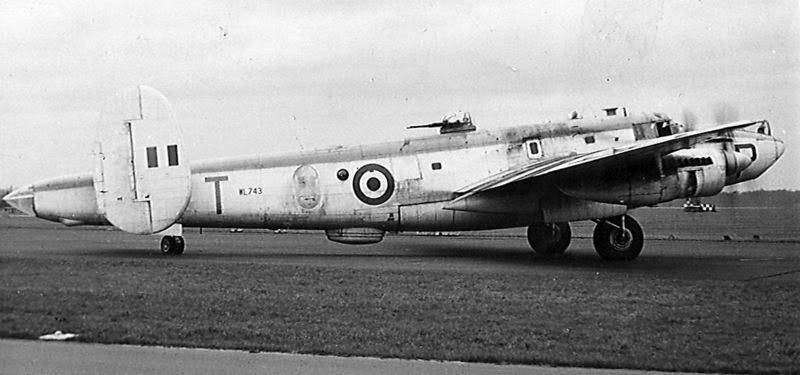
At the 1954 Recognition Day Shackleton WL743 of No.42 Squadron was on show. Sadly this particular aircraft went missing on the night of 11 January 1955 and is assumed to have collided with WG531, also from 42 Sqn, south-west of Ireland. Both aircraft were declared Cat.5 (Missing) the same day. In total eighteen crew died, nine in each aircraft.
I was stationed at Biggin at the time and took this photo of a rather tatty looking WL743; all that low-level stuff with lot’s of sea spray I suppose.
And as reported in the press:
By: pebbles - 16th October 2012 at 14:04
In response to Thaws picture of the Shackleton WL743 I wonder if it would be possible to obtain a copy of the picture for the album I have made up of my father Sgt. L.W. Cooper’s life in the RAF. He was one of the casualties of this crash.
By: pebbles - 15th October 2012 at 11:18
My father was one of the missing crew on WL743. I must say it is very strange to be looking at a photo of the actual plane that he died on as I have never seen a picture of it before. I have not been able to find out anything other than what has been printed here as to exactly what the cause of the accident was. The explanation we were given was that the most probable cause was that the two planes locked together and went down as one, hence no wreckage.
By: Mykultee - 25th February 2012 at 22:28
Missing Shackletons
I got airborne from St Eval at 16:55 on 11th Jan 1955 as an Air Signaller on Shackleton Mk2 WR962 of 228 squadron, landing at Gibraltar at 08:05 on 12th January. Our wireless operator had reported that Group W.T had been calling two aircraft with no response for most of the night. On landing we were given the information that two aircraft of 42 Squadron were missing.
We returned to St Eval on 14th Jan but took no part in the searches.
It was generally believed that the aircraft concerned had been practicing a technique in which one aircraft acted as a radio beacon to allow another aircraft to home onto it. I feel fairly certain that the procedure would have incorporated height separation as a safety factor but it was a rough night and communication was not as slick and easy as it is today.
By: G.dorri - 21st February 2012 at 21:45
WL743
Thaws. Thank you for posting the photo of wl743. On 4/11/53 we did an 18hr10 min trip on 743 with F /o George Board as co pilot up to Iceland and back.On the way back we came within a whisker of hitting the hills on the S/W tip of Ireland.
On 12/5/54 I crewed on WG531 escorting our new Queen on her way back from her state visit to Australia . 15hr 10mins
By: thawes - 8th February 2012 at 23:03
At Biggin Hill in the early 1950’s it was the custom for a variety of RAF, RN and USAF aircraft to be flown in so the Royal Observer Corps and the Army Anti-Aircraft Command (then an integral part of the UK’s air defences) could examine up close on the ground the friendly aircraft they were expected to recognise in the air.
At the 1954 Recognition Day Shackleton WL743 of No.42 Squadron was on show. Sadly this particular aircraft went missing on the night of 11 January 1955 and is assumed to have collided with WG531, also from 42 Sqn, south-west of Ireland. Both aircraft were declared Cat.5 (Missing) the same day. In total eighteen crew died, nine in each aircraft.
I was stationed at Biggin at the time and took this photo of a rather tatty looking WL743; all that low-level stuff with lot’s of sea spray I suppose.
And as reported in the press:
By: G.dorri - 8th February 2012 at 15:48
Shackleton Tragedy
My conclusion is that this was a tragic colision due to aircraft operating at similar altitude using the same regional pressure setting in the same area without specific coordinated separation in view of the possibility of navigational innaccuracy. I knew most of the missing crew members very well, and flew with many of them. Every January I offer a selfish thak you prayer and remember my friends who were so unlucky. I will be glad to give my reasons for my conclusions if invited to do so.
By: Bomberboy - 1st February 2012 at 21:46
Apologies, but please excuse a slight temporary thread jack here.
Clearly, there appear to be a number of ex St Eval service personnel who have very recently found themselves on this forum and viewing a very intriguing subject.
Are you fellows aware of an association for all ex St Evalians?
If you are not and would be interested to know a bit more, please PM me and i’ll pass on the info. I’m sure the association would love to hear from you.
If you are already in the association then PM me anyway to see if we already know each other?
The thread itself is very interesting and I know we would all like to hear more, particularly those with what seems to be some vivid first hand account knowledge.
Bomberboy
By: GEK - 1st February 2012 at 19:05
Some 10 years or more ago, I was doing some research in DoRIS, on 131 Sqn, when I realised that a small group of people were talking about this incident to one of the staff. From what I can remember, they were family of one of the crew who were lost, and that they were donating some stuff, can’t remember what, to the RAFM collection.
Geoff
By: Arabella-Cox - 31st January 2012 at 22:11
Welcome to the forum gents.
Would love to hear your Shackleton tales & see any pictures you might have taken at St Eval during your time there.
Thanks,
NickB
By: pagen01 - 31st January 2012 at 19:47
I was a crew member on 11jan55 .would like to give some input
Welcome to the forum G.dorri, would be very interesting to hear about your Shackleton experiences.
By: John Green - 31st January 2012 at 19:11
#19
ShakAirSig
Quote: “We normally operated at low altitude…..” Were both a/c given an incorrect barometric pressure setting which could have placed them considerably lower than they would normally be?
Were the Armed forces at the time using inches or millibars of mercury for altitude setting? Were they possibly in transition between the two measurements giving rise to confusion?
Was there a ‘lead’ a/c or, were they acting independently?
John Green
By: G.dorri - 31st January 2012 at 18:29
wR952
I was a crew member on 11jan55 .would like to give some input
By: G.dorri - 31st January 2012 at 18:08
Shackleton mystery
imystery I was crewing on Shack WR952 with F L Fennell on Jan 11 1955. I would be keen to know who ShakAirSig is as we were obviously on 42 sqdron at the same time.
T
By: pagen01 - 10th January 2012 at 17:34
Welcome to the forum ShakAirSig, and for recounting what must have been a terrible night for you.
I do think that these tragic post-war losses are sadly overlooked in the general publics’ eye.
By: pagen01 - 10th January 2012 at 17:34
Welcome to the forum ShakAirSig, and for recounting what must have been a terrible night for you.
I do think that these tragic post-war losses are sadly overlooked in the general publics’ eye.
By: ShakAirSig - 10th January 2012 at 15:54
42 Squadron Loss
Take Off 0930 GMT on Tuesday 11th January 1955 Shackleton Mk. II with F/S Regan at the controls. Tasks included Gunnery tests, Sonics and Radar homings due to return to St Eval at 0030 GMT on Wednesday 12th January. Actual time of landing 0335 GMT on 12th January, additional flight time due to full scale search for missing aircraft. Yes, I was flying that fateful night when my old crew, plus a close friend who took my place, did not return. It was their first flight since returning from their Christmas leave; I had remained on the squadron to assist in the ASR cover required during that period. I was on the radio (1154/1155) when the distress message from St Eval came through diverting us to start a search for our missing colleagues.
Without referring to individual comments previously entered on this site, I am surprised that a person in the Ops Block at that time didn’t know about the catastrophe. I was detached to the Ops Block to give evidence to the Board of Enquiry and remained there on duty for nearly two weeks due to having been on communications duty at the estimated time of the incident, my radio log being used as evidence of lost contact procedures being adopted. Also, at the time of the incident, we were operating ASV Mk. 13 Radar, even older than the previously mentioned Mk. 21. Was it a mid-air collision? The CO didn’t think it could be but that was the only feasible explanation that the Board of Enquiry submitted. Why no advance warning for the crews? As previously stated the ASV equipment was optimised to search the surface of the sea, not the air and unlike the Mk. I Shackletons the scanner was located under the aircraft aft of the main spar whereas the Mk. I had its scanner in the aircraft’s nose. All of 42 Squadron’s aircraft were Mk. IIs and therefore designed to scan down and not up. Additionally, we normally operated at low altitude which made detection of aircraft at the same height a difficult task. Whatever the cause the result was the tragic loss of 18 colleagues on that fateful night in 1955.
It is 57 years since this incident occurred and my memory is not 100% at 77 years of age but should anyone have specific questions on the conditions and events on that fateful night, I will try my best to answer them truthfully.
By: ShakAirSig - 10th January 2012 at 15:54
42 Squadron Loss
Take Off 0930 GMT on Tuesday 11th January 1955 Shackleton Mk. II with F/S Regan at the controls. Tasks included Gunnery tests, Sonics and Radar homings due to return to St Eval at 0030 GMT on Wednesday 12th January. Actual time of landing 0335 GMT on 12th January, additional flight time due to full scale search for missing aircraft. Yes, I was flying that fateful night when my old crew, plus a close friend who took my place, did not return. It was their first flight since returning from their Christmas leave; I had remained on the squadron to assist in the ASR cover required during that period. I was on the radio (1154/1155) when the distress message from St Eval came through diverting us to start a search for our missing colleagues.
Without referring to individual comments previously entered on this site, I am surprised that a person in the Ops Block at that time didn’t know about the catastrophe. I was detached to the Ops Block to give evidence to the Board of Enquiry and remained there on duty for nearly two weeks due to having been on communications duty at the estimated time of the incident, my radio log being used as evidence of lost contact procedures being adopted. Also, at the time of the incident, we were operating ASV Mk. 13 Radar, even older than the previously mentioned Mk. 21. Was it a mid-air collision? The CO didn’t think it could be but that was the only feasible explanation that the Board of Enquiry submitted. Why no advance warning for the crews? As previously stated the ASV equipment was optimised to search the surface of the sea, not the air and unlike the Mk. I Shackletons the scanner was located under the aircraft aft of the main spar whereas the Mk. I had its scanner in the aircraft’s nose. All of 42 Squadron’s aircraft were Mk. IIs and therefore designed to scan down and not up. Additionally, we normally operated at low altitude which made detection of aircraft at the same height a difficult task. Whatever the cause the result was the tragic loss of 18 colleagues on that fateful night in 1955.
It is 57 years since this incident occurred and my memory is not 100% at 77 years of age but should anyone have specific questions on the conditions and events on that fateful night, I will try my best to answer them truthfully.
By: pagen01 - 6th May 2008 at 15:57
St Eval
Hi David, welcome.
Do you think you could start a thread about some of your St Eval reminisences, it is a much uncovered subject. Do you have pictures from your time there?
By: david lockyer - 6th May 2008 at 15:34
RAF St Eval Cornwall
Re the missing two Shackletons from RAF St Eval , I had just arrive at RAF St Eval Cornwall when this Incident occurred although I was in the Operations Block as a radio operator I heard nothing about this Incident and now assumed It was hushed up, and It was only some time later I heard vague talk about two missing Shackletons , And It was only years later an ex RAF St Eval Colleague sent me a newspaper copy about this incident , And two years ago at our yearly reunion In Newquay I had a chat with one of my colleague’s who was in the same billet as myself and I happened to mention this Incident and he told me he was In Air Traffic Control at that time and sent the distress signal out , after chatting to some of those that were at RAF St Eval when this Incident happened and one theory is that one Shackleton crashed Into the back of the other and locked together , as if there had been a frontal crash that Impact would have caused a vast amount of wreckage , There is a commemorative plague In St Columb Church Cornwall to those that lost there lives as a result of this crash.
And In our next Newsletter we have an article about this Incident


 Sign In








 June 7, 2006 at 4:38 pm