After the end of the second world war surplus amounts of bombs and amunition were “redundent” untill another war appears so how long does these bombs last/survive or do they get destroyed?
Same for amunition was this saved and used latter like the falklands or the 1st gulf war or replaced with new?
There must have been stock piles of left over ordanace.

By: ade wilkes - 8th September 2010 at 10:56
There is one chap that has to have his well in the back garden periodically checked by the EOD as it contains large amounts of 40mm Bofors shells.
By: vanir - 8th September 2010 at 00:49
War stocks are usually mothballed as surplus then tested and issued for second echelon work, like shore bombardment (like the New Jersey or whatever that shelled at the Gulf, that was using WW2 stocks). The Russian Federation actually keeps a massive stock of old wartime 122/152 howitzers and guns to make use of WW2 ammo surplus when newer stocks run low. This actually happened in Chechnya and they retired newer smoothbores and whatnot, dusted off ancient artillery and started using the old war surplus.
For these major powers, who produced so many armaments and materiel you kind of expect this, even over half a century later. They just made that much, which is a testament of how destructive WW2 really was.
Hey did you know more ordnance was dropped by the USAF in the last year of the war than for all the other years by all the other nations combined, well at least that’s what it says in Clash of Wings but sounds about right.
By: Creaking Door - 7th September 2010 at 23:32
Second World War ammunition saved for the Falklands!
I was just going to comment that all the calibres would be different…
…and then I remembered those 20mm Oerlikon and 40mm Bofors guns that proved so useful…..but not with vintage ammunition surely!
By: Old Fart - 7th September 2010 at 23:21
However, the exciting news for anyone living near Sheerness is the presence of the Richard Montgomery, a US ammunition ship which sank off the coast in 1944 with some 7000 tons of stuff on board. As its close inshore, it’ll rattle more than the odd window if it ever goes BANG!
The Richard Montgomery is 6 miles from my front door… At all staes of tide the masts are above water, its not just the shock wave from the blast that will hit Sheerness and Southend but also a tidal wave that at low tide would not be massive but would still flood large parts of both the Essex and Kent Thames Estuary shore lines however at High tide the water ingress would reach for over a mile or so thay say.
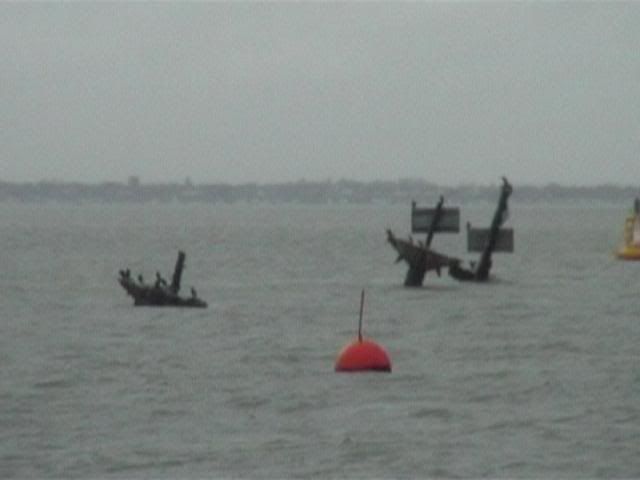
From 2006ish
By: smirky - 7th September 2010 at 22:46
found it, a 1996 US report into the $80bn ammo stockpile, 25% of which is believed to be over 25 years old.
Given the difficulty of locating and testing the old stuff, they tend to buy new every time something ‘kicks off’ which makes the problem worse.
By: piston power! - 7th September 2010 at 21:52
Aswell as amunition and bombs were rifles and machine guns thrown over board or sold on?
Imagine finding these washed up on the shores after a storm!!:eek:
By: daveg4otu - 7th September 2010 at 21:32
In the late 50s my father, a Merchant Navy skipper working for the War Department on an RASC fleet vessel , spent about a year dumping ammunition of all kinds out in the Atlantic somewhere off Northern Ireland.
They were based in Cairn Ryan( on Loch Ryan N of Stranraer- the stuff was brought in by road and rail.
Some of the dumping (according to him) involved large cubes of concrete containing what?
By: navigate - 7th September 2010 at 21:31
I Gets Worse!!
At the end of the war, we imported from Germany 75000 tons of poison gas shells for disposal from UK.
Large quantities of surplus ammunition was dumped in mines and quarries in North Wales, to the extent that some areas are still unsafe.
However, the exciting news for anyone living near Sheerness is the presence of the Richard Montgomery, a US ammunition ship which sank off the coast in 1944 with some 7000 tons of stuff on board. As its close inshore, it’ll rattle more than the odd window if it ever goes BANG!
The 1000 lb bomb was retained for many years and and was ‘sampled’ to ensure it was safe. Some munitions have their fillings replaced periodically and it rather depends on what’s inside the case as to how long it remains a viable weapon. Some armourer out there will doubtless explain about ‘red carding’ and ‘black listing’.
Navigate
By: piston power! - 7th September 2010 at 21:15
Thanks for those links.:D
By: minimans - 7th September 2010 at 21:02
I’m still shooting wartime 30/06 and some very old 308 with only the occasional missfire. if Ammo is stored properly I can’t see it ever “going off”
There have been reports of old 308 having massive over pressure as a result of the powder flakes having been reduced to a fine powder by years of misshandling and some reports of damage to guns and people………..
By: Phillip Rhodes - 7th September 2010 at 20:40
Even before we won the war over Japan, ammunition was being dumped in the North Sea. Bomber Command crews flew with full bomb loads (minus fuses) and bombed (very accurately) the sea. Ships laden with bombs and bullets were also scuttled, while cases of 303 rounds were thrown overside.
Check out: http://www.kimointernational.org/DumpingatSea.aspx
and http://scienceblogs.com/deepseanews/2007/06/munitions_dumping_at_sea.php
and http://www.lancaster-archive.com/forum/viewtopic.php?p=24990&sid=ec1889763a9f0a0f4d942988d2f7cdcc
Just type in “bombs dumped in the sea” in google…
All this while we were still making more bombs and bullets.


 Sign In








 September 7, 2010 at 8:17 pm