
By: ZRX61 - 29th January 2013 at 01:30
He once explained to me that he kept a careful index of all the ‘loonies’ who wrote to him, noting the individual’s name, address, and oddball belief. He would then put this latest ‘looney’ into contact with a ‘looney’ of the opposite beliefs, working on the principle that, as he put it: “Loonies of opposite polarity cancel out”.
So who did he put you in contact with? :D:D:D:D
By: Aces High - 29th January 2013 at 00:20
Dr Chris Lintott’s tribute to Sir Patrick Moore…
“Sir Patrick Moore made a huge mark on astronomy, made all the remarkable by his insistence that he was not and never had been a professional scientist.
He counted himself as a writer and broadcaster first and foremost, but as Britain’s most recognisable scientist for more than 50 years, he inspired countless people to take up astronomy as a hobby or astrophysics as a career.
His own education was unconventional. He was prevented from attending Eton by illness. He then found himself thrown into the melee of World War II, lying about his age and signing up for the Royal Air Force at the age of 15.
Following the war, he turned down a place at the University of Cambridge in favour of working, first, briefly, as a teacher and then as a freelance writer.
‘Treasured by scientists’
Yet the year 1957 saw two launches that would dramatically change Sir Patrick’s life.
The first was of Sputnik 1, the first artificial satellite which fired the starting gun on the space race.
The second, six months earlier, was of the Sky at Night. Initially commissioned for a trial period of three episodes, the programme and its presenter ran without a break for more than 50 years.
The Sky at Night is treasured by scientists not only because of its longevity, but because it allowed them to talk about what they’re most passionate about – their work.
One of Sir Patrick’s favourite anecdotes was about his interview in 1970 with Neil Armstrong.
Sinking into the chair opposite Sir Patrick after a gruelling set of interviews which focused on politics and funding, the beleaguered astronaut lit up: “Now we can talk about science,” he said.
This science-led focus was entirely due to Sir Patrick’s strong lead, but the reason it worked was because of his ability to represent the viewer.
Where others would have lost their audience when talking about the difficult stuff – the Sky at Night even attempted a programme dedicated to general relativity in 1969 – Sir Patrick was trusted and could be relied upon to interject when necessary.
‘Open house’
This ability to speak plainly and clearly to his audience was also evident in his writing.
He published well over 100 books, ranging from works of serious scholarship – he was particularly proud of his survey of pre-space age observations of Neptune – to books for kids of all ages.
These books in particular inspired a generation of schoolchildren to take up astronomy and it was a regular occurrence for Sir Patrick to be presented with dog-eared copies of long forgotten titles by eminent professors looking for his signature.
Many of them will have been among the legions of fans whose letters bombarded Sir Patrick, each of which would get a reply bashed out on Sir Patrick’s long-suffering Woodstock typewriter.
This personal encouragement from a national figure must have motivated countless enthusiasts to pursue a scientific career.
It did not stop at letters either. Sir Patrick took every opportunity to meet his audience, undertaking lectures, tours, public appearances and more.
Farthings, Sir Patrick’s home in Selsey in West Sussex, ran for years as an effective open house and science centre, with the observatory in the garden.
This was primarily used for Sir Patrick’s own observations of the Moon and planets, but was also open to passing amateur astronomers, youth groups and anyone else who might be inspired by a glimpse of the sky.
In short, Sir Patrick dedicated his life to talking about astronomy at any opportunity – not out of a desire to make a name for himself or to further an agenda, but because he thought the world would be a better place if he did so.
For more than half a century, it was.”
By: pagen01 - 13th January 2013 at 21:07
There’s an interview programme on now (21.06) on BBC4, apparently never seen before and filmed in 2007 with Patrick Moore. May touch on his RAF career, but should be interesting if not anyway.
By: AlanR - 11th December 2012 at 11:11
At the risk of going off-topic, what now is to be the future of “The Sky At Night”, the show Patrick Moore presented for over 55 years – since April 1957 I heard?
Will it go on with a new presenter – or does the show die with him?
Can’t help but notice that “The Sky At Night” has been somewhat marginalized in the BBC’s schedules in recent times (on BBC-2 or BBC-4 in the wee small hours)
The show will definitely go on, who will present it is anyone’s guess. They may bring in a regular programme anchor,
or use some of the regulars in rotation. I think Chris Lintott might be too busy to be a permanent host.
Perhaps Paul Abel or Pete Lawrence ?
S@N has always been on at late o’clock. Although BBC Four do show it earlier, and often show an extended version
They may now film it from a studio ?, as there will now be no need to do it at Patrick’s house. The property has been
left to his God Sons, so it remains to be see what will happen to it.
By: g-anyb - 11th December 2012 at 08:03
At the risk of going off-topic, what now is to be the future of “The Sky At Night”, the show Patrick Moore presented for over 55 years – since April 1957 I heard?
Will it go on with a new presenter – or does the show die with him?
Can’t help but notice that “The Sky At Night” has been somewhat marginalized in the BBC’s schedules in recent times (on BBC-2 or BBC-4 in the wee small hours)
If there were to be a new presenter, I’d like Brian May to take the job; he has the qualifications, has already appeared on the show before, and could bring some “rock-n-roll” glamour!
Problem is – would Brian May give up his “day job” as guitar player with Queen?
On a musical note again, I’m very very sure Wilko Johnson would be immensely proud to do this too…
By: pagen01 - 10th December 2012 at 20:40
If he was on 7 Sqn James, the squadron badge is certainly appropriate!!! 🙂
I think because of the Ursa Major symbol and the ‘By Day and By Night’ moto that’s how its in my mind, that and 7 being my favourite St Mawgan squadron.
re the Telegraph article, I’m sure he mentioned combat to me.
Do you ever have that moment where you wish that you spent more time talking to someone…
By: Radpoe Meteor - 10th December 2012 at 17:47
For quite sometime Sir Patrick has had other co- presenters, the first of which was Chris Lintott, it seemed to me from when he started, he was being mentored as a likely presenter- time will no doubt tell.
I feel that there would still be the Sky at Night one way or another, I’m sure Sir Patrick would wish the programme to continue.
The only silver lining of the sad news yesterday is, that the aviation buff side of me is learning more about his wartime exploits thanks to this thread.
Regards Rad
By: Dr. John Smith - 10th December 2012 at 17:19
At the risk of going off-topic, what now is to be the future of “The Sky At Night”, the show Patrick Moore presented for over 55 years – since April 1957 I heard?
Will it go on with a new presenter – or does the show die with him?
Can’t help but notice that “The Sky At Night” has been somewhat marginalized in the BBC’s schedules in recent times (on BBC-2 or BBC-4 in the wee small hours)
If there were to be a new presenter, I’d like Brian May to take the job; he has the qualifications, has already appeared on the show before, and could bring some “rock-n-roll” glamour!
Problem is – would Brian May give up his “day job” as guitar player with Queen?
By: Arabella-Cox - 10th December 2012 at 17:07
Absolutely gutted…. One, yes, perhaps could see it coming (his health looked to be flagging), but even so it hits hard.
Happy sunlit uplands, Sir Patrick.
By: FoxVC10 - 10th December 2012 at 16:57
Guardian Obit states that he relinquished his commission in the RAF in 1944 because of his hidden heart condition he then took up defusing bombs..
By: Arabella-Cox - 10th December 2012 at 13:33
Very sad news.
I had the very great pleasure of meeting and having a good conversation with Sir Patrick Moore at Wadebridge when he was giving a lecture about Halley’s Comet.
I knew he was an ex BC navigator and I asked him about his career, I was pleasantly surprised in the interest he showed back to me.
He mentioned that it was the use of sextant and astrodomes which certainly perpetuated his interest in astromony.
From memory (as unreliable as that is) I’m sure he said that he was on Wellingtons and 7 squadron Stirlings for a spell.
Apart from rising to Flt Lt RAF, he was also a voluntary Air Training Corps Sqn Ldr.
He also met Orville Wright when aircrew training in Canada.I’ve always admired his character, and to me represents exactly what television should be about, education delivered in a non sensationalist manner, I believe Sky At Night is the longest running programme in TV history, and that Patrick was the longest presenter of a programme.
Possibly his most outstanding gift to aviation was his mapping of the moon which NASA partly used for the Apollo programme.
RIP
If he was on 7 Sqn James, the squadron badge is certainly appropriate!!! 🙂
By: Phantom Phil - 10th December 2012 at 12:49
I read somewhere he was part of the Pathfinder force… Is this true and what squadron’s did he serve with?
By: PanzerJohn - 10th December 2012 at 00:49
From the Telegraph….
“At the end of 1941 he joined the RAF to train for aircrew duties, and during 1943 left for Canada for training as a navigator. He was commissioned in June 1944 and completed his training at a bomber conversion unit at Lossiemouth in northern Scotland but, due to epilepsy, was declared medically unfit for further flying duties. He spent some time in the RAF’s training branch before leaving the Service in 1947. From 1952 he had made his living as a freelance writer. “
By: pagen01 - 9th December 2012 at 23:09
Unsure how you can access it, but there is superb colour photo of Flt Lt Moore in his uniform on Facebook, posted by Rainbow Aviation.
I’m not sure that he was reluctant to talk of his RAF career, or that it was overlooked and not asked about very often.
He certainly made his views on Nazi Germany very clear, and was rightly proud of his service.
He spoke about it openly to me, he seemed delighted that I had asked.
By: Radpoe Meteor - 9th December 2012 at 22:32
This is my poor attempt at capturing it earlier this year, though now I want to go back and try much harder to capture it better and in more detail.
Stephen, I’m sure if Sir Patrick can se this he will have a smile in appreciation, it is a pretty decent photo to me.
Although he spoke little about his RAF career, I always noticed in the later years of the Sky at Night, he wore a RAF tie and a sign in the background says commanding officer.
I have just come back in from a half hours observing, maybe its just me, but despite a slight haze, Jupiter and Orion seemed to stand out with a beautiful brilliance, if you read this now- go have a look for yourself.
Rad.
By: G-ASEA - 9th December 2012 at 20:21
I have two friends who use to go and see Sir Patrick. They said he would never talk about his time in the RAF.
Dave
By: flaikbait5 - 9th December 2012 at 20:13
Such a sad loss to lose Sir Patrick and Clive Dunn Cpl Jones from Dads Army passed recently too, such a loss.
By: PeterVerney - 9th December 2012 at 19:19
Dare I say it, but Sir Patrick Moore was a true eccentric, but above all a gentleman and an inspiring commentator. I was not pleased to hear the BBC announcement of his passing made no reference to his RAF career.
By: pagen01 - 9th December 2012 at 19:04
Very sad news.
I had the very great pleasure of meeting and having a good conversation with Sir Patrick Moore at Wadebridge when he was giving a lecture about Halley’s Comet.
I knew he was an ex BC navigator and I asked him about his career, I was pleasantly surprised in the interest he showed back to me.
He mentioned that it was the use of sextant and astrodomes which certainly perpetuated his interest in astromony.
From memory (as unreliable as that is) I’m sure he said that he was on Wellingtons and 7 squadron Stirlings for a spell.
Apart from rising to Flt Lt RAF, he was also a voluntary Air Training Corps Sqn Ldr.
He also met Orville Wright when aircrew training in Canada.
I’ve always admired his character, and to me represents exactly what television should be about, education delivered in a non sensationalist manner, I believe Sky At Night is the longest running programme in TV history, and that Patrick was the longest presenter of a programme.
Possibly his most outstanding gift to aviation was his mapping of the moon which NASA partly used for the Apollo programme.
RIP
By: Arabella-Cox - 9th December 2012 at 16:52
This is extracted from his page on ……Would be correct to presume that his interest in things celestial started with his RAF training in astronavigation?
I believe his interest in astronomy began with a book he was given at the age of 6. I’ve had a long interest in astronomy, but only this year got around to buying a telescope. I’ve watched Sky at Night for years, and spent many hours searching for objects discussed by him.
So sad that he has finally left us, but what a legacy he’s left behind in both professional and amateur astronomers.
Messier 44, the Beehive cluster was his favourite cluster. This is my poor attempt at capturing it earlier this year, though now I want to go back and try much harder to capture it better and in more detail.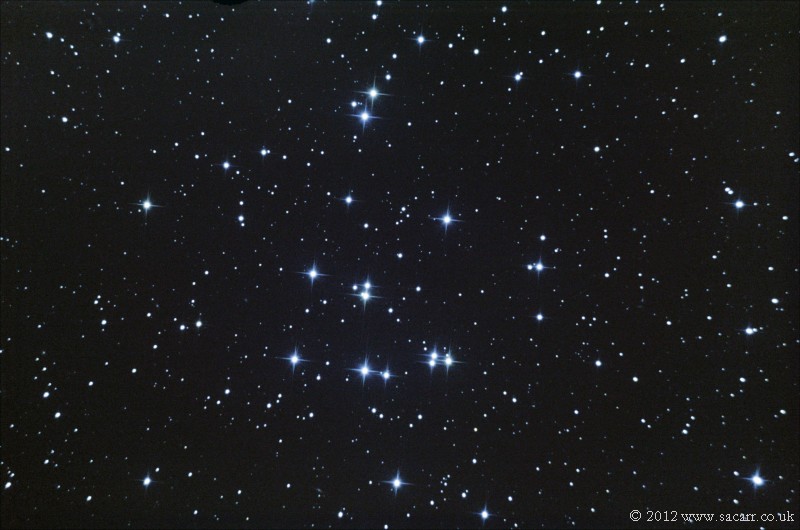


 Sign In








 December 9, 2012 at 1:51 pm