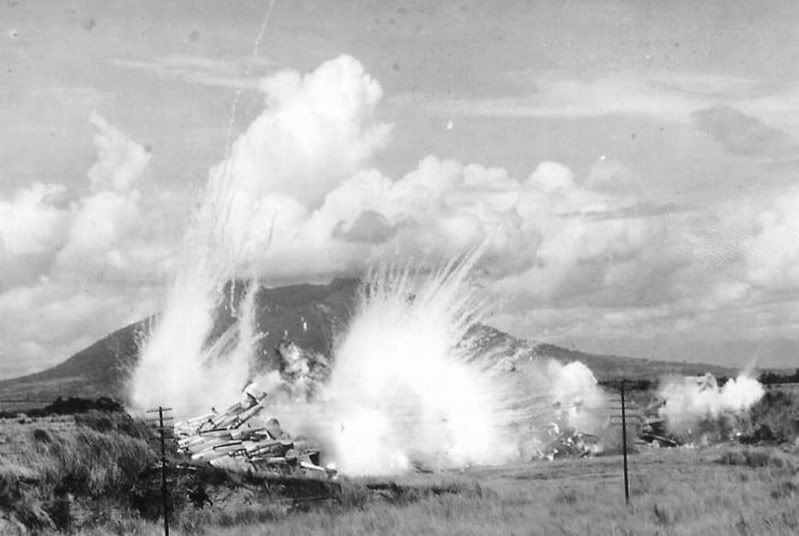
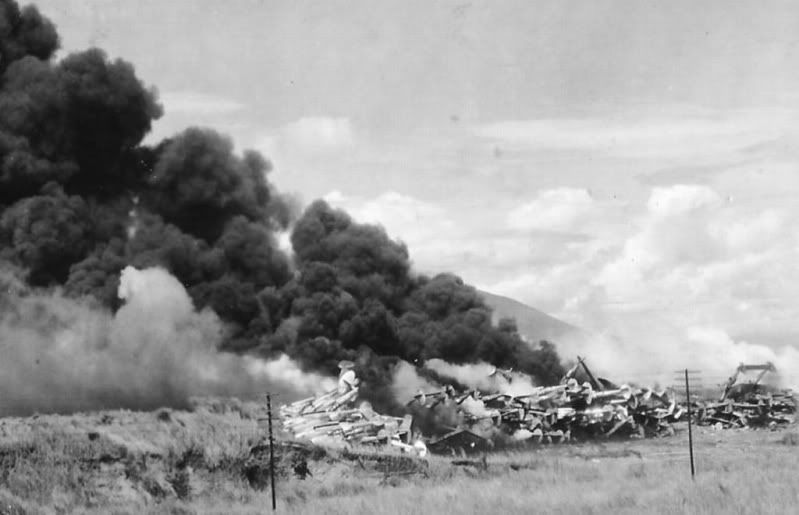
After the war was finished, I was still in the Philippines. We were flying 51s and 47s but still had a number of 38s on the field. I remember ferrying what were basically brand new 38s down to Clark Field and then taxiing them through a field to a huge hole where they were bulldozed into and burned. Some of these planes had less than 10 hours on the form one. They all had full gas tanks and all instruments. They could have been purchased for one hundred dollars ($100). The gas alone would have been worth that. The instruments could have been salvaged if a person didn’t want to keep the plane. How sick do you think I feel today, when there are very few left in the world and now would sell for close to, if not more than, $1,000,000. I did take one of the control wheels out and brought it back home with me. Should have had the whole plane.
http://www.winthrop.dk/stanwood.html
😀

By: Flat 12x2 - 25th November 2014 at 23:04
To add a little bit to the story of the brand new wireless sets being dumped down mine shafts, when it became more widely known within the Ministry there was disquiet because the sets were still in their cartons – no-one had given any thought to the value of cartons!
Now, how about 256 tons of “wheels and aircraft parts” from the Dunlop Rim and Wheel Co. Ltd, Coventry? Gotta be a few spade grips and gun buttons in that lot surely: nice little project for someone in the South Staffs area? 😉
From ‘Britain from above’ “Scrap processing on the site of Cannock Chase Collieries, Chasetown, 1949” Clearly in the picture (link below) can be seen aircraft wheels/tyres + piles of other stuff spread over a large area, I wonder where it all ended up ?
http://www.britainfromabove.org.uk/image/eaw024542?search=scrap&ref=34
bigger detailed pic in link above
By: Mark12 - 11th January 2013 at 07:36
I might join and ask if he’s had any luck tracking down our Lewis gun with the postal people.
Do you want me to ask about the Syrian Spitfires too..??
Affirm.
By: Andy in Beds - 11th January 2013 at 07:18
I might join and ask if he’s had any luck tracking down our Lewis gun with the postal people.
Do you want me to ask about the Syrian Spitfires too..??
By: Melvyn Hiscock - 11th January 2013 at 00:49
Would that be the same ‘Setter’ currently posting on the Warbirdz forum in Australia?
Mark
Affirm
By: hindenburg - 10th January 2013 at 21:22
Dig up Eaglescliffe Depot…………..From the 1940s to the 1990s there was an MOD base situated at Allens West in Eaglescliffe. After World War II the base was Metal Reclamation Unit No 2, and was used to dismantle aircraft that were downed in the north of England.
By: Mark12 - 10th January 2013 at 17:58
Would that be the same ‘Setter’ currently posting on the Warbirdz forum in Australia?
Mark
By: kev35 - 10th January 2013 at 15:29
For all of Setter’s fantasies and failings let us not forget that he was responsible, single handedly, for the transfer and transport of a P-51 to Australia.
Regards,
kev35
By: airmanual - 10th January 2013 at 15:22
For those of us with long memories, wasn’t this one of Setter’s fantasies?
Along with photos of the Syrian Spitfires from the Italian Air Attaché (which I’m sure Mark12 remembers well), P-61s in transit to Paul Allen in a haulage yard near Manchester, and many other little gems to brighten up our days a few years back.
That one (the P-38 at clark) is definitely not one of Setter’s fantasies but a well documented fact (see for example photos below). But Setter had “gone wild” when he started to claim that the recovery of those P-38 had actually started and that he had personnally seen a few perfect recovered examples.
Considering that the last (but still very few) P-38 recovered for restoration were just very incomplete corroded hulks just good for “data plate” restorations, i find it strange that no real effort has been made yet to go to Clark and see what’s left of them. Especially that these buried P-38 should be easy to locate : the Arayat volcano at the back of all photo gives a very good idea of location and early post war aerial photos of clark must be plentiful.
Laurent
By: jeepman - 10th January 2013 at 14:37
this is straying far from the focus of this forum and is perhaps more appropriate to HMVF but I’m sure that vehicles were used to seal breaches during the floods of 1947
By: l.garey - 10th January 2013 at 14:05
Re Lincoln7’s story of tanks being used as Fenland road foundations, I have no proof one way or the other, but I do remember my father telling me that old army tanks were used for flood defences after the war. We lived in Peterborough at the time. So there is at least some local hearsay evidence!
By: avion ancien - 10th January 2013 at 12:47
It’s not just aircraft in old mine shafts
It appears that even houses were dumped into disused mine shafts, often well after the cessation of hostilities – see http://www.independent.co.uk/news/mans-house-falls-into-old-mine-shaft-1092897.html.
By: jeepman - 10th January 2013 at 12:45
Who from the 1950’s can remember surplus Irvin flying jackets advertised in the Exchange and Mart, every week or whatever it was?
£5 is the price that comes to mind.
Mark
from Silvermans IIRC – and every dustman and coalman wore a leather jerkin….
By: Moggy C - 10th January 2013 at 12:32
Which was about a week’s wages at that time.
Moggy
By: Mark12 - 10th January 2013 at 12:17
Who from the 1950’s can remember surplus Irvin flying jackets advertised in the Exchange and Mart, every week or whatever it was?
£5 is the price that comes to mind.
Mark
By: Arabella-Cox - 10th January 2013 at 11:57
To add a little bit to the story of the brand new wireless sets being dumped down mine shafts, when it became more widely known within the Ministry there was disquiet because the sets were still in their cartons – no-one had given any thought to the value of cartons!
Now, how about 256 tons of “wheels and aircraft parts” from the Dunlop Rim and Wheel Co. Ltd, Coventry? Gotta be a few spade grips and gun buttons in that lot surely: nice little project for someone in the South Staffs area? 😉
By: Mark12 - 10th January 2013 at 11:51
Companies like Messrs. John Dale & Sons Ltd of London Colney had teams of men and equipment who would visit the MU’s and chop and smelt the aircraft in to ingots on site.
They kindly spared and donated P7350 to posterity.
Mark
By: jeepman - 10th January 2013 at 11:49
Not so much a tale, one of a very well known fact. The A1073 road between Spalding, (Lincs) and Crowland, has a high flood defence, wall and was built, on silty soil, as a good base for this, Ex Army tanks were used as a foundation for the wall, and also the A1073 road along the top.
Jim.
Lincoln .7
Is this where the Neptunes (British tracked amphibious carrier not the plane) were used?
Probably rusted away to nothing now – which is a shame as there are no survivors anywhere. The Tank Museum scrapped the last one years ago!
By: HP111 - 10th January 2013 at 11:42
…..
I have a copy of the list produced for the Minister who had to answer questions in the House when it was discovered that an enterprising local was salvaging and selling brand new wireless sets that had only been dumped the day before. It was headline news for a few days.For a fee, I’ll let you know where the wireless and radio sets are. If you are interested in all 404,455 incendiary bomb bodies, I’ll do you a special deal.
I know someone who was a radio fitter in WWII. After the war, one job he had was to ride in Blenheims being ferried for storage/scrapping and to act as radio operator. As soon as they landed and were taxying in, he had to dismount all the radio equipment and then throw it out the door when they stopped. It was then taken away. They immediately travelled back to base to pick up the next aircraft. Apparently if the radios were left in the aircraft they would get stolen. He can’t remember which airfield it was.
By: TonyT - 10th January 2013 at 11:27
Tanks are easy
Top ones are Shermans and greyhounds on a French range
http://the.shadock.free.fr/Tanks_in_France/basse-normandie.html
I mean just look at the surviving cromwells
http://the.shadock.free.fr/Surviving_Churchills.pdf
German stuff
By: Arabella-Cox - 10th January 2013 at 10:58
Not so much a tale, one of a very well known fact. The A1073 road between Spalding, (Lincs) and Crowland, has a high flood defence, wall and was built, on silty soil, as a good base for this, Ex Army tanks were used as a foundation for the wall, and also the A1073 road along the top.
Jim.
Lincoln .7
We did look into this tale during development work for “War Digs With Harry Harris” but concluded that, like most such stories, it had absolutely no basis in fact and there was no evidence to support it.
I’d be interested to know of any evidence you have.


 Sign In








 January 10, 2013 at 1:12 am