One of several Lancaster engine bearers sitting on a farm track above the village of Rothes, taken in March 1984. I don’t think they are still extant…
A Merlin trawled up in th Moray Firth, and deposited on the outer wall of Lossiemouth harbour, taken in February 1983. It had a bomber-type bearer, perhaps from a Whitley, with a metal prop. I guess the engine bearer and that good prop blade were buried in the silt, as they were in very good condition when first seen – the blade was still very black, and its yellow tip plainly visible…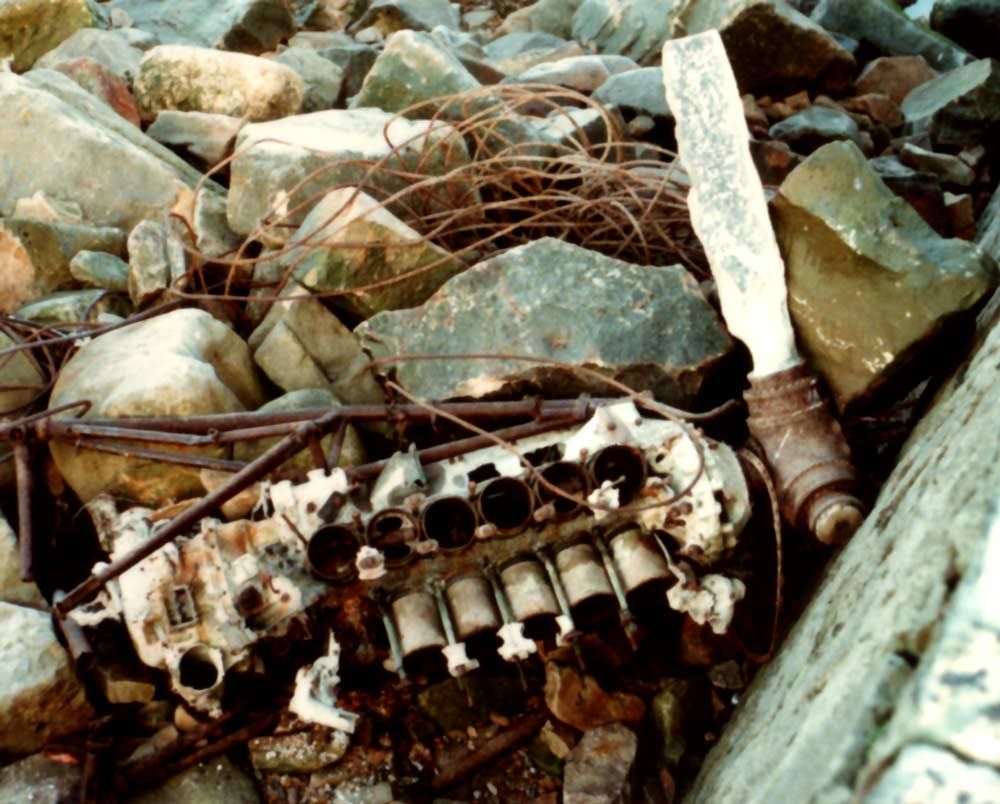
Merlin trawled up in the Moray Firth, and deposited at Burghead harbour in February 1983. The wooded prop blades had rotted away…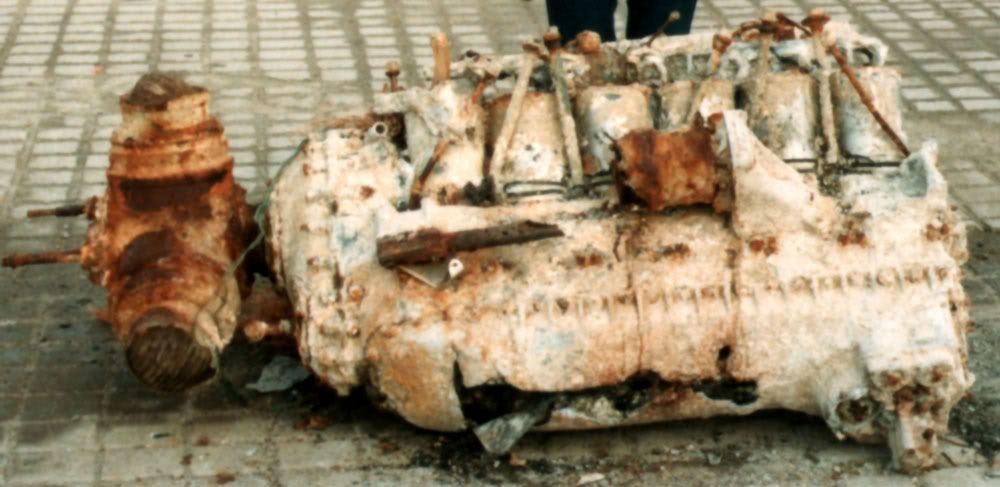
A Griffon from 766 Sqn Seafire XV SW826, which collided with SW904 on 05.07.48 over Kellas, Moray, and crashed near Glenlatterach reservoir, Elgin.
Petty Officer Raymond Walker, HMS Fulmar, Lossiemouth, survived the crash (the other pilot didn’t), and later said “We were flying at 1,000ft, doing crossover turns above Glenlatterach reservoir. I was aware of a dark shadow falling over my cockpit, then there was a great bang as another plane hit me. The whole glass canopy was smashed and gone, so I opened the cockpit and jumped.”.
Photo taken March 1983, but not much left nowadays…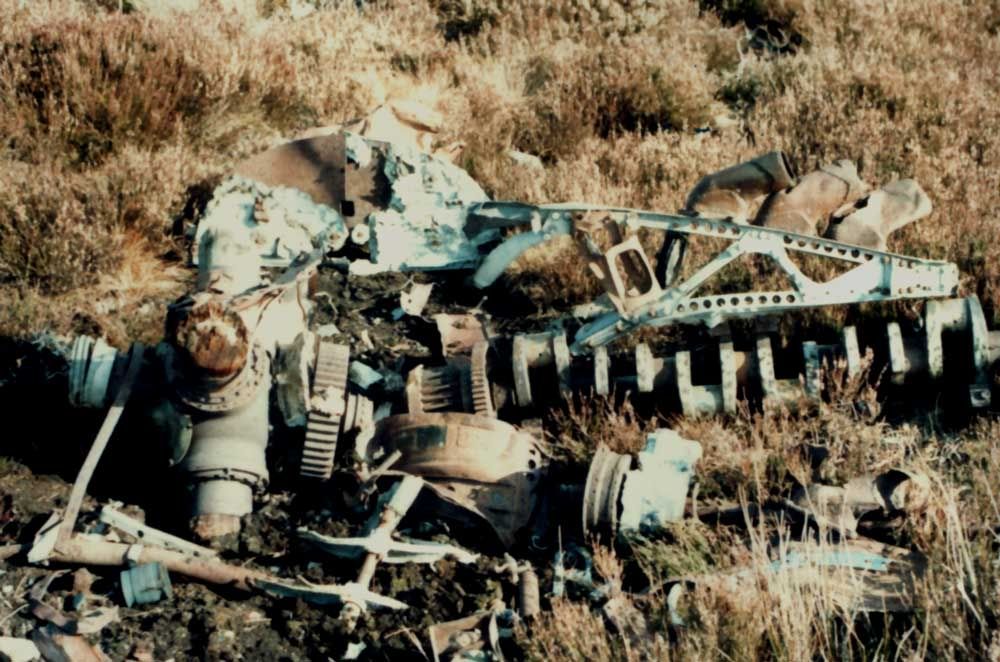
This Vickers Warwick Mk 1 BV512 of 6 OTU crashed in Culbin forest after taking off at Kinloss, on 05.12.45. Photo taken in the mid 1980s…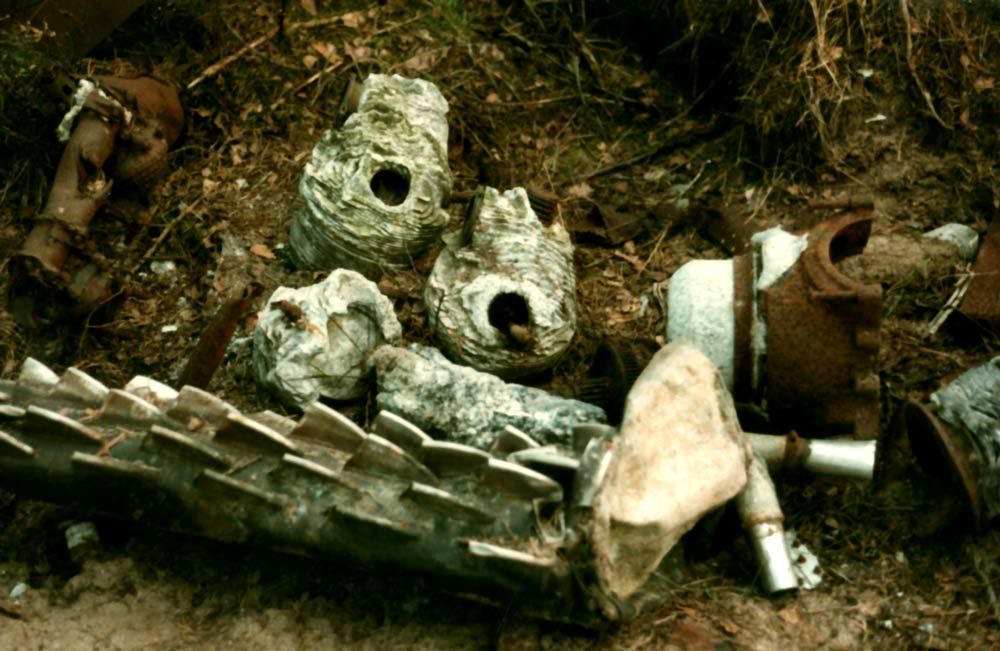

By: D1566 - 31st March 2025 at 10:36
Fascinating – thanks!
By: ade wilkes - 31st March 2025 at 10:33
Still extant..i doubt it,magpies have been about..
By: suu23 - 31st March 2025 at 10:33
I remember playing on that engine at Lossie harbour when we were kids:D
By: scotavia - 31st March 2025 at 10:33
I recall the visit to the Lanc engine bearers and I never did find a reference to a crash in that area. I wonder if any readers here have any idea?
By: Arabella-Cox - 31st March 2025 at 10:32
Wreckage
A fascinating set of photographs and, typically, shows the amount of stuff that has disappeared after just a few short years.
The lanc bearers (first photo) are in fact the nacelle frame to which the bearers were attached. That is the firewall you can see.
It looks remarkably undamaged from a crash – if it was in a crash at all. My guess is that this particular component originated from scrapping, which may explain the absence of any reported Lanc crash from that area.
Anon.
By: Al - 31st March 2025 at 10:32
It looks remarkably undamaged from a crash – if it was in a crash at all. My guess is that this particular component originated from scrapping, which may explain the absence of any reported Lanc crash from that area.
Anon.
Though I can’t quite picture why a farmer would bother to move them at least ten miles from any scrapman, lug them all up a single track road to the top of a steep hill, and then forget about them for forty years, unless he wanted a firewall for his combine harvester…
By: Arabella-Cox - 31st March 2025 at 10:32
Lanc bits
If you can come up with a more plausible explanation for non-crash Lanc remains, let’s hear it.
Anon.
By: Whitley_Project - 31st March 2025 at 10:31
Just because it doesnt look damaged doesn’t mean the aircraft didn’t crash!
By: Arabella-Cox - 31st March 2025 at 10:28
Lanc frame
Yes, quite correct.
It could be the outboard nacelle frame, which might well remain intact in, say, a forced landing.
But with the absence of any information pointing to a crash or forced landing in that area it seems (at least to me) a likely scenario.
Anon.
By: bloodnok - 31st March 2025 at 10:27
A fascinating set of photographs and, typically, shows the amount of stuff that has disappeared after just a few short years.
26/27 years is hardly ‘a few short years’ 😉
By: Arabella-Cox - 31st March 2025 at 10:27
Nit picking
I think certain contributors to this thread need to concentrate on the subject of the thread and offer something constructive instead of nit-picking another contributor’s text.
I think that most people would understand the spirit of the comment and not try to find mistakes with the text of a post – that is, unless they have nothing better to do.
Perhaps you would like to try and suggest, or research, explanations as to why there were a couple of Lancaster engine frames on a hillside in Scotland instead?
27 years ago is the early eighties. As far as I am concerned, this doesn’t seen very long ago at all, hence the comment.
Anon.
By: scotavia - 31st March 2025 at 10:26
Two of the frames/firewalls on the right hand side of the track,somewhere I have the notes of the part numbers which confirmed the type.
Location by track cross roads 264503 near Drumbain farm. I checked the losses of the Tirpitz raid Lancs but no losses in that area.
There is still an ident to find for the Wellington on Lossie beach and I would like to go back for a good dig around at low tide.
By: Al - 31st March 2025 at 10:26
I recall the visit to the Lanc engine bearers and I never did find a reference to a crash in that area. I wonder if any readers here have any idea?
Gary – I seem to remembr you had heard from a local that it had crashed/forced landed nearby in some sort of ravine or valley? Can you recall how many firewalls were there?
QUOTE=Anon
27 years ago is the early eighties. As far as I am concerned, this doesn’t seen very long ago at all, hence the comment.
Anon.
I agree – it doesn’t seem all that long ago, but when you think of it, going back another 26 years from when I took the photo, the Lanc was still very much in service with the RCAF, and had only just retired from the RAF!
By: Alan Clark - 31st March 2025 at 10:26
I’ve had a look at the entries I have copied from the 20 OTU ORB, they didn’t record too many crashes on the beach, most seemed to be in the sea just off the beach.
The only one which specifically mentioned a crash on the beach, rather than bodies recovered from the beach in the following days, was HD985 on the 19th Jan 43, but there were some periods when the ORB didn’t mention crashes.
By: Alan Clark - 31st March 2025 at 10:26
If there was a forced landing, and I do stress the if, I think it would more than likely be from the period when 120 Squadron were operating Lancasters out of Kinloss in the early 50s prior to getting Shackletons. It is more likely that regular operations in the region would have brought one or two incidents instead of the one-off anti shipping strikes mounted with Lancasters in the wartime period.
In my opinion though that firewall looks too tidy to have come from any kind of crash / forced landing, though quite why someone would acquire them from surplus and then dump them on a hilltop, but may be someone thought they might be useful.
Were there ever ranges in that general area? Another possibility is relic from a target range out in the hills which didn’t end up like a dairy product from the alpine region.
By: Al - 31st March 2025 at 10:24
There is still an ident to find for the Wellington on Lossie beach and I would like to go back for a good dig around at low tide.
Gary – I found this hook on Lossie west beach at low tide (more or less on the runway 23 centreline) probably in the early 1980s. Definitely from an aircraft, the hook is stainless steel, the clamp is alloy, and the bolts steel. The hook looks the same as found on a parachute harness.
Around the same time, I scuba dived on a Mosquito around the Halliman Skerries – lots of engine parts, and large caliber ammunition…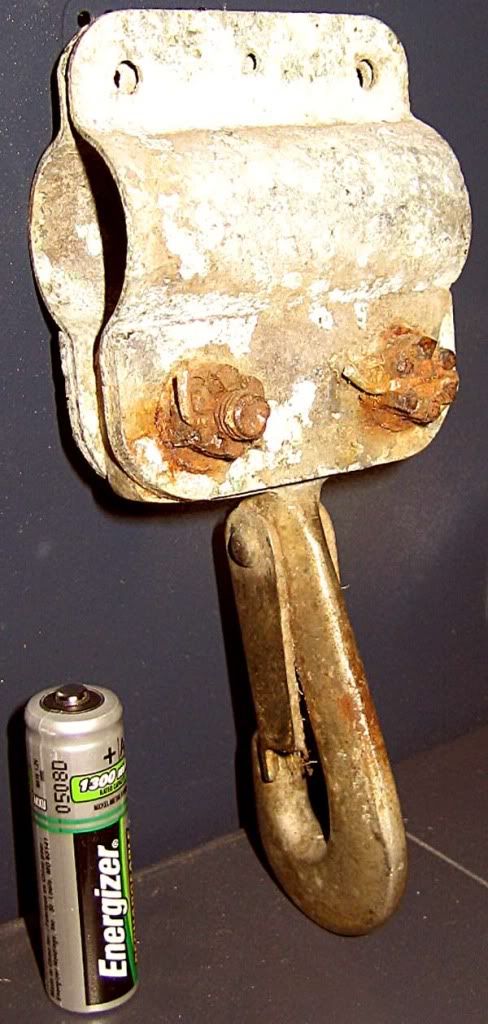
By: Phantex - 31st March 2025 at 10:24
re the Culbin Forest Warwick….
In the mid 80’s a friend and I cycled from Elgin to Culbin (this in the days of Strumney Archer 3 speed boxes!) along the ‘killer’ A96 to see what we could find.
We had absolutely NO idea where the plane might be, but the CO of our ATC squadron had been there and had picked up a Very pistol from the wreck. That was enough for us and off we went. I still remember the fruitless slog to this day.
Incidentally, the Culbin sands area, on which the forest stands, was used as a range for practice attacks before D-Day…several thousand rockets were fired onto it and a lot of them never went off. Definately NOT a place to go randomly digging about and hauling up lumps of metal.
By: Al - 31st March 2025 at 10:24
The beaches of the Moray coastline are strewn with WW2 and post-war aircraft parts, especially after a storm tide. With so many WW2 RAF training bases around, it’s not surprising, considering how many Whitleys, Wellingtons, Beaufighters, Mosquitos, Defiants etc have crashed a short distance out to sea over the years, not to mention all the Gannets, Buccaneers, and even Jaguars!
The most likely areas to find relics are Findhorn beach, and Lossiemouth west beach, both just north of Kinloss and Lossiemouth airfields respectively.
I once even found WW1 ammunition (rifle and pistol bullets, artillery shells) in a large hessian sack on Culbin north beach, and reported it to the Forres police, who couldn’t have cared less.
When I first had a nose around the Warwick wreck in the 1980s, the area was littered with damaged (but intact) .303 rounds, and more disturbingly, scraps of blue uniform material…
By: scotavia - 31st March 2025 at 10:24
I was shown items dug up from the West beach Lossiemouth Wellington wreck site including a camera lens and bomb shackles.
By: Der - 31st March 2025 at 10:22
I stumbled across some aircraft aluminium on the rocky raised beach near Garmouth a few years ago. Some bits were very small and scattered, one or two bits larger and one bit had the evidence of lettering painted on. Havent read any accounts of crashes here but I’ve wondered ever since. There was a fascinating book on the history of the many airfields in this area which I think was titled “A steep turn to the stars” by a local author.


 Sign In








 February 23, 2010 at 10:36 am