Interesting piece from Navy News about the service entry of this latest antidote to the nasty little SSKs that are so prevalent now:
http://www.navynews.co.uk/articles/2004/0412/0004122301.asp
New sonar gives Westminster the edge 23.12.04 09:15
Anti-submarine warfare is an area where the advantage swings between the surface fleet and the submerged boats.
German U-boats almost made their advantage tell in the Battle of the Atlantic – until tactics and technology caused the submarine hunters to take the ascendancy.
Nuclear propulsion brought the advantage back to the submarines – but one of the Royal Navy’s Type 23 frigates is now showing the way ahead for the surface flotilla with the introduction of the world’s most powerful sonar.
The world-beating Sonar 2087 system is designed to find the quietest of submarines long before that submarine is ever in a position to strike at a British maritime asset.
The new system was unveiled aboard Type 23 frigate HMS Westminster in Portsmouth – the first vessel in the RN fleet to receive the multi-million-pound piece of wizardry.
Over the next 12 months the sonar will go through extensive trials around the UK as sailors and scientists get the most from the detection system.
The old Sonar 2031 had a range of around ten mile, but its successor could find targets at three or even four times that distance – no one yet knows its true capability.
The Cold War may be over, and there were those who hoped that the submarine threat might have diminished with its passing – and perhaps that is the case when considering the big missile-carrying ‘bombers’ of the Soviet Union which posed a threat in the North Atlantic.
Yet there remain 500 submarines in service with the world’s navies, many of which are diesel boats, and technological advances have meant that these vessels have been getting quieter and more difficult to track.
So the threat hasn’t gone, it has simply changed. And those who hunt the submarines have been forced to keep in step with the change.
The MOD has spent £300m in developing Sonar 2087 during the past decade, and purchasing six of the systems for the Type 23 fleet – HMS Northumberland is currently being fitted with it.
“In the Cold War we were operating in waters we knew against a threat we knew – noisy Soviet Akula boats,” explained Cdr Alex Lochrane, of the Directorate of Equipment Capability (Underwater Effects).
“Today the threat has evolved into new waters – warmer, shallower, more acoustically-challenging seas where the threat is much more likely to come from much quieter diesel-electric submarines, and existing sonar does not perform as well against these.
“This is a new-generation answer to a new generation threat. The enemy only has to get lucky once. We have to stay lucky all the time.”
After trials, the sonar should be declared operational early next year. The initial batch of six systems for the Type 23 fleet will be up and running by 2008.
Sonar Type 2087 is an active low-frequency sonar in which a towed body (an innocuous-looking yellow float) is trailed from the frigate’s quarterdeck, providing the sound-wave ‘ping’ which features prominently in wartime submarine-hunting films.
The sound wave hits the target submarine, and the return ‘echo’ is picked up by a towed array, also trailed from the quarterdeck on a cable up to 2km long.
The results are fed back to the screens of sonar operators.
2087 is just one enhancement to Westminster during her year-long £25m refit in Rosyth, which has also seen the frigate adapted to carry the Merlin helicopter and the Sonar 2170 automated anti-torpedo system.
Commanding Officer Cdr Andrew Betton is delighted with his new-look ship.
“For the time being this is the best anti-submarine warfare ship in the world’” he said.
“Westminster’s sword is greatly enhanced – where there is a threat, we need to be at the leading edge of technology, and this sonar gives us an amazing advantage over the opposition.”
Media attention surrounding Sonar Type 2087 has mainly focused on its impact on the environment.
Few pieces of Royal Navy equipment have gone through a more thorough examination by scientists to adjudge how it will perform at sea, in terms of marine life.
.
And as yet, the extensive tests – monitored by independent mammal experts – have shown that no marine life has been harmed by the new piece of kit.The new sonar is not more powerful than its predecessors, but operates at a lower frequency – a longer wavelength – to detect enemy submarines at a greater range.
More than £1m has already been spent on environmental tests, and the trials suggests that a mammal would have to be within 500 metres of the sonar for 15 minutes continuously to suffer any damage – an extremely unlikely scenario, given that both ship and mammal will be moving.
However, there are restrictions affecting when 2087 can operate and when it cannot.
Ships must check for diving activity or known centres of marine mammal life before using the sonar, and new computer software is being provided for 100 RN vessels with active sonar to advise COs of the potential risks to marine life and how to lessen these.
“Sonar 2087 does put sound into the water, but there are other natural sounds such as lightning strikes on the sea and the calls of some species of whales which can be louder,” explained Dr Sam Healy, head of the environmental team at QinetiQ, the former Government laboratories which have overseen the sonar trials.

By: Severodvinsk - 25th December 2004 at 13:17
No, it’s just an addition to what I said in the beginning… I’m never complete in posts, so I need multiple ones (well normally I edit, but if I see someone already answered, then I post again)… I probably forgot another 1,000 things I could mention, but I’ll leave it to Jonesy to correct/add me, or Hyperwarp to ask something more…
By: matt - 25th December 2004 at 12:36
It’s of course very dependant, like radar, on the conditions, although I’d say it’s more important for sonar than it is for Radar… Pressure differences are much larger in the water, pollution is also there… Other factors are salinity and temperature, which also differ a lot on area. These factors affect the speed of sound in that medium, slow it down or make it faster. This difference in speed allows it to bend (refract) down or up. So, it’s very important to have a good measure of them before you start transmitting. Submarines do this by pushing a probe from a tube in the ship’s hull. the probe then measures pressure, temperature etc. and sends its results to the sub. Then they have a good sight on what their sonar can and can’t do.
So a straight “RANGE” for sonar is very hard to predict and probably the range given, is the direct range, not bouncing on the bottom, watersurface etc. But I still wouldn’t dare to say that new Sonar gives the advantage to the surface ship.
*scratches head*
was that meant for me?
By: Severodvinsk - 25th December 2004 at 11:48
It’s of course very dependant, like radar, on the conditions, although I’d say it’s more important for sonar than it is for Radar… Pressure differences are much larger in the water, pollution is also there… Other factors are salinity and temperature, which also differ a lot on area. These factors affect the speed of sound in that medium, slow it down or make it faster. This difference in speed allows it to bend (refract) down or up. So, it’s very important to have a good measure of them before you start transmitting. Submarines do this by pushing a probe from a tube in the ship’s hull. the probe then measures pressure, temperature etc. and sends its results to the sub. Then they have a good sight on what their sonar can and can’t do.
So a straight “RANGE” for sonar is very hard to predict and probably the range given, is the direct range, not bouncing on the bottom, watersurface etc. But I still wouldn’t dare to say that new Sonar gives the advantage to the surface ship.
By: matt - 25th December 2004 at 09:42
Great news, and good to see the restrictions put in place also
By: Severodvinsk - 25th December 2004 at 09:41
Well, for the sonar, the same basic rules apply… The longer the wavelength the more “protrusion” you will have, the further your wave can go. The disadvantage of this long wavelength is that you can’t aim very well.
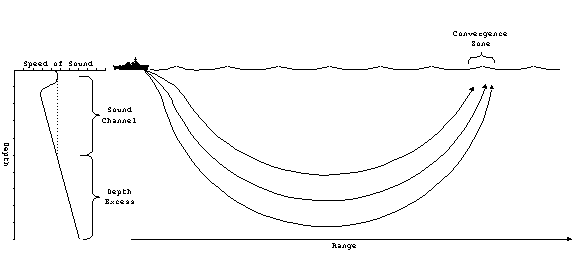
Now, for sonar’s ranges, there is something called CZ (Convergence Zone) it’s a way of sending your waves to the surface. By encountering the air above it (this is the first CZ) they bounce back down, but by temperature and pressure they go back up at a certain level. There they hit the surface again (that’s called the second CZ) dependant on how strong your sonar is, you will get more and more Convergence Zones. Normally something like 20 or 30 nm is between the zones.
By: Hyperwarp - 25th December 2004 at 08:09
Jonesy…..this question might seem quite a dumb question, but hope you will bare with my lack knowledge here…….. 😮 😮
I always hear range of RADARS……..Ex. AN/APG-77, 460 km Vs 20 m2 target………I also hear things like……..track XX number of targets and engage X number of targets……..
How does this apply to SONARS carried by Subs and Ship………(if it does apply………I mean things like range………track/engage targets)
And what are the worlds longest ranged SONARS carried subs/ships…….
Felt like asking because of this quote from the above article you posted…..
The old Sonar 2031 had a range of around ten mile, but its successor could find targets at three or even four times that distance – no one yet knows its true capability.
Thanx in advance
– Hyper…..


 Sign In








 December 23, 2004 at 4:58 pm