Hi everyone,
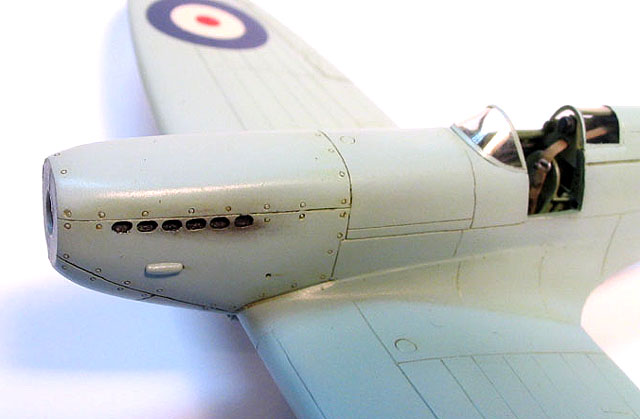
The K5054 replica at Tangmere looks stunning in cerulean blue, with Jeffery Quill authenticating it’s the correct shade. Does anybody know a modern paint match for that colour?
I have something sitting in my garage that is shaped somewhat but not completely unlike a Spitfire, single seat, all metal, 75% size and tucks it’s wheels up. While not wanting to re-ignite the discussions about the worthiness of this particular design and bring further dis-grace upon it, mine has been heavily modified and does contain a few bits of the real thing. Well, the pitot mast and tube, spade grip and most switches that is…
It is currently in partial primer and bare metal, and I would like to finish it as K5054. While being way simpler to save time and money and stick/paint the roundels and markings on and keep the somewhat unfinished “first flight” Eastleigh look, I do love the blue finish.
So, metal finish and fly next year, or cerulean blue and the year after?
Can somebody point me to a currently available paint match for the cerulean blue?
Thanks from Downunder,
Chris

By: skyskooter - 9th April 2015 at 22:28
Done.
By: R6915 - 8th April 2015 at 20:08
Mr Skyscooter, I note that you are in West Sussex. I’m not too far away either. Maybe if you PM me, we might be able to meet up, and you can have a look at my copy of the book! I have to say that I do think we are looking at one and the same info set here!
By: skyskooter - 8th April 2015 at 15:02
Post 28 from Skyshooter and the reference to a Harry Robinson drawing in Scale Models magazine of March 1977 is it correct to assume it is the same drawing used by Dr. Price in his 1982 book “The Spitfire Story” ?
Sorry for the delay. I don’t have Dr. Price’s book on the Spitfire to make the comparison. Could you possibly scan and post a portion of it so that I can give you an answer.
By: R6915 - 13th October 2014 at 11:45
Mr Beermat, Sir, your post No 29 is very intersting! I think that you may have solved the question. Lookig on my monitor screen (that probably isn’t very accurate!) that looks to be a very close match to my eyes. That you have also played about with the words and come up with a practical suggestion I feel adds weight to this being the closest colour shade comparison that anyone can make in present times.
Looking at other recent posts I know nothing about chemistry and paint make up but one friend did phone me ask if the type of ‘body filler’ that may have been used by the paint contractors back in 1936 could have reacted with the paint to produce the paint ‘pickling effect’ that subsequently caused the ‘crazing of the surfaces to occur?
Post 28 from Skyshooter and the reference to a Harry Robinson drawing in Scale Models magazine of March 1977 is it correct to assume it is the same drawing used by Dr. Price in his 1982 book “The Spitfire Story” ?
By: Meddle - 10th October 2014 at 17:36
There is a suggestion that it was enamel based. In a well researched feature on the Spitfire prototype which appeared in Scale Models magazine issue March 1977 Harry Robinson wrote that a highly polished enamel finish was applied. He adds:
“This was a shade of blue-grey commonly called French Grey and was arrived at by adding blue pigment to a grey enamel base. The resulting subtle blend not only appeared blue to some eyes and grey to others but often photographed as a pale colour, although in reality it was rather dark as indicated by the yellow outlines to fuselage roundels and white outlines to black serial numbers.”
That is pretty interesting to read. Having done some sleuthing, it appears that ’30s enamel paints were based on alkyd resins. Ironically I’ve been spraying a bit of alkyd-based lacquer recently on a non-aircraft project and I could not get the stuff to dry. I understand that UV protection is minimal for alkyd enamel, so it is possible that, combined with weathering effects, K5054 subtly changed colour for the period it was painted this mystery blue shade.
If Harry Robinson is correct, then the Toyota paint mentioned in this thread is incorrect, as it contains a green hue that would be absent if one were to simply mix a grey and a blue paint together. Having said that, BS381 Light Admiralty Grey clearly contains a green-blue component. If we ignore this then we must assume that K5054 must have looked more like this:
By: Beermat - 10th October 2014 at 14:07
Not ‘Toyota Niagara Green’? Just checking.. [ATTACH=CONFIG]232257[/ATTACH]
..from http://www.toyotareference.com/stout
If one looks at the different examples, you can really see how it photographs differently (or perhaps got mixed differently) each time!
By: skyskooter - 10th October 2014 at 10:49
Was this a cellulose-based colour paint or something else?
There is a suggestion that it was enamel based. In a well researched feature on the Spitfire prototype which appeared in Scale Models magazine issue March 1977 Harry Robinson wrote that a highly polished enamel finish was applied. He adds:
“This was a shade of blue-grey commonly called French Grey and was arrived at by adding blue pigment to a grey enamel base. The resulting subtle blend not only appeared blue to some eyes and grey to others but often photographed as a pale colour, although in reality it was rather dark as indicated by the yellow outlines to fuselage roundels and white outlines to black serial numbers.”
He also refers to the clinker built panels claiming that on the upper surfaces of the wings they ran spanwise but chordwise on the under surfaces in line with the machine gun access panels.
Credit is acknowledged to Jeffrey Quill, C. F. Andrews, Charles W. Cain, Ian Huntley and Wacek Klepacki in the article.
By: R6915 - 9th October 2014 at 15:53
Quick catch up’s
Post 23, a very good question in para one I suggest. This afternoon a 1942 + ex Supermarine friend is looking in thre Boscombe Down archives as he thinks there may be a refernce in them – I’ll let you no more when I know. But he also said to me that it was a possibility that Supermarine’s manufactured a redesigned wing structure hand built at Woolston to test the new structure’s increased rigidity. Some wings were also made in the Itchen works at Woolston early on before subcontract manufacture went to General Aircraft and Pobjoy.
Post 24 Mr. Meddle ! Good idea..except the person who purchased it auction required anonymity from the auctioneers so no go I’m afraid. Cellulose based paint on the original…. I don’t know and doubt its possible to find out beyond a comment from years ago from a Supermainer of that era who told me they ‘liked’ Titanine’ branded paint at Woolston Does that help at all, Sir?
Post 25 I do not have the Glancy book but thank you I will acquire a copy. As far as clinker built is concerned. The reason it is said that Pemberton Billing started the company on an old coaling wharf at Woolston Southampton was because “it was said” he wanted to make float planes and thought that the Socut Coast of the Uk would give him access to the traditional boat building skills in the area. Odd actually because Rolls-Royce cars stated the same reason for coming to Chichester around 2003 !
By: David Burke - 8th October 2014 at 22:04
Stuart -the Solent Sky /Clive Du Cross machine is at Hawkinge.
By: Edgar Brooks - 8th October 2014 at 20:57
There is a photo, taken from above, of K5054 in camouflage, with Jeffrey Quill at the controls, and it’s just possible, in places, to see the faint lines of the strip construction of the wings; Gordon Mitchell described it as “clinker-built,” and a seaman assured me this meant overlapped. There is a copy of the photo in Jonathon Glancey’s “Spitfire, The Illustrated Biography,” pages 56/57.
By: Meddle - 8th October 2014 at 17:12
I confirm that the desk model was painted with the surplus paint, Gordon told me so and added that his father had mentioned that to him before he died. The model was auctioned by the family with other artefacts from Gordon’s estate only three or so years ago.
It seems that the logical step here would be to find this model again and do a subtle wet-sanding job on a very small area of the aircraft. I don’t know a whole lot about 30’s car paint, but anything from the ’50s and ’60s has the capacity to develop a white bloom in the case of the former and a yellowing in the case of the latter. Back then I presume aircraft were painted by first priming then applying a colour coat? Was this a cellulose-based colour paint or something else?
By: stuart gowans - 8th October 2014 at 16:53
Without absolute detailed knowledge, I could only say being as the prototype was hand built, how close to that was the mkI, in terms of tolerance, would the wing fixings line up, and if they didn’t, and they then changed the stub spars, would the holes for their fixing line up?
Wasn’t the issue of wing flexing solved by the introduction of a modified rear spar web?
As an aside the replica built by Clive Du crois was painted as K5054 when it was trailered around by Solent Sky, any pictures around of it in that trim; I wonder where that ended up? and another part built replica down at Hawkinge; I seem to remember the fuselage was mostly finished, was it painted? what did they use for reference, re, paint colour?
By: R6915 - 8th October 2014 at 16:38
The comments in posts 21 & 22 make valid points. Perhaps then I may just add some additional splinters of background info. Gordon Mitchell and Jeffrey Quill were closely involved ( JKQ with other former colleagues from Supermarine) in ensuring that the facsimile was as accurate as it was possible to be in all visual details from the build beginning to the unveiling at RAF Hendon Museum. They visited Andover a number of times and it was actually JKQ’s original idea that a facsimile should be built for future generations to study if they so wished. They also helped raise much of the £40K needed for the build incorporating a very few early Mark parts where appropriate.
In the event that the question is raised could the facsimile ever be flown? NO! Fuselage frames are made from ply-wood and the wing attachment is such that it can be dismantled from the fuselage quickly (fuselage remains on the undercarriage as well) and easily with just one small screw in each wing – as examples!
I confirm that the desk model was painted with the surplus paint, Gordon told me so and added that his father had mentioned that to him before he died. The model was auctioned by the family with other artefacts from Gordon’s estate only three or so years ago.
Lastly, Alfred Price’s book on page 26 has a fine detail drawing of the original K5054. Including the wing ‘plating’ details and the original rudder horn balance shape. This book also mentions the wing flexing and the crazed surfaces that continually appeared and needed remedying by works staff. That’s why I posed the question – if in the works visit in Sept / Oct 1937 the wings MIGHT have been changed to a preproduction Mark l design set? I have never seen any mention on this (minor?) topic and does anyone know if this happened? Or was it left to the first production Mark l first flown in May 1938 to establish that the new wing structure design was satisfactory?
By: DazDaMan - 8th October 2014 at 12:36
I believe Gordon Mitchell’s book suggests the wings were formed from long thin strips of alloy, possibly they were filled flush so as to appear one piece, and that is the cracking of filler you mention.
I’ve seen diagrams/three-views which support the suggestion.
By: stuart gowans - 8th October 2014 at 12:23
I believe Gordon Mitchell’s book suggests the wings were formed from long thin strips of alloy, possibly they were filled flush so as to appear one piece, and that is the cracking of filler you mention.
Are we getting hung up on the name of the colour, rather than the shade; if as you said previously the small model given to Mitchell was the basis for the colour match on the facsimile, then (always presuming it was painted in the leftover paint from K5054) that is surely definitive?
As you suggest much of the content of the aforementioned books are based on memories, but equally so is Jeffrey Quill, (and others) authentication of the colour.
By: R6915 - 8th October 2014 at 11:11
I’ve been asking some non Forum friends a few questions that may provide more accuracy to recent posts here. In addition I have looked more closely at relevant sections of three books. Morgan & Shacklady Spitfire, The History (1987), Dr. Alfred Price The Spitfire Story (1982) and Gordon Mitchell’s School Days To Spitfire (1987, revised 1997 & 2002). Although are minor errors in all of these books, these are an essential start point as the authors were all in a position to directly interview eye witnesses during their researches. Other books could also have been checked but time available is not infinite, I regret.
Firstly, the shade of paint used is definitely not cerulean blue as Gordon Mitchell’s book suggests. Today the facsimile K5054 is displayed at Tangmere Military Aviation Museum in West Sussex. But it may not be known widely that it suffered some paintwork (and other) damage in July 2012 when the then owners (The Spitfire Society) transported it rather carelessly to and from an event held at Polesden Lacey (Surrey, UK).
The clever people on the tech staff at Tangmere Museum who are now the facsimile owners are remedying this and have this year had matching (car / auto) paint mixed in nearby Chichester. The paint title TOYOTA, NIGERIAN GREEN is a (UK) colour the car manufacturer used in the 1970’s and is a light blue despite the title. If Zodiachris in Post Nr. 1 to privately contact me with his postal address, the museum will be pleased to spray a couple small sample pieces of material for him and I will get them to him in Australia so that his local aircraft paint supplier can scan the sample and produce a paint match for him locally. (my email for this is:- [email]k5054proto@gmail.com[/email])
Answering a few other points. A Rolls–Royce Heritage Trust friend says that company colours for their vehicles were usually dark blue with a light blue or possibly silver sign writing. Why, then, would R-R have wanted to see the prototype Spitfire in their colours ? Maybe the question was asked because R-R sponsored Supermarines’ with £7,500 towards the development cost of the prototype.
Supermarine did commission a Rolls-Royce car body builder to do the work in. Until post WW2, R-R usually only manufactured rolling chassis. An owner would then commission an independent high class body builder to manufacture the body to his/ her specifications. The four main UK companies were Park Ward, Mulliner, Hooper and Thrupp & Maberly. Dr Alfred Price’s book The Spitfire Story does not tell us which company was used except that in 3 or 4 days the superb finish was completed.
Turning to the paragraph in Gordon’s book where cerulean blue (no caps, Mr Brooks!) is mentioned I cannot dodge the thought that I believe that entire paragraph is not as accurate as I expect he would have wished it to be.
The light blue lasted on K5054 from May 1936 until September 1937 (certainly not until it was written off at Farnborough on Sept 4th 1939 as Gordon staes). By the end of October 1937 it had been brought up close to production Mark l standards. Complete with the standard day fighter camouflage of the day! The wing flexing problems of the prototype with the inflexible car body filler used meant the wing surface light blue finish required constant attention.
K5054 had wing surfaces that had been that had been ‘plated’ with small Duralumin panels and the comouflaged finish wings in photographs do not appear to show this fairly dominent feature. So, were the wings completely changed to the emerging Mark l redesign? A ciné gun port is clearly apparent. Or were the photos retouched? Or was the lighting that day in the air to air photos such that they just are not clearly defined?
I hope that the foregoing will help add accuracy to this thread, but I am aware that the three books mentioned depended upon other people’s memories and some documentation and that there are many other excellent books I have not had the time to look into!
By: Edgar Brooks - 2nd October 2014 at 16:57
Cerulean Blue it is not!
Which is not how Gordon Mitchell described it; he said “cerulean blue,” which, for those educated “back then,” being non-capitalised, means that it’s a description, not a name.
K5054 (as related by/to Dr. Alfred Price, in “The Spitfire Story) was painted by the company which Rolls-Royce used for their vehicles (not by Vickers, themselves,) and their company colour was a blue, matched to the Mediterranean sky.
By: Meddle - 2nd October 2014 at 09:50
Thanks for the information everybody, I’m humbled by the effort some of you have put into their postings to my questions! So cerulean blue it will be, just which version is the question? I know that the colour on the photos I took last summer is nothing what it looks like in the flesh, and googling ‘Toyota Nigeria green’ only brings up a ton of second hand green Toyotas currently for sale in Nigeria. Guess I’ll have to check with the local paint specialists to see if they can dig that tone up, or go back to Tangmere with a colour chart next time I’m in the UK.
I think you might be after ‘Nebula green’;

 [
[
By: D1566 - 2nd October 2014 at 08:08
Looks good 🙂
By: Zodiacchris - 2nd October 2014 at 06:47
Thanks for the information everybody, I’m humbled by the effort some of you have put into their postings to my questions! So cerulean blue it will be, just which version is the question? I know that the colour on the photos I took last summer is nothing what it looks like in the flesh, and googling ‘Toyota Nigeria green’ only brings up a ton of second hand green Toyotas currently for sale in Nigeria. Guess I’ll have to check with the local paint specialists to see if they can dig that tone up, or go back to Tangmere with a colour chart next time I’m in the UK.
Meanwhile a couple of pictures of the thing as it is, sorry about the quality, the port side is currently on stands to work on the UC and I can’t get it out of the garage. And yes, the nose is too long, the UC not splined etc, but if it looks halfway okay when flying past 500 feet up I’ll be quite satisfied…
Cheers,
Chris
[ATTACH=CONFIG]232121[/ATTACH][ATTACH=CONFIG]232122[/ATTACH]


 Sign In








 September 27, 2014 at 11:50 pm